Travel spots in Lithuania
Towns and sacred heritage in Lithuania
Old-town squares, street perspectives, Gothic and Baroque churches, monasteries, and wooden village shrines.
Town and sacred heritage guides
Each place page combines cultural context, practical details, and visitor orientation.
Miestų objektai ir sakralinis paveldas

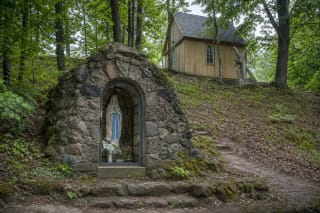
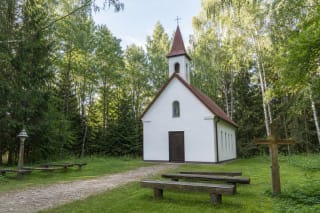
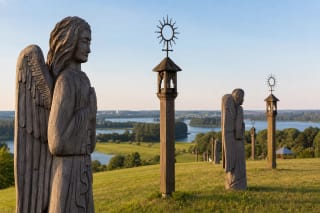
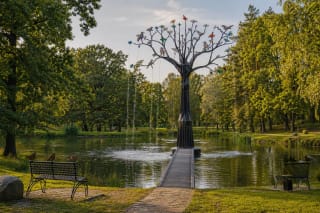
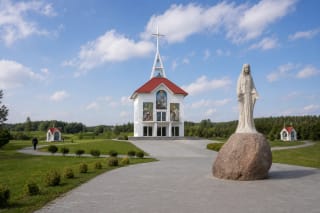
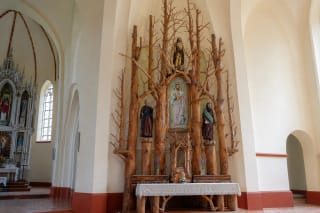
Angel Hill in Trakai is an open-air place of wooden angels, wayside shrines, and prayer signs in Būdos village, created in 2009 to mark the millennium of Lithuania's name and the 600th anniversary of Trakai Basilica.

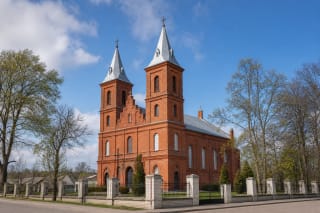
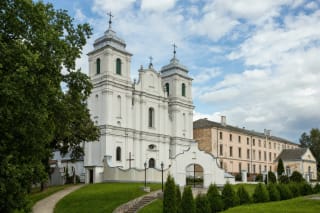
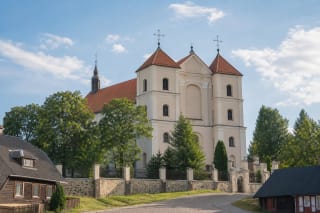
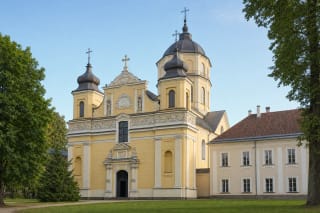
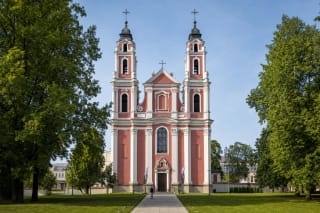
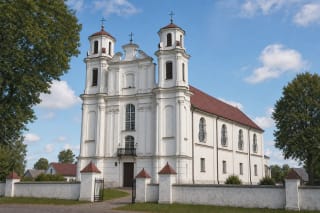
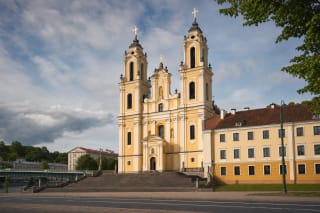
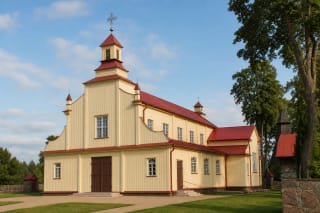
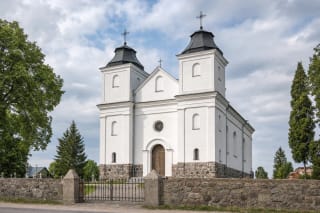
The Discalced Carmelite monastery of Antalieptė with the Church of the Discovery of the Holy Cross is a late Baroque ensemble by the Šventoji River in Zarasai District. The twin-towered church was built in 1732-1760 with funds from Livonian castellan Jonas Mykolas Strutinskis; beneath it extends a three-nave crypt with twelve cellars. The former monastery is now adapted for visitors.

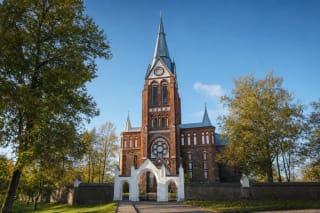
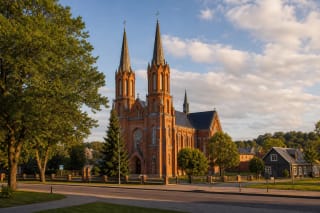
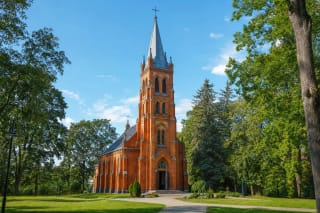
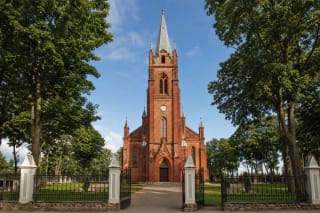
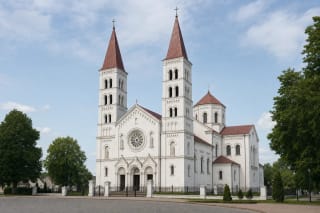
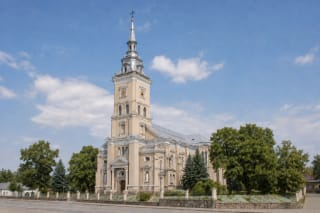
Anykščiai Church of St. Matthew the Apostle and Evangelist is Lithuania's tallest twin-towered Neo-Gothic church, with towers reaching 79 m. Built in 1899-1909, it dominates Anykščiai, and one tower has a viewing platform over the Šventoji valley.

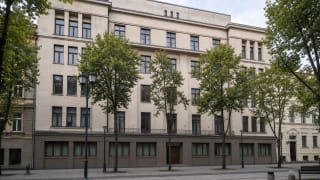
The Ateitininkai Union Palace at Laisvės al. 13 is one of the most interesting transition buildings in interwar Kaunas architecture. Begun in 1926 as an Ateitininkai student dormitory based on Feliksas Vizbaras's historicist design, the palace was probably completed around 1929 and modernized by Algirdas Šalkauskis in 1931. Today it functions as KTU Building III.
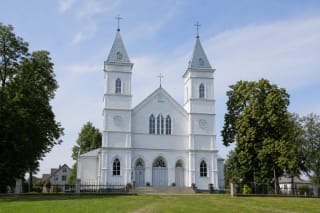
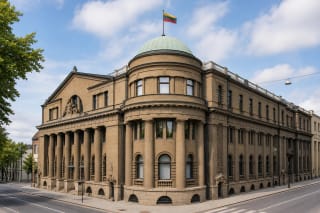
The Bank of Lithuania Palace in Kaunas is a central-bank palace designed by Mykolas Songaila and built in 1925-1928, as the temporary capital consolidated the litas and a modern financial system. Its monumental exterior, operations hall, vaults, Milners doors, old lift, and Voldemaras apartment make it one of the most luxurious interiors of interwar Kaunas.

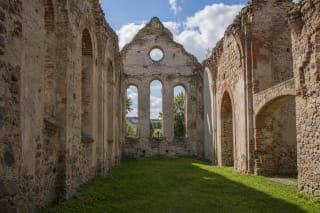
The Bartninkai Church Ruins in Suvalkija are the conserved remains of the 1790 masonry church where Jonas Basanavičius was baptized. Destroyed during the Second World War, the roofless walls have become an open-air venue for concerts, art festivals, film screenings, and local memory.

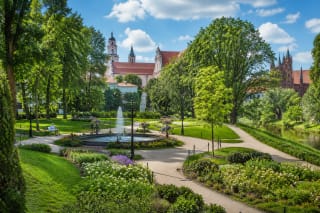
Bernardine Garden is a historic Vilnius Old Town park in a bend of the Vilnelė, linking the layers of Bernardine monastery gardens, the Vilnius University Botanical Garden, a nineteenth-century public garden, and today's city park.

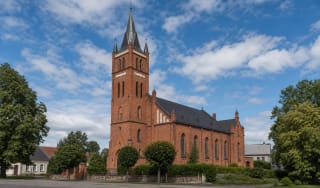
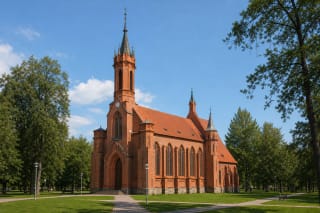
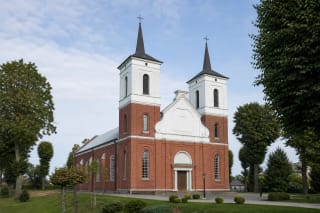
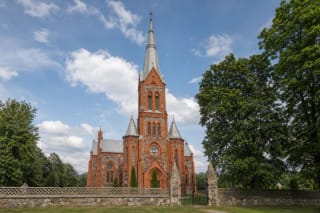
Biržai Evangelical Reformed Church is a red-brick Neo-Gothic church built in 1867-1874 to a design by Riga architect Heinrich Schell. It continues the history of a Radziwiłł-supported Reformed community known from 1584 and remains a key Reformation centre in northern Lithuania.

Būtingė Evangelical Lutheran Church is a neo-Classical masonry sanctuary built in 1822-1824 and consecrated in December 1824 - the fifth successive church of the old Šventoji-Būtingė parish. The Cultural Heritage Register protects it as a regional-significance object (code 32574); Tsar Alexander I supported its construction, and its tower was added only in 1866. This is a Curonian congregation tied to Rucava on the Lithuanian-Latvian border.

The Chamber of Commerce, Industry and Crafts Palace on K. Donelaičio Street is an interwar Lithuanian business-institution building designed by Vytautas Landsbergis-Žemkalnis in 1937-1939. From outside it is a restrained blend of modernism and classical representation with arched granite portals; inside, KVR records Petras Kalpokas frescoes, Stasys Ušinskas stained glass, Bronius Pundzius reliefs, and other rare art and interior heritage.

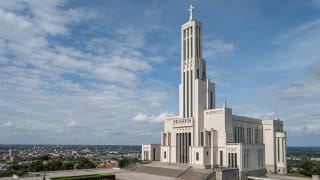
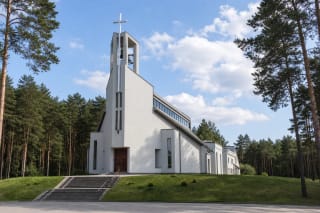
Christ's Resurrection Basilica in Žaliakalnis is a symbol of Kaunas Modernism and statehood: an interwar independence monument idea, Soviet interruption, white vertical architecture, and a city panorama from the terrace.

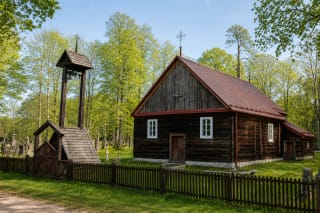
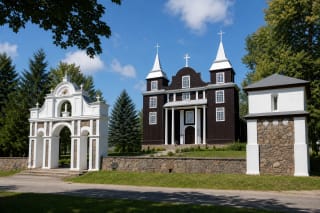
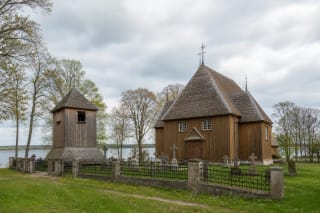
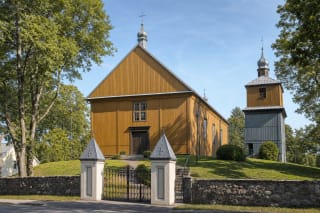
The Church of St Matthew the Apostle and Evangelist in Veiviržėnai is a wooden Samogitian church built in 1767-1769, state-protected as part of a building complex (code 33477; the church itself code 1422). The Cultural Heritage Register describes it as traditional Samogitian folk architecture with Historicist elements; the belfry, churchyard fence, gates, and chapel-posts are also important parts of the ensemble.

The Holy Spirit, or Dominican, Church at Dominikonų g. 8 in Vilnius is one of Lithuania's most valuable late-Baroque and Rococo interiors, with 16 artificial-marble altars, A. G. Casparini's 1776 organ, an oval domed space, and famous underground crypts with naturally mummified remains.

Dotnuva Monastery Ensemble is a sacred-heritage site in the Kėdainiai region, where the history of a Bernardine monastery founded in 1701 and a masonry church built in 1773-1810 intertwines with the memory of the 1830-1831 and 1863-1864 uprisings, the monastery's 1864 closure, and the Capuchin revival here in 1990.

Dovilai Evangelical Lutheran Church is a Lithuania Minor sanctuary built of fieldstones and brick in 1861-1862 by the Minija River, with the Register naming Friedrich August Stüler as its architect. Protected as a regional-significance object (code 16028), its history spans services begun in 1784, use as a Red Army stable in 1944, a postwar warehouse and mill, and reconsecration in 1995.

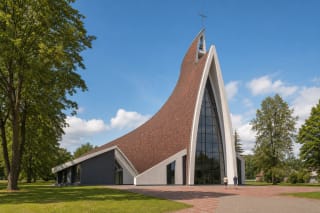
Elektrėnai Church of the Blessed Virgin Mary, Queen of Martyrs is a huge modern sanctuary and the main symbol of a Soviet-era energy-workers' town. Built in 1990-1996 to a design by architect Henrikas Kęstutis Šilgalis, the two-towered church dominates the city's typical apartment-block skyline.

The Firefighters' Palace in Kaunas is a modernist and Art Deco fire station built in 1929-1930 and designed by engineer-architect Edmundas Frykas with structural engineer Pranas Markūnas. Its curved facade with garage doors, towers, and city-service programme shows how interwar Kaunas gave even utilitarian infrastructure a representative capital-city scale.

The former Kaunas Central Post Office on Laisvės aleja is one of the key buildings of interwar Kaunas modernism. Designed by Feliksas Vizbaras and built in 1930-1932 as a state communications centre, it combines functional planning, national-style decoration, and the context of UNESCO-recognized Modernist Kaunas.

The Gates of Dawn are the only surviving gate of the Vilnius city wall and one of Lithuania's most important pilgrimage sites, where the image of Our Lady of Mercy is venerated.

The Higher Technical School in Kaunas is the 1937-1938 technical-education palace designed by Stasys Kudokas at Tvirtoves al. 35. The building marks interwar Lithuania's ambition to train engineers, the growth of northern Kaunas, and the direction of modernized historicism. Today it functions as part of the Lithuanian Engineering College.

The Hill of Crosses near Šiauliai is one of Lithuania's strongest places of pilgrimage and memory: hundreds of thousands of crosses stand on Jurgaičiai Hillfort, where faith, resistance, and the Lithuanian cross-crafting tradition meet.

The House of Perkūnas in Kaunas is one of Lithuania's clearest late-Gothic burgher-architecture sites. Although its name comes from an 1818 figurine find and a Romantic legend about a temple to Perkūnas, documents point to a more earthly beginning: a wealthy Kaunas resident's house that later became a Jesuit chapel, theatre, clergy residence, and restored heritage object.

The Jewish Bank in Kaunas was the Central Jewish Bank and commercial passage complex built at Laisvės al. 106 in 1924-1925, designed by Grigorijus Mazelis and Mikas Grodzenskis. Today the Kaunas Tadas Ivanauskas Zoological Museum operates here, while the bank passage is a lost heritage layer protected as a significant former building site in the KVR territory of Kaunas Naujamiestis.

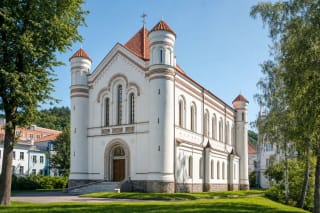
The Joniškis Synagogue Complex is a rare surviving ensemble of a summer White Synagogue and winter Red Synagogue in the town centre. Restored synagogues now serve as spaces of the Joniškis History and Culture Museum, telling the history of the region's Jewish community.

Kaišiadorys Cathedral of the Transfiguration of Christ is the Neo-Gothic main church of the Kaišiadorys Diocese, completed in 1932 and consecrated as a cathedral in 1936. Since 2017 it has housed a chapel of Blessed Teofilius Matulionis with his relics, while the crypt holds the first shepherds of the diocese.

The Kalvarija Synagogue Complex in Suvalkija is a rare surviving group of three synagogue-related buildings on one enclosed site by the Šešupė: a Baroque summer synagogue, an eclectic winter synagogue, and a brick Talmud school. It testifies to the town's rich Litvak history and is widely described as the only surviving ensemble of its kind in Lithuania.

Katyčiai Evangelical Lutheran Church is a Baroque-flavoured Lithuania Minor sanctuary built of fieldstones and brick in 1733-1734 on Market Square. The Register protects both the church (code 2293) and its building complex (code 32967); its history includes a tower broken by a whirlwind in 1801, a bell donated by Queen Louise, the work of pastor Vilius Gaigalaitis, Soviet nationalization, and reconsecration in 1994.

Kaunas Archcathedral Basilica on Vilniaus Street is the main church of the Archdiocese of Kaunas and one of Lithuania's largest Gothic sacred buildings, connected with the city's fifteenth-century growth, cathedral status, and interwar church history.

Kaunas Choral Synagogue at E. Ožeškienės g. 13 is the Ohel Yaakov Synagogue built in 1872 and one of the most important surviving Jewish sacred-heritage sites in Kaunas. This state-protected object of national significance remains an active prayer house, and its history connects guberniya-period architecture, interwar Litvak culture, Holocaust memory, and a postwar meeting place for survivors.

Kaunas City Sickness Fund Palace is a healthcare-modernism building designed by Vytautas Landsbergis-Žemkalnis and Antanas Novickis and built in 1933-1935 at the corner of A. Mickevičiaus and Miško streets. It served Sickness Fund administration, insurance operations, and outpatient clinics; today it houses the Centre branch of Kaunas City Polyclinic.

Kaunas Clinics Complex at Eivenių g. 2 is the Vytautas Magnus University hospital built in 1937-1939, still preserving its original medical, teaching, and research function. It was one of interwar Lithuania's largest construction projects: a university hospital designed by French architect Urbain Cassan with Elie Ouchanoff, with underground tunnels, a 75 m chimney, red-roofed blocks, and national cultural-monument status.

Kaunas County Municipality Palace at Vytauto pr. 91 is one of the largest administrative buildings of interwar Lithuania, designed by Vytautas Landsbergis-Žemkalnis in 1932-1934. Its light granite facade, dark labradorite portals, and modern reinforced-concrete structure show the representative ambition of the temporary capital, while the later Soviet security history gives the building a heavy memory layer.

Kaunas Evangelical Reformed Church at E. Ožeškienės g. 41 is a rare example of interwar modernist sacred architecture. Karolis Reisonas's 1937 project replaced Vaclovas Michnevičius's neo-Gothic idea, and the church's history runs from services that never began, through Soviet warehouses and a sports hall, to its 2019 return to believers and the tower-restoration story that began in 2026.

Kaunas Ninth Fort is part of Kaunas Fortress, later turned into a prison, NKVD transfer point, and Nazi mass-murder site. Today it is a museum and one of Lithuania's most important places of memory.

Kaunas Sports Hall at Perkuno al. 5 is the first arena in Europe designed specifically for basketball, built in 1939. Anatolijus Rozenbliumas's engineering solution with four 60 m steel arches and Stasys Kudokas's architectural work created the venue for the 1939 European Men's Basketball Championship and the long memory of Kaunas Zalgiris.

Kaunas State Philharmonic occupies the former Ministry of Justice and Seimas Palace of the Republic of Lithuania, one of the most prestigious interwar state-institution buildings in Kaunas, designed by Edmundas Frykas and built in 1925-1929. It housed the Ministry of Justice and Supreme Tribunal, hosted the Neumann-Sass trial, served the Fourth Seimas in 1936-1940, and from 1961 became an important Kaunas concert venue.

Kaunas Tatar Mosque is a masonry mosque at Totoriu g. 6 in Ramybes Park, built in 1930-1932 as a Vytautas the Great jubilee-period monument to Lithuania's Tatar community. It is a state-protected object of national significance and today again functions as a Muslim prayer house in Kaunas.

Kaunas Town Hall, known as the White Swan, is the axis of Town Hall Square and one of old Kaunas' main self-government buildings, begun in masonry in the sixteenth century and now operating as a Kaunas City Museum space.

Kavarskas St. John Spring by the Šventoji is a tufa spring and old sacred site, protected as a hydrogeological natural-heritage object and shown in the town coat of arms. A separate Lourdes grotto stands in the town cemetery, so Kavarskas links two sacred places visited around the St. John feast.

Kėdainiai St Joseph's Church is a two-towered late Baroque wooden church built by the Carmelites in 1766 on masonry foundations. This cruciform, three-nave church with a separate wooden belfry and venerated St Joseph painting was used as a warehouse in the Soviet period, reconsecrated in 1991, and later became an archdiocesan pilgrimage shrine.

Kintai Evangelical Lutheran Church is one of the oldest Pamarys sanctuaries by the Curonian Lagoon, built in 1705 from the materials of the vanished Ventė church. Towerless, it is protected in the Register as a regional-significance object (code 1637); it carries the memory of Vydūnas, its Soviet-era use as a grain warehouse, restorations for exhibitions and concerts, and its 1990 transfer to the Catholic community.

Klaipėda Mary Queen of Peace Church is one of the few Lithuanian churches built during the Soviet period: constructed in 1957-1960, confiscated and turned into a philharmonic hall, then returned to believers in 1988 with its tower rebuilt and the Peace Bell installed.

Klaipėda Old Town is Lithuania's distinctive port-city core: its plan is tied to medieval Memel, the Danė River, the castle, trading quays, and half-timbered warehouses unlike the old towns of Vilnius or Kaunas.

Kražiai on the Kražantė is one of historic Samogitia's key small towns: a famous Jesuit college worked here from the seventeenth to nineteenth centuries, the Kražiai massacre took place in 1893, and today visitors still find sacred heritage, the restored college building with a museum, and the Medžiokalnis nature reserve.

Krekenava Basilica is one of the most important Marian shrines in the Panevėžys region: a two-towered brick church built in 1902, with Neo-Gothic features, a venerated image of Mary, and minor-basilica status.

Kretinga Franciscan Monastery with the Church of the Annunciation to the Blessed Virgin Mary is one of Samogitia's oldest sacred ensembles, founded by Grand Hetman Jonas Karolis Chodkevičius in the early seventeenth century; its church is considered the oldest surviving church in Samogitia.

The Labour Palace in Kaunas, now the Kaunas Cultural Centre, is an interwar workers' culture and self-education centre formed in 1938-1940. The building by Adolfas Lukosaitis and Antanas Novickis at Vytauto pr. 79 combines a strict modernist facade, a rich cultural programme, the memory of the Nazi Gestapo, and a public cultural function that continues today.

The Land Bank Palace in Kaunas is a 1933-1935 bank building by Karolis Reisonas near Vienybės Square, now used as the KTU central building. Its restrained architecture shows how interwar Kaunas bank buildings moved from historicist representation toward light, hygiene, function, and modernism.

Linkuva Church of Our Lady of Mount Carmel and the former Carmelite monastery form one of the largest surviving monastery ensembles in the region. Founded in 1634, the monastery is known for the old Scapular feast tradition, while the Renaissance church is surrounded by a three-wing masonry monastery with a courtyard.

Liškiava Monastery Ensemble is one of Dzūkija's strongest sacred-heritage sites: the late Baroque Holy Trinity Church, former Dominican monastery, crypts, liturgical exhibition, and Nemunas valley landscape.

Marijampolė's minor basilica of St Michael the Archangel is the city's main shrine, linked with the Marian Fathers, whose settlement gave the city its name. Built in 1824 and granted the title of basilica in 1992, it preserves the relics of Blessed Archbishop Jurgis Matulaitis and is a stop on the John Paul II Pilgrim Route.

Mary Help of Christians Church in Nida is the first and only Roman Catholic church on the Curonian Spit, opened on 14 June 2003. Set into the dune relief and clad in dark oak boards and reeds, it blends the material language of the lagoon coast with contemporary sacred art - a marble font by Mindaugas Kuzma, a crucifix by Stasys Kuzma, and stained glass by Algirdas Dovydėnas.

Merkinė Pyramid in Česukai is a contemporary spiritual space near Merkinė, where a 12.5 m geodesic dome, a triangular pyramid, crosses, and quiet practice form not an archaeological site but a living object of contemporary faith-based visiting.

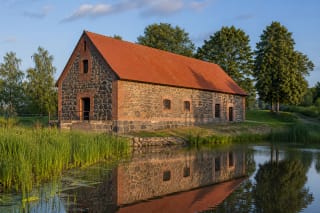
Minčia Watermill in Tauragnai eldership is a registered cultural heritage object in Aukštaitija National Park: a wooden watermill by the Minčia stream, linked with a 1792 rebuilding, the memory of the 1863 uprising, and today's recreation and entertainment homestead.

The Neo-Lithuania Student Corporation Palace at Parodos g. 26, beside Vytautas Park, is a historicist building designed by Edmundas Alfonsas Frykas. Opened on February 16, 1928, it served as the organizational centre of a nationalist Lithuanian student corporation, with a hall, library, editorial offices, dining and residential rooms. Today the building is linked with youth education and performing-arts functions.

Nida Evangelical Lutheran Church is a neo-Gothic red-brick church on a pine-covered dune, built in 1888. During the Soviet period it housed the Curonian Spit History Museum, and the old cemetery with krikštai grave markers survives beside it.

Old Zapyškis Church of St John the Baptist is one of Lithuania's most iconic Gothic churches, standing alone in an open meadow on the Nemunas bank, without a tower. The sixteenth-century red-brick church was repeatedly struck by Nemunas floods; today it serves as a cultural and concert space.

Pagėgiai Evangelical Lutheran Church is a Lithuania Minor sanctuary consecrated in 1933 in a fast-growing railway and border town near Tilsit. Its story includes independent-parish status in 1931, the 1938 tower with Apolda bells, a postwar spell as a grain store and the Komjaunuolis cinema, and the parish revival in 1989.

Palanga Church of the Assumption of the Blessed Virgin Mary is the red-brick Neo-Gothic landmark of central Palanga, with a 24 m tower, built in 1896-1906 to a design by Swedish architect Karl Eduard Strandmann. Protected in the Register of Cultural Property (code 1294), it was initiated by canon Juozapas Šniukšta and one-third funded by Count Feliksas Tiškevičius; inside are marble altars, Kraków stained glass, and Baroque altars from the older church.

Palėvenė Church of St. Dominic and Dominican Monastery form the most important late Baroque ensemble in Aukštaitija, with origins in 1676. The cross-plan church preserves one of Lithuania's most original folk-Baroque altar groups, and in 1858 Bishop Motiejus Valančius founded one of Lithuania's first temperance brotherhoods here.

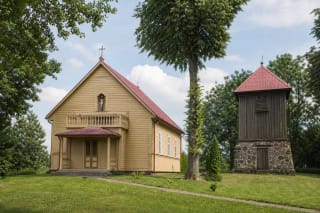
Palūšė Church of St. Joseph is one of the most recognizable sacred sites in Aukštaitija National Park: a wooden church built in 1757, with a separate octagonal bell tower, standing in the landscape of Lake Lūšiai and Palūšė village.

Panevėžys Cathedral of Christ the King is the centre of the Diocese of Panevėžys, designated as a future cathedral in 1926 and consecrated in 1933. The 55 m long Neo-Baroque church contains a grand fresco, 1931 Goebel organ, bells cast in Apolda, and a memory of Maironis.

Pažaislis Monastery by the Kaunas Reservoir is Lithuania's most important Baroque ensemble, linked with the Pac family, Camaldolese monks, Italian architecture, frescoes, and a living sacred and cultural space.

Pažanga Palace on Laisvės alėja is a representative interwar office building designed by Feliksas Vizbaras in 1933-1934. It housed AB Pažanga, the leadership of the Lithuanian Nationalist Union, Lietuvos aidas editorial offices, and other political and cultural organizations. Its facade brings together modern office logic, national-style decoration, balconies, curved display windows, and the urban stage of Laisvės alėja.

The Physical Education Palace at Sporto g. 6 is the core of interwar Kaunas's state project for sport and physical culture. Designed by Vytautas Landsbergis-Žemkalnis in 1932-1934, it was intended to train physical-education teachers, army instructors, and sports specialists. Today it is the central building of Lithuanian Sports University.

Pienocentras Palace at the corner of Laisvės alėja and S. Daukanto Street is one of the clearest functionalist buildings of interwar Kaunas. Designed in 1931-1934 by Vytautas Landsbergis-Žemkalnis and Karolis Reisonas, this administrative, commercial, and residential building showed the economic and representative power of Lithuania's dairy cooperative system.

Pivašiūnai Church is one of Dzūkija's main pilgrimage sites: a classicist wooden Church of the Assumption built in 1825, preserving the famous Comforter of the Afflicted image crowned in 1988.

Plikiai Evangelical Lutheran Church is a red-brick, single-tower neo-Gothic sanctuary built in 1896 in Klaipėda District, Kretingalė eldership. The Cultural Heritage Register protects it as an object of regional - and architecturally even rare - significance, and part of the Plikiai church building complex with its surviving parish-school history.

Priekulė St. Anthony of Padua Church is a Catholic sanctuary built in 1937 in the Klaipėda Region, on the right bank of the Minija. It testifies to the interwar Catholic community's establishment after the Klaipėda Region joined Lithuania and is protected in the Cultural Heritage Register as a regional-significance object (code 31048).

The Research Laboratory in Kaunas is the 1933-1935 Armament Board building designed by Vytautas Landsbergis-Žemkalnis for military chemistry, ballistics, metallurgy, and technical research. Today it is used by the KTU Faculty of Chemical Technology and remains one of the strongest examples of interwar functionalism in Kaunas.

Rusnė Evangelical Lutheran Church is a historic Lithuania Minor sacred site on Rusnė Island: a red-brick single-nave church built in 1809-1854 with a square bell tower, octagonal apse, and a weather-vane date of 1419 recalling an older parish tradition.

Salakas Church of Our Lady of Sorrows is an imposing Neo-Romanesque church with Neo-Gothic features, built in 1906-1911 from fieldstones. Its tower reaches about 72 m and is considered one of the tallest stone church towers in Lithuania.

Salantai Church of the Assumption of the Blessed Virgin Mary is a tall twin-towered Neo-Gothic sanctuary built in 1906-1911 to a design by architect Karl Eduard Strandmann. Its towers are the strongest accent of Salantai and Salantai Regional Park, visible from far across the valley.

Saugos Evangelical Lutheran Church is a red-brick Lithuania Minor sanctuary built in 1854-1857 with funds from the Prussian kingdom's treasury, rooted in the Saugos filial founded in 1815. Never destroyed during the war or the Soviet era, it still serves as the small Saugos parish and is a stop on the Pamarys Lutheran route.

Seda Church of the Assumption of the Blessed Virgin Mary is one of the largest and most ornate eighteenth-century wooden churches in Samogitia and among Lithuania's most valuable wooden churches. Rebuilt in 1768-1770, the Latin-cross hall church has a transept, two-storey sacristies, columned galleries, and five wooden Baroque altars.

Seda St John Nepomuk Church is a small eighteenth-century wooden folk-architecture church in a bend of the Varduva River. Built in 1781 by a Seda landowner as a votive chapel to his name saint and enlarged into a church in 1783, it is the humbler neighbour of the famous great church of Seda.

Senieji Trakai Church and Monastery stand where Gediminas founded one of Lithuania's earliest masonry castles in the early fourteenth century and where tradition places the birth of Vytautas the Great. In 1405 Vytautas founded a Benedictine monastery here, one of Lithuania's oldest, and the present Neo-Gothic church grew out of the old monastery building.

Šiauliai Cathedral of Sts Peter and Paul is the dominant landmark of the city centre and one of Lithuania's clearest examples of Renaissance Mannerist sacred architecture: an approximately 70 m tower, early seventeenth-century construction, consecration in 1634, and cathedral status granted in 1997 when the Diocese of Šiauliai was established.

Šilutė Evangelical Lutheran Church is a neo-Gothic Pamarys sanctuary built in 1924-1926, with an about 50 m tower, the largest tower clock in Lithuania, frescoes by Richard Pfeiffer, and a 104-figure altar composition. The Register of Cultural Property protects it as a regional-significance object, and the town patron Hugo Scheu initiated its creation.

Šiluva Shrine is one of Lithuania's most important pilgrimage centres, where the 1608 tradition of the Marian apparition, the late-Baroque basilica, the white Apparition Chapel, and the living Šilinės indulgence tradition meet.

Simnas Church of the Assumption is a rare Renaissance masonry church, built in the early sixteenth century on a narrow isthmus between Lakes Simnas and Giluitis. It is Lithuania's only cross-plan Renaissance church and one of the oldest buildings in Užnemunė.

Skaruliai Church of St. Anne near Jonava is one of the region's oldest and most valuable Renaissance Gothic churches, built in 1622 by Andriejus Skorulskis. It preserves an old carved altar and apostle sculptures, while the surrounding Skaruliai village was moved during construction of the Azotas, now Achema, factory, leaving the church standing alone beside industry.

Skuodas Church of the Most Holy Trinity is a Neo-Romanesque, twin-towered stone-and-brick church in the town centre, built in 1844-1847 and consecrated in 1850 by Bishop Motiejus Valančius. Its hall-type, three-nave body with a semicircular apse carries bell-shaped tower helmets, three 19th-century bells, and a churchyard bell tower; the towers knocked down in 1944 were only partly restored.

St Anne's Church is one of the clearest symbols of late Gothic Vilnius: a compact red-brick facade, almost unchanged across the centuries and closely connected with the Bernardine ensemble.

St Anne's Church in Lenkimai, north-western Samogitia, is a masonry folk-architecture sanctuary with a bell tower and fieldstone churchyard fence, protected as a state-listed building complex. It is also linked with historian Simonas Daukantas: he was baptized here, and his mother is buried in the churchyard.

St Casimir's Church in Vėžaičiai is one of the oldest wooden churches in Samogitia: a folk-architecture shrine with Baroque features, built in 1784 by the Volmer manor owners, known for old indulgence feasts and altars consecrated by bishops.

St. Francis Xavier (Jesuit) Church in Kaunas dominates the southern side of Town Hall Square with two Baroque towers. Together with the Jesuit monastery and gymnasium, it forms a whole old-town block; over the centuries the church belonged to Jesuits and Franciscans, was converted into an Orthodox cathedral and a Soviet sports hall, and finally returned to the Jesuits.

St. George the Martyr Church and the Bernardine Monastery beside Kaunas Castle form one of Kaunas's oldest sacred complexes: a late Gothic red-brick ensemble returned to the Franciscan community after a difficult twentieth century.

St. Gertrude Church in Kaunas is one of Lithuania's oldest and most distinctive Gothic churches, hidden in a small courtyard off Laisvės aleja. The single-nave red-brick church is cared for by the Marian Fathers; it holds the famous Miraculous Cross, and a candle shrine operates in the basement.

St. Michael the Archangel (Garrison) Church in Kaunas, often called Soboras, is one of the strongest landmarks of Laisvės aleja and Nepriklausomybes Square. Built in 1890-1895 as the Orthodox garrison cathedral of Kaunas Fortress, it became a Catholic Lithuanian army garrison church in 1919, was turned into a stained-glass and sculpture gallery in the Soviet period, and was returned to the Kaunas Archdiocese after 1991.

The State Savings Bank Palace at Laisvės al. 96 is the last major interwar architectural accent on Laisvės aleja: a functionalist state finance and administration building constructed in 1938-1940 and designed by Arnas Funkas, Adolfas Lukosaitis, and Bronius Elsbergas. It was not opened before the Soviet occupation, but still preserves the scale of a modernist temporary capital.

Stelmužė Church of the Cross of the Lord Jesus, dated 1650, is considered Lithuania's oldest wooden church: a filial manor church with a 12-column portico around three sides, a 1650 Baroque altar and pulpit, a bell tower with bells cast in 1613, and a church-art exhibition.

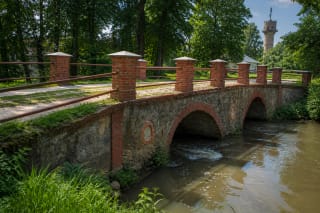
Švėkšna St James the Apostle Church is a nationally significant Neo-Gothic sanctuary built in 1900-1905 to a design by Karl Eduard Strandmann, in red brick and connected to Švėkšna Manor Park by a red-brick viaduct.

The Šventoji Church of the Blessed Virgin Mary, Star of the Sea is a contemporary brick seaside sanctuary built in 1991-2003 to a design by R. Krištapavičius and G. Aperavičius, and blessed on 20 June 2003 by Telšiai Bishop J. Boruta. Its 62 m tower with an observation deck is one of the tallest landmarks in Palanga, and its Stella Maris name continues the tradition of a 1929 wooden church.

Tauragė Church of the Most Holy Trinity is the dominant historicist Catholic church in Tauragė old town, consecrated in 1904. Its single octagonal tower rises above the city, while the Latin-cross-plan building with Neo-Romanesque and Classicist features recalls a border city where Catholic and Lutheran communities lived side by side for centuries. The church was built through the efforts of parish priest Fabijonas Kemėšis on the site of earlier wooden churches.

Tauragė Evangelical Lutheran Church is one of the town's oldest confessional communities: the parish was founded in 1567, and the present stone church with a square tower was built after the 1836 fire and consecrated in 1843. In 1947 it was given the name of Martynas Mažvydas.

Telšiai Cathedral of St Anthony of Padua stands on Insula Hill above Lake Mastis; completed in 1791 as a Bernardine church, it has served as the cathedral of the Telšiai Diocese since 1926.

The Trakai Karaim Kenesa on Karaimų Street is the first kenesa established in Lithuania, with roots in the fifteenth century, and during the Soviet period it was the only functioning Karaim temple in Europe. It is one of the most important religious and cultural heritage sites of Lithuania's Karaims.

Trinapolis Church of the Holy Trinity and the former Trinitarian monastery stand on the bank of the Neris in Verkiai, in northern Vilnius. The Baroque ensemble was founded in 1700 by Vilnius Bishop Konstantinas Kazimieras Bžostovskis, who named the place Trinapolis. Today it is a Vilnius Archdiocese retreat house in a quiet, scenic setting.

Troškūnai Church of the Holy Trinity and the former Bernardine monastery form a late Baroque ensemble in Anykščiai District. The brick church was built in 1774-1787 according to architect Martynas Knakfusas; all four pediments are decorated with wrought-iron crosses, and inside is the oldest organ in the Anykščiai region.

Tverai Church of the Visitation of the Blessed Virgin Mary is Lithuania's largest wooden church, built in 1897 in the old Samogitian centre of Tverai. It is known for the country's only Samogitian Baroque churchyard gate, a separate belfry, and an old revered image of the Mother of God that has long drawn pilgrims.

Tytuvėnai Church and Bernardine Monastery Ensemble is one of Lithuania's most important sacred complexes and a pilgrimage New Jerusalem: church, monastery, Holy Stairs Chapel, and Stations of the Cross galleries unite seventeenth- and eighteenth-century architecture with devotional tradition.

Užupis Republic is Vilnius' artistic quarter across the Vilnia River, known for its symbolic independence declared in 1997, Constitution wall, Užupis Angel, and slow walking route.

Vanagai Evangelical Lutheran Church is a red-brick Lithuania Minor sanctuary designed in 1907-1909 by the Ragainė master Tamošaitis and protected in the Cultural Heritage Register as part of the Vanagai church building complex. It is known for its neo-Gothic, Art Nouveau, and rationalist features, the stained glass "St Peter" and "St Paul," a 1908 Voelkner organ, and its ties to the writer Ieva Simonaitytė.

Vandžiogala Holy Trinity Church is a wooden folk-architecture church built in 1830 in a multicultural Kaunas district town. Vandžiogala is known for Lithuanian, Polish, Jewish, and Russian history, and the church is one of the few in central Lithuania where Polish-language Mass is still celebrated on Sundays. Ancestors of Nobel laureate Czesław Miłosz are buried in the old cemetery.

Varniai Cathedral, officially the Church of Saints Peter and Paul, is the former cathedral of the Samogitian Diocese: a Baroque twin-towered church built in 1680-1691, with 13 bishops buried in its crypt.

Videniškiai Monastery in Molėtai District is a rare sacred ensemble at the turn from Renaissance to Baroque, a Giedraitis family foundation and the only centre of the Canons Regular of Penance, known in Lithuania as the White Augustinians. Beside St Lawrence Church stands the former monastery, now a museum.

Vilkaviškis Cathedral is a symbol of loss and rebuilding: the 1884 Church of the Visitation of the Blessed Virgin Mary was damaged in World War II, destroyed by Soviet order, and rebuilt in 1998 as the cathedral of the Vilkaviškis Diocese.

Vilkyškiai is a distinctive Lithuania Minor town in Rambynas Regional Park: a radial-plan settlement with an Evangelical Lutheran church, manor estate, memory of Salzburg colonists, and Witches' Spruce growing nearby.

The Vilnius Basilian Monastery and Holy Trinity Church on Aušros Vartų Street is a Greek Catholic ensemble, famous for its impressive late-Baroque gate designed in 1761 by Johann Christoph Glaubitz. The history of Adam Mickiewicz is also connected with the monastery prison.

The Vilnius Calvary Way of the Cross is a 35-station pilgrimage route laid out in Verkiai in 1664-1669, with masonry and wooden chapels, gates, a bridge over the Cedron stream, and the Church of the Discovery of the Holy Cross. It is one of Lithuania's most important Calvaries.

Vilnius Cathedral and Bell Tower form the central sacred and state-memory ensemble of the capital: neoclassical facade, crypts, St Casimir's Chapel, separate bell tower, and Cathedral Square history.

Vilnius Choral Synagogue on Pylimo Street is an eclectic synagogue built in 1903 and decorated with Moorish and Neo-Romanesque motifs. It is the only one of more than one hundred prewar Vilnius synagogues and prayer houses that survived and still functions, and it remains a centre of religious life for Lithuania's Jewish community.

Vilnius Church of St Francis of Assisi, usually called the Bernardine Church, is one of Lithuania's largest and most mature Gothic monuments. Together with neighbouring St Anne's Church it forms the country's best-known Gothic ensemble, while the defensive attic with firing openings shows that the church once also formed part of city defence.

The Church of St Peter and St Paul in Antakalnis is one of the strongest Baroque landmarks in Vilnius. Its restrained twin-towered facade hides a luminous seventeenth-century interior filled with thousands of white stucco figures and linked to the foundation of Mykolas Kazimieras Pacas.

Vilnius Holy Spirit Orthodox Church on Aušros Vartų Street is Lithuania's main Orthodox shrine: a monastery cathedral of Baroque origin, preserving the memory and veneration of the relics of the Vilnius martyrs Anthony, John, and Eustathius.

Vilnius Missionaries Church, formally the Church of the Ascension of the Lord, is one of the most graceful late Baroque silhouettes in the old town. Its two slender towers rise on Saviour Hill above Subačiaus Street and form a recognizable Vilnius panorama accent shaped by Jonas Kristupas Glaubicas, the leading architect of Vilnius Baroque.

Vilnius St Casimir's Church on Didžioji Street is one of the first Baroque churches of the Grand Duchy of Lithuania, begun by the Jesuits in 1604. It is marked by a 40 m dome crowned with a helmet shaped like the crown of a Grand Duke of Lithuania and by the memory of St Casimir, Lithuania's patron saint.

Vilnius St Catherine's Church on Vilniaus Street is part of a sixteenth- to nineteenth-century Benedictine ensemble. Jonas Kristupas Glaubicas gave it its present twin-towered late Baroque form in 1741-1753, and since 2006 it has served as a concert and cultural space.

Vilnius St John's Church and Bell Tower form the core of the Vilnius University ensemble: a late Baroque university church, academic ceremonies, a bell tower with 193 steps, a Foucault pendulum, and one of the best panoramas of the old town.

Vilnius St Nicholas Church is the oldest surviving Gothic shrine in Lithuania, first mentioned in 1387. The modest red-brick hall church preserves Gothic vaults and the memory of Lithuanian-language worship: during the interwar period it was the only Vilnius church with regular Lithuanian services.

Vilnius St Teresa's Church stands beside the Gates of Dawn and is considered one of the first and most beautiful Baroque buildings in Lithuania. Built in the mid-seventeenth century with Pac family funding for the Discalced Carmelites, it has a facade of Swedish sandstone and marble and a rich Rococo interior with frescoes from the life of St Teresa.

The Vilnius University Ensemble links the courtyards, St Johns' Church, bell tower, and architecture of the university founded in 1579 into one of Vilnius Old Town's densest historic spaces.

The Vytautas Magnus University Medical Faculty Palace at A. Mickevičiaus g. 9 is an interwar Kaunas medical-science building designed by Vladimiras Dubeneckis and built in 1931-1933. Today it is the LSMU central building, and its history connects university expansion, modern laboratories, Lithuania's first crematorium, and the 1944 concealment of the remains of Steponas Darius and Stasys Girėnas in its cellars.

Vytautas the Great Church in Kaunas, often called Vytautinė by locals, is regarded as the oldest church in Kaunas and the only Gothic church of Latin-cross plan in Lithuania. Standing on the bank of the Nemunas, it is linked with the memory of Vytautas the Great, preserves flood marks on its wall, and holds the grave of Canon Juozas Tumas-Vaižgantas.

Žaliakalnis Funicular is a Kaunas technical heritage object operating since 1931, connecting V. Putvinskio Street with Žaliakalnis. Its 142 m route with a 14-degree incline takes about 1.5 minutes and shows how interwar Kaunas solved transport between a growing city centre and its slopes.

Žemaičių Kalvarija Basilica is one of Samogitia's most important pilgrimage centres, joining seventeenth-century Dominican tradition, a venerated image of the Mother of God, and the Calvary Hills route of 19 chapels.

Žemaičių Naumiestis Church of St Michael the Archangel is a wooden, cross-plan parish church with a small roof turret, five altars, and a pulpit. Official sources differ on its date: the diocese gives 1790, while the municipality and VLE give 1782. It stands in a former Russian-Prussian border town that was home to Catholic, Lutheran, and Jewish communities.

Žiežmariai Synagogue is one of the few surviving wooden synagogues in Lithuania. The Architecture and Urbanism Research Centre dates the present building to 1782; after Soviet-era neglect it was restored and opened in 2021 as a cultural space preserving the memory of Žiežmariai's Jewish community.
Miestų objektai ir architektūra

Babrungėnai Watermill on the Babrungas River is the only watermill in Žemaitija National Park. Built by the Choiseul counts by 1816, it ground grain until 1977 and now houses artist Leonardas Černiauskas's gallery.
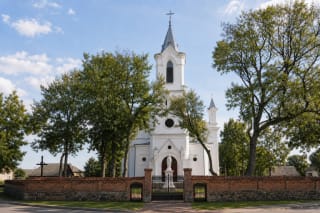
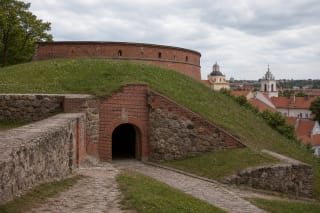
The Bastion of the Vilnius Defensive Wall is a first-half-of-the-seventeenth-century fortification on Bokšto Hill: a cannon tower, horseshoe-shaped artillery casemate, and 48 m underground tunnel, housing a National Museum of Lithuania arms exhibition since 1987.

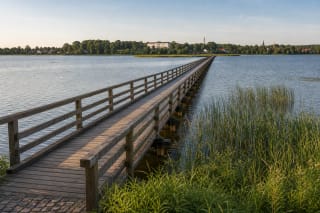
The Biržai Pedestrian Bridge over Lake Širvėna is Lithuania's longest pedestrian bridge, 525 m long, linking Biržai town with Astravas Manor. It crosses the country's oldest known artificial lake, created by the Radziwiłłs in the sixteenth century to defend Biržai Castle.
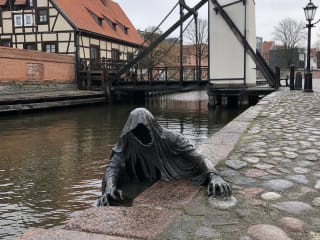
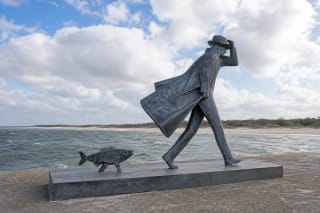
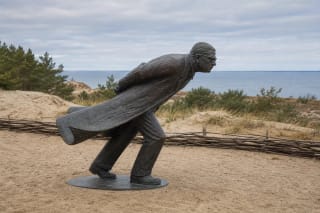
The Black Ghost is a bronze sculpture placed in Klaipėda Old Town in 2010, beside the castle moat and swing bridge. It was created by sculptors Svajūnas Jurkus and Sergejus Plotnikovas and is based on a local story about a black-cloaked man seen on 19 February 1595 by castle guard Hans von der Heide.
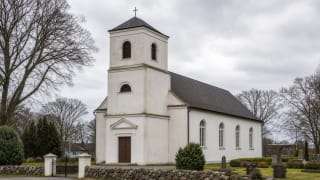
Counts Tiškevičiai Avenue is a historic axis of the Palanga resort running from Kęstučio Street to the Kurhaus. It was created in the late nineteenth century by the resort's founder, Count Juozapas Tiškevičius: it was Palanga's first park and the resort's centre. The restored avenue holds bronze sculptures of Count Feliksas Tiškevičius and Countess Antanina Sofija Loncka-Tiškevičienė and the family motto set into the paving.

Daugai is one of Lithuania's oldest towns, set beside long Lake Daugai in Dzūkija, where a medieval ducal manor past, towerless Church of Divine Providence, old market square, and nearby hillfort meet.

Druskupis is Lithuania's only open-air mineral-water evaporation tower, set in a Birštonas resort park. Mineral water evaporates here and enriches the air with minerals, creating a seaside-air effect and a distinctive wellness space.

Dubingiai Bridge across Lake Asveja is one of the most recognisable objects in Asveja Regional Park: the 1934 wooden bridge designed by engineer Anatolijus Rozenbliumas is considered Lithuania's first wooden bridge across a lake, and underwater archaeologists found older great-bridge piles beneath Asveja.

Friedrich's Passage is an old-town building complex at Tiltų g. 26 and 26A in Klaipėda (Memel), protected by the Cultural Heritage Register as a Historicist-era object of regional significance (code 1188). The plots are linked with the sixteenth-to-seventeenth-century Friedrich suburb; the brick houses with mansard roofs and timber-frame outbuildings were built in the second half of the nineteenth century, and in 2006 the courtyard was adapted into a passage of cafes and restaurants.

The Glass Quarter in Vilnius is a small but dense old-town street fabric between Town Hall, the university, and the former Jewish quarter, where the memory of sixteenth-century goldsmiths and glassblowers, the first printing house of the Grand Duchy of Lithuania, a UNESCO-protected urban layer, and Vilnius Jewish history meet.

Halė Market beside Vilnius Old Town is the city's oldest operating covered market, housed in an impressive steel-and-masonry hall built in 1904-1906 to a design by architect Vaclovas Michnevičius. It still functions as a food and urban-culture centre.

Jono Kalnelis is the best-surviving fragment of Klaipėda's ring of town bastions, listed in the Cultural Heritage Register as the Bastion Complex (code 10457) and dated to the fifteenth-eighteenth centuries. It preserves the Geldern and Purmark bastions, a curtain wall, the old ravelin, and a moat; the Dutch-type system was designed by the engineer René Carraccioli de Niastre, and the place is named after the former St. John's Church that once stood here.

The Kėdainiai Minaret is a rare Ottoman-style brick tower in the former manor park, built around 1880 by General Eduard Totleben to commemorate the Russo-Turkish War. It is the only freestanding minaret in Lithuania; importantly, it was never a religious building but a park ornament and viewing tower.

Kėdainiai Old Town is one of Lithuania's most distinctive historic urban centres. Its Great and Old Market squares, Radziwiłł heritage and mausoleum, churches of several confessions, synagogue complex, and Nevėžis riverfront reveal the town's multicultural past.

Klaipėda Central Post Office on Liepų Street is one of Lithuania's finest neo-Gothic buildings: a red-brick post-office complex built in 1893, with the country's only carillon sounding in its tower.

The Klaipėda Gasworks Complex on Liepų Street is the city's gasworks, built in 1860-1861 as the first large industrial building after the 1854 fire. The design was prepared by J. Hartmann, director of the Königsberg gasworks, and the most striking building is the red-brick gas-holder. Listed in the Cultural Heritage Register as a regional-significance object (code 4694), it is now being revived as a culture and commerce space housing the MEMEL Auto Museum.

Klaipėda University Campus occupies a former barracks complex built in 1904-1907 on H. Manto Street and known, from the colour of its brick, as the Red Barracks. The Cultural Heritage Register protects the Heimatstil ensemble, with its residential blocks, chapel, and canteen, as a monument (code 15844); after 1990 it was handed to Klaipėda University, founded in 1991.

Lankupiai Lock is part of the King Wilhelm Canal building complex and the only lock in Lithuania declared a technical monument. Built in 1864, the roughly 157 m navigation lock with operable gates was designed to manage water levels and move vessels safely between the canal and the Minija.

Lankupiai Suspension Bridge is a 130 m metal pedestrian bridge across the Minija, connecting the Klaipėda and Šilutė district sides. In 2017 it was included in Lithuania's record list as the longest suspension bridge, and it stands exactly where the King Wilhelm Canal branches off the Minija.

Lyduvėnai Railway Bridge over the Dubysa is Lithuania's highest and longest bridge: a 599 m long, about 42 m high, nine-span railway structure whose history begins during the First World War.

Marijampolė Railway Station is an ornate red-brick station palace built in 1923-1924 to a design by engineer-architect Edmundas Frykas. One of the most decorative railway buildings of its type in Lithuania and among the first built after independence, it combines early modern architecture with historicist details. The station still operates, and memorials to deportees and freedom fighters stand nearby.

Marijampolė Sugar Factory is the oldest symbol of Lithuania's sugar industry. Built in 1931 by the Kaunas joint-stock company Lietuvos cukrus, it was the country's first sugar factory, fitted with Czechoslovak Škoda equipment and able to process 600 tons of beet per day. It still marks the industrial layer of Marijampolė.

Pagėgiai Kristijonas Donelaitis Gymnasium is an impressive interwar school palace built in 1930-1932 to a design by Lithuania Minor artist Adomas Brakas. It clearly shows how Pagėgiai grew after the Klaipėda Region joined Lithuania in 1923, becoming a Lithuanian border administrative and cultural centre. Future poets Henrikas Nagys and Algimantas Mackus studied here. Today the building houses the Vydūnas Library and municipal institutions.

Palanga Kurhaus is the oldest building of the resort: Count Juozapas Tiškevičius had its masonry part built in 1875-1877, the Casino restaurant opened in 1878, and a wooden part was added in the early twentieth century. After the 2002 fire, it was restored as a centre of resort culture.

Plateliai is the centre of Žemaitija National Park by the largest lake in Samogitia: a radial-plan town with a wooden St Peter and St Paul church (1654-1744), manor estate, Lithuania's thickest ash tree known as the Witch's Ash, 1792 Magdeburg rights, and a strong Užgavėnės mask tradition.

The Presidential Palace in Vilnius is the complex of the President of the Republic of Lithuania on S. Daukantas Square: from a bishops' residence rooted in the fourteenth century, through Vasily Stasov's 1824-1832 Classical reconstruction, to today's place of state representation with public guided tours.

Priekulė Railway Station is a heritage site of the 1875 Klaipėda-Tilsit-Königsberg railway. Its state-listed complex (code 33207) preserves the station building, two railway workers' houses, a water tower, a warehouse, and two service buildings. Built on the land of manor owner John George Gleich, it is one of the clearest railway-infrastructure layers of Lithuania Minor.

Queen Louise Bridge over the Nemunas connects Panemunė with former Tilsit, now Sovetsk. Opened in 1907, the ornate bridge with an image of Prussian Queen Louise is a clear sign of Lithuania Minor heritage and today marks the Lithuania-Russia border.

Rusnė Bridge and Viaduct are the road infrastructure leading to Lithuania's largest island, where the flood problem of the Nemunas Delta and several layers of its solutions are visible. The current 1974 reinforced-concrete bridge over the Atmata connects Rusnė with the mainland on the site of the pre-war Peters Bridge, while the 750 m viaduct opened in 2020 lets traffic pass above meadows flooded each spring.

Sailing Ship Meridianas is a barquentine built in Turku, Finland, in 1948, one of nearly fifty ships handed to the Soviet Union as post-war reparations. In Klaipėda it served as the maritime school's training ship, and since 1971 it has worked as a restaurant on the Danė quay and one of the strongest symbols of the port city.

Šilutė Railway Station is an 1871-1875 heritage site on the Klaipėda-Tilsit railway, built on the land of Žibai village and therefore historically called the Žibai-Šilokarčema (Szibben-Heydekrug) station. Its yellow-brick station building and state-listed complex (code 30555) testify to the transport links of Lithuania Minor, while the deportations of 1948-1952 from this station add a painful twentieth-century layer of memory.

Šlyninka Watermill on the Nikaja River near Zarasai is one of the few Lithuanian watermills still operating. Authentic millstone and roller mechanisms still turn, heritage flour is milled, and traditional bread is baked at the neighbouring homestead, keeping the mill alive as technical heritage rather than only a museum.

Sundial Square is the most important symbol of Šiauliai, created in 1986 for the city's 750th anniversary. At its centre rises a tall column with the gilded Archer by sculptor Stanislovas Kuzma; the column works as the gnomon of a sundial and gives material form to Šiauliai as the Sun City.

Šventoji Monkey Bridge is a hanging footbridge over the Šventoji River at the end of Kopų Street that sways lightly as you cross it, making it one of the resort's most recognizable landmarks. It is a modern local object with no Register or encyclopedia entry, but a memorable stop beside the river mouth, harbour, and seaside walking routes.

Theatre Square is the heart of Klaipėda Old Town: it holds Klaipėda Drama Theatre and the famous Ännchen of Tharau Fountain, a monument to the song by Klaipėda-born poet Simon Dach. The square connects architecture, maritime culture, and twentieth-century history.

Viekšniai Water Mill is a red-brick technical heritage site built on the Venta in 1897. It once ground grain, carded wool, and even supplied Viekšniai with electricity. The mill survives almost unchanged and awaits restoration; it should not be confused with Viekšniai Pharmacy Museum.

Vilnius Town Hall is the central old-town place of self-government, trade, and representation. On the site of earlier Gothic town halls, Laurynas Gucevičius designed the present mature Classical building in 1785-1799; today it is still used for representative city events.

Visaginas is Lithuania's youngest city, built from 1975 as a Soviet atomgrad for workers of the Ignalina Nuclear Power Plant. Planned in the shape of a butterfly in a pine forest beside Lake Visaginas, it became a multiethnic city with a Russian-speaking majority. The Visaginas City Museum, opened in 2024, tells the story of the city and nuclear energy.

White Rose Bridge in Alytus is Lithuania's highest pedestrian and bicycle bridge, hanging about 38 m above the Nemunas. Built in 2013-2015 on the stone piers of an 1899 railway bridge, it has become a city symbol and a viewpoint over the Nemunas valley and Alytus Hillfort.