- Place
- Šateikiai, Plungė District Municipality
- Region
- Samogitia
- Type
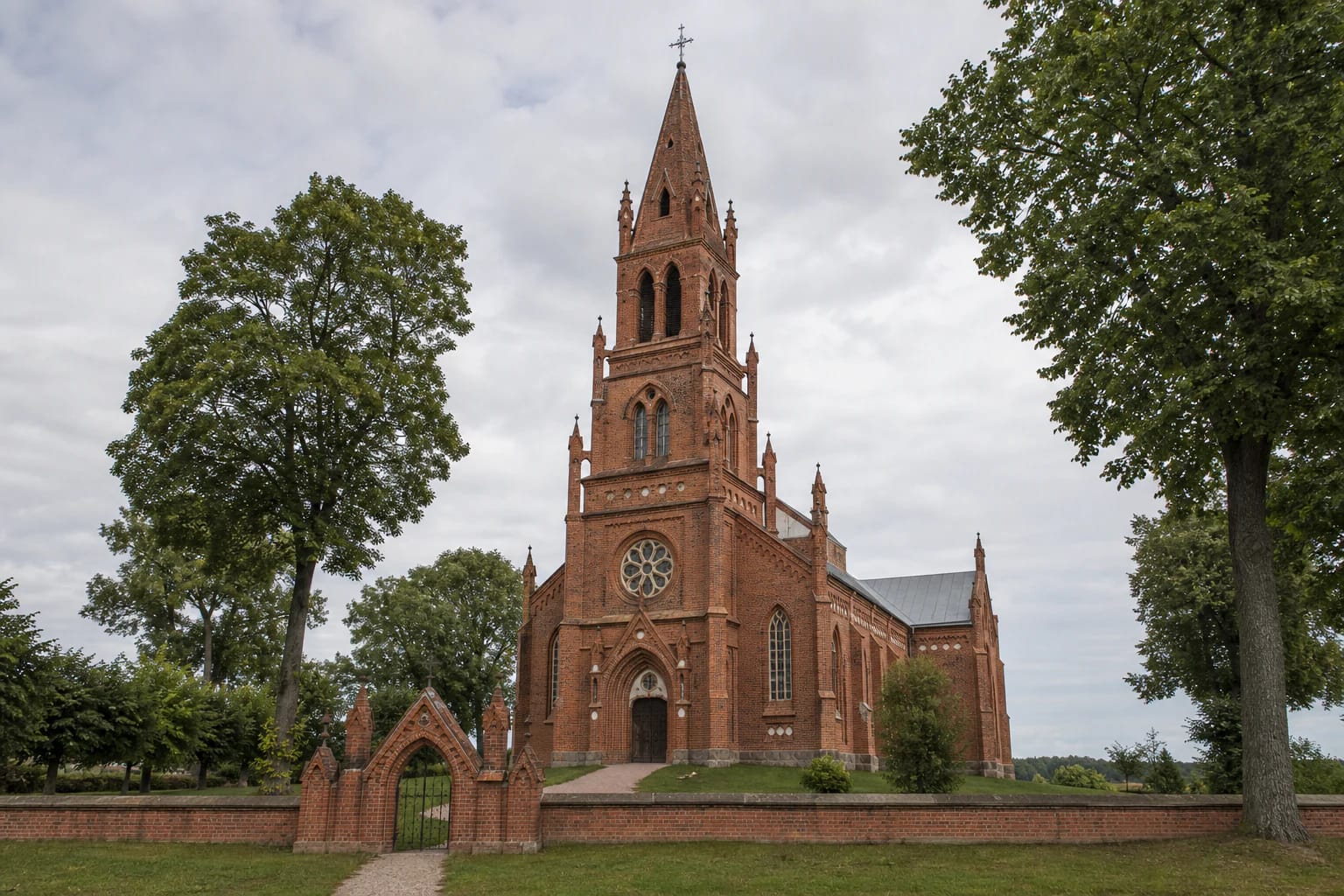
- three-aisled, single-tower brick Gothic Revival church built in 1862-1875, with a churchyard wall and Plater family graves
- Address
- 2 Bažnyčios Street, Šateikiai, Plungė District
- Coordinates
- 55.99900, 21.67774
- Visit duration
- 30-45 minutes for the exterior and churchyard; up to 60 minutes if the church is open and the interior can be seen without disturbing worship
- Best time
- before or after the 12:00 Sunday Mass once the schedule has been checked; a bright dry day for the exterior
Šateikiai Church of St Mark, Šateikiai Church, St Mark the Evangelist Church Complex in Šateikiai
A five-stage tower turns a village church into a regional landmark
Šateikiai Church rises above its settlement in the Blendžiava valley as a strong vertical marker. A five-stage tower controls the red-brick façade: multi-step corner buttresses climb into pinnacles, which are linked to the upper spire by half-arches. A rose window sits above the profiled main portal.
The church is a three-aisled, single-tower, cross-plan building ending in a polygonal apse. Pointed windows, high gables, buttresses, and patterned brickwork use Gothic elements as the language of nineteenth-century Historicism. This is not a medieval Gothic church; it deliberately reinterprets that older style centuries later.
A red-brick wall with two gateways and smaller gates completes the ensemble. Several Plater family graves and monuments stand around the edge of the churchyard, alongside other burials, a timber chapel, and a cross. Treat burial areas respectfully and never cross enclosures for a photograph.
Construction begun in 1862 had to overcome imperial restrictions
The sacred site predates the current masonry. A timber chapel was built around 1700 and a wooden church in 1776; the latter served as a filial church of Plateliai parish. In 1860, records mention a small church maintained by Count Pranciškus Plater. When it deteriorated, the family began a new brick building.
Research on the Plungė deanery states that the project was approved in March 1862 and Pranciškus Plater undertook to fund it. Work was stopped in 1864 but later permitted to resume. The founder's son Vladislovas Plater completed the church in 1875.
The chronology makes the building important for more than style. It rose after the 1863-1864 uprising, when Governor-General Mikhail Muravyov's administration restricted construction of Catholic churches. Šateikiai shows how an influential estate family secured exceptions and finished an already-begun project.
Tomas Tišeckis is the probable, not conclusively proven, architect
Architectural research summaries and the Diocese of Telšiai note that the identity of the designer is not fully settled. The church is most often attributed to Vilnius architect Tomas Tišeckis, a representative of Romanticism who worked with Gothic Revival and other historic styles. The accurate formulation is therefore probable or presumed architect.
Šateikiai's early Historicism can usefully be compared with documented and attributed Gothic Revival works by Tišeckis. Stylistic similarity, however, is not a signature on a drawing. Unless an unambiguous primary document appears, uncertainty about authorship remains part of the building's research history.
Craftsmen were invited from Prussia and the Courland Governorate for construction and fittings. Their experience helps explain both the sophisticated tower and the professionally coordinated nineteenth-century interior that made this masonry church stand out among the timber churches of Samogitia.
Oak fittings and the Plater gallery continue the Gothic Revival language indoors
Researchers regard the interior as a coordinated ensemble of sacred art from the second half of the nineteenth century. Timber altars, a confessional, Stations of the Cross reliefs, the baptismal font, and a pulpit decorated with figures of the Evangelists survive. Some objects came from the earlier church or were adapted to the new space, so the entire inventory is not the work of one workshop in 1875.
The Plater family's side gallery recalls that the patrons not only paid for the church but also had their own place during worship. Local stories describe an underground passage from the manor, but no reliable archaeological evidence for such a tunnel has been found. The gallery is documented; the tunnel is legend.
Do not enter the tower or closed parts of the interior without permission. Woodwork, polychromy, and stained glass are vulnerable to touch and strong light, so agree on photography locally and avoid flash.
The Čiurlionis marriage is documented; plan an interior visit around Mass
Artist and composer Mikalojus Konstantinas Čiurlionis married writer Sofija Kymantaitė at Šateikiai Church on 1 January 1909. Some later narratives give old- and new-calendar dates, but the Diocese of Telšiai officially uses 1 January. The event links this village sanctuary directly to two major Lithuanian cultural figures.
On 27 July 2026, the Diocese listed Mass at 12:00 on Sundays, at 10:00 on weekdays from December to February, and at 18:00 from March to November; Saturdays were by arrangement. Confessions were heard half an hour before Mass. The schedule, unlocked-door periods, and clergy availability can change, so check the official parish page before travelling.
No separate museum timetable or admission ticket is published. The exterior and churchyard can be seen from lawful access, but doors may be locked outside worship. Arrange group visits, interior access, and photography with the parish, and do not walk among the altars or photograph people during services.