- Place
- Kaunas City Municipality
- Region
- Kaunas
- Type
- interwar modernist and national-style architecture landmark
- Address
- Laisvės al. 102, Kaunas
- Coordinates
- 54.89795, 23.90454
Kaunas Central Post Office, Kaunas Central Post Office Palace, Former Kaunas Central Post Office Palace
A modernist palace on Laisvės aleja
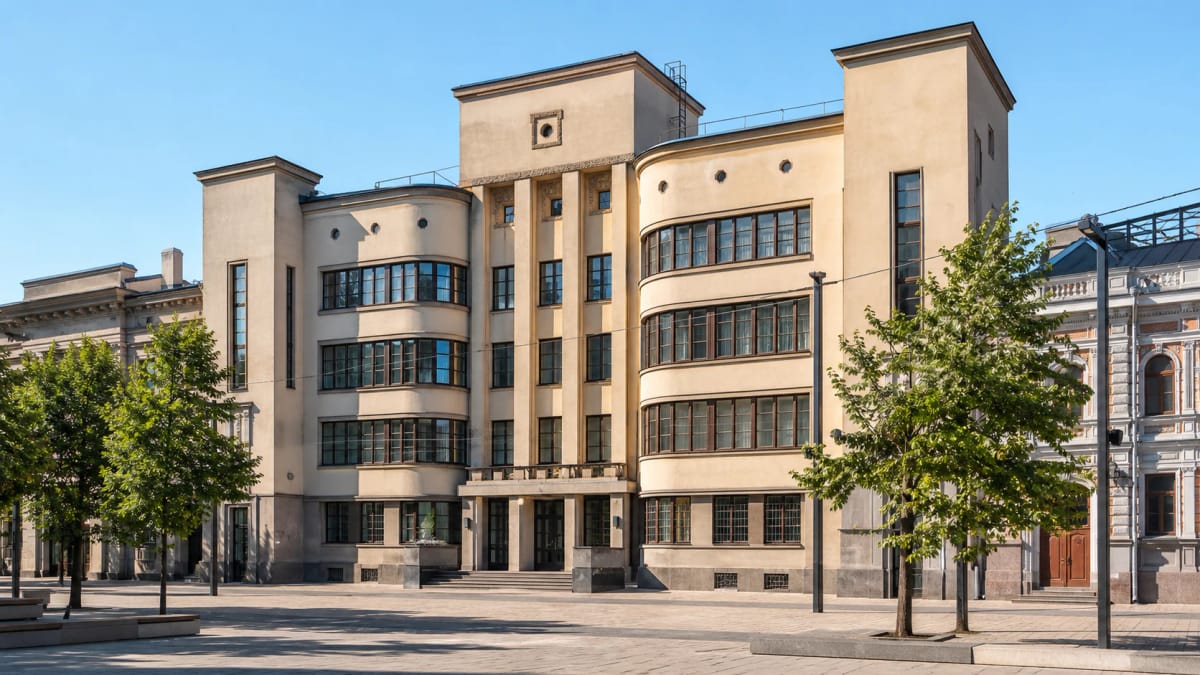
The former Kaunas Central Post Office stands on the main axis of Laisvės aleja, so it is easy to pass it as one centre-city facade among many. Stop longer and the reason it became one of the clearest signs of interwar Kaunas architecture becomes visible: a large but not heavy volume, rhythmic window bands, expressive corner accents, and decoration that translates national motifs into a restrained modernist language.
Sources present it as the former central post office built in 1930-1932 and as one of the most important representative buildings of interwar Kaunas. AUTC is even more specific: it calls the building the most significant interwar Lithuanian post-office functional type, where state infrastructure became a public architectural statement.
Why a post office needed a palace
In the interwar period Kaunas was Lithuania's temporary capital, so communications were not merely a technical service. Post, telegraph, and telephone meant administrative independence, modernity, and the state's ability to connect with its regions and with the wider world.
AUTC states that the need for a new central post office became clear in 1924 and that construction began in 1930, the year marking the 500th anniversary of the death of Vytautas the Great. The building was tied to this state anniversary: a commemorative plaque and Vytautas medal motifs appeared on the facade, giving even a practical communications centre a layer of historical representation.
Feliksas Vizbaras and national modernism
The palace was designed by Feliksas Vizbaras, presented by VLE as a Lithuanian engineer and architect who worked as Kaunas city engineer and later as a senior inspector at the Ministry of Transport. VLE describes his 1930s buildings as modernist, and the Kaunas architecture overview lists the Central Post Office among buildings combining modernism with national style.
AUTC records that Vizbaras himself understood this building as a national-style work. Its national character, however, is not simply added ornament: a functionalist plan, more light and space, clear grouping of premises, and avoidance of unnecessary decoration are combined with interpretations of folk textile and woodcarving motifs.
Details worth noticing
At the facade, do not rush to photograph only the whole building. Read it in layers. First come the modernist horizontal window bands and rounded corner volumes. Then the vertical accents, central entrance zone, and proportions of the side projections stand out.
AUTC notes that motifs inspired by folk woodcarving were transferred into cement window surrounds and cornices, while in the interior the pattern of national textile appeared in ceramic-tile floors. AUTC even mentions a specific folk textile source: a necktie pattern by a weaver from Skapiškis, whose principles were interpreted in the architecture.
A lost and reconstructed interior story
The building's greatest drama is not on the facade but inside. AUTC describes the main operations hall as richly decorated: the upper part included symbols of Vilnius, Gardinas, and Klaipėda, three paintings by Kazimieras Šimonis, motifs of a Lithuanian woman with the Vytis and Gediminas Hill, and below them a frieze of Lithuanian postage stamps painted by Petras Kalpokas.
That interior has not survived as originally conceived. AUTC states that in 1952 the wall painting was destroyed for ideological reasons, in 1978-1980 the hall was changed with new stained glass and finishes, and in 1996 restoration attempted to recreate lost motifs from analogies because visual material was scarce. When speaking about the interior today, it is important to distinguish the authentic interwar concept, Soviet-era changes, and later attempts at reconstruction.
Modern technology and criticism
In the interwar period the building was valued not only for its facade. AUTC mentions five floors and a basement, modern lifts, a spacious operations hall, better working conditions, and even employee showers. In 1935 an electric clock appeared on the main facade, and an automatic telephone exchange and telegraph were built on the plot.
At the same time, the sources show that the building was not accepted without argument. AUTC recalls criticism during construction about the use of old bricks and postal workers' doubts about functionality. This lets the Central Post Office be read not as a flawlessly canonized icon, but as a living interwar construction project where prestige, technology, budget, and daily work met.
From working post office to architecture institute
AUTC states that postal operations in this building ended on November 18, 2019, and the central post office moved to the Akropolis shopping centre. Today it is not an ordinary post office where visitors can mail a parcel and also view the hall.
Public information has stated that the renovated palace should eventually house the National Architecture Institute. Until then, the safest plan is an exterior visit on Laisvės aleja, with interior access tied only to announced exhibitions, tours, open days, or other current programmes.
How to include it in a Kaunas route
The best way to see the former post office is to walk Laisvės aleja and give it a separate stop rather than simply passing by. The facade reads best from the opposite side of the avenue, where you can take in the full width, rounded volumes, and central entrance axis.
The UNESCO World Heritage property Modernist Kaunas: Architecture of Optimism, 1919-1939 gives this building wider context. It is not just one attractive facade stop, but part of a city that had to create capital infrastructure, representation, and everyday architecture very quickly between 1919 and 1939.