- Place
- Akmuo village, Varėna District Municipality
- Region
- Dzūkija
- Type
- towerless timber church completed in 1759, with a separate two-stage wooden bell tower and an active cemetery
- Address
- 35 Akmenio Street, Akmuo village, Varėna District
- Coordinates
- 54.30216, 24.62357
- Visit duration
- 30-50 minutes for the towerless log architecture, open bell tower, and a respectful circuit of the cemetery churchyard
- Best time
- in dry daylight, when the differences between old logs, vertical boards, sheet metal, and shingles are clear; arrange interior access in advance
Akmuo Church, Church of the Crucified Jesus in Akmuo, Akmenio Nukryžiuotojo Jėzaus bažnyčia
A towerless log church and open bell tower create an unmistakable silhouette
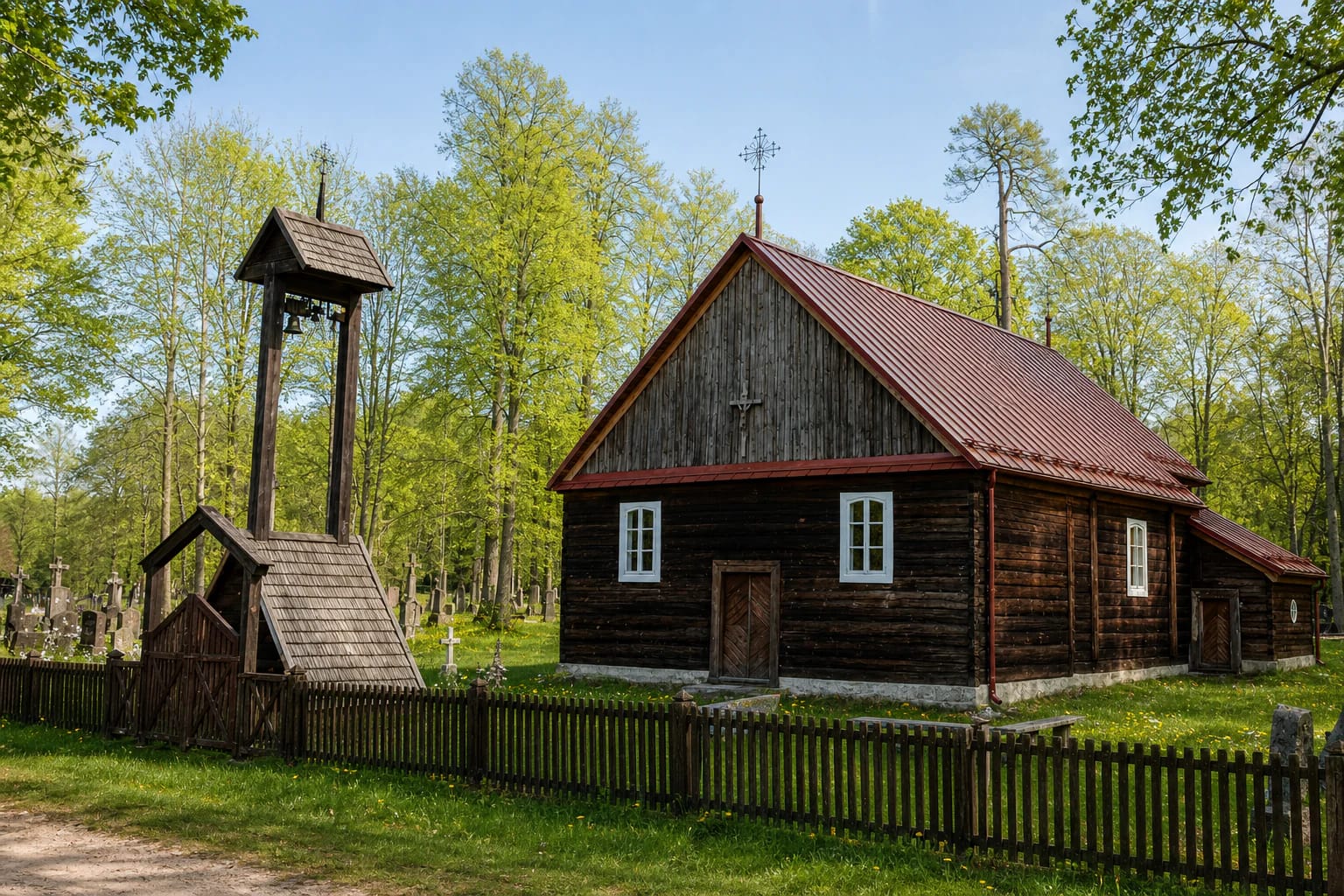
Akmuo church is low, elongated, and entirely towerless. Dark horizontal logs remain clearly visible in its walls, while the triangular principal gable is clad in vertical grey-brown boards. White rectangular windows and doors are the only bright accents, and nothing but an openwork metal cross rises above the plain gabled roof.
A separate timber bell tower beside it has an unusually open structure. Two exceptionally tall dark posts carry a small bell stage and narrow shingle roof, while a low, steeply pitched shingled enclosure wraps around the base. It is not a decorative gateway or an imitation church tower, but a free-standing functional building in the ensemble.
The church, bell tower, wooden fence, and cemetery trees are best read together from an oblique angle. This view reveals their real scale and contrasting materials. Do not expect a grand facade: the place derives its character from restrained proportions, old log surfaces, and the rare construction of its bell tower.
The eighteenth-century sanctuary changed with its parish
Historical research connects the beginning of the Akmuo chapel with 1724 and the completion of the present wooden building with 1759. Grand Duchy of Lithuania official Adomas Bžostovskis is named as its founder. Sources from the late eighteenth century already record annual feasts here, so this was more than a forgotten wayside chapel.
The building was repaired more than once, including work in 1861. After the First World War and the destruction of Varėna's church, priest Juozapas Stašys worked for a time in Akmuo, enlarged the building, and established facilities needed by the community. An independent Akmuo parish was created in 1919.
The church visible today is therefore not an untouched exhibit from one building campaign. Its early origin, later enlargement, repairs, and current care form several historical layers. They should be understood separately rather than describing every surviving element as an eighteenth-century original.
The Crucifix belongs to a living tradition of devotion
The church's dedication and principal image of the Crucified Jesus gradually became the focus of local devotion. Historical descriptions mention votive offerings left by believers. They document personal gratitude and petitions, but they are not scientific proof of a supernatural event.
Tradition describes the Crucifix as an image of grace. This is best understood as part of a religious community's belief and testimony, not a miracle promised to a tourist. Documented building history and oral tradition must remain clearly distinguished.
The stone known as Užkeiktos mergos, or Enchanted Maidens, is also associated with legends near the village. It is a separate site, so the church coordinates are neither its trailhead nor a precise location. Never cross graves or private property in search of a shortcut.
An active cemetery is not a museum with permanent opening hours
The Cultural Heritage Register records the church and bell tower as separate components of a protected ensemble. Kaišiadorys Diocese data confirm an active parish, but no daily tourist hours, guaranteed unlocking, ticket office, or permanent guided tours are officially published.
Visitors may respectfully view the exterior and bell tower from publicly accessible paths when no funeral or service is taking place. Contact the parish in advance to see the interior and check current liturgical announcements. No separate tourist admission charge is published.
Official pages provide no complete description of a step-free route, accessible toilet, or reserved visitor parking. Cemetery paths may be uneven and gates narrow. Check individual access needs before setting out.
The exact map entry marks the church, not a parking space
The ensemble stands at 35 Akmenio Street in Akmuo village, Varėna District. Coordinates 54.3021642, 24.6235703 mark the church inside the cemetery. They do not guarantee a lawful parking bay or wide turning space, so keep the gate and narrow access lane clear.
The Akmuo church entry, Place ID ChIJGx1B340G3kYR1ZRl2jqUYXg, held 4.7 out of 5 from 84 reviews when checked on 27 July 2026. That changing online average says nothing authoritative about conservation condition or step-free access.
Allow 30-50 minutes for a quiet exterior circuit. Timber surfaces are most legible in soft morning or evening light. Do not touch old structures, climb the bell tower, or make identifiable grave inscriptions the principal subject of a tourist photograph.