- Genre
- World-creation sakme
- Source status
- folkloric
- Motifs
- primeval waters, Dievas and Velnias, speck of earth, expanding world, creation from mud
The sakme
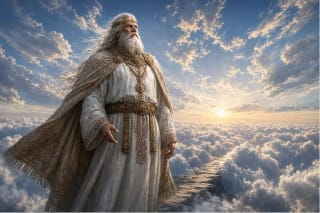
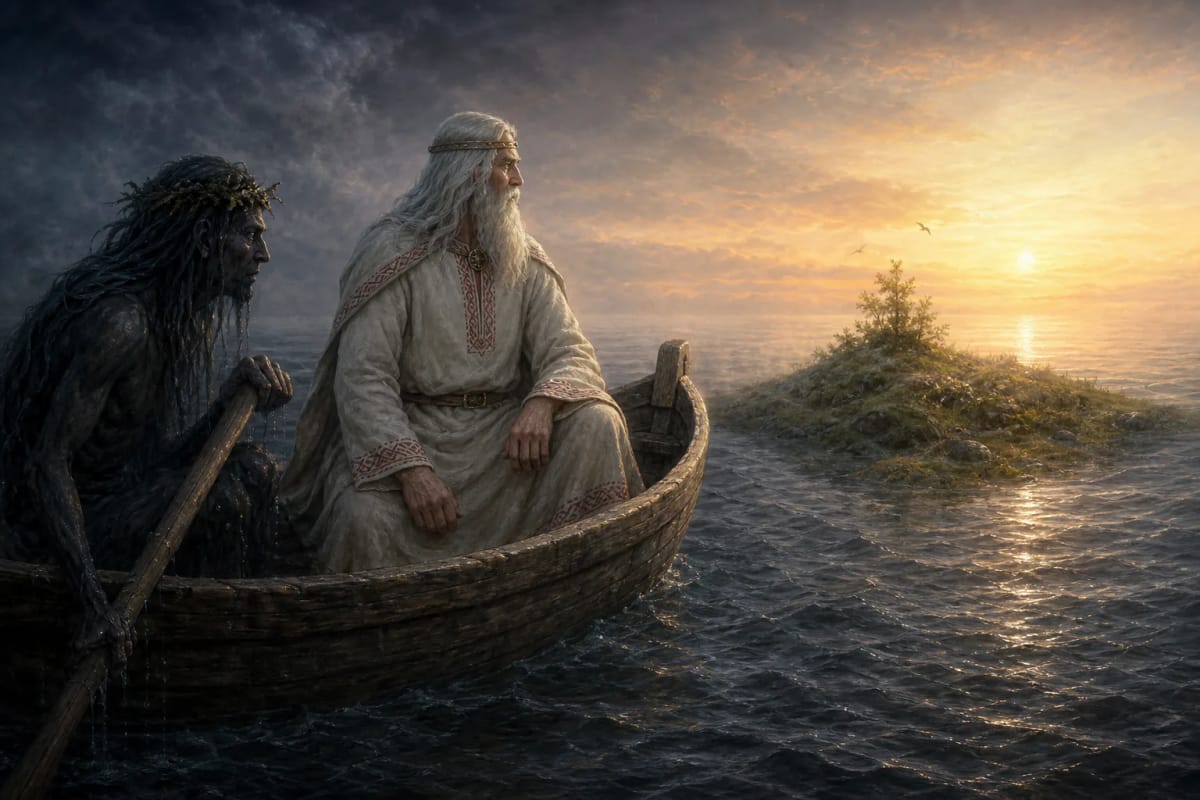
In the beginning there were no fields, no forests, and no road for a human foot. Water lay everywhere, and on that water floated a small boat. Dievas sat in it, while Velnias rowed and stared into the endless emptiness.

When both grew tired, Dievas said there had to be a place to rest. He ordered Velnias to dive to the bottom and bring back earth. Velnias dived once, twice, three times, but the waters washed his hands clean. Only a little mud remained beneath his nails.
Dievas scraped out that tiny bit of dirt, pressed it into a clod, and set it on the water. A small island appeared. Dievas lay down on it to rest, and Velnias grew envious: if Dievas disappeared into the water, the world would be his alone.
Velnias began dragging the sleeping Dievas toward the island’s edge, but the shore moved away. He dragged him the other way, yet the earth expanded there too. The harder he tried to push Dievas into the water, the larger the earth became.
When Dievas woke, he understood the evil intent. Velnias was cast down into the underworld, and on the expanded earth Dievas allowed humans to live.
Interpretation: what does the earth-origin sakme mean?
This sakme shows the beginning of the world not as a single solemn act, but as a drama between creation and destruction. A tiny speck of mud is enough for Dievas to make earth, while Velnias’ attempt to destroy it paradoxically enlarges it.
The primeval waters signify undefined chaos. The small island is the first place of order, where one can stand, sleep, and live. Here the earth arises at the boundary between depth and divine shaping.
Velnias is not a creator in the full sense, but without his movement the world would not expand. This motif is typical of Lithuanian etiological sakmes: an evil intention can be drawn into divine order and unintentionally help the world come into being.
The source variant
Vaikams.lt: „Kaip atsirado žemė“, complete legend text. An editorial retelling of the specific cited variant, checked against its complete source narrative. This is not a literal transcript.
Motifs and cultural context
The most important motifs are primeval water, the pair of Dievas and Velnias, the test of the depths, and the growth of the earth. They connect the sakme to the wider Eurasian earth-diver motif, while the Lithuanian telling strongly emphasizes the opposition of Dievas and Velnias.
The sakme also explains why the world is not purely perfect: envy, deception, and a remnant of chaos are already present at its beginning. Even so, the world finally becomes a dwelling place for humans.