- Genre
- Romantic sea legend
- Source status
- literary tradition
- Motifs
- Jūratė, Kastytis, Amber Palace, Baltic Sea, Perkūnas, love
Legend of Jūratė and Kastytis, Jūratė, Kastytis, and the Amber Palace, Baltic Sea legend
The legend
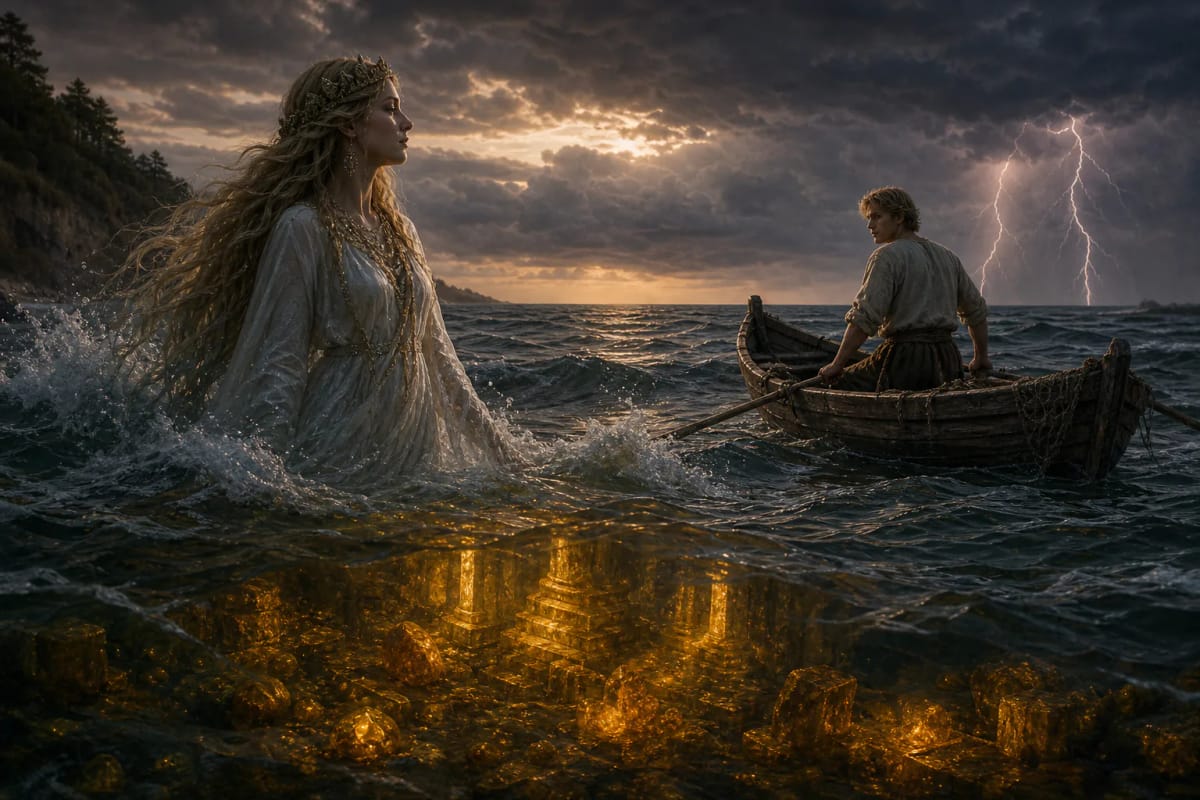
A young fisherman named Kastytis lived by the Baltic Sea. He sailed out, cast his nets, and caught fish, although Jūratė, who lived in the sea depths, guarded her realm and did not want humans disturbing it.
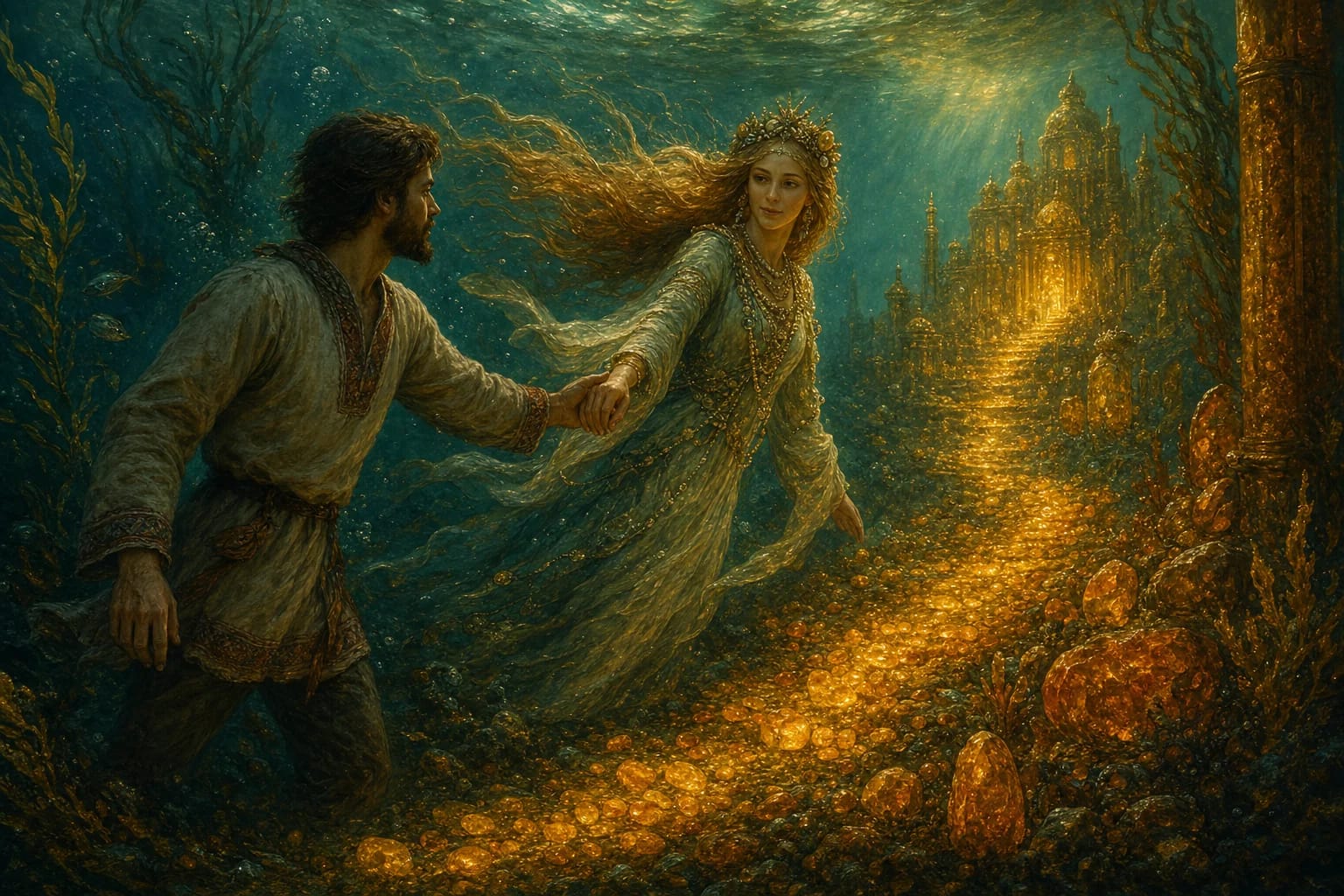
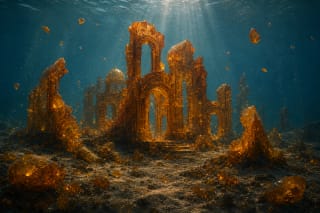
At first Jūratė meant to stop the fisherman, but when she saw Kastytis she loved him. She took him to her amber palace beneath the sea, where light came from the palace walls rather than the sun. Human and sea-goddess worlds briefly joined.
Perkūnas learned of the love and punished Jūratė for loving a mortal. His lightning shattered the amber palace, and waves began to cast amber pieces onto the shore.
Interpretation: what does the legend mean?
The core tension is the boundary between human and divine or mythic worlds. Kastytis belongs to shore and work; Jūratė belongs to sea depth and supernatural order. Their love is beautiful because it is impossible without consequence.
The amber palace makes Baltic amber emotional. Each piece can be read as a fragment of shattered love, punishment, and sea memory.
Perkūnas acts as a guardian of order. His punishment shows that in a mythic world boundaries between gods, humans, and natural forces have a cost.
History, literature, and source status
The story is widely known through Maironis' ballad Jūratė ir Kastytis, published in his poetry collection Pavasario balsai (first edition 1895, later expanded). An earlier literary form of this plot is thought to have been published in the mid-19th century by Liudvikas Adomas Jucevičius, so the legend should be presented as a plot strengthened by literary tradition, not as one old, unchanging folk text.
In literary history, Maironis' ballads are placed among his range of genres together with 'Čičinskas' and 'Šatrijos kalnas.' This does not mean the plot lacks folkloric or mythic imagery, but it lets the source status be stated more precisely: the popular version is closely tied to authored literature.
In the context of the Palanga Amber Museum and coastal culture, this legend became one of the main stories used to explain amber. The museum's research shows that the romantic image of amber — as the "embodiment of the nation's spirit" — was strongly shaped in the early 20th century precisely by literature, including Maironis' work. This helps us understand amber not only as a natural material but also as a cultural symbol.
Why the legend is so popular
It joins several powerful images: sea, amber, love, punishment, and storm. The Lithuanian coast gains its own mythic drama.
Jūratė and Kastytis also let the Baltic Sea speak as a living space, not only water or a travel destination.