- Place
- Kretinga District Municipality
- Region
- Samogitia
- Type
- fieldstone Lourdes grotto built in 1920-1921, timber Chapel of the Nativity of Mary, and spring
- Address
- 2 Abakai, Kartena eldership, Kretinga district
- Coordinates
- 55.90869, 21.46794
Kartena Lourdes, Abakai-Kartena Lourdes, Abakai Chapel of the Nativity of the Blessed Virgin Mary
Finding the grotto across the Minija from Kartena
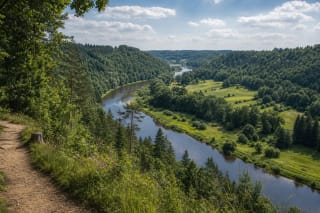
Abakai Lourdes stands at the northern edge of Abakai village on a wooded slope of the Minija's left bank near its confluence with the Kūlupis, at 55.9086918, 21.4679367. It is across the river from Kartena town and roughly 0.7 kilometres north of the Vėžaičiai-Mikoliškiai-Kartena road. Follow the signs marked Abakų Lurdo grota on the route past Kartena Hillfort.
Use the exact grotto pin or the address 2 Abakai for navigation, because a search centred on Kartena may lead to the parish church on the opposite bank. Official sources publish neither a marked parking plan nor the number of spaces. Leave a vehicle only where signs permit, keep private access clear, and be prepared to walk the final approach.
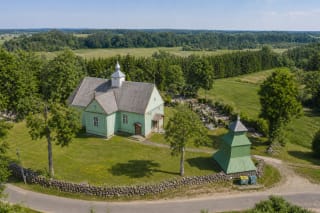
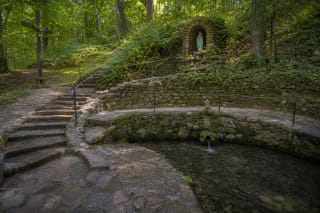
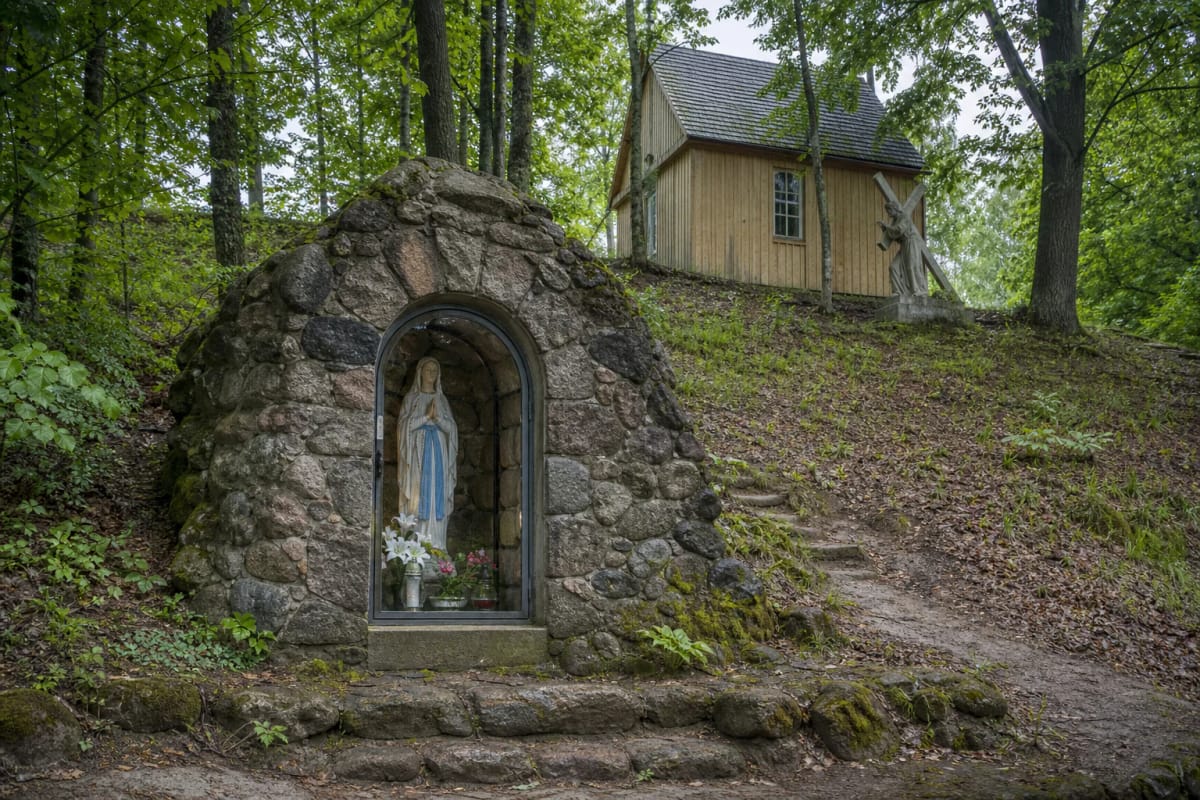
The ensemble occupies several levels of the slope. A fieldstone grotto with a life-size statue of Mary stands below beside the spring, while the small timber chapel and a concrete Christ Carrying the Cross rise higher up. Woodland paths, gradients, and steps can be slippery after rain, and no official step-free-access or accessible-toilet specification is published.
Navirauskas's dreams are tradition; the 1920-1921 construction is documented history
At the beginning of the twentieth century, Kazimieras Navirauskas lived on the Kartena rectory estate at a place known as Pastauninkas Hill. A small timber wayside shrine already stood beside one of the three springs remembered in local accounts, and villagers gathered there for Rogation Days and May devotions. Prayer at the site therefore preceded the present grotto.
Tradition says Navirauskas dreamed three times of the Virgin Mary beside the spring and Jesus Christ above on the hill. Another recorded motif interprets the construction as thanksgiving for his safe return from the First World War. These are accounts of local religious memory, not visions independently established by documents.
What is documented is that Navirauskas built the grotto from locally gathered fieldstones in 1920-1921. Through the Kartena priest, a statue of Mary was brought from Lourdes in France, and a timber chapel rose higher on the slope. Sources give 1921 or 1922 for the chapel, so the most responsible chronology is 1920-1921 for the grotto and about 1921-1922 for the chapel.
An altar older than the Lourdes shrine survives inside the chapel
The chapel's most important artwork is a late-eighteenth-century folk-Baroque altar with two seated angels, made by an unknown craftsman from the Kartena and Budriai area. An anonymous nineteenth-century woodcarver created the Crucifix beside it. Both came from the old filial church at Budriai and reached Abakai after its altar no longer suited the Neo-Gothic church completed there in 1903.
The concrete Christ Carrying the Cross outside is not an arbitrary modern decoration either. Julius Maciejauskas, then priest at Švėkšna, brought it from the churchyard there. The movement of works from Budriai, Švėkšna, France, and Kartena makes the ensemble a small repository of rescued sacred-art fragments.
The Kretinga regional encyclopaedia identifies the grotto, chapel interior, altar with angels, and Crucifix as heritage objects; older register references assign DV-4158 to the altar and DV-4159 to the Crucifix. The chapel is not continuously unlocked, so free access to the grounds does not guarantee a close view of the altar.
From grain store and barbed wire to a community-restored shrine
During the interwar period, processions walked here from Kartena after Mass, and the site hosted May devotions and religious feasts. After the Second World War, Sister Tarcizija, born Marija Šiaulinskaitė, cared for the shrine, secretly taught children catechism, and prepared them for First Communion. Abakai Lourdes was therefore an active place of religious formation, not merely a monument.
Under Soviet rule, the collective farm used the chapel to store grain, while the grotto was fenced with barbed wire and neglected. This desecrated the site's sacred purpose, but the authoritative accounts do not support a claim that the entire ensemble was completely destroyed. The surviving structures and artworks later made renewal possible.
Pilgrimage returned after Lithuanian independence. In 2005 the community created a hillside path, symbolic gate, and small devotional monuments, renewed the chapel's cladding and shingle roof, and restored its authentic porch. Further work in 2020 repaired the roof, replaced windows, and repainted walls; paintings of angels donated by Regina Songailaitė-Balčikonienė now enrich the interior.
The spring belongs to a tradition of faith, not a medical guarantee
Believers have long regarded the spring beside the grotto as special, and local stories credit its water with healing power. Tradition also says that Pranas Mačernis poured blessed water brought from Lourdes in France into the well. These claims belong to religious and communal memory, not to effects demonstrated by laboratory or clinical research.
The official public descriptions of the site provide no current microbiological or chemical test certifying the spring as safe drinking water. Visitors can appreciate the spring and respect devotional custom without treating sacred status as a guarantee of potable-water quality.
Flowers and candles around the grotto show that people come to pray, not only to take photographs. Do not touch the statues, pour anything into the spring, or leave plastic candle containers, and keep quiet when a private prayer or service is taking place.
Hours, the Nativity of Mary feast, chapel access, and a 4.7 rating
In July 2026, Google Maps listed the outdoor Abakai Lourdes site as open 24 hours, while the official protected-areas page named neither a ticket nor a box office. This indicates freely accessible grounds, not an illuminated or supervised night attraction. Visit in daylight because of the wooded slope, uneven path, and neighbouring homes.
Kartena parish serves the Abakai Chapel of the Nativity of the Blessed Virgin Mary. Traditional worship is associated with the Nativity of Mary on 8 September, although the annual service can move to a nearby weekend. Anyone wishing to see the interior or attend the celebration should check the Kartena parish information on the Telšiai Diocese website or call the listed parish contact.
No permanent attendant, regular interior opening hours, admission fee, or guided-tour schedule is officially published. In July 2026, Google Maps rated the site 4.7 out of 5 from 60 reviews. Ratings change; an accurate pin, daylight, dry-weather footwear, and respect for a functioning shrine matter more to a successful visit.