- Place
- Alsėdžiai, Plungė District Municipality
- Region
- Samogitia
- Type
- three-aisled timber folk-Baroque basilica built in 1793, with a detached belfry, churchyard chapel, and masonry wall
- Address
- 2 Bažnyčios Street, Alsėdžiai, Plungė District
- Coordinates
- 56.03035, 22.04617
- Visit duration
- 35-50 minutes for the full complex; around 60 minutes if the church is open and the interior can be viewed without disturbing worship
- Best time
- before or after the 11:00 Sunday Mass once the schedule has been checked; a dry bright day for the ensemble and Alka Hill setting
Alsėdžiai Church, Immaculate Conception Church in Alsėdžiai, Alsėdžių Švč. Mergelės Marijos Nekaltojo Prasidėjimo bažnyčia
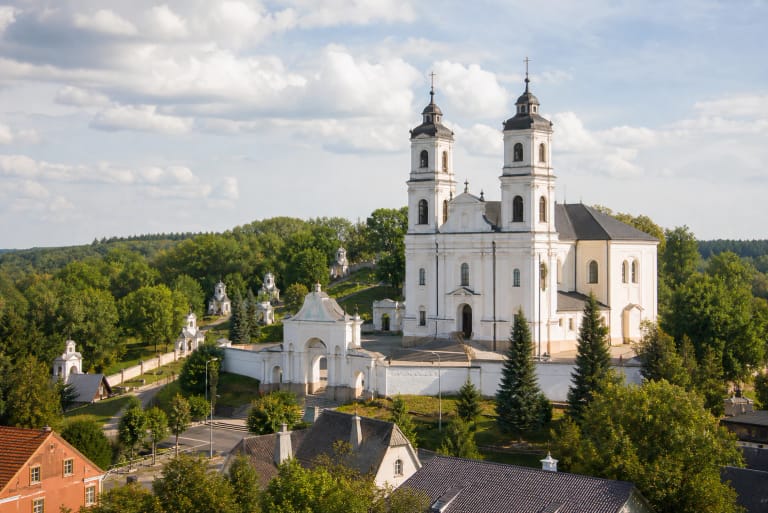
A timber basilica on Alka Hill commands the town's radial plan
The streets of historic Alsėdžiai converge on the old market square and Alka Hill, making the church both an architectural and landscape marker. KPD calls it the most important landmark of the protected town. Steps lead from the square through the gateway, while tree trunks and the slope reinforce the apparent height of the building.
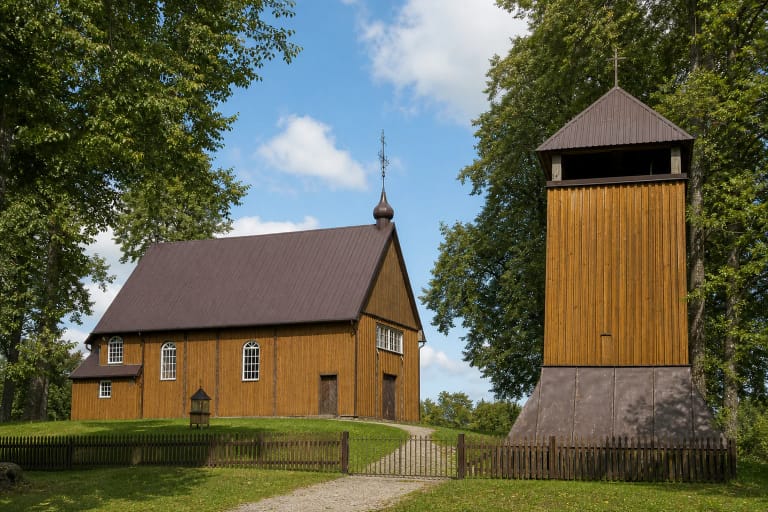
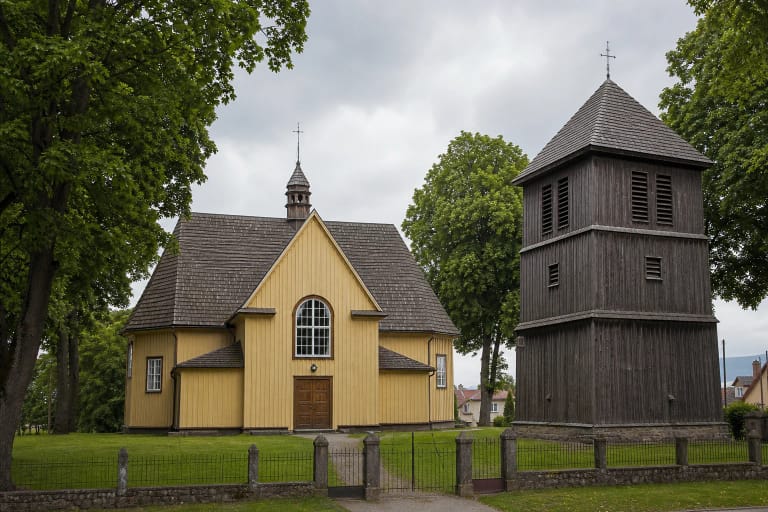
The church is timber-built, three-aisled, basilican in volume, and ends in a three-sided apse. The nave rises above the side aisles. Painted vertical boards clad the walls, fieldstones form the foundations, and sheet metal covers the pitched roofs. Its restrained brownish-yellow façade resembles a very large traditional timber building more than an ornate masonry basilica.
The church is called towerless because it has no full-height façade bell towers. Two small Baroque onion-shaped roof turrets with crosses instead mark the front gable and apse. This distinction helps visitors read the architecture accurately and not confuse the church with the detached belfry in the churchyard.
The church of 1793 continues the history of a residence of the Bishops of Samogitia
Grand Duke Vytautas assigned Alsėdžiai to the Bishop of Medininkai, later known as Samogitia, in 1421. VLE says a bishops' residence developed here in the second half of the fifteenth century and the town grew beside it. Alsėdžiai belonged to the bishops until 1842 and remained a principal residence into the mid-nineteenth century.
Earlier churches stood at the foot of Alka Hill. The parish has been documented since the fifteenth century, but today's sanctuary is later. It was built in 1793 through the efforts of Bishop of Samogitia Steponas Giedraitis, parish priest Jokūbas Degutavičius, and the local congregation.
Part of Alka Hill was cut back to build the present church. A chapel was erected on the site of the old sanctuary, so the ensemble preserves both a standing building and the memory of the earlier sacred place. The bishops' manor burned in the early twentieth century, leaving the church as the strongest visible sign of this long residential period.
The belfry, chapel, and bell of 1679 are important monuments in their own right
A detached timber belfry from the late eighteenth century stands beside the church. Its several stages narrow upwards beneath a metal roof. Detached belfries are characteristic of Samogitian timber church ensembles and keep the load and movement of heavy bells away from the principal building.
VLE highlights a brass bell cast at the J Delamars workshop in 1679. More than a century older than the present church, it demonstrates how liturgical heritage moved from earlier sanctuaries into a new ensemble. The belfry interior and bell mechanism are not a freely accessible exhibition.
The ensemble also includes a churchyard chapel and a masonry wall with gateways built in 1907. Lithuania's 2025-2027 heritage programme provides for investigation and conservation of the wall and gates, so temporary barriers or altered access may be present.
Eight Baroque altars contrast dramatically with the restrained exterior
Three aisles form the basilican interior, focused on eight timber Baroque altars. They were maintained and augmented during the nineteenth century and renewed in 1907-1908. Their different phases mean the interior is best understood as an ensemble that evolved over a long period, not the single campaign of one workshop.
VLE specifically identifies a valuable eighteenth-century painting of the Holy Family in a side altar. Never touch the altar, lean against carving, or use flash while viewing it. The interior remains a living liturgical space rather than a museum gallery.
The church was restored in 2002 and its windows were later repaired while preserving exterior metal frames and coloured-glass crosses. In 2026, KPD recorded concern about defects in the roof covering and structure and the effects of moisture. This does not mean the church is closed, but check whether works or access restrictions are in place before travelling.
Sunday Mass is the most dependable reference point for planning an interior visit
On 27 July 2026, the Diocese of Telšiai listed Mass at 11:00 on Sundays, 18:00 on Tuesdays, Thursdays, and Fridays, 10:00 on Wednesdays, and Saturdays by arrangement. There is no Mass on Mondays, and confessions begin half an hour beforehand. Check the official page before setting out.
No standard ticket or separate tourist hours are published. The churchyard and building exteriors can be viewed from lawful access, but church doors may be locked outside services. Arrange groups, a fuller interpretation, or photography with the parish.
Give the ensemble time rather than taking only a quick façade photograph: walk around the church, find the detached belfry and chapel, and notice the connection with the square and hillside. The Google Maps listing showed 4.6 out of 5 from 51 reviews on 27 July 2026; the coordinates mark the church site itself.