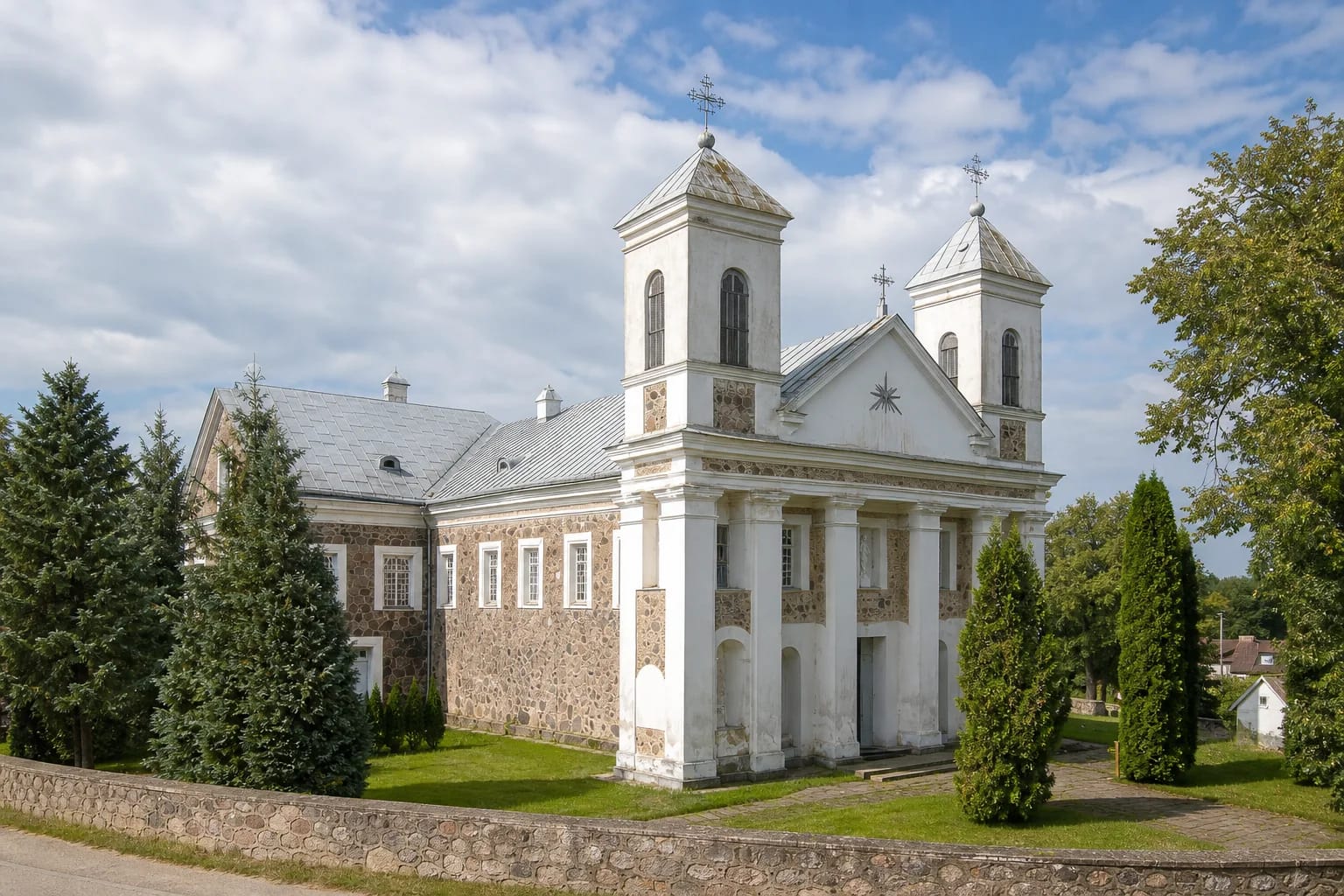
- Place
- Valkininkai, Varėna District Municipality
- Region
- Dzūkija
- Type
- twin-towered fieldstone parish church of the Romantic period, built in 1822 or 1823-1837 and enlarged in 1895-1898
- Address
- 5 P. Bieliausko Street, LT-65438 Valkininkai, Varėna District Municipality
- Coordinates
- 54.35821, 24.84079
- Visit duration
- 30-45 minutes for the church and churchyard; 1-1.5 hours together with historic Valkininkai square
- Best time
- Friday afternoon or the weekend during the published opening hours; choose a bright day to appreciate the fieldstone façades
Valkininkų Švč. Mergelės Marijos Apsilankymo bažnyčia, Valkininkai Church, Valkininkai Visitation Church, Kościół Nawiedzenia Najświętszej Maryi Panny w Olkienikach
Where the church stands and when you can enter
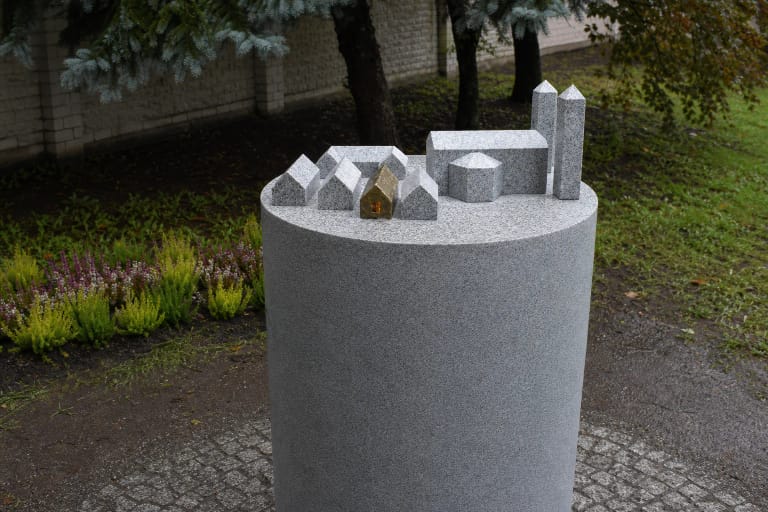
The church stands at 5 P. Bieliausko Street, coordinates 54.3582112, 24.8407936, at the higher end of old Valkininkai square. Its twin-towered front closes the funnel-shaped space formed by four principal streets, so step back into the square for the first full view before entering the churchyard.
On 19 July 2026, the Archdiocese of Vilnius listed opening hours of 16:30-17:30 Monday-Friday, 9:00-11:00 Saturday, and 8:30-13:00 Sunday. Mass was advertised at 17:00 on Fridays from January through April and October through December, changing to 18:00 from May through September; Saturday Mass was at 10:00 and Sunday Mass at 10:00 and 12:00. This is a working parish timetable, so check the official page before a long journey.
No separate sightseeing ticket is advertised. This remains an active parish church, and worship, confession, funerals, and private rites take precedence over viewing. The archdiocesan listing gives no detailed information about step-free entry, door widths, or an accessible toilet. If accessibility is essential or you are bringing a group, call the parish in advance on +370 687 20 340.
Fieldstone gives the Romantic-period church the presence of a restrained Dzūkija fortress
VLE places the church in the Romantic period, while its composition retains a clear late-Classical order. White pilasters divide the broad front and a plain triangular pediment crowns it, but square towers growing from both outer bays disrupt the conventional Classical rectangle. A twin-towered solution of this kind was unusual among Lithuanian parish churches of the period.
Its most memorable effect comes from contrasting materials. Mottled grey, brown, and pink fieldstone and fine crushed-stone surfaces meet white-plastered cornices, pilasters, window frames, and tower tops. The side elevations are much quieter than the front, while projecting gabled arms reveal a transept. Walk around the churchyard to read the whole cross-shaped volume rather than judging it from the square alone.
The interior has three aisles and a monumental scale. Two rows of heavy square supports divide the space, while timber ceiling planes and pale walls feel restrained beside the surviving Baroque works. Do not stop at the high altar: look into the side aisles, turn towards the organ gallery, and notice how a nineteenth-century building accommodates objects inherited from the older Franciscan church.
The present church followed centuries of fires, a temporary sanctuary, and a destructive storm
Valkininkai parish was established in the early sixteenth century, but neither the precise founder nor the appearance of its first church is known. A tradition recorded by priest and historian Pranas Bieliauskas connected its origin with Queen Bona, yet he explicitly acknowledged the lack of firm evidence. A more dependable inventory of 1611 records a newly built church beside the market square.
Fire repeatedly destroyed the wooden parish church. It burned in 1655 and was rebuilt; after another fire in 1772, a temporary replacement was erected, only to be badly damaged by a storm in 1818. Worship moved for a time to the cemetery chapel while construction of the present masonry church began.
Sources differ by one year at the start: an academic regional account gives 1822, while VLE gives 1823. Both agree on completion in 1837; Bishop Wacław Żyliński consecrated the church in 1854. A design for expansion was prepared in 1885, and work in 1895-1898 enlarged and remodelled the building. The dates 1837 and 1898 therefore identify two stages of the same church, not separate surviving structures.
The parish church and the Franciscan friary church were two different buildings
Franciscans maintained a separate complex beside the Merkys from the early seventeenth century. Their church with a Loreto chapel was not the present parish church. After the Russian imperial authorities suppressed the friary in 1832, its buildings became barracks, its church was later converted for Orthodox use, and the surviving structure was destroyed near the end of the Second World War.
The present parish church was still under construction when the friary closed. Its most necessary furnishings were transferred here, including the altar of St Anthony with the St Boniface relic and works associated with the Loreto devotion. The building is consequently nineteenth-century, but some of its sacred contents are much older and preserve the memory of a lost Valkininkai sanctuary.
Bieliauskas recorded a local story that neither horses nor oxen could move the Loreto altar intact, whereas village children pulling together on ropes succeeded. It is a vivid piece of community memory, but it should be understood as a story rather than a documented engineering account of the transfer.
Five Baroque figures and older liturgical objects are not confined to the interior
VLE singles out five eighteenth-century Baroque wooden sculptures on the church façades. Set in niches, painted pale, and dwarfed by the architecture, they are easy to overlook. Their presence is a strong reason to circle the building rather than take a single photograph of its towers from the square.
The encyclopedic inventory also notes a bell cast in 1867, paintings from the second half of the eighteenth and the nineteenth century, a nineteenth-century monstrance, and an eighteenth-century Baroque chalice. Researchers name St Isidore and the Meeting of Elizabeth and Mary among the larger works connected with Valkininkai, although the display inside an active church may change.
Not every object rescued from the Franciscan complex remains on view here. During a 2006 inventory, several works were found in the parish church attic and taken to the Church Heritage Museum in Vilnius for conservation and safekeeping. A fuller understanding therefore spans two places: architecture and some heritage remain in Valkininkai, while particularly vulnerable movable works are held under museum conditions.
The relic-sculpture of St Boniface is a rare expression of European Baroque devotion
The Church Heritage Museum identifies the Valkininkai St Boniface as one of only two surviving corpisanti in Lithuania and one of the earliest surviving examples in Europe. This is not an ordinary carved saint. Bone fragments from Roman catacombs, textiles, wire, and other materials were assembled into a life-size figure of a martyr, creating an object that is both relic and sculpture.
Lithuanian Franciscan provincial Antanas Bonaventūra Bujalskis ceremonially brought the relic to the Loreto chapel of the Valkininkai friary church in 1766. It moved with the altar of St Anthony to the unfinished parish church in 1832. During reconstruction in 1970 its casket was hidden beneath the floor and returned to an altar around the turn of the millennium; in 2020 it went to the museum's conservation studio for almost three years of research and treatment.
The museum exhibited the relic in Vilnius in 2022-2023, but the church's official page does not advertise a permanent viewing arrangement. If St Boniface is the principal reason for your visit, call the parish and ask whether the relic is visible that day. This avoids assuming that every object belonging to the church is continuously accessible.