- Place
- Vilnius City Municipality
- Region
- Vilnius
- Type
- active Early Baroque Catholic church
- Address
- 20/1 Rūdninkų Street, Vilnius
- Coordinates
- 54.67565, 25.28435
- Visit duration
- 30-50 minutes outside services
- Best time
- by day, when both the facade and bell tower are visible and the interior is open
All Saints Church, Carmelite Church of All Saints
A sanctuary beside the Rūdninkai Gate
Royal secretary Wojciech Chludziński sponsored the church in 1620-1631 on what was then the city's edge, beside the defensive wall and now-lost Rūdninkai Gate. It was dedicated to All Saints in 1631, consecrated in 1632 and joined by an operating monastery.
The church belonged to the Old Observance Carmelites. Their complex grew by adapting older buildings, producing an irregular monastery of several ranges and courtyards rather than a conventional cloister.
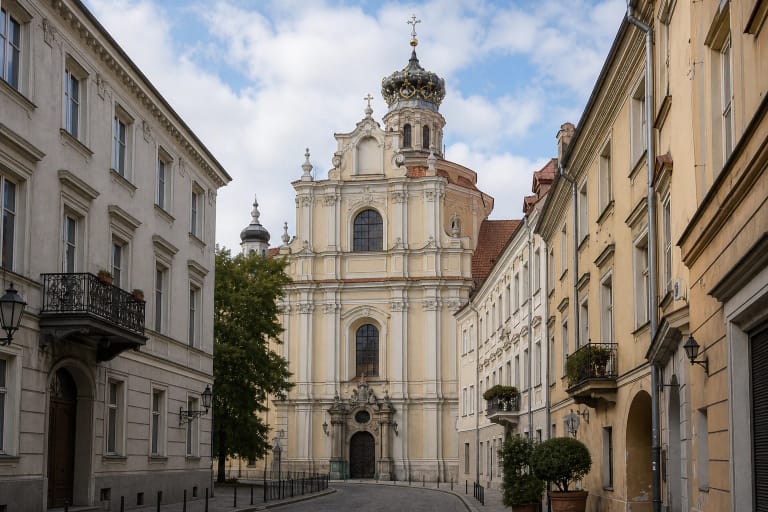
Lithuania's first towerless Baroque church
The parish's architectural study identifies All Saints as Lithuania's first towerless Baroque sacred building. It is a three-aisled basilica with a Latin-cross plan, two lateral chapels and a deep presbytery.
A five-stage late-Baroque bell tower was added beside the facade in 1743. It became an Old Town landmark, while the same campaign added a sacristy with the monastery library above it.
Chapels, altars, and Carmelite imagery
Two domed chapels flank the Latin-cross plan: the Prophet Elijah chapel on the left and Our Lady of Sorrows on the right. Carmelites regarded Elijah as a spiritual forerunner, so his place in the architecture reveals the identity of this particular order rather than generic Baroque decoration.
The high altar was built around 1787 to a design by Marcin Knackfus, while A. Schell made sculptural decoration for some of the altars. Renovation in 1902-1904 covered wall paintings in the aisles and chapel domes; today's interior should therefore be read alongside works lost, concealed, or returned after 1991.
Closures, museum use, and a revived parish
A parish was established here in 1810 and counted 12,250 members in 1830. The Carmelite institutions were later suppressed in the nineteenth century and much of their accumulated art was dispersed.
Soviet authorities closed the church in 1948 and used it as a goods warehouse. Following restoration in 1967-1975 it housed a folk-art display; the building returned to the faithful and was renewed in 1991.
What to notice and when to enter
Step back along Rūdninkų Street to see the restrained two-stage facade and far more elaborate bell tower together. Inside, notice the scale of the central nave, narrow side aisles, chapels and Carmelite imagery of the altars.
On 2026-07-22 the Archdiocese listed opening from 16:00 to 19:00 on weekdays and 08:30 to 14:00 on Saturdays and Sundays. Hours may change, so reconfirm officially and avoid sightseeing during worship.