- Genre
- Wonder tale
- Source status
- well attested
- Motifs
- serpent bridegroom, oath, sea palace, betrayal, bloody foam, transformation into trees
Eglė, Queen of Serpents, Eglė the Serpent Queen, Eglė, wife of the serpent
The tale
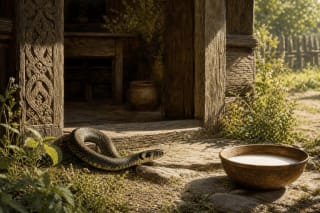
Eglė was bathing by the seashore with her sisters. When the girls came out onto the shore and wanted to dress, Eglė found a serpent in her shirt. The serpent spoke with a human voice and would not come out until the girl promised to marry him. Eglė gave the promise not out of love, but out of fear and the wish to get her garment back.
After some time, a host of serpents crawled to Eglė's parents' homestead. They had come to take the bride. The family tried to deceive them, sending animals or servants in Eglė's place, but the serpents recognized each trick. At last Eglė was sent away to the serpent.
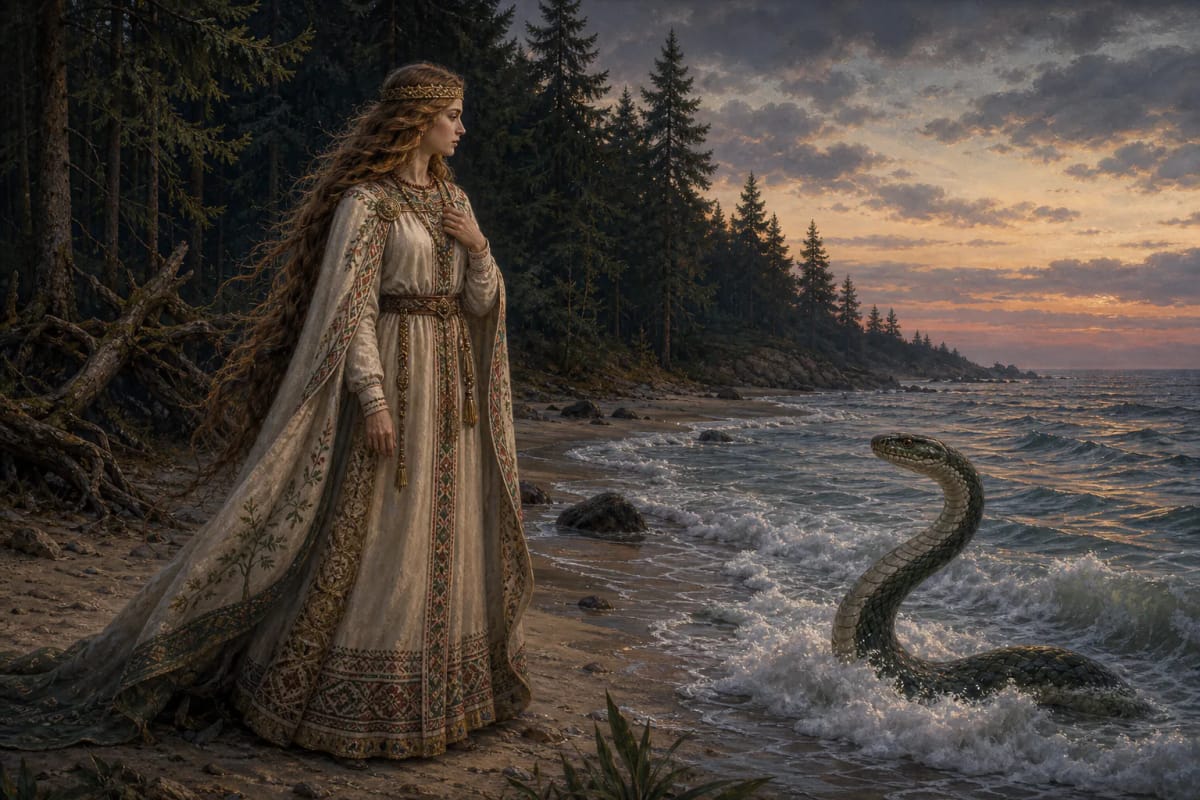
At the sea, Eglė saw that her bridegroom was no ordinary serpent. He became Žilvinas, ruler of the serpents, and led her to a palace beneath the water. There Eglė lived as a queen, bore children, and gradually grew accustomed to another world, where her promise had become a true fate.
After many years Eglė wished to visit her parents. Žilvinas agreed, but gave her difficult tasks: to complete a seemingly impossible spinning task, wear out iron clogs, and bake bread without the usual tools. An old woman helped Eglė, so she was able to return briefly to her native homestead.
At her parents' house, her brothers did not want Eglė to return to Žilvinas. They forced the children to reveal the call by which their father could be summoned at the seashore. Some children kept silent, but one revealed their father's call. The brothers went to the sea, called Žilvinas, and killed him.
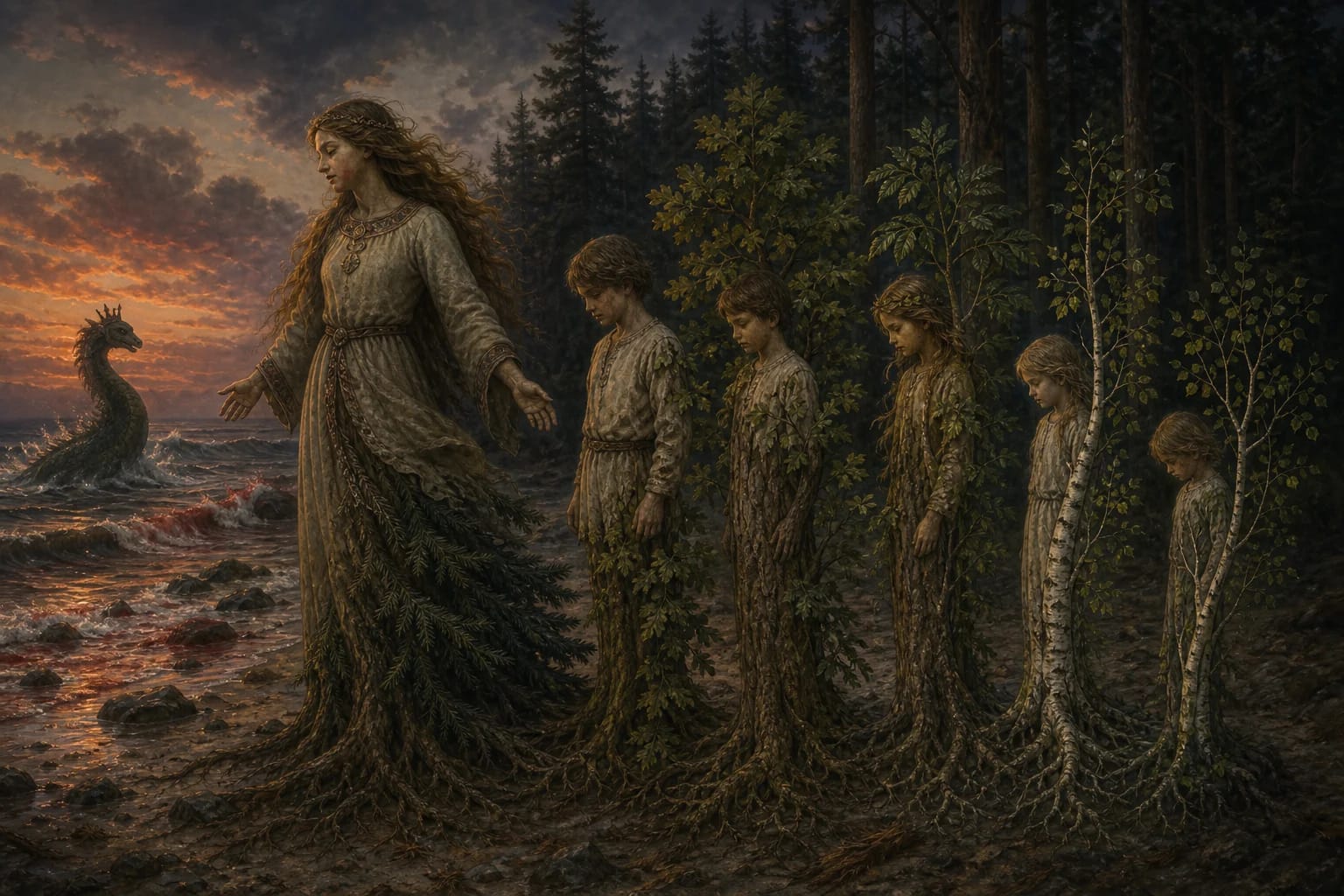
Eglė spoke the summoning words on the shore and waited for her husband. Instead of Žilvinas, bloody foam appeared on the waves. She understood that promise, marriage, and the boundary of family had been broken. The tale ends in curse and transformation: Eglė becomes a spruce, and her children become oak, ash, birch, and aspen. The aspen is often explained as the child who betrayed the father's call.
Interpretation: what does Eglė's tale mean?
The first layer of the tale is the promise. Eglė promises to marry the serpent under pressure rather than in full freedom, but in folklore the spoken word still has power. A promise here is not a polite phrase; it carries a person across a boundary from one kin group and one world into another.
The žaltys in Lithuanian tradition is not simply a symbol of evil. It can signify the household, life, the underworld, or nearness to water. Žilvinas therefore acts as a liminal husband: animal and human, stranger and spouse, danger and royal order.
Eglė's brothers defend the boundary of their kin, but their defense turns into betrayal. They refuse to recognize their sister's new life, so they destroy not an enemy but the center of her family. The ending is not a simple victory of good over evil; it is a tragic story about the incompatibility of different worlds.
The transformation into trees gives the tale an etiological tone, as if explaining tree names, qualities, and emotional weight. Oak, ash, and birch are associated with stronger children, while the trembling aspen is linked to fear, weakness, or the memory of guilt. Eglė as a tree remains an eternal mother and mourning queen.
For visitors, the key point is not to reduce Eglė to a pretty children's tale. It speaks about a coerced promise, a woman's departure from her birth family, the boundaries of marriage, brothers' violence, a child's betrayal, and irreversible loss. That is why the tale is still read as mythic, psychological, and social text.
History, variants, and recording
No exact date can be given for the creation of Eglė, Queen of Serpents. It is a work of oral tradition that lived in variants: storytellers changed details, formulas, the number of children, tasks, summoning words, and the emphasis of the ending. Eglė may be aided by an old woman or other helpers; the child who reveals the call may be portrayed as the youngest or weakest.
From a scholarly point of view, the key matter is not a single original version but the whole body of variants. Lituanistika and LLTI publications show that the Eglė plot has been collected, classified, and analyzed as one of the most vivid Lithuanian tale-myths. Researchers pay special attention to the formulas of summoning, exposing deception, and cursing.
In the international Aarne-Thompson-Uther tale-type system, Eglė's plot is assigned to ATU 425M, "The Serpent Bridegroom," a distinctive Baltic regional branch of the broader ATU 425 cycle, "The Search for the Lost Husband," which is also connected with the ancient story of Cupid and Psyche. Lithuanian narrative-folklore catalogues by Jonas Balys (1936) and Bronislava Kerbelytė (1999-2002), together with Leonardas Sauka's four-volume edition Pasaka "Eglė žalčių karalienė" (Vilnius, 2007-08), preserve more than a hundred Lithuanian variants of this tale, making it one of the most thoroughly studied Lithuanian folklore plots.
The tale also became a source for literature and stage works. It moved from oral tradition into books, school readers, poetry, drama, music, and visual culture. Because of this spread, many people know not one folk variant but a literary retelling of Eglė.
When this page says "Eglė, Queen of Serpents," it refers not to one recorded text but to a traditional plot. The retelling here is original and based on common motifs, not a verbatim copy of one publication.
Why Eglė matters in Lithuanian culture
Eglė joins several major themes of Lithuanian culture: the žaltys as mythological animal, the sea as a boundary of the otherworld, tree symbolism, family conflict, and irreversible transformation. For that reason it works as a bridge between tales, belief legends, mythology, and symbols.
The tale naturally connects with motifs of the žaltys, spruce, world tree, water boundary, and supernatural spouse, as well as with later literary and stage retellings.