- Place
- Druskininkai, Druskininkai Municipality
- Region
- Dzūkija
- Type
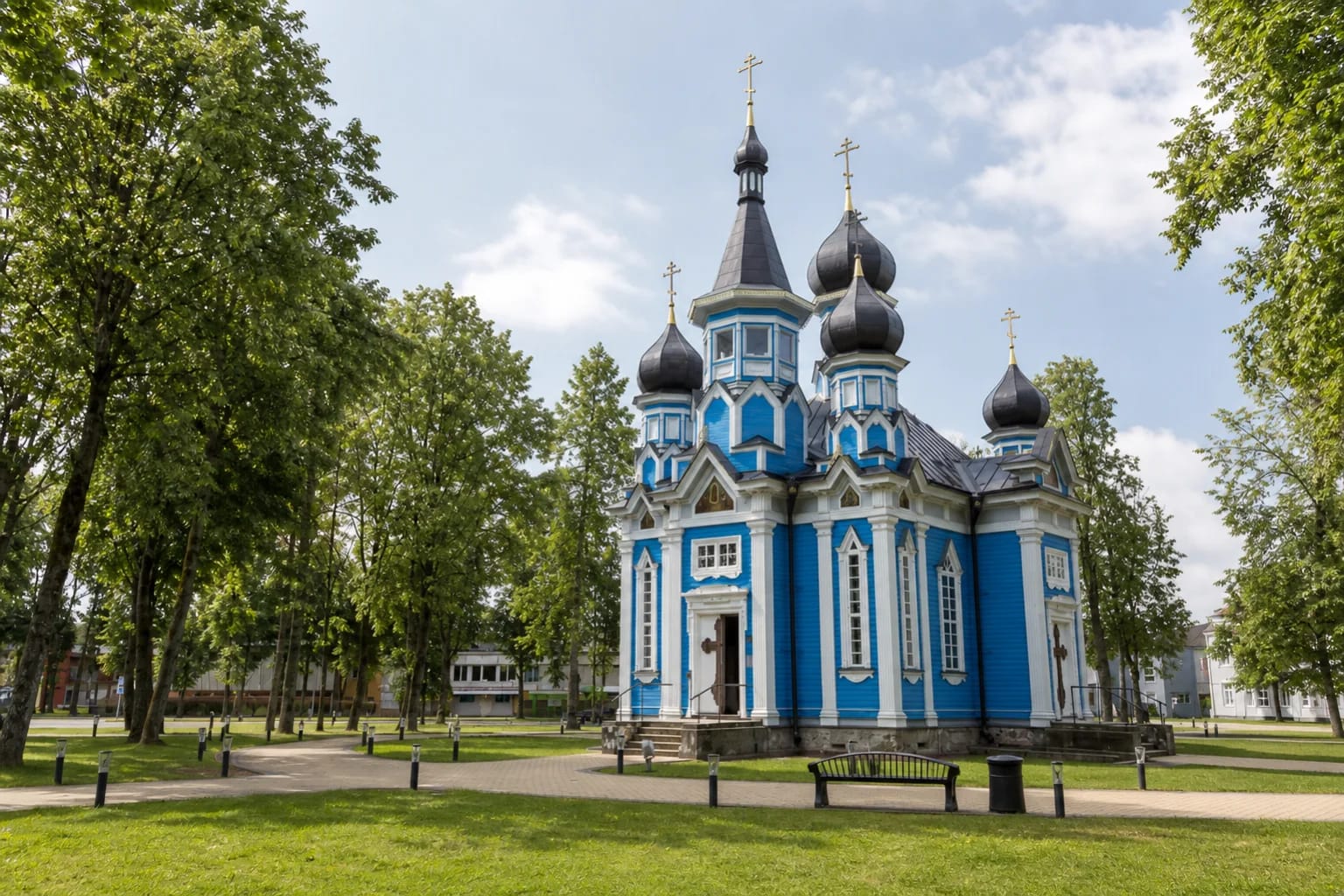
- active wooden Orthodox church built in 1861-1865, with a cross-shaped plan, six-dome silhouette, and three-tier iconostasis
- Address
- 2 Laisvės Square, Druskininkai
- Coordinates
- 54.02117, 23.97104
- Visit duration
- 20-35 minutes for the exterior and interior if the church is open; longer when attending a service
- Best time
- before a service confirmed by the parish or by prior arrangement; the exterior can be viewed in public space during daylight
Druskininkų Dievo Motinos ikonos „Visų liūdinčiųjų Džiaugsmas“ cerkvė, Druskininkų Džiaugsmo visiems liūdintiems stačiatikių cerkvė, Druskininkai Orthodox Church, Church of the Icon of the Mother of God Joy of All Who Sorrow, Храм иконы Божией Матери Всех скорбящих Радосте
The complete name distinguishes the blue church from two other Druskininkai sanctuaries
The full visitor-facing name is the Druskininkai Church of the Icon of the Mother of God “Joy of All Who Sorrow”. Lithuania's Cultural Property Register uses a shorter Lithuanian wording for the same building and assigns it unique code 30662. Both names identify the active blue wooden church in the resort centre.
Do not confuse it with the red-brick Roman Catholic Church of Our Lady of the Scapular on Vilniaus Avenue. A second Orthodox site, the Church of St Gabriel at Druskininkai's old cemetery, belongs to the same parish but stands elsewhere and is not part of this registered property.
The Register and AUTC give the address as 2 Laisvės Square, while the municipal events directory uses number 1. To prevent that discrepancy from sending visitors to an adjacent plot, coordinates 54.02117, 23.97104 were derived from Geoportal orthophotography, the building outline, and the documented facade orientation. They mark the western main portal, which has steps, and do not certify a step-free entrance.
A temporary prayer room in 1857 preceded the church consecrated in 1865
Druskininkai's first temporary Orthodox place of prayer opened in a private house in 1857 through the efforts of Grodno vice-governor Jakov Rozhnov. Liturgical furnishings came from the Cathedral of St Sophia in Grodno. This was the beginning of the present parish, not the building seen today.
Work on the current church began in 1861. Rozhnov contributed 10,000 silver roubles, and 600 roubles for the interior came from the Vilnius Governor-General's fund. AUTC identifies military engineer Major Marunich as the designer and supervisor. The completed church was consecrated on 29 June 1865.
The church served more than the permanent local Orthodox community. The expanding mineral-water resort attracted seasonal visitors from across the Russian Empire, and the new sanctuary answered that changing pattern of life. Its central location belongs to the resort's social history, but the building was created for worship rather than as a decorative tourist pavilion.
Wood imitates masonry forms, and every side presents a different silhouette
This is one of the oldest surviving examples of wooden architecture in Druskininkai. Log walls on stone-strip foundations are clad in horizontal boards. White pilasters, window surrounds, friezes, and cornices divide the intense blue elevations so that timber recreates the ordered appearance of nineteenth-century masonry churches. Russian Orthodox forms meet Romantic and Historicist detail.
The main facade faces west. Above its projecting porch rises a two-stage octagonal tower, while onion domes and gold crosses build the complex roofline. Similar portals appear on the north and south sides, and the altar section projects to the east. The 1865 date above the main doors records the building's completion and is not a modern decorative addition.
The church occupies a tree-filled diamond-shaped island around which five streets and the pedestrian Laisvės Avenue converge. This exposed site allows visitors to walk around the whole structure. The carriageway is not a church car park, however, and no authoritative parking capacity was found. Leave a vehicle only in a legal central Druskininkai space and keep every approach clear.
Sources separate the Moscow iconostasis from the icon attributed to Kutuzova
The interior's focal point is a three-tier wooden iconostasis, carved and gilded in Moscow; Moscow artists painted its icons in an academic manner. Images of the Apostle James and Great Martyr Barbara on either side commemorate benefactor Jakov Rozhnov and his wife Varvara. The iconostasis is a liturgical boundary, so visitors do not pass through its central doors.
A short Druskininkai tourism account says that Ekaterina Kutuzova, granddaughter of Field Marshal Mikhail Kutuzov, gave the iconostasis. More detailed AUTC research distinguishes two things: the Moscow-made iconostasis and a separate 1766 Vladimir Icon of the Mother of God attributed to Kutuzova. Sources also disagree over whether that icon disappeared around the First World War or after the Second World War. It should not be described as an original still visible here.
During the 1890s, an Orthodox brotherhood supported a girls' parish school beside the church, and sources also mention shelter and care for the sick. Accounts place the beginning around either 1890 or 1895, so the decade is safer than one exact year. A separate bell tower and its four bells have not survived; the bells disappeared during the First World War.
In 2026 this remains an active parish church, not an all-day museum
After a brief post-war closure, the parish was officially registered in 1947, and the building received repairs in later Soviet decades. A Lithuanian Orthodox Church report dated 9 July 2026 confirms that a Divine Liturgy was held here, while the official clergy list names Archpriest Vladimir Sinitsyn as rector. The building is therefore not a deconsecrated architectural exhibit.
An older official Druskininkai tourism article still lists services at 09:00 on weekdays and Saturdays and 10:00 on Sundays and feast days. That page does not say when the recurring timetable was last confirmed, and no permanent Druskininkai schedule was found on the Church website when checked on 19 July 2026. Before making a special trip, call the rector on +370 682 25386 to confirm the service time and whether a quiet interior visit will be possible.
No general tourist ticket or guaranteed daily visiting hours are published. Silence phones inside, request permission before photographing the interior outside services, and never photograph worshippers or walk in front of the iconostasis during a rite. Steps and handrails are visible at the western portal, but no dependable current account confirms another step-free entrance, an adapted toilet, or mobility assistance. Discuss particular access needs by phone.