- Type
- God
- Domain
- Thunder, lightning, storm, rain, heavenly fire, justice
- Source status
- well attested
Perkunas, Perkūnas Dievaitis, Percunos, Pargnus, Perkuns
Who is Perkūnas in Lithuanian mythology?
Perkūnas is the Lithuanian god of thunder, lightning, storms, and rain. He belongs to the strongest-attested layer of Baltic divinities: written sources, Lithuanian folklore, place names, language, and later ethnographic belief all preserve traces of him.
Unlike the distant Sky God, who often appears remote or passive in folklore, Perkūnas is active. He moves through the sky, thunders, throws lightning, pursues Velnias, punishes broken order, and brings the rain needed for harvest.
For that reason Perkūnas is not only a mythological explanation for weather. He embodies a heavenly force that cleanses, separates, judges, and restores the order of the world.
The name Perkūnas: what does it mean?
The name Perkūnas is associated with thunder, striking, and the oak. The Encyclopedia of Lithuania Minor notes explanations that connect the name with Latin quercus, meaning oak, and with Lithuanian perti, to beat or strike. Both directions fit the image well: Perkūnas strikes with lightning, and the oak is treated in tradition as his tree.
Older sources also preserve variants such as Percunos, Pargnus, and Perkuns. These are important not as separate gods, but as traces left by different languages, periods, and recorders of the same divine name.
How Perkūnas appears in folklore
In Lithuanian legends Perkūnas often appears in human form. Folklore scholar Nijolė Laurinkienė highlights an image of Perkūnas as an elderly but powerful man, sometimes called an old man, a red-bearded hunter, or a strong male figure. In some tales he may also appear as a young man.
This human form matters: Perkūnas is not just an abstract storm. He can speak with people, thank them for help, warn them, give miraculous powder or bullets, and still remain a dangerous heavenly force.
The power of Perkūnas: thunder, lightning, storm, and rain
Perkūnas' main domain is the atmosphere: thunder, lightning, storm, rain, wind, and tempest. Studies of old Baltic religion often treat him as a sky and storm god whose power is heard in thunder and seen in lightning.
His rain is not only a destructive force. In an agrarian culture, a storm may also signal fertility because rain awakens growth. Perkūnas therefore joins threat and blessing: he can strike, but he can also give the water life needs.
Perkūnas and Velnias: why does Perkūnas chase Velnias?
One of the strongest Perkūnas motifs is his struggle with Velnias. In Lithuanian tales, Velnias hides under a stone, inside a tree, in a hollow, in water, in an animal, or around human dwellings, while Perkūnas chases him and strikes with lightning. The motif explains why lightning hits trees, stones, or buildings.
Mythologically this is a clash between sky and underworld, dry fire and the damp chthonic realm. Gintaras Beresnevičius emphasizes that the Perkūnas-Velnias opposition remains vivid even in Christianized folklore: Perkūnas is not demonized, but stays close to divine order.
So the question 'why does Perkūnas strike Velnias?' has both a simple and a deeper answer. Simply, Velnias is his enemy. More deeply, Perkūnas destroys the hidden principle of chaos, deception, and the underworld so the world can become clean and fertile again.
Perkūnas, Dievas, and Perkūnas Dievaitis
Perkūnas' relationship with Dievas, God, is not described in one single way in folklore. In some narratives God takes Perkūnas into heaven and gives him the task of ruling the weather or hunting devils. In others Perkūnas is called Dievaitis, a word researchers have discussed as possibly meaning God's son or a heavenly being close to God.
These images show how Perkūnas was later fitted into a Christian worldview. He could be explained as God's servant, messenger, or a figure comparable to St. Elijah, but in folk imagination he remained independent and active.
Symbols of Perkūnas: oak, hill, stone, and fire
Perkūnas' symbols grow from his heavenly and striking power. The most important tree is the oak, associated with strength, height, long life, and the lightning strike. In discussions of sacred places, oaks are often mentioned among trees connected with Perkūnas.
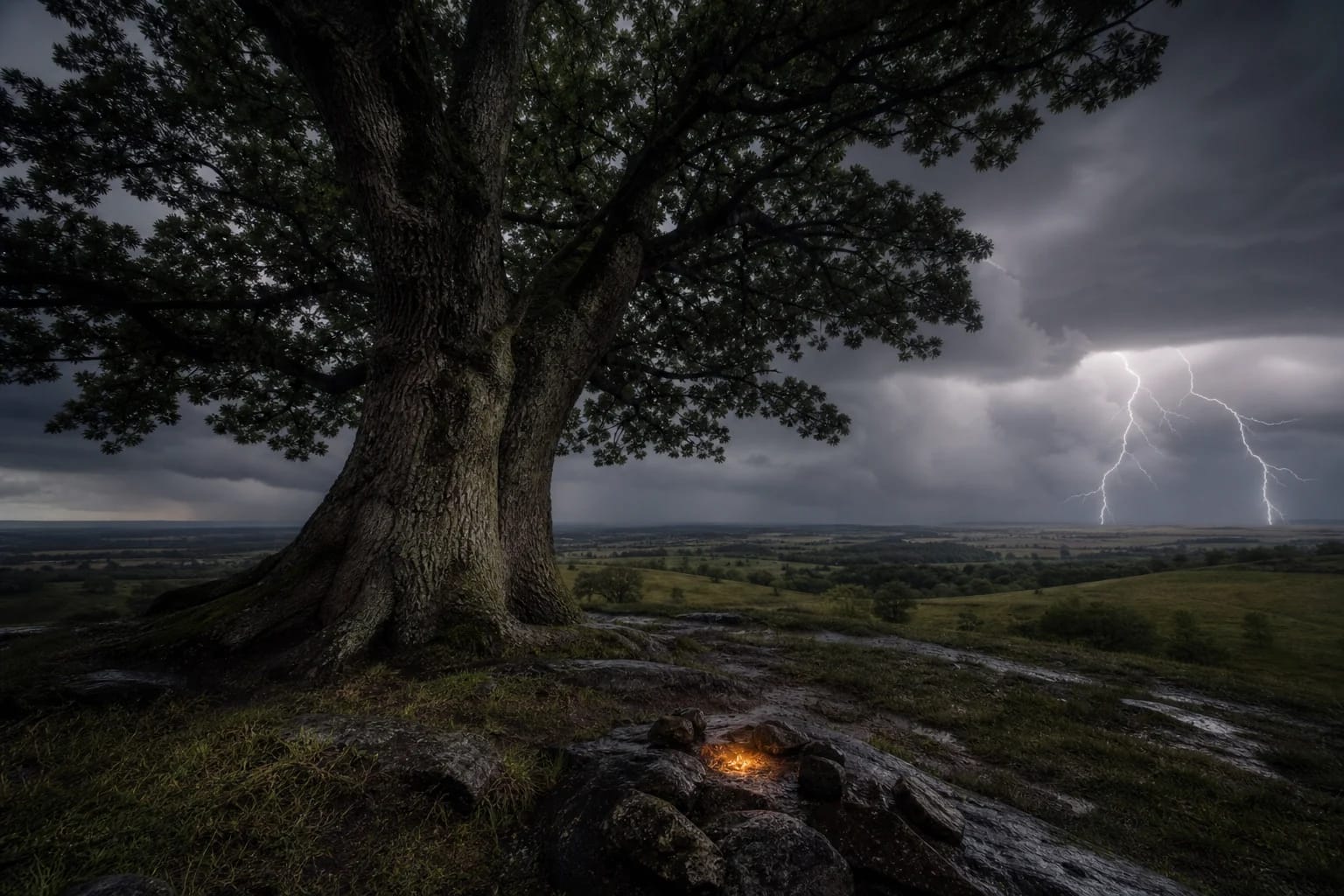
Another important sign is the hill. Storm gods in many Indo-European traditions are linked with high places, and Lithuanian place names preserve forms such as Perkūnkalnis, Perkūnas' hill. A hill is a border between earth and sky, so it naturally becomes a place where Perkūnas acts.
Stone and fire also belong to his field. Lightning was understood as heavenly fire, and thunder as a blow. This is why folklore and belief speak of Perkūnas' arrows, stones, axes, and fire.
Worship of Perkūnas and sacred places
Written sources connect Perkūnas with offerings, sacred fire, and important cult places. Lithuanian encyclopedic material on old religion notes that fire in the sources is most often connected with Perkūnas and that sacred fire was kept burning in sanctuaries.
The tradition of a Perkūnas temple in Vilnius is especially important. Reference sources mention the idea that Palanga may have been one of the key centers of Perkūnas worship and that a later cult center may have moved to Vilnius. They also preserve sources about a Perkūnas shrine once standing at the site of the present Vilnius Cathedral.
These accounts need cautious reading because old religion is reconstructed from different sources of uneven reliability. Still, Perkūnas' connection with sacred fire, sanctuaries, high places, and oaks is one of the firmest cores of his cultural image.
Perkūnas in Baltic and Indo-European mythology
Perkūnas is not an isolated Lithuanian figure. He belongs to a wider Baltic and Indo-European family of storm gods. In Latvia his close counterpart is Pērkons; in Slavic tradition the related figure is Perun; comparisons are often made with Thor in Germanic mythology and Indra in Vedic tradition.
These comparisons do not mean all of the gods are 'the same'. They show a shared mythic logic: the storm god rules lightning, fights an opponent, releases rain, maintains order, and is often connected with a hill, tree, stone, or weapon.
Perkūnas today: why the image still matters
Perkūnas matters both in cultural heritage and in contemporary Baltic religion. For example, Romuva’s 2019 activity report records six celebrations dedicated to him. Legends, storm prohibitions, oak symbolism, and place names reveal other aspects of his role in Lithuanian culture.
The figure also helps read wider Lithuanian culture. Songs, sutartinės, calendar festivals, and place names often use the same signs of sky, earth, fire, water, tree, and hill.