Lithuanian food heritage

Lithuanian traditional foods

Explore Lithuanian dishes through translated recipes, history, regional context, and food traditions.

Food pages as recipes and cultural history

Each page keeps the practical dish, ingredients, preparation, region, history, serving customs, and source context together, so a recipe does not lose its cultural setting.

Food guides

Recipes, serving traditions, ingredients, and food history in English.
Potato dishes

Potato dishes from cepelinai and kugelis to pancakes and regional combinations.

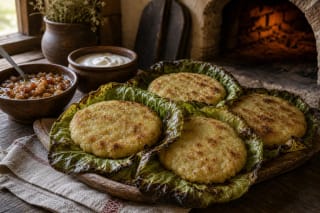
Dzūkija bulvinė banda baked on a cabbage leaf in a bread oven, with crackling sauce and sour cream
Potato dishesBulvinės bandos

Bulvinės bandos are a Dzūkija and Suvalkija dish: flat cakes shaped from grated-potato mass are baked on cabbage leaves in a bread oven. In the Lazdijai region, this is a certified living culinary heritage tradition.
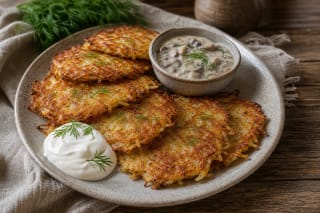
Crisp Lithuanian potato pancakes with sour cream, dill, and mushroom sauce
Potato dishesBulviniai blynai

Bulviniai blynai are an everyday Lithuanian grated-potato dish: thin pancakes are fried in a pan until the edges turn crisp and the center stays soft. They are served with sour cream, cracklings, mushroom sauce, or curd.
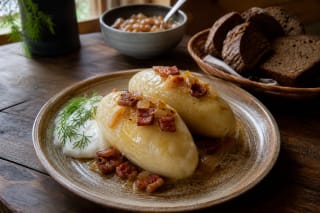
Cepelinai with crackling and onion sauce, sour cream, dill, and black rye bread on a wooden table
Potato dishesCepelinai

Cepelinai, also called didžkukuliai, are one of the most recognizable dishes of Lithuanian cuisine: large dumplings formed from grated and boiled potato mass, usually filled with meat, curd, or mushrooms and eaten with sour cream and crackling sauce.

A clay pot of kastinys with caraway seeds, hot potatoes in their skins, and a linen tablecloth
Dairy and potato dishesKastinys with potatoes

Kastinys with hot potatoes is one of the clearest combinations in Žemaitian dairy cooking. The cold, hand-stirred sour cream and butter product is eaten with steaming potatoes, which bring out its tart and buttery flavor.
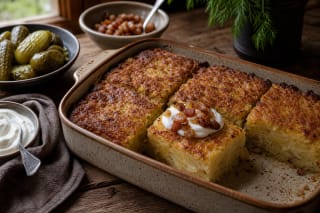
Kugelis or bulvių plokštainis cut into pieces with sour cream, cracklings, and fermented cucumbers
Potato dishesKugelis / bulvių plokštainis

Kugelis, often called bulvių plokštainis in Lithuanian, is an oven-baked grated potato dish with eggs, onions, hot milk, and cracklings. It is eaten with sour cream, crackling sauce, or fermented vegetables.
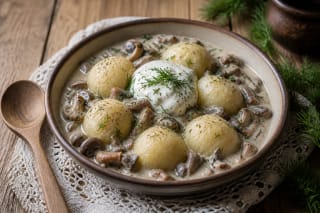
Lithuanian potato kukuliai with sour cream and mushroom sauce, herbs, and a wooden spoon
Dough and potato dishesKukuliai

Kukuliai is a broad Lithuanian kitchen term: it can mean potato, flour, meat, fish, curd cheese, or mushroom balls, boiled, braised, or baked and served with sauce or in soup.

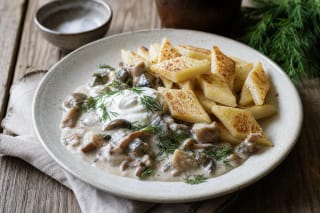
Dzūkija švilpikai with mushroom sauce, sour cream, dill, and browned potato pieces
Potato dishesŠvilpikai

Švilpikai are pieces shaped from boiled-potato dough and browned in the oven or a pan, often served with mushroom, crackling, or sour-cream sauce. They are especially associated with Dzūkija cuisine.
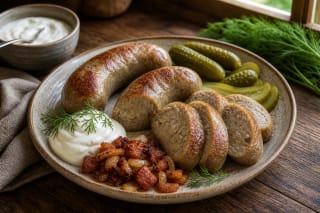
Baked Lithuanian potato vėdarai with a crisp crust, sour cream, cracklings, and pickled cucumbers
Potato and meat dishesVėdarai

Vėdarai are a traditional dish in which cleaned pig intestines are filled with grated potato mass or a blood and groat mixture, then baked until browned. In Lithuania, potato vėdarai with sour cream or cracklings are most widespread.
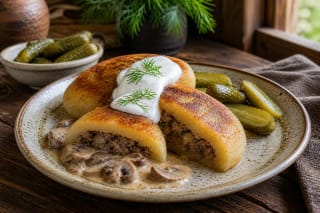
Žemaičių blynai with meat filling, sour cream, mushroom sauce, and dill on a ceramic plate
Potato dishesŽemaičių blynai

Žemaičių blynai are pan-fried pancakes shaped from boiled mashed potatoes and filled with meat, mushrooms, or curd cheese. They are associated with Samogitia, but today they are widespread throughout Lithuania as a filling home dish.
Soups

Warm and cold Lithuanian soups, including saltibarsciai.

Baravykienė with porcini, potatoes, sour cream, and dill, with dried porcini nearby
SoupsBaravykienė

Baravykienė is a porcini mushroom soup in which the main flavor should come from porcini: fresh or dried. It is close to mushroom soup, but narrower and more aromatic.
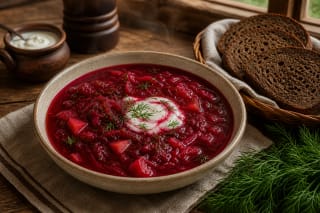
Hot Lithuanian barščiai with beets, cabbage, potatoes, sour cream, and dill
SoupsBarščiai

Barščiai is a hot beet soup, cooked in Lithuania with broth, potatoes, carrots, sometimes cabbage, mushrooms, or fermented beets. It differs from šaltibarščiai in both temperature and flavor.
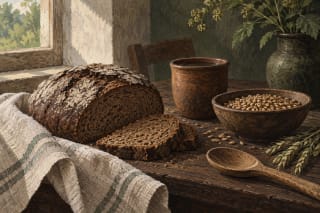
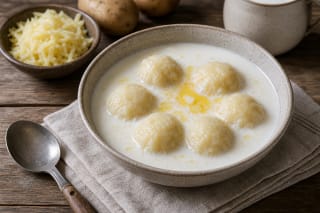
Potato dumpling soup in a clay bowl with sour cream, dill, and potatoes on a wooden table
SoupsBulvinių kukulių sriuba

Bulvinių kukulių sriuba combines two traits of Lithuanian cooking: potato dough and warm soup. The dumplings may be made from boiled or grated potatoes, and the soup is cooked in milk, water, or light broth.
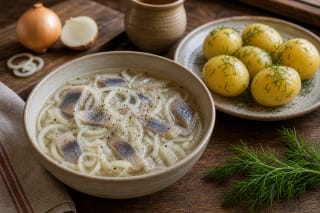
Dark juka soup in a clay bowl with groats, bay leaves, and rye bread nearby
SoupsJuka

Juka is an old blood soup associated with pig slaughter and the thrift of rural farm kitchens. It is a dish many people no longer make today, but it is important for understanding how traditional cooking used the whole animal.

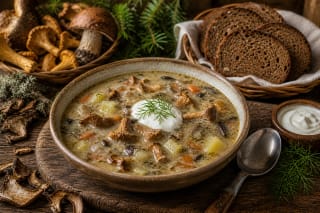
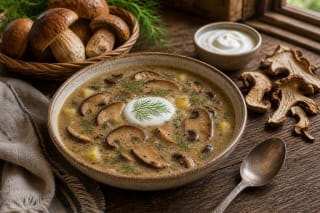
Lithuanian wild mushroom soup with potatoes, sour cream, dill, and dried mushrooms nearby
SoupsMushroom soup

Mushroom soup is a Lithuanian forest-kitchen dish made from fresh or dried mushrooms, potatoes, carrots, onions, and sometimes groats or noodles. Versions made with dried mushrooms are especially suited to winter and the Christmas Eve table.

Milk soup in a white bowl with groats, potatoes, butter, and fresh milk in a clay jug
SoupsPieniška sriuba

Pieniška sriuba in Lithuanian cuisine is a broad group of everyday dishes: groats, potatoes, vegetables, dough crumbs, or dumplings cooked in milk. It is a gentle, filling, and economical home food.

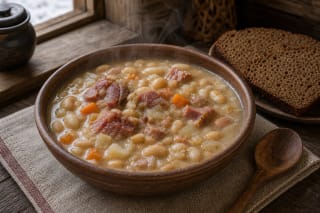
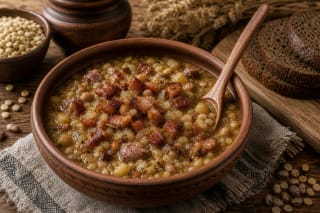
Thick white bean soup in a bowl with smoked pork, carrots, onions, and rye bread on a wooden table
SoupsPupelių sriuba

Pupelių sriuba is a thick winter soup made from soaked common beans (Phaseolus vulgaris), usually cooked with smoked pork or bones, onions, and root vegetables. It is a late 19th-20th century peasant-kitchen dish, because common beans are an American crop grown in Lithuania only from the 18th century.

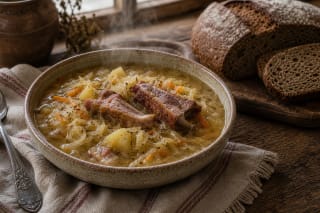
Lithuanian sauerkraut soup in a bowl with potatoes, smoked meat, carrots, and rye bread
SoupsRaugintų kopūstų sriuba

Raugintų kopūstų sriuba is a hearty Lithuanian winter soup made with sauerkraut, potatoes, carrots, onions, and often smoked pork. It relies on the acidity of preserved cabbage and long simmering, which softens the flavor.

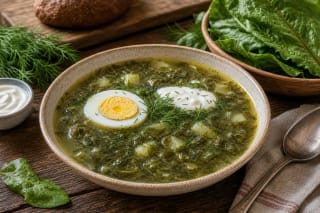
Lithuanian sorrel soup with potatoes, boiled egg, sour cream, and fresh herbs
SoupsRūgštynių sriuba

Rūgštynių sriuba is a spring and summer green soup made with sorrel, potatoes, carrots, and onion, often served with boiled egg and sour cream.

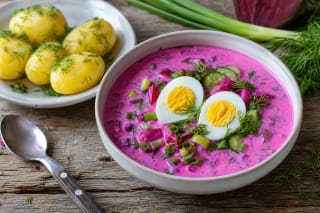
A bowl of Lithuanian šaltibarščiai with egg, cucumber, dill, and hot potatoes on the side
Cold soupsŠaltibarščiai

Šaltibarščiai is Lithuania's bright pink summer soup made with kefir, beets, cucumbers, dill, scallions, and boiled egg. It is served cold, usually with hot boiled potatoes on the side.

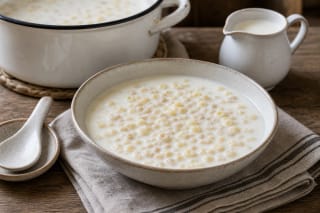
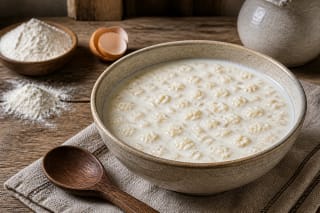
A bowl of zacirka milk soup with small flour crumbs, a wooden spoon, and flour on the table
SoupsZacirka

Zacirka is a simple soup with flour crumbs rubbed between the fingers or torn small. It is usually cooked in milk or water, so it belongs to a modest kitchen of quick and filling home foods.

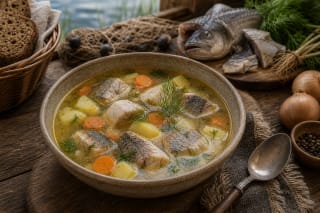
Lithuanian žuvienė with pieces of fish, potatoes, carrots, dill, and bread
SoupsŽuvienė

Žuvienė is a fisherman's fish soup cooked from fish heads, bones, fillets, potatoes, carrots, onions, and spices. In coastal, lake, and camp traditions, it is often cooked outdoors from several fish species.

Meat and fish

Smoked, boiled, dried, and festive meat or fish traditions.

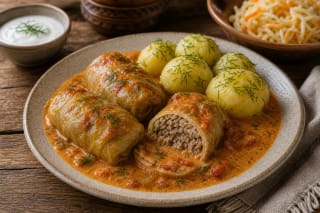
Lithuanian balandėliai in tomato and sour cream sauce with potatoes and dill
Meat and vegetable dishesBalandėliai

Balandėliai are cabbage leaves wrapped around ground meat with rice or groats and braised in tomato, sour cream, or broth-based sauce. They are shared across the region, but in Lithuania they are a very familiar family-lunch classic.

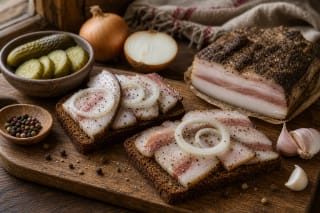
Lithuanian lašiniai in thin slices with rye bread, onions, garlic, and pepper
Meat productsLašiniai

Lašiniai are salted, smoked, or dried pork fat, or fatty bacon, traditionally eaten in thin slices with rye bread, onion, and garlic, or used for cracklings and other dishes.

Lithuanian sausages on a board with garlic, peppercorns, rye bread, and sauerkraut
Meat productsLietuviškos dešros

Lietuviškos dešros include fresh frying sausages, smoked sausages, blood sausages, and other stuffed meat products. Their base is pork, the balance of fat and lean meat, garlic, pepper, and a natural casing.

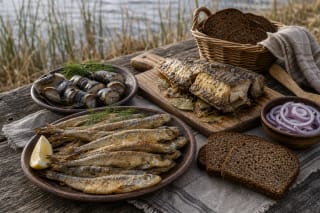
Pamarys fish dishes: fried smelt, cold-smoked eel, and fish baked on a board with rye bread and onions on a wooden table
Fish dishesPamario žuvies patiekalai

Pamario žuvies patiekalai are the cuisine of the Curonian Lagoon and coastal region, where the fishing catch - eel, smelt, flounder, and other lagoon and sea fish - is salted, smoked, fried, or marinated. Its best-known signs are cold-smoked Curonian Lagoon eels and fish baked on a board in the oven.

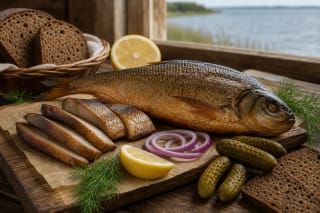
Smoked fish on a wooden board with rye bread, onions, lemon, and dill in a Lithuanian lagoon style
Fish dishesRūkyta žuvis

Rūkyta žuvis is a tradition of Lithuania's coast, lagoon, and lake regions: fish is salted or brined, dried, and smoked, often over alder smoke. It is eaten on its own, with bread or potatoes, or used in spreads and salads.

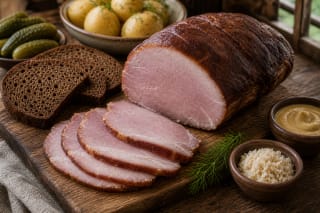
Sliced Lithuanian smoked ham on a wooden board with horseradish, mustard, rye bread, and pickles
Meat productsRūkytas kumpis

Rūkytas kumpis is a traditional preserved pork product: ham is salted, seasoned, dried, and smoked, then served in thin slices or warmed with potatoes, cabbage, horseradish, or mustard.

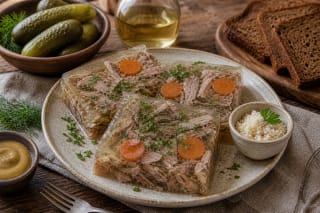
Lithuanian šaltiena with meat pieces, carrots, horseradish, vinegar, and rye bread
Meat dishesŠaltiena

Šaltiena is a Lithuanian meat aspic made from long-simmered meat and collagen-rich pork cuts that set without added gelatin. It is served cold with horseradish, vinegar, bread, or potatoes.

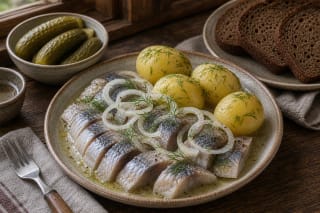
Herring with hot boiled potatoes, onions, dill, and oil on a Lithuanian table
Fish dishesSilkė su bulvėmis

Silkė su bulvėmis is a simple but very Lithuanian pairing: salted or marinated herring served with boiled potatoes, onions, oil, dill, and sometimes sour cream, egg, or pickles.

Sliced Lithuanian skilandis on a wooden board with rye bread, garlic, and pepper
Meat productsSkilandis

Skilandis is a traditional Lithuanian aged and smoked meat product made from coarsely cut pork, pieces of fat, and spices stuffed into a natural casing. The name Lietuviškas skilandis is protected as an EU traditional speciality guaranteed.

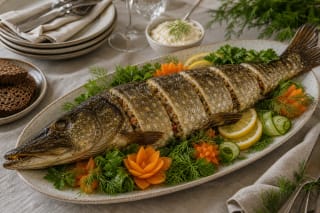
Festive stuffed pike on a platter with vegetables, lemon, herbs, and horseradish sauce
Fish dishesStuffed pike

Stuffed pike is a festive fish dish: the skin is carefully removed from the pike, the fish flesh is ground with additions, the stuffing is returned to the skin, and the fish is baked or braised. It is served warm or cold.

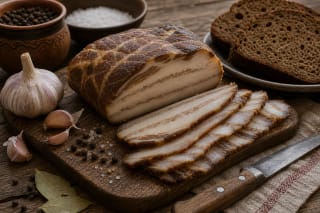
Thin slices of smoked užkulas with a caul-fat layer, garlic, pepper, and black rye bread on a wooden table
Meat productsUžkulas ir taukinė

Užkulas, elsewhere called taukinė, užtrinas, or įsnauja, is an old Lithuanian pork-fat product: belly fat seasoned with spices and garlic, wrapped in caul fat, pressed, and smoked, then used to flavor porridges, soups, and steamed potatoes.

Bread, grain, and groats

Rye bread and grain dishes at the base of the Lithuanian table.

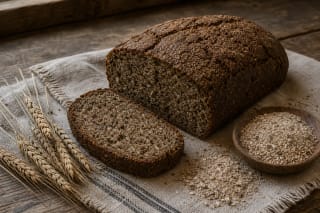
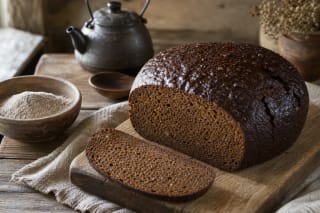
A dark coarse loaf of bėralinė rye bread with a slice and rye ears on a wooden table
Bread and grain dishesBėralinė duona

Bėralinė duona was the everyday rye bread of Lithuanian peasants in the serfdom era, baked from flour ground from unwinnowed grain with chaff (bėralas). It was greyer, rougher, and poorer than festive pure-rye bread and gradually disappeared from peasant life after the abolition of serfdom in 1861.

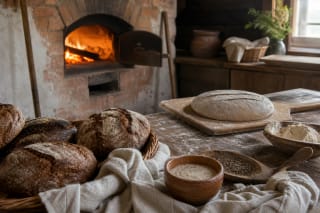
Lithuanian bread baking by a bread oven with rye loaves, sourdough, caraway, and a wooden peel
Bread and grain dishesDuonos kepimas

Duonos kepimas in Lithuania is not only kitchen work: rye sourdough, scald, bread oven, bread peel, and respect for the loaf connect everyday food with home, farming, and festive-table tradition.

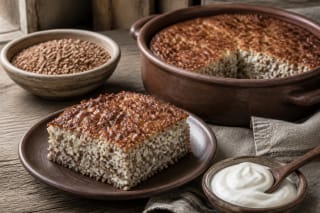
Grikinė boba in a clay dish with buckwheat groats, curd, sour cream, and slices on a wooden table
Grain and groat dishesGrikinė boba

Grikinė boba is a filling buckwheat-groat bake or casserole, most often associated with Dzūkija's buckwheat culture. It sits between porridge and cake: groats are bound with dairy, eggs, and baked until firm enough to slice.

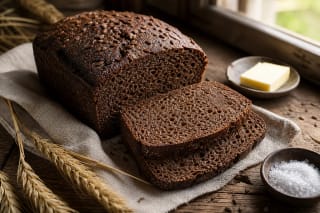
A loaf of Lithuanian black rye bread with a slice, caraway seeds, and rye ears on a wooden table
Bread and grain dishesJuoda ruginė duona

Juoda ruginė duona, Lithuanian black rye bread, is one of Lithuania's most important food symbols: fermented from rye flour, often scalded, flavored with caraway seeds, and eaten daily, on holidays, and with many traditional dishes.

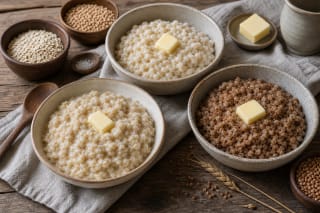
A bowl of Lithuanian groat porridge with butter, a wooden spoon, buckwheat, barley, and oats
Grain and groat dishesKošės

Košės, porridges, are one of the oldest and simplest forms of Lithuanian cooking: groats, flour, potatoes, or vegetables are boiled in water or milk, seasoned with butter, cracklings, or sour cream, or eaten more plainly during fasting.

A loaf of scalded rye bread with a moist dark crumb, caraway, malt, and rye flour
Bread and grain dishesPlikyta duona

Plikyta duona is a type of rye bread in which part of the flour is scalded with hot water. The scald gives a sweeter flavor, moister crumb, and richness that make this bread especially valued in Lithuania's home baking tradition.

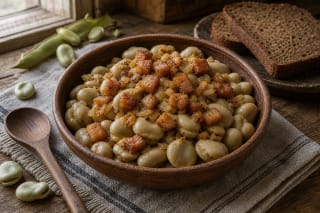
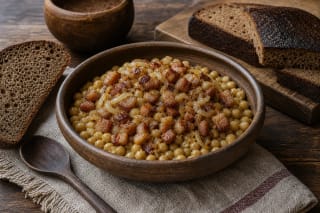
Boiled large-seeded fava beans with fried bacon cracklings and onions in a clay bowl on a wooden table
Groat and legume dishesPupos su spirgučiais

Pupos su spirgučiais are an old Lithuanian peasant food made from boiled large-seeded garden fava beans (Vicia faba), seasoned with a sauce of fried bacon cracklings and onions. Fava beans were grown in Lithuania already in the 10th-13th centuries, so they are much older than American common beans (Phaseolus).

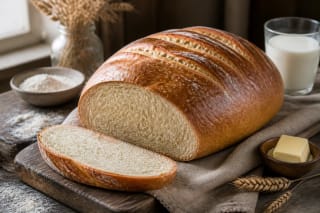
Lithuanian ragaišis on a linen tablecloth with a slice, butter, milk, and wheat flour
Bread and grain dishesRagaišis

Ragaišis is a softer, lighter, and often more festive baked good than everyday rye bread. In Lithuanian cuisine it is associated with wheat flour, milk, butter, family hospitality, and the rarity of white bread in the older village household.

Šiupinys with peas, beans, barley groats, pork, spirgai, and onions in a clay bowl
Grain and legume dishesŠiupinys

Šiupinys is an old, hearty mixed dish of peas, beans, grains, meat, or spirgai, often associated with Užgavėnės and Žemaitian cooking. Its texture is close to a thick porridge or stew.

Dough dishes and pancakes

Dumplings, pancakes, and other dough-based foods.

Small Lithuanian auselės with mushroom filling served in a bowl with butter, onions, and herbs
Dough dishesAuselės

In Lithuanian cooking, auselės is a variant name: it can refer to small ear-shaped dumplings with mushrooms or another filling, and in some places to thin sweet fried pastries close to žagarėliai. This page explains both uses and chooses mushroom auselės for the recipe.

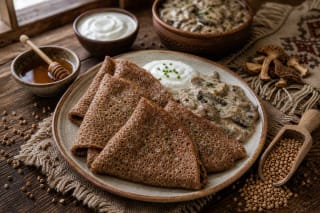
Buckwheat pancakes with sour cream, mushroom sauce, honey, and buckwheat groats on the table
PancakesGrikiniai blynai

Grikiniai blynai are pancakes fried from buckwheat flour or cooked buckwheat groats, especially naturally connected with Dzūkija's buckwheat tradition. They can be savory with mushrooms or sour cream, or sweeter with honey.

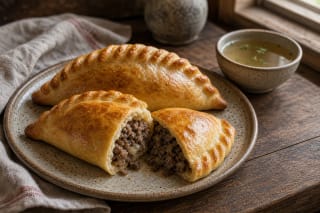
Karaim kibinai with a golden crust, chopped meat filling, and broth on the table
Dough dishesKibinai

Kibinai are Karaim pastries, in Lithuania most strongly associated with Trakai. Traditionally they are baked from rich shortcrust-style dough with chopped mutton or other meat and onion filling, keeping the inside juicy.

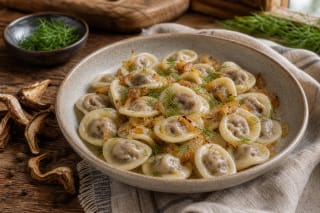
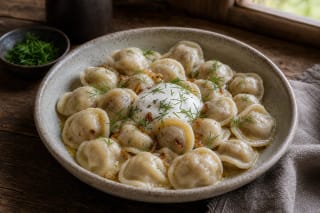
Lithuanian koldūnai with meat filling in a bowl, with butter, sour cream, herbs, and pepper
Dough dishesKoldūnai

Koldūnai are small filled dough dumplings, in Lithuania most often boiled with meat, mushroom, or curd cheese filling. They belong to the broader cuisine of the Grand Duchy of Lithuania and the region, and in Lithuania they are often also associated with Tatar culinary heritage.

Lithuanian lietiniai blynai with curd cheese filling, sour cream, berries, and folded thin pancakes
PancakesLietiniai blynai

Lietiniai blynai are thin Lithuanian pancakes made in a pan from a fluid batter of flour, eggs, and milk. They may be eaten plain or filled with curd cheese, meat, mushrooms, apples, jam, or other additions.

Sklindžiai with curd and apples, served with sour cream, jam, and powdered sugar
PancakesSklindžiai

Sklindžiai are small, thicker Lithuanian pancakes made from a denser batter and spooned into a pan. They may be flour-based, curd-based, apple, vegetable, or potato pancakes, sweet or savory.

Lithuanian skryliai with spirgai and onion sauce, sour cream, and herbs
Dough dishesSkryliai

Skryliai are simple boiled pieces of flour dough cut into diamonds, triangles, or other shapes. They are served with spirgai, onions, sour cream, butter, or curd sauce.

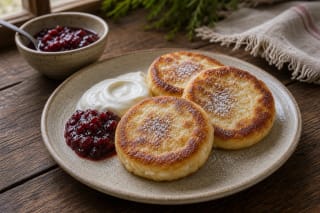
Lithuanian varškėčiai with sour cream, butter, berries, and sugar on a ceramic plate
Dairy and dough dishesVarškėčiai

Varškėčiai are boiled, fried, or oven-baked dishes made from curd cheese, egg, and flour or semolina. They may be sweet or savory and are served with sour cream, butter, berries, or jam.

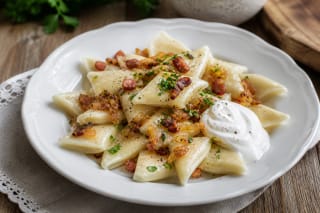
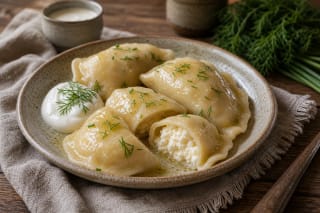
Lithuanian virtiniai with curd-cheese filling, melted butter, sour cream, and herbs
Dough dishesVirtiniai

Virtiniai are Lithuanian boiled dough dishes with curd cheese, potato, mushroom, meat, or berry fillings. They are close to koldūnai, but are often larger, softer, and more strongly associated with home cooking.

Dairy foods

Curd cheese, kastinys, sour cream, and other dairy foods.

Thick sour cream in a white bowl with a wooden spoon, dill, and boiled potatoes
Dairy productsGrietinė

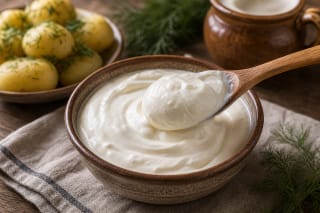
Grietinė in Lithuanian cooking is not only something added to soup. It connects dairy sauces, potato dishes, pancakes, curd, and the Žemaitijan kastinys tradition.

Žemaitiškas kastinys in a clay bowl with caraway seeds, garlic, dill, and hot potatoes
Dairy productsKastinys

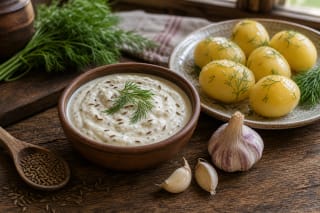
Kastinys is a dairy product characteristic of Žemaitija, hand-stirred from sour cream, butter, and soured milk products, flavored with caraway seeds, garlic, or herbs, and most often eaten with hot potatoes.

Pasukos in a clay jug beside churned butter and hot boiled potatoes on a linen-covered table
Dairy productsPasukos

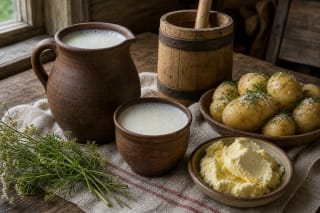
Pasukos are the dairy by-product left after butter is churned from cream: a lean, biologically valuable, lightly sour liquid that in Lithuania was drunk, used to whiten potatoes and soups, and made into a curd called bužė.

Thick Lithuanian rūgpienis in a clay bowl with boiled potatoes, rye bread, and a linen tablecloth
Dairy productsRūgpienis

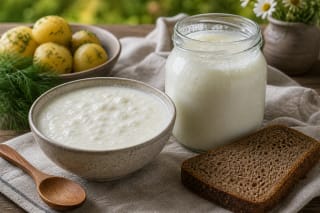
Rūgpienis is one of the simplest and most important products in Lithuanian dairy cooking: soured milk eaten with potatoes, porridges, and bread, and used for šaltibarščiai, curd, and cheeses.

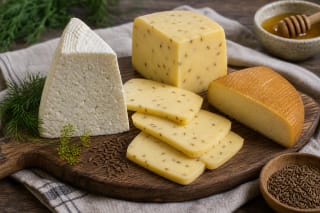
Lithuanian curd cheese with caraway seeds on linen, with honey, a knife, and a milk jug nearby
Dairy productsSūriai

Lithuanian sūriai include homemade curd cheese, caraway-flavored or dried cheese, and a separate tradition of aged rennet cheeses. The cheese bag, whey, and pressing are key signs of home cheese making.

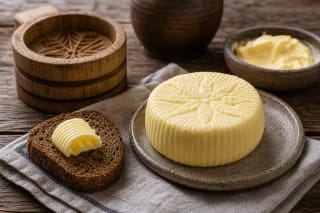
A piece of fresh butter on a wooden board with a butter churn, a cup of buttermilk, and rye bread
Dairy productsSviestas

Sviestas, butter in Lithuanian cooking, connects dairy farming with bread, porridges, potatoes, baked goods, and kastinys. Traditionally it was churned from sour cream or cream, then salted or clarified for longer storage.

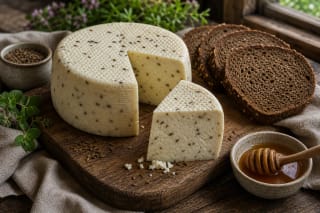
Lithuanian varškės sūris with caraway on a board, with bread, honey, and herbs nearby
Dairy productsVarškės sūris

Varškės sūris is one of Lithuania's most recognizable dairy products: cheese formed from curdled milk or curd cheese, pressed, and often flavored with caraway, eaten fresh, dried, fried, or marinated.

Vegetables and mushrooms

Fermented vegetables, mushrooms, and vegetable dishes.

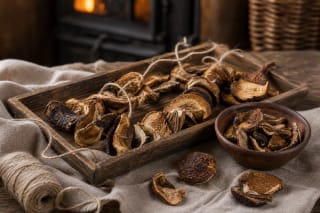
Porcini drying on a string near a stove, a jar of dried mushrooms, and a wooden shelf
Mushroom dishesDžiovinti grybai

Džiovinti grybai carry the forest season into winter. Porcini especially become a strongly aromatic base for soups, sauces, dumpling fillings, and Christmas Eve dishes after drying.

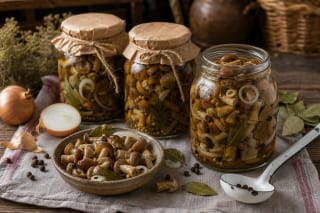
Jars of pickled wild mushrooms with bay leaves, peppercorns, and rye bread
Mushroom dishesMarinuoti grybai

Marinuoti grybai are a Lithuanian winter-table appetizer: pre-boiled wild mushrooms are covered with a sour spiced marinade and kept in jars. They suit the cold table, potatoes, herring, and Kūčios dishes.

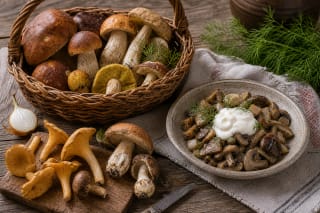
A basket of Lithuanian wild mushrooms, a pan with onions, boiled potatoes, and a rustic table
Mushroom dishesMushrooms in Lithuanian cuisine

In Lithuanian cuisine, mushrooms are both food and forest culture: they are gathered, dried, pickled, cooked in soups, fried with onions, used in dumplings, and especially strongly associated with the forests of Dzūkija.

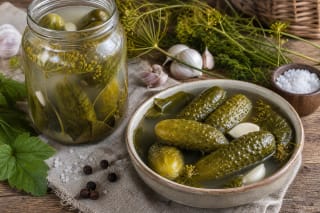
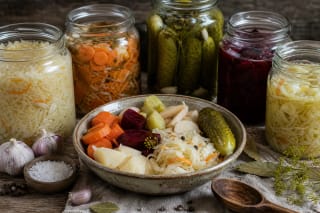
Jars of fermented cucumbers with dill umbels, garlic, horseradish leaves, and brine
Fermented vegetablesRauginti agurkai

Rauginti agurkai are cucumbers kept in salt brine with dill, garlic, horseradish or other leaves while lactic fermentation takes place. They differ from vinegar-pickled cucumbers because the acidity develops through fermentation rather than added vinegar.

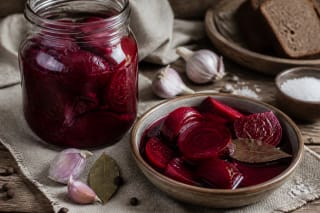
Fermented beets in a glass jar with dark red rasalas, a slice of rye bread, garlic, and a wooden spoon
Fermented vegetablesRauginti burokėliai

Rauginti burokėliai and their rasalas are an old way to keep beets and obtain a sour base for beet soup, šaltibarščiai, or salads. The acidity develops during fermentation, so cleanliness, salt, and proper storage matter.

Assorted vegetables fermenting for winter with cabbage, carrots, beets, and cucumbers in clay vessels, with caraway and cranberries nearby
Fermented vegetablesRaugintos daržovės žiemai

Raugintos daržovės žiemai are one of the most important Lithuanian ways to prepare stores: cabbage, cucumbers, beets, and other vegetables are fermented with salt and spices and kept cool so winter meals have acidity, crunch, and vitamins.

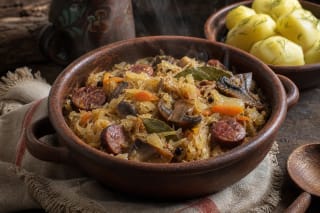
Braised sauerkraut with carrots, onions, mushrooms, and smoked sausage in a clay dish
Vegetable dishesTroškinti rauginti kopūstai

Troškinti rauginti kopūstai is a winter dish or side in which sauerkraut is slowly braised with onions, carrots, spices, mushrooms, or smoked meat. It pairs with sausages, ham, potatoes, and meatless Kūčios dishes.

Sweets and bakes

Sakotis, cakes, pastries, and festive desserts.

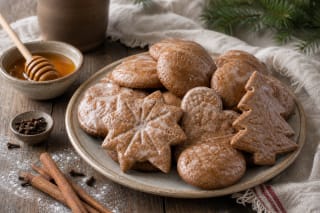
Decorated Lithuanian meduoliai with white icing, cinnamon sticks, and honey
Sweet baked goodsMeduoliai

Meduoliai are spiced baked goods made with honey or syrup, cinnamon, cloves, ginger, and other spices. In Lithuania they are associated with holidays, fairs, and decorated shaped pastries.

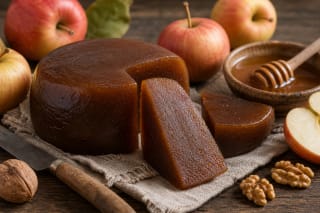
Amber slices of obuolių sūris on a linen cloth with apples, cinnamon, and walnuts
Sweets and fruit preservesObuolių sūris

Obuolių sūris is not dairy cheese: it is a sweet made from long-cooked apples, sugar, and spices, then pressed and dried. It preserves the autumn apple harvest and is sliced like a festive treat.

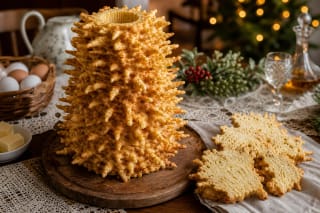
Lithuanian šakotis on a festive table with visible branches, sliced pieces, and eggs for the batter
Festive baked goodsŠakotis

Šakotis is a festive Lithuanian cake traditionally baked by pouring egg- and butter-rich batter onto a rotating spit near heat. Its branches and layers have become a sign of weddings, anniversaries, and large family celebrations.

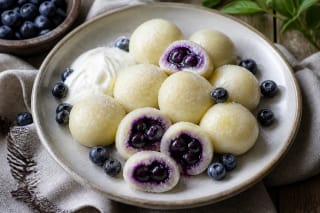
Šaltnosiai with blueberry filling, sour cream, berries, and sugar on a ceramic plate
Sweet dough dishesŠaltnosiai

Šaltnosiai, more often also written as šaltanosiai, are sweet Lithuanian dumplings with blueberries or other berries. They are boiled as small sealed dough pieces and served with sour cream, butter, sugar, or berry sauce.

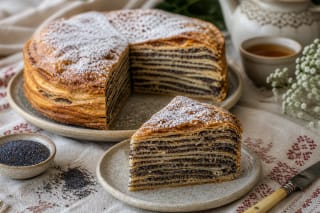
Cut šimtalapis with many buttery layers, poppy seed filling, and raisins on a wooden table
Festive baked goodsŠimtalapis

Šimtalapis is a pastry of Lithuanian Tatar gastronomy that has become a widely recognized festive dessert in Lithuania. Thin dough layers are generously brushed with butter, sprinkled with poppy seeds and raisins, and reveal many layers when sliced.

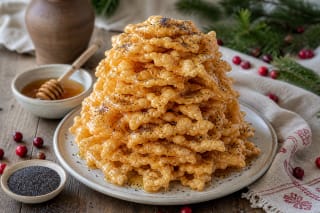
Tall skruzdėlynas tower of golden dough sheets with honey syrup, poppy seeds, and nuts
Festive dessertsSkruzdėlynas

Skruzdėlynas is an impressive Lithuanian festive dessert made from thinly rolled dough sheets fried in oil, stacked into a tower, and drizzled with honey syrup. Its success depends on crispness and syrup balance.

Fresh curd spurgos in a bowl with powdered sugar, one broken open to show the fluffy inside
Sweet dough dishesSpurgos

Spurgos in Lithuania are most familiar as curd spurgos or yeast spurgos. They are rich fried pastries suited to winter holidays, the Užgavėnės table, and home desserts.

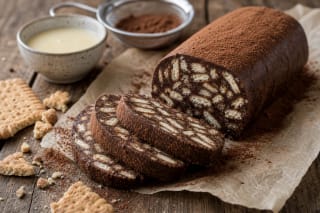
Slices of tinginys with visible biscuit pieces, cocoa, and a cup of coffee
Sweets and dessertsTinginys

Tinginys is a modern Lithuanian home dessert: broken biscuits are mixed with a cocoa, butter, and condensed-milk mixture, shaped, and chilled. Its strength is simplicity, not an ancient ritual.

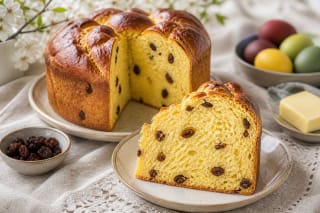
A tall Easter cake with white glaze, raisins, and margučiai on a festive table
Festive baked goodsVelykų pyragas

Velykų pyragas is not one strict recipe, but a sweet bake enriched with butter and eggs, placed on the festive Easter table alongside margučiai, meat dishes, and horseradish.

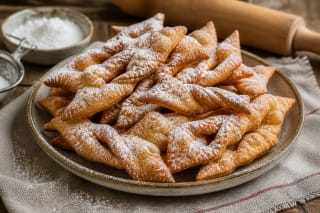
A plate of crisp žagarėliai with powdered sugar on a floured wooden table
Sweet dough dishesŽagarėliai

Žagarėliai are thin, twisted dough treats fried in oil and dusted with powdered sugar. They suit the festive home table, especially in the context of rich winter and pre-Lenten fried pastries.

Festival foods

Christmas Eve, Easter, and other holiday-table foods.

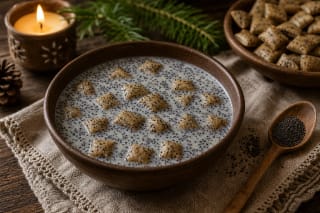
Aguonpienis in a clay bowl with kūčiukai, poppy seeds, and warm Christmas Eve table light
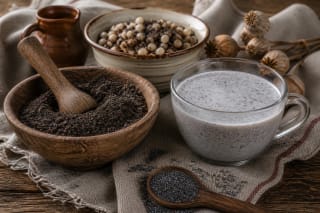
Christmas Eve dishesAguonpienis

Aguonpienis is a white, sweet drink or cold soup made from soaked and crushed poppy seeds, traditionally served at Kūčios with kūčiukai.

Žemaitijan cibulynė with herring, onions, pepper, and hot potatoes on the side
Regional dishesCibulynė

Cibulynė is a cold Žemaitijan dish made from onions, herring, water, vinegar or herring brine, and pepper, most often eaten with hot potatoes. It is a sharp, sour, and salty regional food.
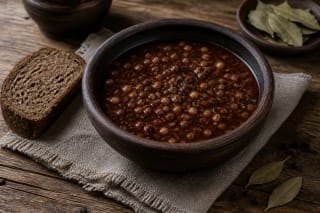
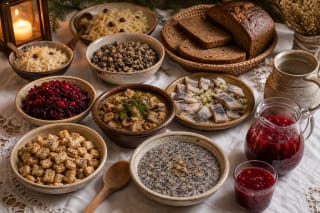
A white-clothed Kūčios table with herring, kūčiukai, poppy milk, cranberry kisielius, mushrooms, and a candle
Kūčios dishesKūčių vakarienės patiekalai

Kūčių vakarienės patiekalai, the dishes of the Lithuanian Christmas Eve dinner, form a quiet fasting table without meat or dairy: herring, mushrooms, beans, peas, fermented vegetables, kūčiukai, poppy milk, and cranberry kisielius. Twelve dishes work as a customary sign of fullness.

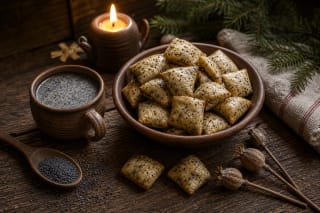
Kūčiukai with poppy seeds in a bowl beside poppy milk and a Kūčios table candle
Kūčios dishesKūčiukai

Kūčiukai are small poppy-seed baked pieces inseparable from the Lithuanian Christmas Eve dinner. They are eaten on their own or soaked in poppy milk, and in different regions they may be called šližikai, prėskučiai, or other names.
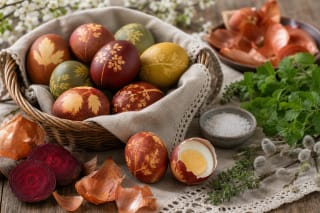
Wax-decorated and scraped margučiai on an Easter plate with salt, horseradish, and a linen napkin
Easter dishesMargučiai as an edible Easter symbol

Margučiai are not only folk-art objects but also edible symbols of the Easter table. Boiled eggs are decorated, given as gifts, tapped, rolled, and eaten during the festive breakfast with salt, horseradish, or other Easter dishes.
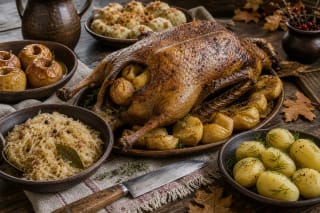
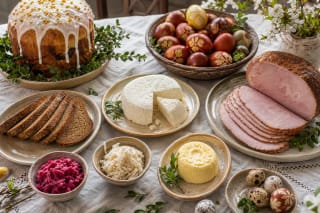
A spring Easter table with margučiai, ham, šaltiena, horseradish, and yeasted cake
Easter dishesVelykų stalo patiekalai

Velykų stalo patiekalai mark the end of Lent and the spring holiday: margučiai are eaten first, with šaltiena, ham, sausages, horseradish, salads, and sweet cake placed beside them.

A wedding feast table with a tall šakotis in the center, karvojus, linen napkins, and traditional snacks
Festive dishesVestuvių vaišės ir šakotis

Wedding feasts in Lithuania connect the communal table, karvojus, homemade cakes, beer, and šakotis. Šakotis is especially recognizable as a tall, layered festive cake that has become a center of the wedding table.
Drinks

Gira, mead, beer, and other traditional Lithuanian drinks.

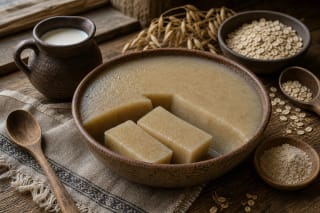
Pale set oat kisielius in a bowl, cut into pieces with a pitcher of milk nearby on a wooden table
Drinks and dessertsAvižinis kisielius

Avižinis kisielius is Lithuania's oldest kisielius: a sour, unsweetened dish made from oat flour fermented for two to three days. Until the early 20th century it was a common peasant fasting and Christmas Eve food, the opposite of the later sweet berry kisielius.

A clay cup of dark acorn coffee with roasted oak acorns, a wooden spoon, and autumn oak leaves
DrinksGilių kava

Gilių kava is a coffee substitute made from oak acorns that are soaked, dried, roasted, and ground. It has no caffeine, but it has a roasted, nutty, gently bitter flavor.
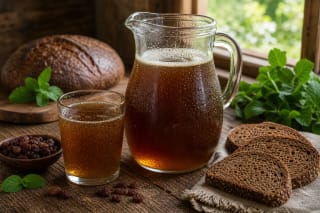
Lithuanian bread gira in a glass pitcher with rye bread slices, raisins, and mint
DrinksGira

Gira is a traditional lightly fermented drink, in Lithuania most often made from rye bread, sugar or honey, water, and yeast or natural fermentation. It is refreshing, lightly sour, and usually very low in alcohol.

Malt loaves baking in a rustic oven, with a wooden tub, hops, and a glass of dark beer nearby
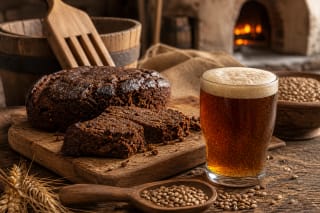
DrinksKeptinis alus

Keptinis alus is a rare branch of Lithuanian brewing associated with the Jūžintai area: barley malt mass is shaped into loaves, baked in an oven, then used to prepare wort and ferment beer.

Amber krupnikas in a small glass with honey, cinnamon, cloves, and orange peel
DrinksKrupnikas

Krupnikas is a honey and spice liqueur associated with Lithuanian and Polish noble and later drink traditions. It differs from midus: krupnikas is a strong liqueur, while midus is a fermented honey drink.
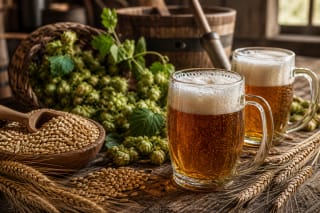
Traditional Lithuanian beer in a clay jug with hops, barley malt, and a slice of rye bread
DrinksLietuviškas alus

Lietuviškas alus covers home-brewed, farmhouse, and industrial layers of beer, but the traditional core is barley malt, water, hops, yeast, wort, and the brewer's knowledge. Northern Lithuania is especially associated with a living brewing tradition.

A glass of pale midus beside honeycomb, a wax candle, herbs, and a small oak barrel
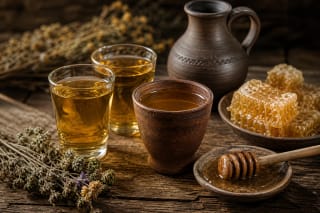
DrinksMidus

Midus is a naturally fermented honey drink with old historical memory in Lithuania and a modern protected-geographical-indication context in Stakliškės. It should be distinguished from krupnikas and other strong honey drinks.
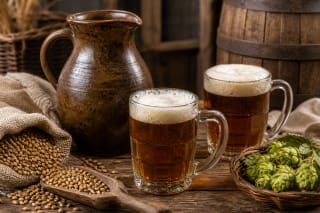
A home brewer's table with an enamel pot, malt, hops, jars, and a foaming glass of home-brewed beer
DrinksNaminis alus

Naminis alus in Lithuania is especially associated with the brewing tradition of the Biržai and Kupiškis areas. It is not only a recipe, but family and community knowledge about malt, wort, hops, fermentation, and the occasion for hosting.
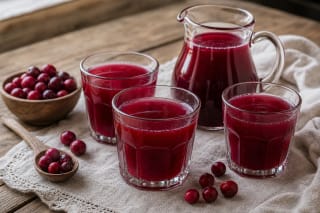
Clear red cranberry kisielius in a glass pitcher and glasses with cranberries and kūčiukai
Drinks and dessertsSpanguolių kisielius

Spanguolių kisielius is a bright red, tart Lithuanian Kūčios and winter-table drink or dessert. It is made from cranberry juice and thickened with starch, so it can be thinner for drinking or thick enough to eat with a spoon.

A spring birch tree with a wooden spout, clear sula in a jar, and green forest moss
DrinksSula

Sula is birch or maple sap collected in spring, drunk fresh, fermented, or preserved. It marks the change of seasons and requires responsible treatment of the tree.

Homemade herbal and berry trauktinė in a glass vessel with oregano, calamus roots, and berries on a wooden table
DrinksTrauktinės

Trauktinės are strong, aromatic alcoholic drinks with a bitter edge, made by pouring spirit or vodka over herbs, roots, seeds, and berries and letting them steep. This is a broader category than one specific liqueur: from homemade herbal infusions to industrial Lithuanian trauktinės.

Dried chamomile, linden blossoms, thyme, and raspberry twigs on a wooden table with a glass of herbal tea
DrinksŽolelių arbatos

Žolelių arbatos in Lithuania are made from local flowers, leaves, twigs, and fruits: chamomile, linden blossom, thyme, raspberry twigs, and wild strawberry leaves. They should be presented as food and folk-tradition drinks, not as a promise of treatment.

Seasonings and sides

Sauces, seeds, condiments, spices, and snacks.

Other foods

Other Lithuanian dishes and regional recipes.