- Place
- Vilnius City Municipality
- Region
- Vilnius
- Type
- active Orthodox cathedral with surviving Gothic fabric
- Address
- Maironio g. 14, Vilnius
- Coordinates
- 54.68117, 25.29233
- Visit duration
- 20-45 minutes; longer during a service or for a detailed architectural visit
- Best time
- in daylight outside service times, after checking whether the cathedral is open
Orthodox Cathedral of the Dormition, Uspensky Cathedral Vilnius, Cathedral of the Theotokos
One of Vilnius's oldest Orthodox sanctuaries
The first church on this site is associated with Maria of Vitebsk, the first wife of Grand Duke Algirdas. It became a metropolitan cathedral in 1414. The present building retains many historical periods, so its white nineteenth-century exterior alone cannot tell the whole story.
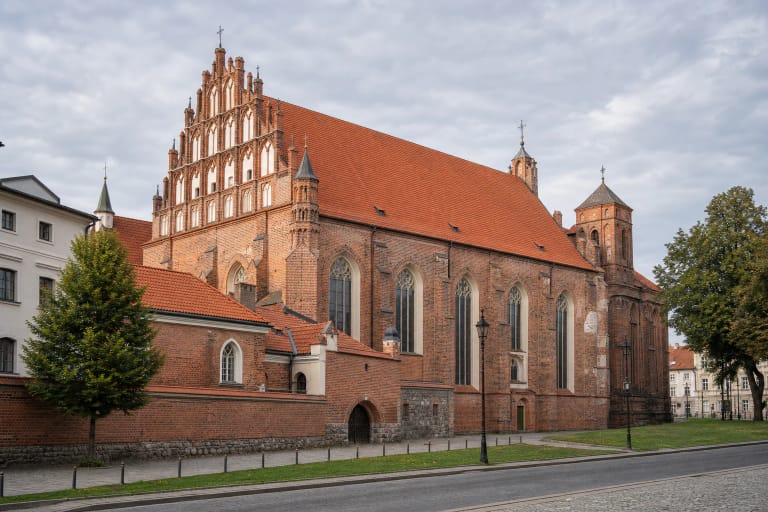
Between 1511 and 1522, Grand Hetman Konstanty Ostrogski substantially rebuilt the cathedral in Gothic forms. Important Orthodox and court figures were buried in its crypts, among them Elena, wife of Grand Duke Alexander, who died in 1513.
From a Uniate sanctuary to a university anatomy theatre
The cathedral passed to the Uniates in 1609. Rebuilt in Baroque forms after the fire of 1748, it was damaged again in the uprising of 1794. In 1808, Emperor Alexander I gave the building to Vilnius University. Architect Michał Szulc adapted it as an anatomy theatre, classrooms, library, and laboratories.
After the university closed, the building served as barracks, arsenal, archive, and even a forge. This succession explains why architectural investigation has found evidence of more than religious history. It is a rare place where the histories of science, imperial administration, and several confessions meet in one structure.
A nineteenth-century exterior and surviving Gothic masonry
From 1864 to 1868, the building was adapted once again as an Orthodox cathedral to a design by Nikolai Chagin. The present white mass with round corner towers dates largely from that intervention. It concealed earlier fabric for many years without destroying all of it.
Architectural investigations led by Evaldas Purlys in 1990-1992 revealed surviving Gothic masonry. The contrast between white plaster and exposed red brick is therefore not decorative imitation but a deliberate display of the building's complex development. Examine the side walls and junctions as well as the main façade.
An active cathedral and respectful visiting
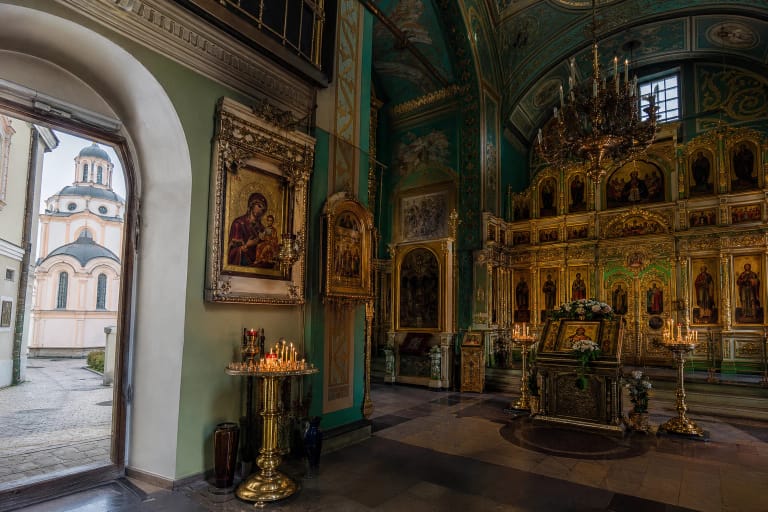
This is not a museum with fixed ticket-desk hours but an active cathedral of the Lithuanian Orthodox Church. Official announcements in 2026 document services and events marking the cathedral's 680th anniversary. Visitor access may depend on liturgy, community events, and preparations for worship.
No tourist admission ticket is officially stated. Dress modestly, do not disturb worshippers, silence your phone, and ask before photographing inside. If seeing the interior is the purpose of a special journey, check official church information first because the doors are not always open on a museum schedule.