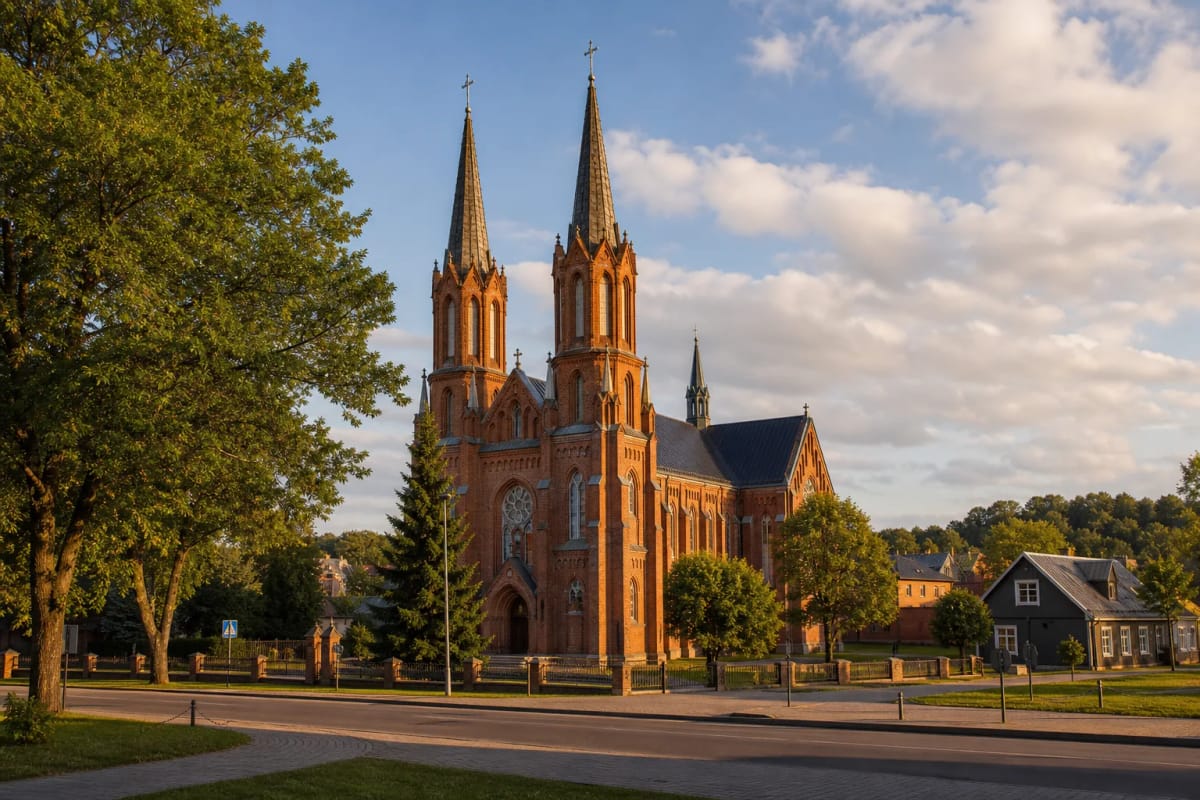
- Place
- Anykščiai, Anykščiai District Municipality
- Region
- Anykščiai District
- Type
- Neo-Gothic twin-towered church with a viewing platform in the tower
- Address
- Vilniaus g. 8, Anykščiai
- Coordinates
- 55.52450, 25.10020
Anykščiai Church, St. Matthew Church, Anykščiai St. Matthew Parish
Lithuania's tallest twin-towered Neo-Gothic church
Anykščiai Church of St. Matthew the Apostle and Evangelist is the clearest landmark in Anykščiai, standing on the left bank of the Šventoji. It is the tallest twin-towered Neo-Gothic church in Lithuania: its towers reach 79 m, making them visible from far away and turning the church into a symbol of the town. Because of this height, the church matters not only as a sacred building, but also as a landscape marker.
The church is Neo-Gothic, basilican in plan, with three naves and two towers. It is worth seeing in two ways: from outside, to appreciate the silhouette and scale, and inside, where the Neo-Gothic space and sacred art appear. One tower is adapted for visitors, giving the church a rare upward-viewing experience.
Construction in 1899-1909
According to the Panevėžys Diocese, the project for the present church was prepared in 1898 by Nikolajus Andrejevas, engineer of Kaunas Governorate and author of many Neo-Gothic churches in Lithuania. The church was built in 1899-1909, master Ansulis supervised construction, and thousands of parishioners contributed funds. VLE also dates the Anykščiai building to the early twentieth century.
The church was consecrated in 1914 and from then bore the name of St. Matthew the Apostle and Evangelist. It replaced an earlier eighteenth-century Classical brick church, demolished in preparation for the new construction. Anykščiai's sanctuary is therefore not a medieval church, but a mature early twentieth-century Neo-Gothic example.
Towers: from 84 to 79 metres
The history of the towers explains their present shape. The Panevėžys Diocese states that the original crowned towers reached as high as 84 m, but in 1915, during the First World War, retreating German troops blew up the upper parts of the towers. Falling debris damaged the roof and vaults.
The towers were rebuilt by about 1932, but in a simpler form and at a lower height: 79 m. The church silhouette seen today is therefore the result of post-war reconstruction, while the original more ornate tower tops did not survive. It is a useful reminder that wars changed even brick architecture.
Viewing platform in the tower
In 2012 a viewing platform was installed in the church tower, one of the most interesting visitor experiences in Anykščiai. Visitors climb to a viewing point about 33 m high, and the upper platform in the right tower is reached by 186 metal steps, directly below the bells. From the top, the panorama opens over the Šventoji valley and Anykščiai.
The viewpoint is visited with a ticket, and its opening hours are usually seasonal. Check the exact hours, season, and prices officially before travelling, because this information changes. The climb is physical, so comfortable footwear helps.
Interior and the literary Anykščiai region
Inside the church is valuable sacred art: the Gothic high altar was rebuilt in 1932 after a fire, and in the second half of the twentieth century the interior gained new works; a new organ was installed in 1999. This makes the church important not only for architecture, but also for religious art heritage.
Anykščiai is famous for literature, and the church stands near this memory. VLE recalls the writers connected with Anykščiai: Antanas Baranauskas, who created "Anykščių šilelis", Jonas Biliūnas, and Antanas Vienuolis. A monument to Antanas Baranauskas stands next to the church, so it fits naturally into a literary Anykščiai route.