- Place
- Panevėžys District Municipality
- Region
- Aukštaitija
- Type
- active modern church and memorial ensemble for a sanctuary destroyed under Soviet rule
- Address
- 2 Kurorto Street, Berčiūnai, Panevėžys District
- Coordinates
- 55.73766, 24.23922
- Visit duration
- 30-60 minutes for the church and Way of the Cross; longer for Mass or the 13 June commemoration
- Best time
- before or after the Sunday 2 pm Mass if you hope to see the interior; walk the Stations in dry daylight
Berčiūnai Church of the Lithuanian Martyrs, Berčiūnai Church of the Nation's Martyrs
The present church and the destroyed sanctuary are not the same building
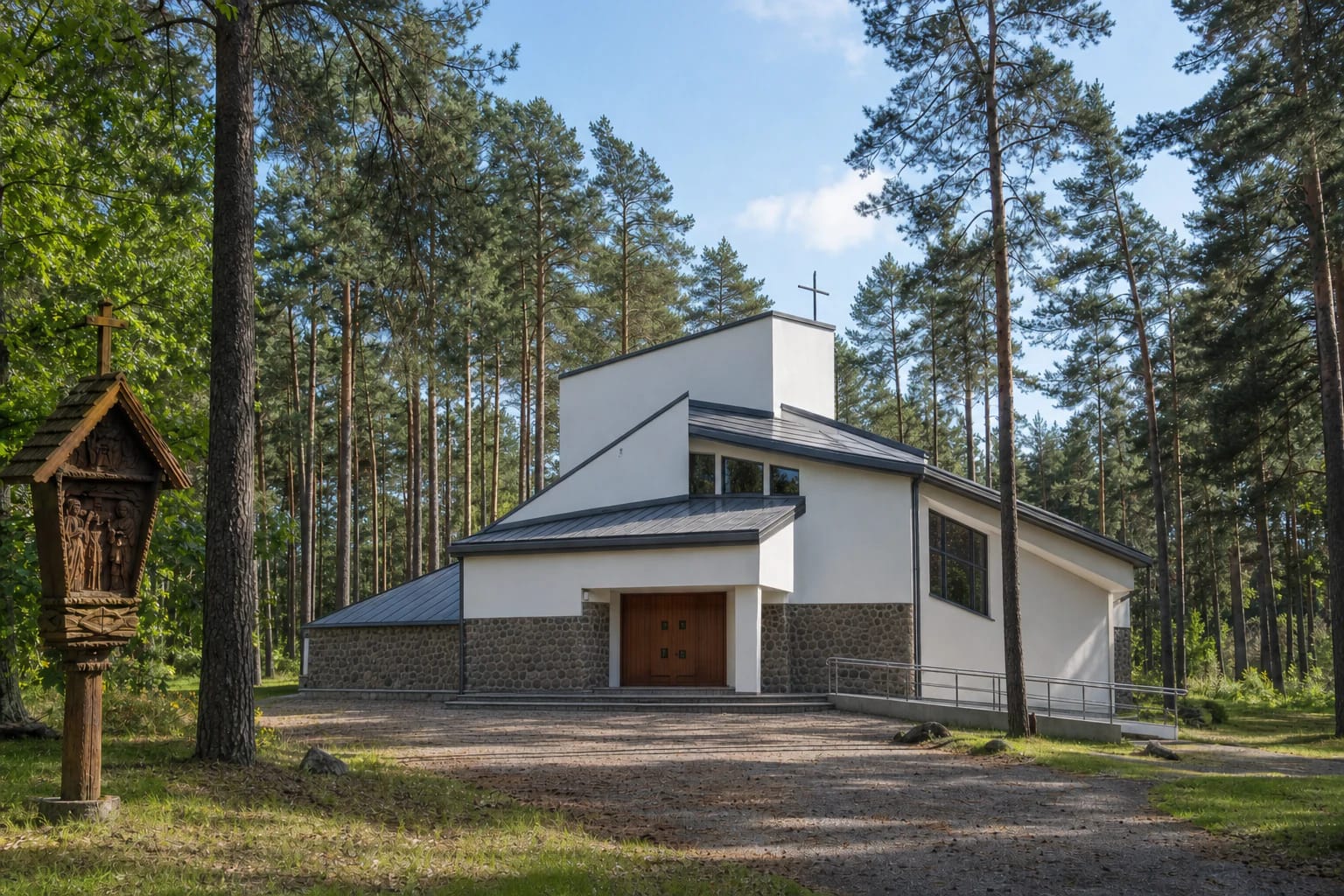
The church at 2 Kurorto Street was built in 1994-1997 to a design by Algis Šironas. It stands near the entrance to the former camp grounds, beyond the Sanžilė bridge. Coordinates 55.7376567, 24.2392239 mark the current church, not the old foundations or car park.
A fourteen-station Way of the Cross leads to the earlier site. Folk artists Adolfas Teresius, Algimantas Varžinskas, and Marijonas Būga made the carved wooden shrines. At the end, sculptor Antanas Kmieliauskas's Resurrection of Christ stands on the remains of the former church.
The distance is central to the ensemble's meaning: visitors walk from a renewed community sanctuary to a place physically erased. A photograph of today's facade alone therefore misses much of the story. Allow time for at least part of the Stations and the old foundations, while assessing the forest path surface on arrival.
Mass began among the pines of the Berčiūnai resort in 1930
Interwar Berčiūnai developed as a Panevėžys summer resort beside the Nevėžis and Sanžilė. AUTC records 24 villas by 1932, around 1,500 summer residents, and approximately 20,000 visits in 1937. Priests from Panevėžys Cathedral began celebrating Sunday Mass outdoors in the park in 1930.
A permanent-church committee formed in 1937, and architect Jonas Mulokas prepared the design. The foundations were blessed in 1941 and the building completed in 1944. It was a small masonry church, approximately 17 by 12 metres, with white walls, a red-tile roof, Gothic expression, and one high asymmetrical tower.
Its dedication and art connected the Sacred Heart of Jesus with the memory of the June 1941 deportations. This historic building must not be confused with today's low modern church with grey intersecting roof planes. Old photographs and descriptions show a different structure.
The 1957 explosion became a route of memory and renewal
Retreating German forces detonated ammunition stores nearby in 1944, but the church survived. Soviet authorities later closed it, dispersed its furnishings and art to other churches, and established a Pioneer and Komsomol camp around the site.
The Diocese of Panevėžys and AUTC both date the church's demolition by explosion to autumn 1957. Some secondary descriptions give 1956, but this guide follows the matching institutional accounts. The camp grounds returned to the Church in 1989, and work towards a new sanctuary began in 1990.
Construction in 1994-1997 was not a reconstruction of the old building and took place elsewhere on the grounds. The dedication to the Lithuanian Martyrs connects the memory of the first Soviet deportations, the destruction of the sanctuary, and the religious community's return. Dramatic local anecdotes about individual Soviet officials are not presented here as established fact.
Angular architecture and Ušinskas stained glass join two periods
The present plan has been described as a modified triangle, with changing-height volumes resembling intersecting triangular prisms. Low dynamic grey roofs, white rendered walls, and grey facing allow the church to sit among tall pines rather than competing with them through a high tower.
Large side windows and a dark timber ceiling direct natural light towards the sanctuary. The interior is restrained, with wooden pews and none of the elaborate Gothic Revival treatment associated with the earlier church. The rhythm between angled roof planes and pine trunks reveals the architecture most clearly.
The principal historic work is Stasys Ušinskas's 1941-1944 Sacred Heart of Jesus stained glass, created for the first church. After the closure it was moved to Krekenava, preserved there, and returned to Berčiūnai in 1997. It is an authentic part of the lost sanctuary inside the current building, not a modern copy.
Plan an interior visit around the church's liturgical life
The Diocese of Panevėžys lists Sunday Mass at 2 pm and summer Saturday services by arrangement. The Lithuanian Martyrs observance is held on 13 June at 6 pm with the Stations of the Cross; Good Friday Stations are listed at noon. Schedules can change, so check the official diocesan page before travelling.
No separate daily tourist timetable or admission ticket is published. The most reliable way to see the interior is before or after Mass without disturbing preparation and prayer, or by arranging access with the rectorate. Respect worshippers and local photography rules when viewing the stained glass.
Google Maps marks an accessible entrance and parking, while a municipal route identifies parking by the Sanžilė. This is not an accessibility audit for the whole forest Way of the Cross. The ramp and main church can form the more accessible part, but ask in advance about the Stations, old foundations, and toilets.