- Place
- Vilnius City Municipality
- Region
- Vilnius
- Type
- active Evangelical Lutheran church and part of the state-protected church-and-houses complex on Vokiečių Street
- Address
- 20 Vokiečių Street, Vilnius
- Coordinates
- 54.67914, 25.28285
- Visit duration
- 30-45 minutes; longer for worship or a concert
- Best time
- before or after an officially announced service, when the Vokiečių Street gate is open; check the individual event time for concerts
Vilniaus evangelikų liuteronų bažnyčia, Vilnius Lutheran Church, Lutheran Church on Vokiečių Street
The church is hidden beyond a Vokiečių Street gateway, while the map pin marks the sanctuary itself
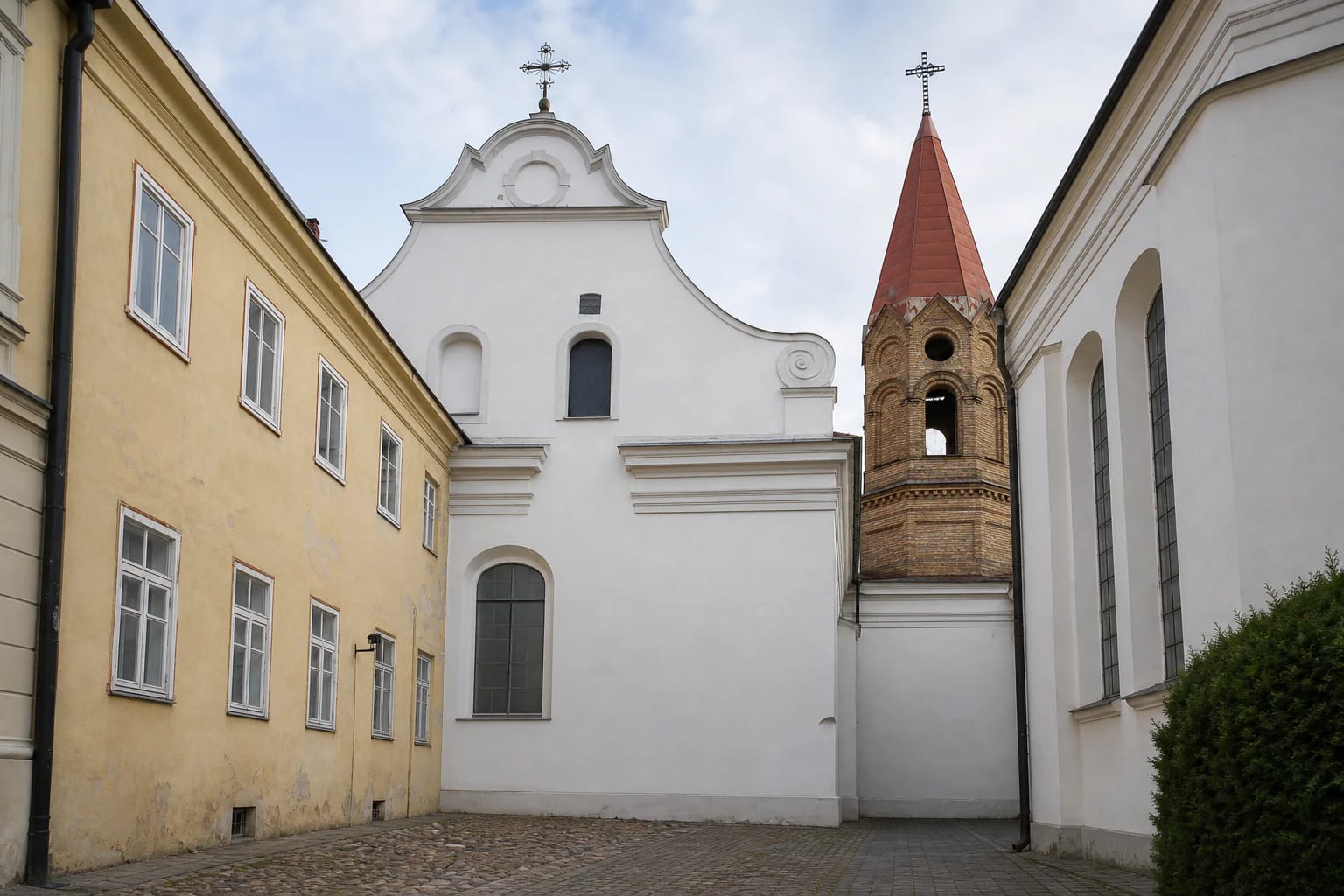
The address, 20 Vokiečių Street, can be deceptive because the church does not stand in the street frontage. Enter through the gateway of the complex and cross the inner courtyard, where the white church façade and its adjacent brick belfry come into view. The street gateway is access to the complex, not the façade of the church itself.
The coordinates 54.679141, 25.282851 mark the church site inside the courtyard rather than the gateway on the pavement. The Register of Cultural Property lists it as the Evangelical Lutheran church in the Vilnius Evangelical Lutheran church-and-houses complex, unique code 1081. It is an active parish of the Evangelical Lutheran Church in Lithuania, not the Evangelical Reformed Church in Vilnius.
On 15 July 2026, the exact Google Maps card named Vilniaus evangelikų liuteronų bažnyčia, place ID ChIJDZDm9RSU3UYR_IYV9K-YcNI, displayed a rating of 4.8 out of 5. Ratings change, which makes the check date important, and no review count is stated here.
The year 1555 dates the community, not a securely dated construction of the present church
VLE dates the establishment of the Evangelical Lutheran community in Vilnius to 1555. The parish history records that a preacher named Viklif arranged prayer rooms and a school on Vokiečių Street at that time, while the parish acquired a building in 1583. The same account stresses that neither the date nor even the material of the first church is securely known, so 1555 should not automatically be presented as the construction date of the present masonry building.
The record becomes clearer in the seventeenth century. An organ was present by 1616, sculptures were added to the altar in 1624, and the building was repeatedly reconstructed after fires. The parish documents rebuilding in 1633-1649, walls left after the fire of 1655, and another reconstruction in 1662 with vaults, confessionals, and boxes. The site therefore preserves the history of several building and loss phases, not one unchanged sixteenth-century structure.
Glaubitz remodelled the church after the 1737 fire, but the belfry belongs to the nineteenth century
The church burned in 1706, 1732, and 1737. A foundation stone for rebuilding followed the last fire, and the work was entrusted to Johann Christoph Glaubitz, known in Lithuanian as Jonas Kristupas Glaubicas. VLE dates his intervention to 1743 and explicitly identifies both the church remodelling and the furnishing of its interior. This supports Glaubitz's role but not a claim that he founded the community in 1555 or designed its first church.
The courtyard elevation is white plastered Baroque, with a curved gable, tall round-headed window, and restrained architectural mouldings. Beside it stands a separate exposed-brick belfry with tall arched openings and a steep roof. The parish chronicle dates the belfry to 1871 and the casting of a large bell to 1872, so the tower should not be folded into Glaubitz's 1743 phase.
The altar and pulpit convey Glaubitz's late Baroque interior composition, but they cannot be described as an untouched eighteenth-century ensemble. The parish records that museum worker J. Hopen photographed what remained in 1942 and that the interior was reconstructed from those photographs after its Soviet-era destruction. A visit therefore reveals both the architect's concept and the work of twentieth-century restorers.
The 1887 organ did not survive, and a Soviet floor slab once divided the worship space
The organ history is not the story of one continuously preserved instrument. An organ is documented in 1616, and in 1887 a new 27-stop instrument was installed within the organ case. It was looted after the Second World War. A 2024 publication by the Evangelical Lutheran Church in Lithuania describes the Vilnius parish organ as new, so the instrument heard today should not be identified as the organ of 1887.
Parish activity ceased amid repatriation and nationalisation in 1940-1941. A sculptors' workshop occupied the church after the war, and in 1954 it passed to state restoration-production workshops. A reinforced-concrete slab split the interior into two floors, with workshops below and a basketball hall above; the organ and senior galleries were removed, and the altar and pulpit were damaged.
The Vilnius Evangelical Lutheran parish was re-established on 19 November 1988, and the building was returned to the faithful in 1990. The first service and rededication in the restored church took place on 19 November 1995, exactly seven years after the parish's revival. These dates distinguish the return of the community, the restitution of the building, and the completion of a usable liturgical interior.
Services are the most reliable clue that the courtyard is open, but they are not tourist opening hours
Vilnius parish notices normally give 11:00 for Lithuanian Sunday worship, and the official 2026 Holy Week notice confirmed an 11:00 Palm Sunday service alongside separate times for the festival days. The International Church of Vilnius officially advertises an English-language liturgical service with Holy Communion every Sunday at 9:30. Holiday timetables change, so check the newest official notice before travelling.
The parish publishes no separate daily tourist opening hours, visitor ticket price, or detailed accessibility statement. The gateway and courtyard surface provide the route from Vokiečių Street, but thresholds, door widths, and available assistance cannot be verified remotely. If step-free entry is essential or you want to arrange a visit outside worship, contact the parish in advance.
During a service, keep silent, mute your phone, and do not photograph people or the liturgy without permission. Music events are also held here and may feature the present organ, but concert dates and entry arrangements are announced separately. An open street gate alone does not guarantee that the church interior is available for casual sightseeing.