- Place
- Eišiškės, Šalčininkai District Municipality
- Region
- Vilnius Region
- Type
- Romantic Classicist fieldstone Catholic church with a freestanding gateway bell tower
- Address
- 39 Bažnyčios Street, Eišiškės
- Coordinates
- 54.18110, 25.00460
- Visit duration
- 35-60 minutes
- Best time
- a weekday between 17:00 and 17:45, when the church is officially open but the 18:00 Mass has not yet begun
Eišiškės Church, Church of the Ascension of Christ the King in Eišiškės
Six columns and the fieldstone aesthetic of Romantic Classicism
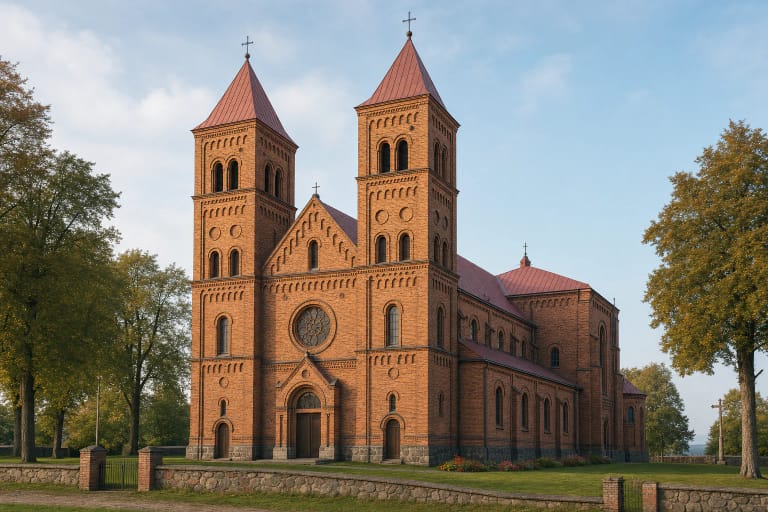
The church stands in Jurzdika, the smaller northern part of Eišiškės. It is a three-aisled pseudobasilica on a Latin-cross plan, with a presbytery, two sacristies, and an organ gallery. Its body has no integrated tower, and a portico of six massive white columns carrying a triangular pediment spans the principal façade. Only a small turret rises from the roof ridge, leaving the separate bell tower as the ensemble's dominant vertical landmark.
Mottled grey, brown, and reddish fieldstones remain deliberately exposed. White-rendered columns, cornices, corner strips, and surrounds around the round-headed windows do not hide the stonework but sharpen its effect. This contrast between Classical order and rough local stone is characteristic of nineteenth-century Lithuanian Romantic Classicism.
From Eišiškės's early churches to the ensemble completed in 1852
VLE dates the first church in Eišiškės to the late fourteenth or early fifteenth century. Švitrigaila's army burned the town and church in 1433, and a second filial church arose in another part of town around 1500. A parish school is recorded from 1524. Both sanctuaries suffered during the mid-seventeenth-century war, and Swedish forces again burned the town and church in 1706.
The present masonry complex was built between 1847 and 1852 to a design by Teodoras Narbutas. He is best known as the author of a nine-volume history of Lithuania, but he was also a trained military engineer and practising architect. VLE describes the Eišiškės church and bell tower as an original sacred ensemble of his design. The Register of Cultural Property records that Bishop Eduard von Ropp of Vilnius consecrated the church in 1905.
A 40-metre bell tower, gateways, and the 1929 enlargement
The bell tower is freestanding yet also announces the main entrance into the churchyard. Broad white-rendered bands and tall round-headed openings articulate its fieldstone stages. A dark swelling cap, small lantern, and cross crown the uppermost level.
The official Šalčininkai District Tourism and Youth Centre gives the tower's height as 40 metres and highlights its rare composition with two gateway openings at the sides. VLE records that the tower was raised in 1929. Its present silhouette therefore combines Narbutas's nineteenth-century design with an interwar alteration.
The 1778 altarpiece and sacred art transferred from Vilnius
The high-altar ensemble dates to about 1730, and the altar with its tabernacle was transferred in 1844 from the closed Missionary Church in Vilnius. Its polychromed, silvered, and gilded figures represent Saints Stanislaus, John the Baptist, Paul, and Adalbert, as well as Christ and angels. At the centre hangs The Ascension of the Lord, a canvas more than four metres long and two metres wide.
Conservation in 2017 uncovered a signature on the 1778 painting, identifying Antonis Albertrandis, a court artist to King Stanisław August Poniatowski. Elsewhere in the church are altars dedicated to Our Lady of the Gate of Dawn, St Anthony, St Francis, and the Holy Trinity, an eighteenth-century pulpit, a fourteen-stop organ from Wacław Biernacki's early-twentieth-century workshop, and stained glass made by Vytautas Švarlys in the 1970s.
Opening hours, Mass, and finding the correct entrance
On 27 July 2026 the Archdiocese of Vilnius listed the church as open Monday to Saturday from 17:00 to 18:30, and Sunday from 07:30 to 13:00 and 16:15 to 18:00. Mass is celebrated in Polish at 18:00 Monday to Saturday; on Sunday it is in Polish at 08:30, 12:00, and 17:00, and in Lithuanian at 10:00. Recheck the official schedule before travelling.
No separate visitor ticket is listed. The Archdiocese gives the church address as 39 Bažnyčios Street, whereas the current Google Maps card displays number 37, so the verified site pin is the safest guide. On 27 July 2026 the listing showed 4.6 out of 5 from 73 reviews; both figures change.