
- Place
- Gudai, Mažeikiai District Municipality
- Region
- Samogitia
- Type
- a two-storey timber watermill with an attic, a surviving collection of milling machinery, and hydroelectric infrastructure
- Address
- 111 Virvytės Street, Gudai, Viekšniai Eldership, Mažeikiai District
- Coordinates
- 56.18740, 22.54100
- Visit duration
- 20-35 minutes for viewing the exterior and Virvytė setting from lawfully accessible places; interior access is not included
- Best time
- a bright, dry day from late spring to autumn, when the timber façade, river valley, and hydraulic setting can be viewed safely
Gudų vandens malūnas, Gudai Mill, Gudai hydroelectric mill
This is both a protected mill and an operating hydroelectric plant, not a permanently open museum
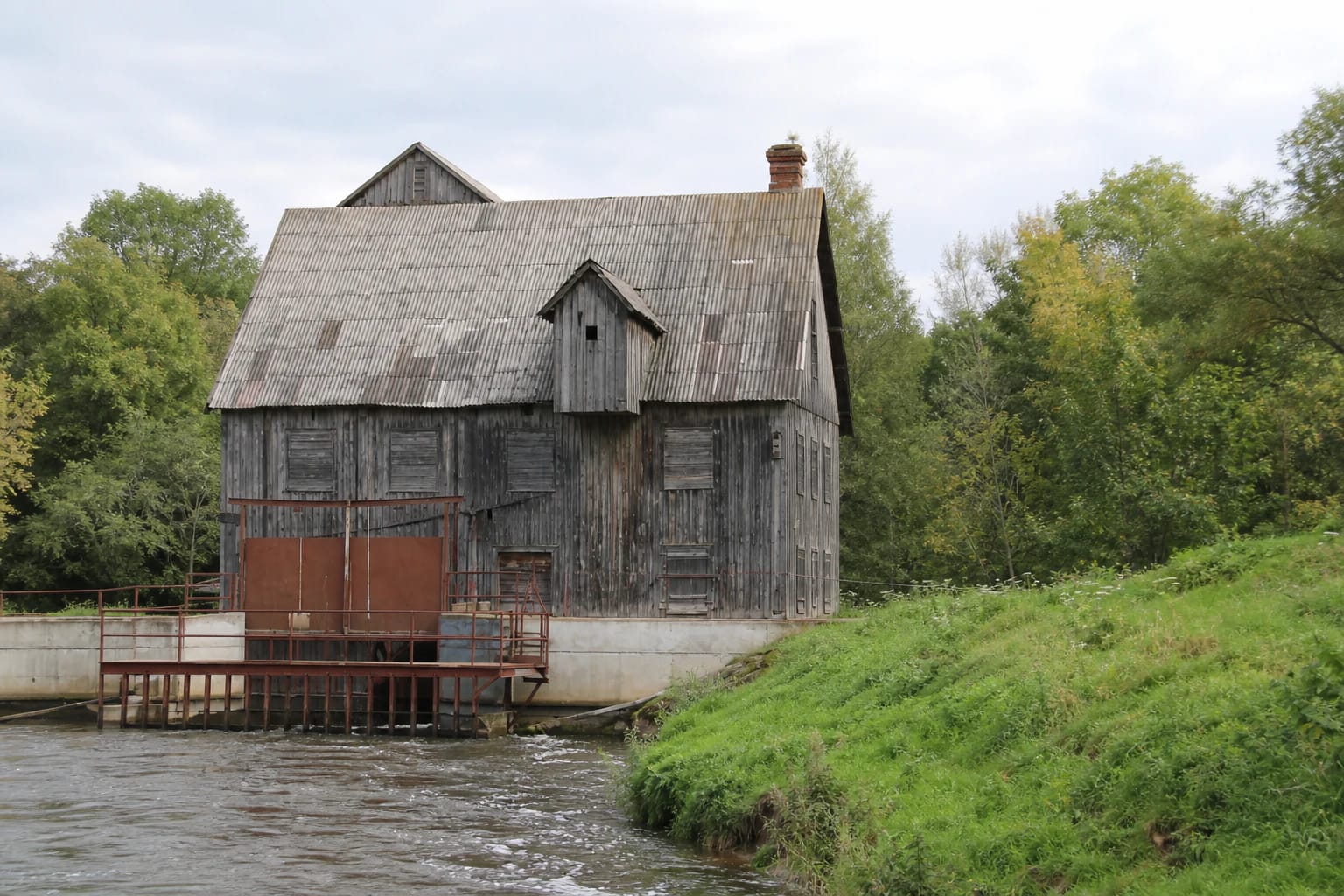
Gudai Water Mill stands in the village of Gudai on the right bank of the Virvytė, south of Viekšniai. The coordinates 56.1874, 22.541 identify the mill and hydroelectric site itself, not an official visitor car park. Look for a broad gabled roof, grey walls clad in vertical boards, small projecting dormers, and a masonry chimney.
KVR recognises the mill as architectural, engineering, and landscape heritage of regional significance. Its value extends beyond the timber shell: the protected relationships encompass the building's structure and machinery as well as the Virvytė channel, dam site, and millrace system. VLE likewise includes Gudai Mill among the cultural properties of Venta Regional Park.
NERC's register dated 30 April 2026 still listed a 0.264 MW hydroelectric plant operated by UAB Meksimela at the Gudai reservoir on the Virvytė. This confirms the site's energy-generating status, not public admission to the building. Plan any visit around current signs, fences, and instructions from the owner rather than assuming that a tourism-map marker grants access.
The Jung family's mill became well known enough to attract grain carts from Telšiai
The State Service for Protected Areas says that the timber mill was built in 1922 by the Germanised Latvian family of Vilius and Alvina Jung. Until the Second World War, the Jungs also leased the mill of Santekliai Manor. Gudai developed a strong reputation: the official protected-areas account records that carts brought grain here even from Telšiai.
The construction date is not entirely consistent across the records. The historical section of the KVR assessment also attributes a 1922 mill to the Jung family, but its technical header gives 1924 and notes repairs in 1956. No dependable source was found to establish whether 1924 represents completion, a registration error, or another phase. This page therefore uses the better-supported 1922 date while making the 1924 entry visible.
The Jung family withdrew westward near the end of the Second World War. The mill later belonged to a collective farm and then an agricultural company. KVR states that it ceased operating as a grain mill in 1986. Those successive phases explain why the building combines the stories of a family business, Soviet agriculture, and present-day energy generation.
Production needs, rather than decoration, shaped the two-storey building and its attic
KVR describes a compact rectangular building of two storeys and an attic beneath a gabled roof. Its walls are assembled from sawn logs and clad in vertical timber boarding, supported by a fieldstone foundation with a brick levelling course. Timber floors, stairs, and roof trusses survive within the structure.
Two projecting dormers break the roof planes, while a crowned fired-brick chimney rises above them. Beside the watercourse, a masonry arch of fieldstone and fired brick is particularly revealing: the building was organised around the route taken by water and mechanical power. Boarded openings and later technical additions should not be mistaken for original ornament.
KVR's condition notes date from 2016 and are not a live inspection report. They recorded damaged boards, windows, and dormers, but conditions may have changed since then. Judge the exterior by what is actually visible during a lawful visit, without touching the fabric or trying to enter through closed openings.
The registered machinery traces the complete journey from cleaning grain to flour and groats
Gudai is exceptional because KVR lists specific mechanisms rather than merely referring to old equipment. Grain was cleaned by an Omega machine locally called šatrai. The protected milling apparatus includes two drums with millstones, hoppers, and frames, as well as roller mills; a groat machine produced groats, a bolter graded flour, and elevators carried grain between levels.
A second layer of equipment explains how power moved through the building. KVR records the transmission system, wheels controlling the turbine and water flow, a sack-hoist wheel, timber grain chutes, elevator heads, and a flour-distribution box. This was not a picturesque external waterwheel arrangement: a turbine and internal transmissions provided the power, so an exposed overshot wheel should not be invented in descriptions or illustrations.
A register entry does not demonstrate that every mechanism still operates or can be approached safely. Its importance is that the mill can be understood as a surviving technological system, not just an attractive old building. Machinery may only be inspected with permission from the lawful owner or operator and under appropriate safety rules.
A post-war ambush and the 1995 auction mark two very different turning points
A documentary collection prepared by the Lithuanian Special Archives records that on 30 September 1946, partisans of the Alka unit staged an ambush near Gudai Water Mill in which four MVD internal-troops servicemen were killed. This is a documented episode of the post-war conflict. This page does not repeat additional dramatic details found in later retellings because the selected official sources do not substantiate them.
After grain milling ended in 1986, the property remained for a time within an agricultural enterprise. The mill was sold at auction in 1995. The State Service for Protected Areas says that the new business owners installed a small hydroelectric plant while retaining the historic mill building.
Hydroelectric adaptation altered part of the hydraulic system. KVR records the site of the older dam, made with earth, clay, gravel, stone, and branches, whereas the present system includes a concrete dam and reconstructed inflow and outflow channels. The landscape visible today is therefore a junction of the historic mill and later energy infrastructure, not an untouched 1920s complex.
View the exterior from lawful access and keep well away from the water-control structures
No official museum opening hours, ticket office, regular tours, or unrestricted interior access are published for Gudai Water Mill. Do not plan on finding the doors open. Anyone seeking to see the machinery or bring a group must arrange permission in advance with the present owner or lawful operator and confirm the latest official information before travelling.
The dam, intake and discharge channels, railings, and service platforms belong to an operating hydroelectric installation. Never cross fences or barriers, step onto dam structures, approach fast-flowing water, or obstruct the equipment. Keep children close, and give the technical zone an even wider berth when surfaces are wet or icy.
No detailed official step-free-access or visitor-parking audit has been published. The address at 111 Virvytės Street and the coordinates locate the property but do not guarantee a public parking space. Leave a vehicle only where current signs permit and local traffic remains unobstructed. A 20-35 minute exterior stop combines well with Viekšniai Water Mill, the Pharmacy Museum, or other sites in Venta Regional Park.


