- Place
- Ariogala town eldership, Raseiniai District Municipality
- Region
- Žemaitija
- Type
- active Roman Catholic church and interwar sacred-architecture site
- Address
- 3 Taurupio Street, Ariogala
- Coordinates
- 55.26603, 23.46757
- Visit duration
- 20-40 minutes; about 1 hour when attending Mass
- Best time
- before or after a published Mass; morning or late-morning light for the façade
Ariogala Church, St Michael's Church in Ariogala, Ariogalos Šv. arkangelo Mykolo bažnyčia
The present church ended a long cycle of wooden buildings
Ariogala's first Catholic church was built in 1416 on the initiative of Grand Duke Vytautas. It was wooden, and later churches repeatedly burned and were rebuilt. A parish school was operating by the sixteenth century; the church burned in 1690 and was rebuilt around 1726, then rose again in 1813 after another fire in 1807.
In 1863, poet and priest Anupras Jasevičius read the insurgents' manifesto here. He was arrested and exiled to Siberia as a result. This documented episode shows that Ariogala's church was not only a liturgical setting but also part of the town's public life.
In 1915, fighting during the First World War destroyed the church, belfry, and much of its equipment. Until a new sanctuary was built, the parish celebrated Mass in a masonry building adapted from a grain warehouse.
Eduard Peyer's design replaced an unrealised proposal
Planning for a new church began in 1918. Architect Vaclovas Michnevičius prepared a scheme in 1922, but it was not built. Construction eventually followed the 1926 design of Swiss architect Eduard Peyer, who was working in Kaunas.
The ambitious scale and constant shortage of money stretched the work to 1939. The tower shapes changed during construction, while almost all the decorative details in the original design were omitted. Parish priest Antanas Simanavičius organised the project, Latvian contractor Petras Graudinas carried out the work, and Peyer directed its architecture.
Archbishop Juozapas Skvireckas consecrated the church on 17 September 1939. The parish's jubilee study records that President Antanas Smetona attended the ceremony. The building itself survived the Second World War.
The contrast of red brick and white plaster is deliberate
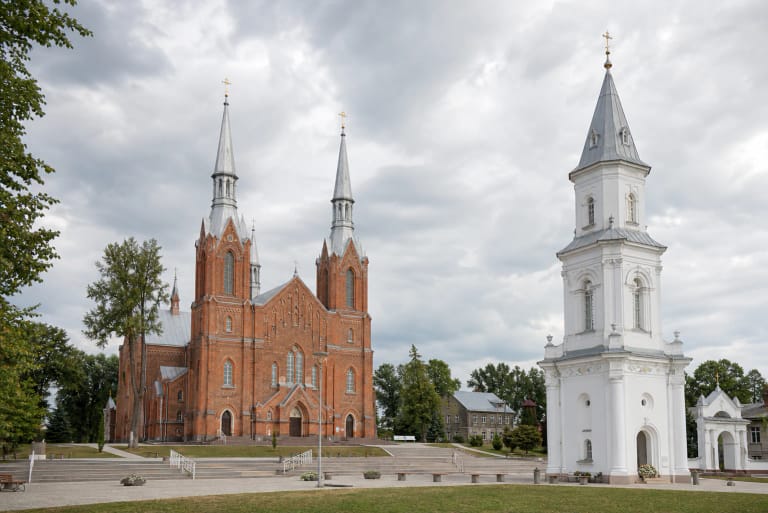
The rectangular basilica has twin towers and combines Baroque Revival and Neoclassical elements. The lower façade stages are exposed red brick, while the tower stages above the roofline, the gable, and window surrounds are rendered white.
Between the towers, a slightly projecting centre terminates in a triangular gable with a recessed Latin cross. Concave and convex wall surfaces lend movement to the façade. Researchers connect its composition with Lithuanian, particularly Vilnius, Baroque, which interwar architects treated as a possible source for a national style.
Inside, semicircular arches between piers divide the building into three naves. A barrel vault covers the central nave and cross vaults the aisles, while a continuous frieze, cornice, and sequence of high windows unify the interior.
The high altar is older than the building
A two-tier wooden high altar, painted white and richly gilded, dominates the bright sanctuary. Openwork cartilage ornament forms its dramatic wings and frames sculptures of St Benedict and his sister St Scholastica.
The altar was not made for Ariogala. When the sanctuary of the Benedictine Church of St Nicholas in Kaunas was redesigned in 1936-1938, its older altars were removed, and the mature seventeenth-century Baroque high altar was transferred to the church under construction in Ariogala around 1938.
The first tier now holds Our Lady and the Child, painted in 1946 by the then parish priest Pranas Šniukšta. The sanctuary also contains Stasys Ušinskas's 1945 Immaculate Conception, while the Neoclassical side altars date from 1960-1961.
Visiting, Mass times, and respect for an active church
This is an active parish church, not a museum with a permanent ticket desk. On 27 July 2026, the Archdiocese listed Mass on Sundays at 10 am, Saturdays at 11 am, and Tuesday-Friday at 5 pm from September to April or 6 pm from May to August; Monday Mass is only for funerals. Times can change for feasts, funerals, and special services, so check the official page.
Entry for worship is free and donations are voluntary. To view the interior quietly, do not arrive in the middle of a service, photograph only without disrupting worship, and follow notices on site. Doors may be locked outside services; groups should arrange a visit with the parish in advance.
The towers were repaired and the sanctuary and sacristy renewed in 2014, followed by several years of exterior and interior work before the 600th anniversary in 2016. Google Maps showed 4.7 out of 5 from 148 reviews on 27 July 2026; the figure changes over time.