
Narrative folklore
Lithuanian mythological tales
Read Lithuanian sakmes in English: concise belief and origin stories about supernatural encounters, creation, taboos, signs, and consequences.
Editorial retellings with source-based context; these are not verbatim archival transcriptions.
Start with a story
About this genre and its sources
Supernatural encounters. Meetings with beings and unexplained phenomena.
Origins of the world. Stories explaining the earth, sky, plants and animals.
Fate and destiny. Beliefs about the course and boundaries of a human life.
Sakme guides
Belief tales, origin tales, and mythological stories with source context and interpretation.
Supernatural encounters
Meetings with beings and unexplained phenomena.
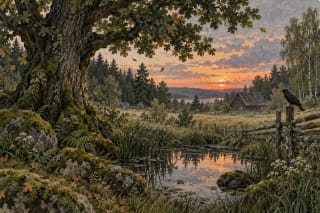
Before dawn, Jurgauskis sees a small child pursued by dogs. News of a neighbour’s child dying changes how the encounter is understood.
A peg found in a pasture brings a farm unexpected prosperity. The good fortune ends when an unsuspecting hired hand moves it in the stable.
A hunter trades his gun for Perkūnas’s small weapon, subject to one prohibition. Three prosperous years end when curiosity brings extraordinary destruction.
A mysterious gentleman pays for a poor young man’s wedding in return for an invitation. An unexpected musician’s name keeps the unwanted guest away.
A newly hatched aitvaras asks its master what to bring. A sleepy answer produces endless piles of bast shoes instead of money.
After a funeral, a daughter-in-law clearing the dishes is visited by the dead family member. He offers to help, asking only for the crumbs from the feast.
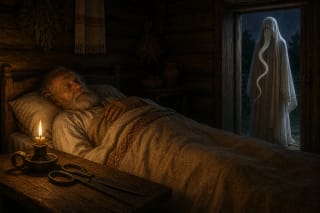
A sakme about an old man who, before dying, asks for shears to be placed by his body so that when Giltinė comes close he can cut off her poisonous tongue.
A kaukas asks where to put its load. A farmhand answers without thinking, and in the morning the well is packed with hay.
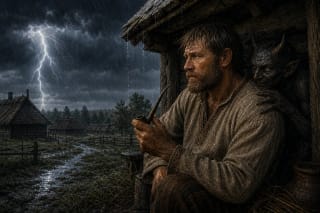
A short sakme about a man who finds Velnias hiding under an eave during a storm, and a strike from Perkūnas kills the man rather than the one who was hiding.
Men guarding horses at night receive mischievous little visitors. They throw a hatchet into the fire but move aside when a man rises to retrieve it.
A man comes to borrow a sharper axe and glances through a pantry door. Inside, his neighbour is milking a towel that hangs on the wall.
The plague figure Pavietrė travels in a carriage and cracks her whip in villages.
Two harvest workers hurry home through a storm. A black cat jumps into a folded skirt, and an overseer notices their dangerous passenger.
On a warm day a ploughman meets a stranger in a white fur coat. Asked to wake him before a storm, he later finds a very different creature asleep.
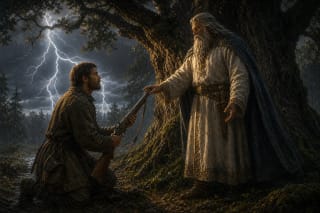
A sakme about a hunter who helps Perkūnas shoot Velnias and receives a magically loaded gun whose power disappears when he boasts.
A man gives his neighbour a horsefly instead of the aitvaras he promised to buy. The intended trick leaves the cheat with the worthless purchase.
A wealthy woman has endless cloth to sell but no peace of mind.
A traveller urges a moustached man resting under a bush to get up. The wind’s smallest breath proves disastrous back at home.
A bee leaves a sleeping woman’s mouth and visits a hollow willow. Her dream reveals a hidden find that her companion secretly claims for herself.
A devil caught at a manor performs the hardest work. During an emergency, the housekeeper’s impatient command accidentally sets it free.
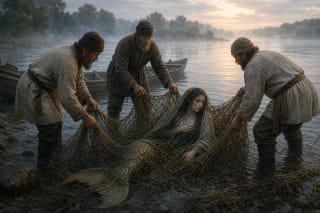
A sakme about an undine caught by fishermen in the Nemunas near Ploksciai: she sings in an incomprehensible language, weeps before people, and is finally…
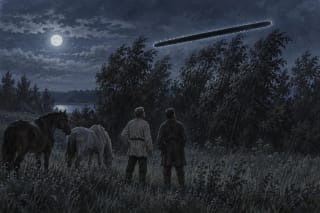
Horse herders see an aitvaras resembling a black pole with glittering edges. A knife makes it descend, but they decide to release their catch.
Tiny footprints appear on a floor freshly sprinkled with sand after All Saints’ night.
A girl wagers that she can bring a pole from a haunted barn. She tricks the devils by suggesting that her task will take many more trips.
Children who have lost their mother notice the baby’s cradle rocking by itself when their father goes out.
A devil waits beside a roofer driving the last nail into a church roof. The craftsman escapes by saying something different from what he intends.
A mistress turns her exhausted farmhand into a horse for nightly rides to Šatrija.
Witches invite their servant to fly to Šatrija. His own astonished cry, invoking the Virgin Mary, abruptly ends his journey.
Farm servants see a shining aitvaras settle on a granary. Full bins of wheat reveal why the owners keep the store locked away from other eyes.
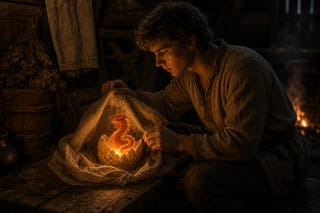
A sakme about a young man who secretly hatches an Aitvaras from an egg under his arm, after which wealth begins flowing into the household.
Three kaukai plan to burn a barn after finding their food spoiled. A shepherd overhears them and learns where they intend to shelter from the fire.
A farmhand tries to discover whose house shelters a kaukas. His mocking challenge ends in a fire that reveals the spirit’s home.
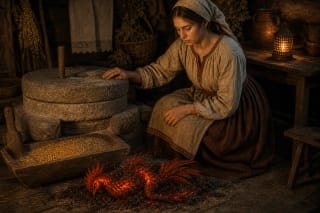
A sakme about a daughter-in-law tormented by endless grinding until she sees Aitvaras in the form of a red rooster and kills it.
A laumė takes a woman’s place at the loom and demands that she guess her name to reclaim the cloth. While weaving, she gives the secret away in song.
A traveller questions a laumė about a flax field on the way to a wedding. After offering to carry her cakes, he uses the secrets she has told him.
A changeling who has remained silent for twenty years sees a strange arrangement of fire and eggs. Its first words reveal an extraordinary age.
A mother rushing to gather hay before the rain forgets her baby in a meadow. The laumės give it gifts, but a wealthy neighbour’s imitation ends in tragedy.
Two laumės ask the weaver Braškakoja for her shuttle. Accepting their help makes her an unrivalled craftswoman, while another weaver refuses the visitors.
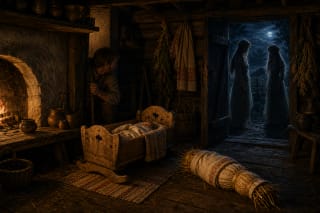
A sakme about a baby stolen by Laumės and a bundle of straw left in its place, which would have turned into a little Laumė-being if the trick had not been…
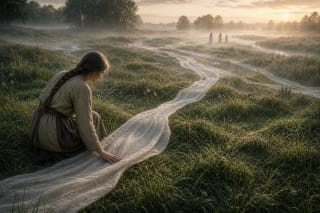
A sakme about a poor woman who finds a Laumės’ cloth that would never have run out if she had not wanted to see its end.
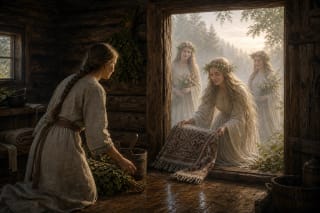
A sakme about a woman who left hot water and bath whisks for Laumės in the bathhouse, and was repaid with fine woven goods.
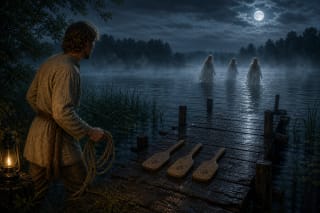
A sakme about Laumės who wash by a lake footbridge on Thursday evenings, and brave Jakamas who takes away their washing paddles.
A tailor walking late from Kupiškis feels an invisible weight on his shoulders.
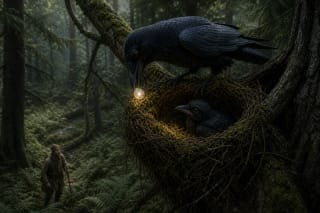
A sakme about a small stone that makes a person invisible, and the grim way to obtain it from the beak of a young raven.
A gentleman hires a lost musician for a feast. Ointment on one eye reveals a marsh instead of a manor, but the strange gift of sight does not last.
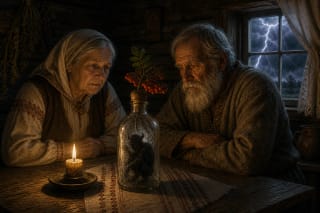
A sakme about Velnias arriving at an old couple’s home during a thunderstorm, asking to be hidden in a bottle with a rowan stopper, and rewarding the people who…
A lord demands an impossible seamless suit from a tailor. A devil makes it possible, but the fine garment holds together only while its helper stays.
A traveller meets three strangers by a cross. The sun and winter threaten him, but the wind promises protection.
A voice from the water announces that the appointed time has come but the person is absent. Fishermen warn a farmhand against bathing, yet he later returns.
Two little helpers feed a poor farmer’s horses at night. New clothes made in gratitude become, to the helpers, wages that end their service.
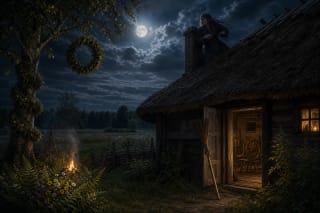
A mythological sakme about a witch who steals cow's milk through a dishcloth, then on Joninės night misses the chimney when her broom is set the wrong way.
A young woman in white visits the gravely ill Šimkus. One woman sees her through a window, while the neighbours sitting with the patient see no visitor at all.
As Jonas falls asleep in a barn, a voice warns him three times of approaching misfortune. Angrily searching for the unseen speaker, he meets the danger himself.
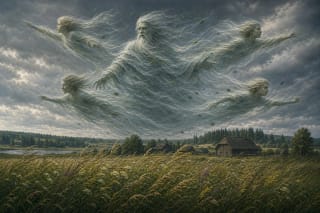
Four winds try to lift a stone from the sea. When three children are trapped beneath it, their father hides in a hollow tree and the world falls still.
After the wind knocks a man from a bridge, he demands justice. A wind really does appear in court, and the judges’ mockery turns against them.
A girl promises to keep an embarrassing encounter with the wind secret. In return he brings rain to her fields, until she breaks her word.
A boy going to watch horses at night finds a tether and fastens it around his waist. The strange cord belongs to the wind and lifts him into the air.
Adomas Ramanauskis watches his seven mistresses and follows their flight to Šatrija on Midsummer Eve.
Hidden in a beehive, a young man flies with two witches to gather peas in winter.
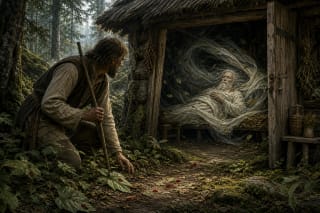
A sakme about a man who grew angry at the wind, threw a knife, wounded the wind in the form of an old man, and later blew away his own home.
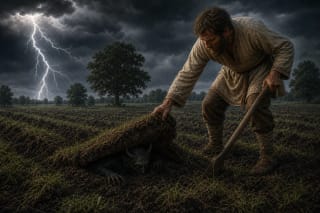
A sakme about Velnias asking Perkūnas where he might hide, and finally finding the one place under a strip of turf turned back on itself.
One stolen stone starts the endless quarrel between Perkūnas and the devil. This short legend explains why the devil keeps looking for new hiding places.
Origins of the world
Stories explaining the earth, sky, plants and animals.
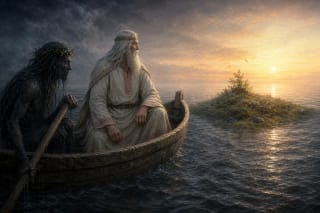
An etiological sakme about Dievas, the speck of mud Velnias brings from the bottom, and a small island that expands into the earth while Velnias drags the…
During a war between birds and beasts, the bat keeps joining the winning side. Once peace is made, neither side will take it back.
Unable to see, the ash asks other trees when to change its leaves. Their mocking answers make it leaf out late and shed its leaves early.
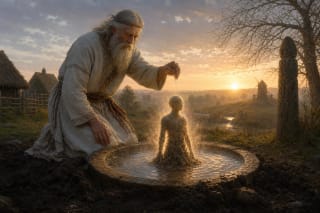
A sakme about the first human arising from a drop of water as Dievas washed, and about the creation of woman so that the human would not be alone.
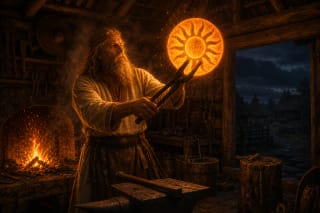
An etiological sakme about a smith who, in the age of darkness, forges the Sun from shining iron over six years and throws it into the sky.
A hedgehog proud of its soft fur pricks its face on a spruce. After insulting the tree, it loses its own gentle coat.
At a river, God asks two animals for help. The horse refuses to interrupt its grazing, while the hungry ox agrees to carry him across.
The devil decides to paint a peacock and a peahen. He finishes the male’s splendid plumage, but never gets to paint the female.
A pigeon asks a thrush to teach it nest-building, then boasts too soon that it knows how. An unfinished lesson leaves an unfinished-looking nest.
The first ram has no way to defend itself. After being mistreated, it asks God for help and receives horns.
God makes a companion from earth for a man ploughing alone. The little grey bird rises into the sky in song.
Other animals laugh at the squirrel’s tiny tail. When it asks for help, it receives a tail unlike any they have seen.
A stork must carry a closed sack to the sea. Curiosity releases every creature inside and leaves the bird with a lasting mark.
The birds find excuses not to catch troublesome insects. Only the swallow takes on the task, earning a special gift for its diligence.
A devil chased by a dog tries to escape into a tree. Blood from a bite leaves the alder with red wood.
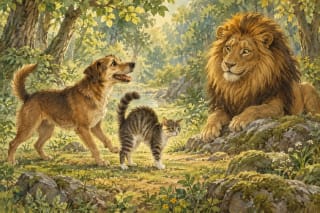
The lion sends a dog to fetch an absent camel. Knowing only that a camel has a hump, the dog brings back a cat with an arched back.
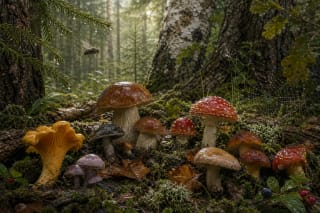
A sakme about a time when mushrooms were all alike and harmless, until a fly dressed them for a colorful feast and a spider caught the fly before it could…
Partridges ask for feathers that shine like stars or glow-worms. Their new splendour makes it impossible to hide.
Birds hiding from the monstrous Skukas dare not leave their shelter. The cuckoo volunteers to scout, after securing a promise for her young.
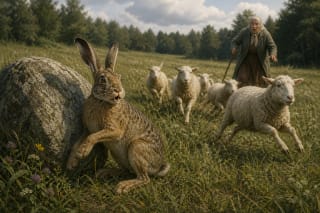
A short sakme about a sad hare whom no one feared, and how laughing at his own trick split his lip.
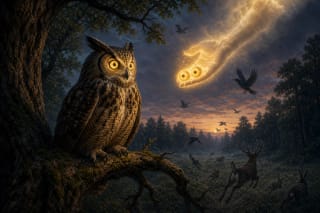
A sakme about the time when birds and animals had no eyes, and the late-arriving owl received large eyes so it could see at night.
Long ago every tree about to be felled begged for mercy. In this story, their repeated pleas lead to the silence of trees.
Fate and destiny
Beliefs about the course and boundaries of a human life.
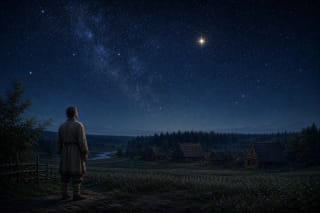
A short mythological sakme about the belief that when a person is born, their star lights in the sky, and recognizing one’s own star can be mortally dangerous.
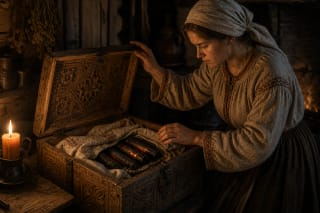
A sakme about a newborn’s life being destined to last until extinguished charred sticks burn out, and about opening a secret chest that fulfills the fate.
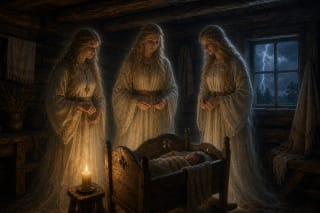
A sakme about voices that allot a newborn wealth, early death, and death by Perkūnas, while the father’s efforts and the child’s hiding place change the…
Lithuanian mythological tales: frequently asked questions
What is a Lithuanian sakmė, and why does it sound like a true event?
A sakmė is a short narrative-folklore account often tied to a named person, place, time, or witness. Those details make a supernatural encounter or an origin explanation sound as though it could genuinely have happened.
How does a sakmė differ from a fairy tale?
A sakmė is normally presented as a possible or plausible event and explains a supernatural encounter, prohibition, sign, or origin. A fairy tale develops invention, wonder, and adventure more freely without needing to sound true.
What are the main groups of Lithuanian sakmės?
Mythological sakmės describe encounters with laumės, velniai, aitvarai, witches, and other beings. Etiological sakmės explain the origins of the world, animals, plants, or human features, while fate sakmės concern destiny and the course of a life.
Are these pages verbatim archival transcriptions of sakmės?
No. The individual pages contain modern retellings based on the stated plot motifs and sources. Their source sections show what each retelling draws on and distinguish it from an archival transcription.
What is the difference between a memorate and a fabulate?
A memorate recounts something a person says they personally saw, heard, or experienced. A fabulate is a more developed traditional plot passed between narrators and adapted to different places or characters.
Other genres
Keep exploring Lithuanian stories
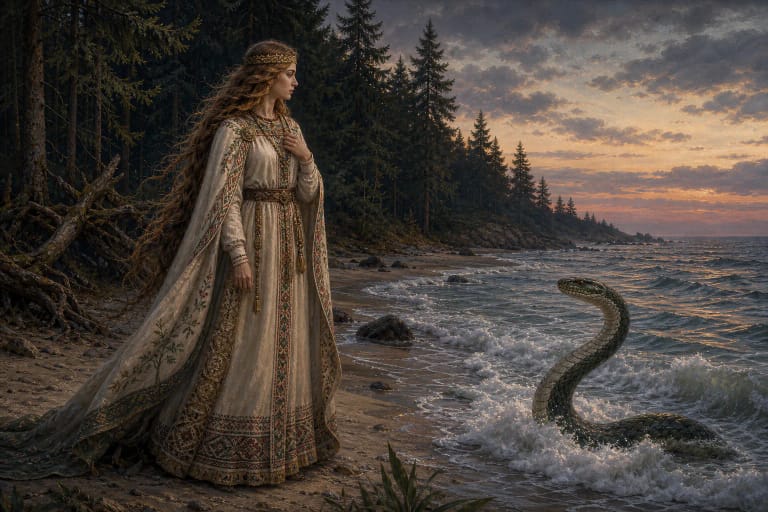
An English collection of Lithuanian tales with full retellings, motif explanations, variant history, and cultural interpretation.
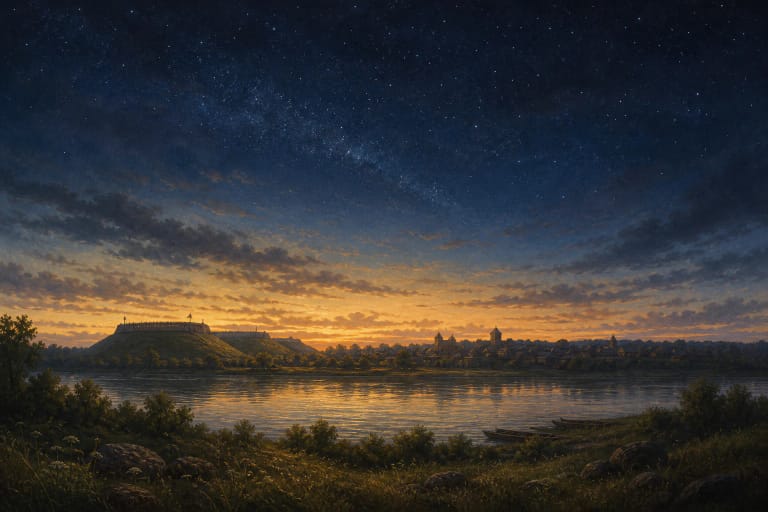
Explore Lithuanian legends in English, distinguishing folklore, chronicle tradition, literary retelling, and local religious memory.
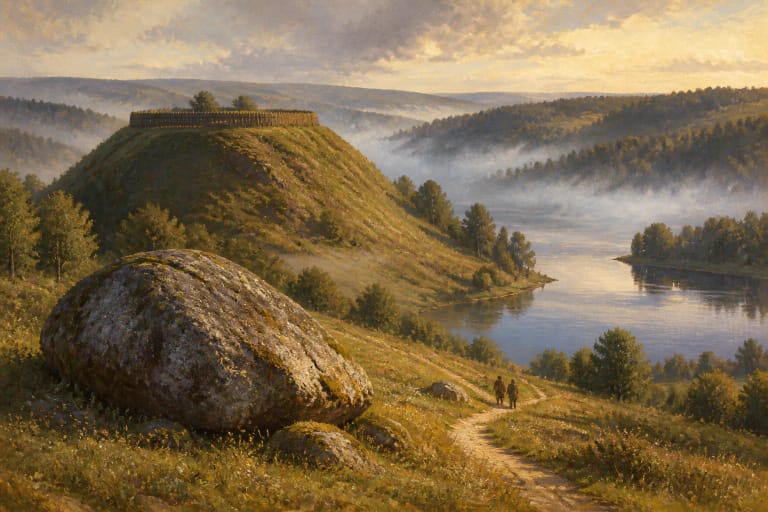
Read Lithuanian place legends in English, tied to hillforts, lakes, stones, sacred springs, valleys, and names still visible on the map.