- Place
- Vilnius City Municipality
- Region
- Vilnius
- Type
- historic Vilnius Old Town park in a bend of the Vilnelė
- Address
- B. Radvilaitės g. 8A, Vilnius
- Coordinates
- 54.68440, 25.29544
Sereikiškės Park, Bernardinai Garden, Youth Garden
Bernardine Garden is not only a place to rest
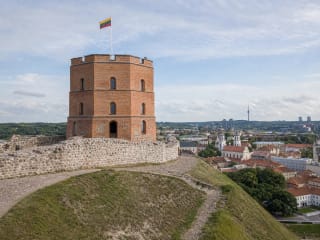
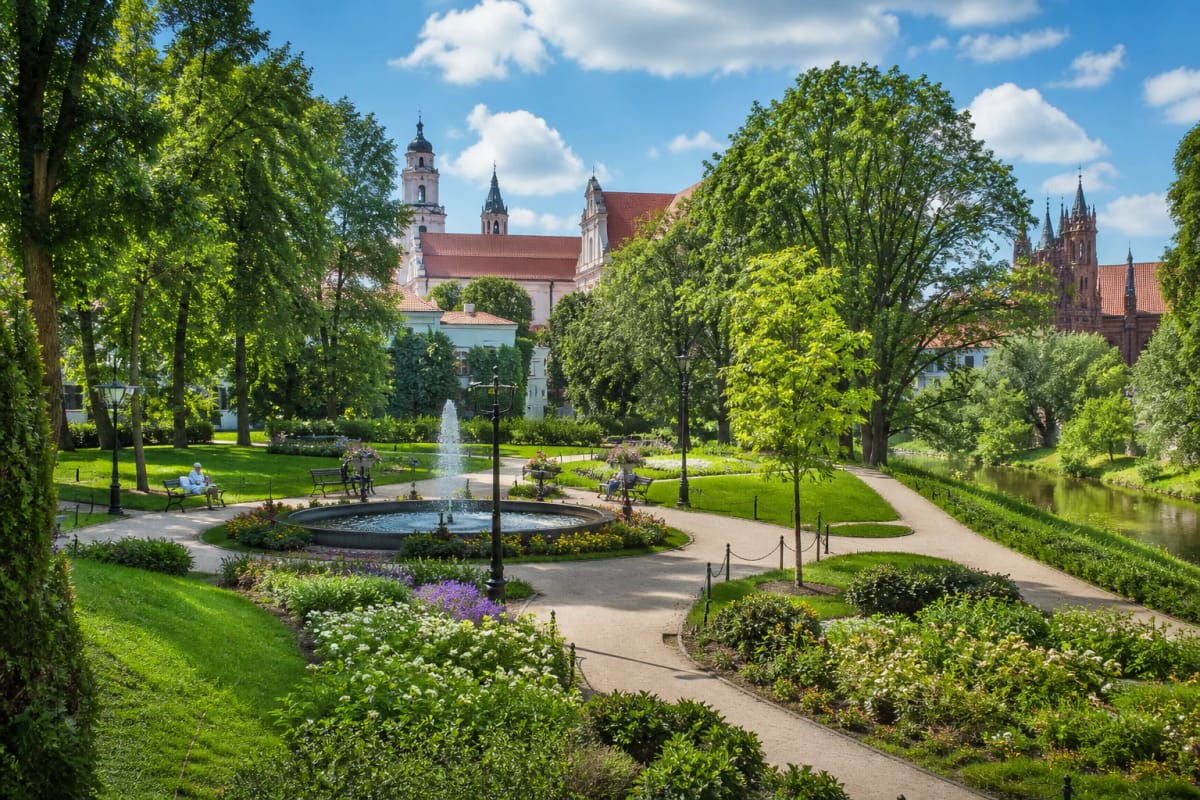
Bernardine Garden grows in the very heart of Vilnius Old Town, between the Vilnelė, Gediminas Hill, Kalnų Park, and the Bernardine architectural ensemble. Because of this position, it works as a quiet transition between dense old-town streets and the natural relief of the Vilnius castles.
Vilnius city parks emphasize that this roughly 9 ha territory is one of the city's most important parks. It is worth coming here not only to sit on a bench: the paths, flowerbeds, Vilnelė banks, old oak, botanical displays, and historical axes show how Vilnius' relationship with nature changed across several centuries.
From Bernardine gardens to a city garden
The official park history gives 1469 as a key beginning: King Casimir Jagiellon invited Bernardine monks to Vilnius and granted them the area. The monks gradually cultivated what had been a springy, marshy, and wild place, using it as a vegetable garden, orchard, and working territory.
From 1469 to 1864 the territory belonged to the Bernardines. The historical description by Vilnius city parks mentions monks' gardens and vegetable plots, ponds, water channels, an orangery, and ornamental plants. The current word 'garden' is therefore not only decorative; it reflects a long tradition of how this place was used.
The Vilnius University Botanical Garden period
Vilnius University is central to the history of Bernardine Garden. The official description states that in 1797, through the care of botanist Stanisław Bonifacy Jundziłł, the Vilnius University Botanical Garden began to be created in Sereikiškės, with plants moved from the cramped earlier site on Pilies Street. VLE adds that the Botanical Garden operating here in 1799-1919 was one of the first public parks in Eastern Europe.
The garden was shaped as a university, scientific, and representative green space: ponds and channels were dug, gazebos and small bridges were built, and later orangeries operated. Vilnius city parks note that during the Jundziłł period the plant collections grew to several thousand species, and in 1829 the botanical garden opened to the public. VLE also states that Lithuania's first water-supply station, a pumping station with a drinking-water laboratory, was built here in 1914.
The nineteenth-century public garden and Strauss composition
After the closure of the university and the Medical-Surgical Academy, the botanical garden collections declined and the territory became a summer entertainment garden. In 1880, the city council decided to establish a public recreation park, and in 1886-1888 one of Vilnius' first public city gardens was laid out according to a design by artist A. Strauss and engineer Jasinskis.
The current reconstruction, completed in 2013, deliberately drew on the nineteenth-century environment and the Strauss-era idea. That is why the garden composition still has the logic of a historic public park: representative entrances, curved paths, a central axis, flowerbeds, fountains, ponds, and a balance of open and more enclosed spaces.
What to see today
Vilnius city parks list botanical plant displays, children's playgrounds, a carousel, a musical fountain, the Vilnelė River, and the oldest oak in Vilnius among the garden's features. This makes the park suitable both for families with children and for a calm historical walk.
Entering through the main gates from Barboros Radvilaitės Street, one side recalls a geometric historical garden, while the other leads toward the monastery garden and botanical theme. According to the official description, the main path follows the old bed of the Vilnelė and leads toward the central fountain.
The oldest oak in Vilnius
One of the garden's most important objects is the oldest oak in Vilnius, growing near the gate to Šv. Brunono Bonifaco Street. Vilnius city parks state that it is about 400 years old and has been declared a botanical natural heritage object.
This oak is not just a decorative old tree. Its trunk is cracked and hollowed, its root system is damaged, and it has received professional arborist care: the crown's centre of gravity was lowered and the crown was secured. It is a living reminder that a historic park is not only an architectural composition, but also the ongoing care of old trees.
Vilnelė, birds, and garden ecology
The eastern side of the garden is bordered by the Vilnelė. The official description emphasizes the river's swift flow, gravel and stones, springs, and even migrating salmon visible in autumn. The river gives the garden not only a view but also sound, moisture, and ecological variety.
Because of the trees, shrubs, flowerbeds, and river habitats, birdlife is rich here. Vilnius city parks mention common mergansers nesting in birdhouses, small songbirds, jays, thrushes, and woodpeckers. These are worth noticing during a slower walk, especially early in the morning.