- Place
- Gardamas, Šilutė District Municipality
- Region
- Pamarys
- Type
- fieldstone Lourdes grotto and a well on the site of a former spring
- Address
- 2 Bažnyčios St, Gardamas, Šilutė District
- Coordinates
- 55.40653, 21.66374
- Visit duration
- 20-40 minutes; about one hour with the grounds of St Roch Church
- Best time
- a dry day from spring to autumn; confirm the programme before visiting for May devotions or the St Roch feast
Gardamo Lurdas, Gardamas Our Lady of Lourdes, Gardamas Lourdes and Miraculous Spring
What actually stands below the Gardamas churchyard
Gardamas Lourdes is at 2 Bažnyčios Street, below the churchyard of St Roch Church, at 55.406527081, 21.663737874. VLE confirms that the Tenenys runs through Gardamas, while local scholarship places the grotto between the church above and the stream. This is not an isolated rural shrine hidden beyond the village but a compact part of Gardamas's sacred centre.
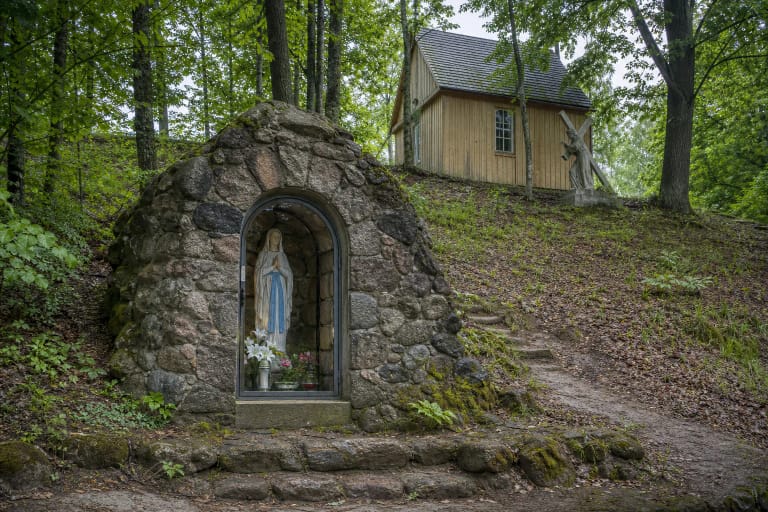
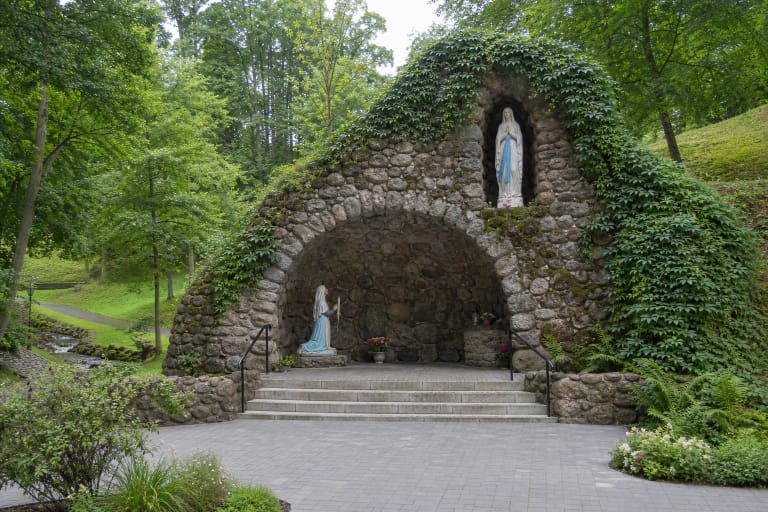
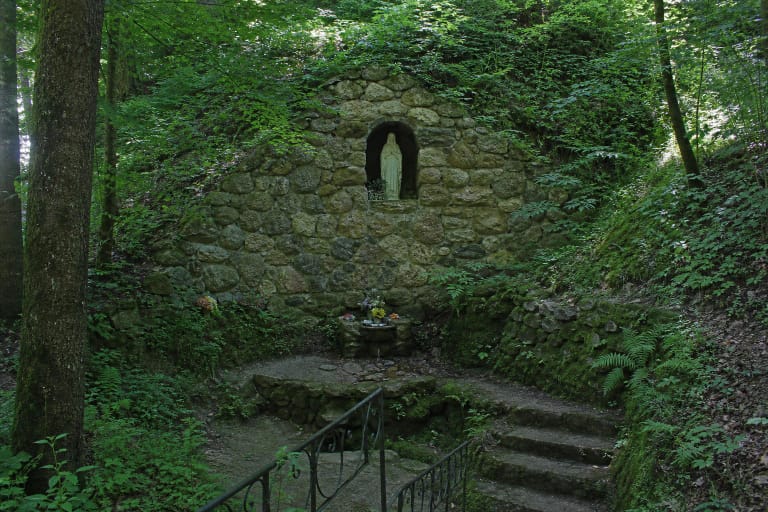
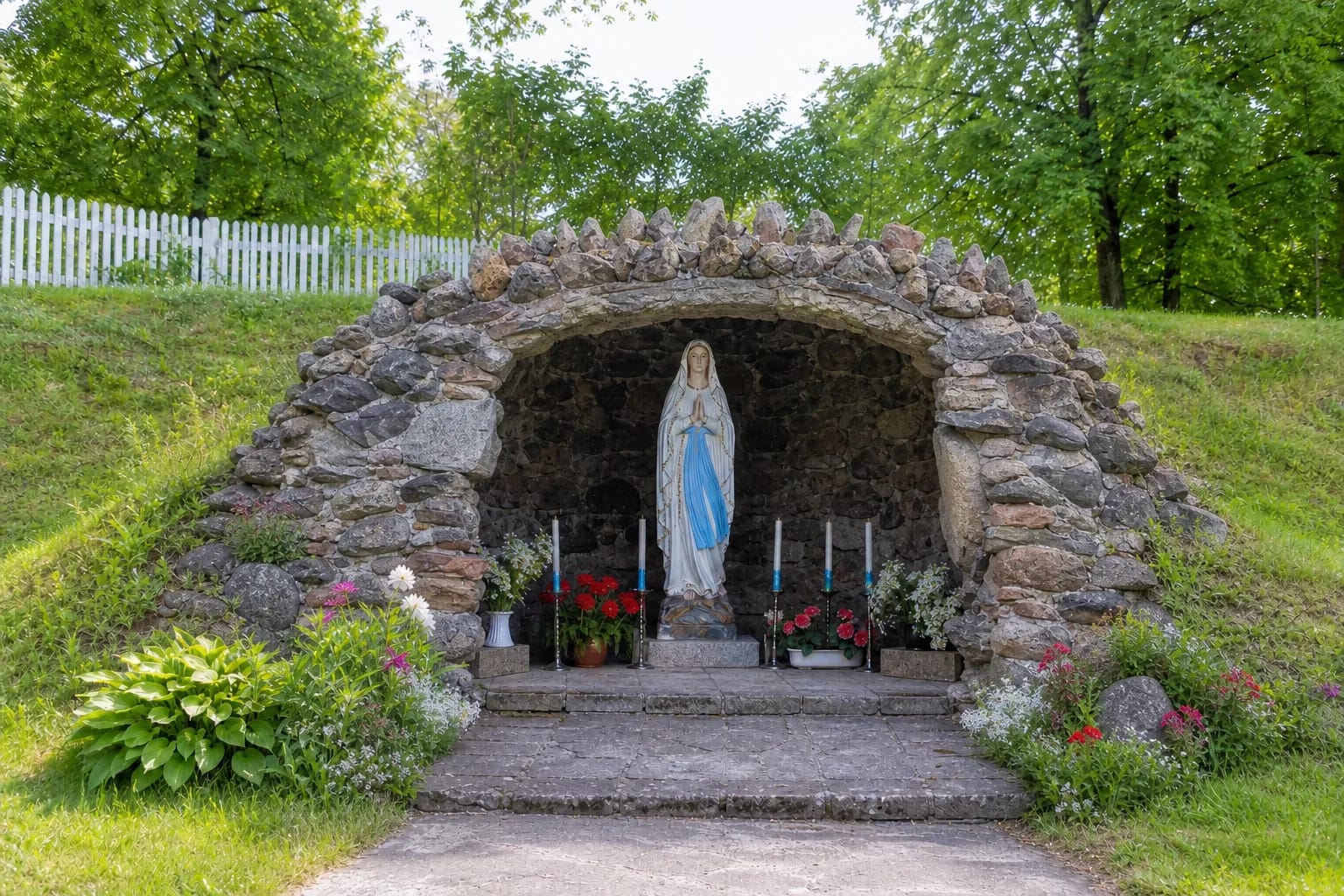
A fieldstone niche roughly 1.8 metres high occupies the slope, with a white-and-blue statue of Our Lady of Lourdes inside. The water point faces the grotto, while 14 stone steps rise on its right towards the church. Flowers, candles, and the structure's small scale make it a place of close personal devotion rather than monumental architecture.
Travel descriptions commonly call the site Gardamas Lourdes and Spring, but the municipality makes a more precise distinction. It calls the present water feature a well dug around 1925 and says that a spring flowed here earlier. Today's well should therefore not be described without qualification as a still-flowing natural spring.
Construction began in 1920, but the origin story remains unresolved
Ethnologists studying western Lithuanian grottoes used testimony collected during expeditions in 1994-2000 together with archival material. They date the start of work at Gardamas to 1920 and explicitly note that neither the archives nor witnesses supplied an exact completion date. This is more reliable than repeating a single supposedly precise date.
The most widely recorded account credits the initiative to Julius Maciejauskas, the long-serving prelate of Švėkšna who was also involved with the Inkakliai Lourdes site. Another local version attributes the grotto to priest Stasys Ignatavičius after a parishioner dreamed of Mary; an earlier clue names priest Aleksandras Bialozaravičius and a Lourdes statue he erected in Gardamas. These competing strands cannot responsibly be collapsed into one confirmed founder's biography.
The grotto is often said to have been blessed with the new Gardamas church in 1932. The Telšiai Diocese confirms that masonry work on the church began in 1929 and that it was blessed on 25 September 1932, but that does not by itself prove that the grotto was completed on the same day. The soundest chronology is a construction start in 1920 and likely incorporation into the sacred ensemble by 1932.
A small Samogitian Lourdes and its 14 steps
VLE defines a lurdas as a Catholic devotional structure modelled on the apparition grotto at Lourdes in France. Lithuania has about 50 of them, concentrated particularly in Samogitia and Suvalkija, and they often stand at the foot of a hill beside water. Gardamas fits that landscape pattern exactly, though it is far smaller than the pilgrimage complexes at Kretinga or Plungė.
The architecture is direct: an irregular broad opening assembled from local fieldstones shelters the statue of Mary. Its force comes not from elaborate ornament but from the contrast between a dark recess, the pale figure, and coarse stone. The modest height also allows visitors to take in the whole structure at close range, including the tradition of leaving candles, votive offerings, and flowers.
Local accounts connect the 14 steps beside the grotto with the 14 Stations of the Cross. Older residents described climbing them as 'walking the stations'. This is a local ritual reading of the staircase, not evidence that each step carries a separate, officially marked Station of the Cross image.
May devotions, processions, and the memory of St Roch's feast
Before the Second World War, May devotions took place at Gardamas Lourdes, and people prayed alone or gathered to sing hymns. A Corpus Christi procession once travelled from Gardamas church to a wayside chapel at Užlaukis, with the grotto serving as one station. The small roadside shrine thus belonged to a much wider parish landscape.
Fieldwork in 1994-2000 recorded a procession to the statue of Mary on the feast of St Roch and communal prayer on May evenings. That testimony is valuable evidence of practice in the late twentieth century, not an automatic timetable for events in 2026.
The current diocesan page lists May devotions in Gardamas parish, Sunday Mass at noon, and the St Roch feast on 16 August, transferred to Sunday. It does not say that every one of these services, or today's feast-day procession, necessarily takes place at the grotto. Visitors wishing to participate should contact the parish and check that year's notices.
Damage, renewal, and stories that remain stories
Academic research supports a restrained historical outline: the Gardamas shrine was damaged under Soviet rule and restored during the Lithuanian national revival. A later local tourism account adds that the statue's head was broken off and thrown into the Tenenys, and that a priest named Vaitkus arranged its restoration. Because the academic study does not corroborate that specific episode, it is best treated as recorded local memory.
People also tell of Mary appearing here or of an unbelieving man's child recovering, after which the grateful father built the grotto. Another tradition links its construction to the end of fires that had repeatedly harmed Gardamas churches. These are differing devotional legends, not documented causes of construction or verified medical cases.
Local accounts once described the water as healing, and feast-day visitors collected it to take home. Yet the public official descriptions provide no current microbiological or chemical analysis of the Gardamas well. Sacred meaning is neither a drinking-water certificate nor evidence of a therapeutic effect, so visitors should not drink it without new confirmation from a competent authority.
Planning a short and respectful visit
As of 20 July 2026, the official municipal and parish pages published no separate admission fee, ticket office, or set hours for the outdoor Gardamas grotto. It stands in an open space below the church, but that does not imply supervision or lighting around the clock. Daylight is the sensible time to visit, and 20-40 minutes is enough for the grotto itself.
The church service schedule is not a Lourdes opening timetable and does not guarantee that St Roch Church will be unlocked at other times. To combine the grotto with the church interior, May devotions, or the feast, check the Gardamas parish page of the Telšiai Diocese before travelling and use the contact listed there.
No official parking plan, step-free-access specification, or accessible-toilet information is published. A slope and 14 stone steps separate the grotto from the church, so wear slip-resistant footwear after rain and do not assume that the entire ensemble is independently wheelchair accessible. Park only where permitted, leave access to the church and neighbouring homes clear, never leave candles burning unattended, and carry all litter away.