- Place
- Biržai, Biržai District Municipality
- Region
- Aukštaitija
- Type
- disused narrow-gauge station heritage site with an outdoor rolling-stock display
- Address
- 9 Stoties Street, Biržai
- Coordinates
- 56.20090, 24.74728
- Visit duration
- 30-45 minutes for a self-guided exterior look; do not rely on published hours for interior access
- Best time
- in daylight, when the rails, rolling stock, and building exteriors are easiest to read
Biržai Narrow-Gauge Railway, Biržai Narrow-Gauge Station, Siaurojo geležinkelio kompleksas Biržuose
What Biržai Narrow-Gauge Railway Complex actually means
The visitor-facing name is convenient, but the Cultural Heritage Register uses a more complex structure. There is no separately nested record called the Biržai Station Complex. Instead, the national-level Narrow-Gauge Railway Complex, code 21898, contains 92 constituents across the Panevėžys, Pasvalys, Biržai, Pakruojis, and Anykščiai areas. The Biržai station properties are direct constituents of that much larger protected system.
Seven registered structures belong to the Biržai station group: the station (21902), first goods warehouse (21903), depot (21904), water tower (21905), baggage building (21906), station residence (32941), and second goods warehouse (32942). The first five are state-protected regional-level properties. The residence and second warehouse are also regional-level KVR constituents, but their current status is registered rather than state protected.
The track is not assigned to one of those seven buildings. It is protected through another constituent of the same national complex, the Panevėžys-Biržai section, code 21899. The locomotive and wagons standing outside form the site's rolling-stock display, but they are not listed as separate immovable structures among the complex's 92 KVR constituents.
1921 or 1922: how the Biržai station story began
Both dates appear in reliable sources. Biržai Municipality's heritage page says the Šiauliai-Biržai narrow-gauge railway was built in 1921, while Biržai TIC says the German-started Gubernija-Pasvalys line reached Biržai in 1922. The evidence fits a construction and opening phase spanning 1921-1922: KVR dates the timber passenger station, first goods warehouse, and baggage building to 1922.
The site continued to grow. The red-brick depot was built around 1930, followed by the tall square water tower in 1934. KVR gives the broader 1920s-1930s for the railway house and second goods warehouse. Biržai was therefore not a one-year project, but a terminus that developed over more than a decade into a passenger, freight, and locomotive-servicing yard.
The railway connected an agricultural district with the wider network. Biržai TIC mentions timber, quartz sand, livestock, flax, beet, and food consignments, alongside everyday journeys to work and school. The warehouses, raised loading edge, baggage building, water tower, and depot are therefore not decorative outbuildings. Each records a different part of how the station worked.
Reading the buildings, track, and rolling stock on site
The most recognisable passenger building is a single-storey timber station with a half-hipped roof, two dormers, and a central projection whose gable carries the name BIRŽAI. KVR protects its log walls, patterns of horizontal and vertical boarding, window and door surrounds, and historic opening rhythm. This is not a monumental masonry terminal, but a terminus that retains the intimate scale of Lithuania's interwar narrow gauge.
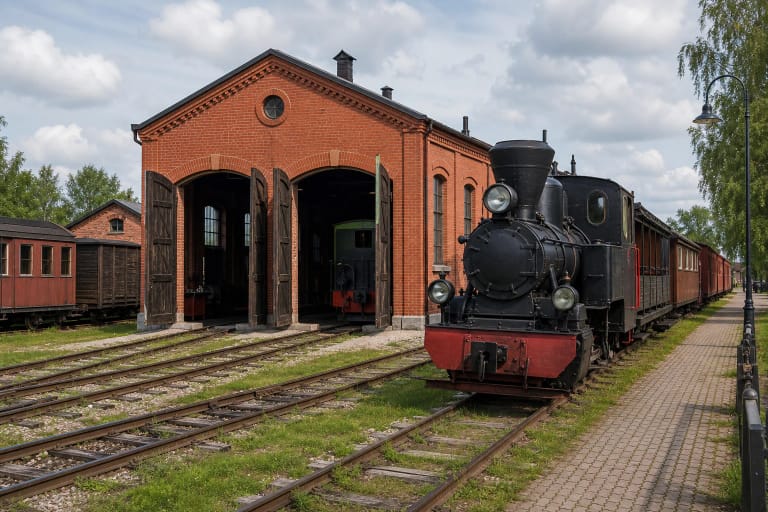
The first goods warehouse is a low red-brick building with a gabled roof, raised loading edge, and a deep end canopy on iron braces. Wide doors and a long row of windows identify the depot, where locomotives could be brought under cover for maintenance. The water tower is a slender square red-brick shaft with a subtly broader upper stage and a low pyramidal roof.
The KVR record for the Panevėžys-Biržai section protects the gravel ballast, rails, timber-sleeper type, embankments, cuttings, crossings, culverts, and bridge types. At the Biržai station yard it identifies one switch with a direction indicator, four switch fragments, and the stone-paved station yard. The green TU2-type diesel and timber wagons make the railway's scale tangible, but their position on the track is not evidence of an operable train.
The inactive Biržai line is not today's visitor Siaurukas
Biržai TIC says passenger service ended in 1988 and the line to Biržai closed completely in 1996. That is the crucial distinction from the 68.4 km Panevėžys-Anykščiai-Rubikiai section, where Aukštaitijos siaurasis geležinkelis operates excursions and events. A ticket for the visitor railway in Panevėžys or Anykščiai does not create a service to Biržai.
A 2025 KPD discussion explicitly described the Panevėžys-Biržai and Joniškėlis-Linkuva sections as inactive, with tourism and community reuse discussed as future possibilities. Its report identifies Miruta as the company that had acquired the railway section that year. That statement concerns the section; it does not establish that the company owns every station building, item of rolling stock, or visitor-access point in Biržai.
Heritage protection does not mean the whole route is fit for trains. KVR had already recorded rotten sleepers and dismantled or stolen rail segments in 2008. In Biržai, approach the site as a surviving terminus system rather than as a place to wait for a historic departure.
How to visit the Biržai narrow-gauge site today
Biržai TIC gives 9 Stoties Street and the coordinate 56.200905, 24.747284. The pin marks the general rolling-stock display and station yard, not a confirmed entrance to one building. The registered properties occupy several numbers: the passenger station is at 7 Stoties Street, the baggage building at number 9, and the depot and railway house at 9A.
The official attraction page publishes no dedicated station-museum hours, tickets, tour booking, or regular interior offer. Hours shown in the page footer sit with the Biržai TIC contact block and its address at 2 J. Janonio Street, so they must not be transferred to the station buildings. The narrow-gauge centenary event held here in 2021 demonstrates occasional programming, not routine admission.
Allow 30-45 minutes for an exterior look from Stoties Street and clearly open paths. Do not enter locked buildings, loading areas, or a yard with unclear access without permission. Rails, timber sleepers, switches, and raised loading edges lie among the grass; no continuous step-free visitor circuit, site-specific toilet, or dedicated attraction car park is published.
Fitting the complex into a day in Biržai
The narrow-gauge yard is a compact industrial-heritage stop rather than a full-day attraction. Biržai Castle deserves more time for its bastion-fortress and museum story, while the station works well as part of a walk or drive across town. Check the museum's schedule separately because it has no operational link to the railway site.
Continue through central Biržai and across the Lake Širvėna footbridge to Astravas Manor Park. This joins three very different layers of the town: the Radziwiłł fortress, the Tyszkiewicz manor, and twentieth-century transport infrastructure. At the railway yard, the most revealing details sit low, so look for branching rails, the warehouse loading edge, and a sightline towards the water tower.
A ride on a narrow-gauge train requires a separate trip to Panevėžys or Anykščiai and a confirmed departure. Those sites belong to the same large KVR heritage complex, but only the Panevėžys-Rubikiai section carries visitor trains. The comparison is useful: Biržai preserves an inactive terminus, while Panevėžys and Anykščiai present a living railway service.