- Place
- Molėtai District Municipality
- Region
- Aukštaitija
- Type
- active Neo-Romanesque Catholic church and protected architectural landmark of Alanta
- Address
- Turgaus a. 24, Alanta, Molėtai District
- Coordinates
- 55.35115, 25.29572
- Visit duration
- 20-40 minutes for the exterior and churchyard; up to 1 hour for the interior when open
- Best time
- daylight for the architecture; arrange a visit shortly before or after a service if you wish to see inside
Alanta Church, Alanta Church of St James, Alantos Šv. apaštalo Jokūbo bažnyčia
Why the church appears before you enter Alanta
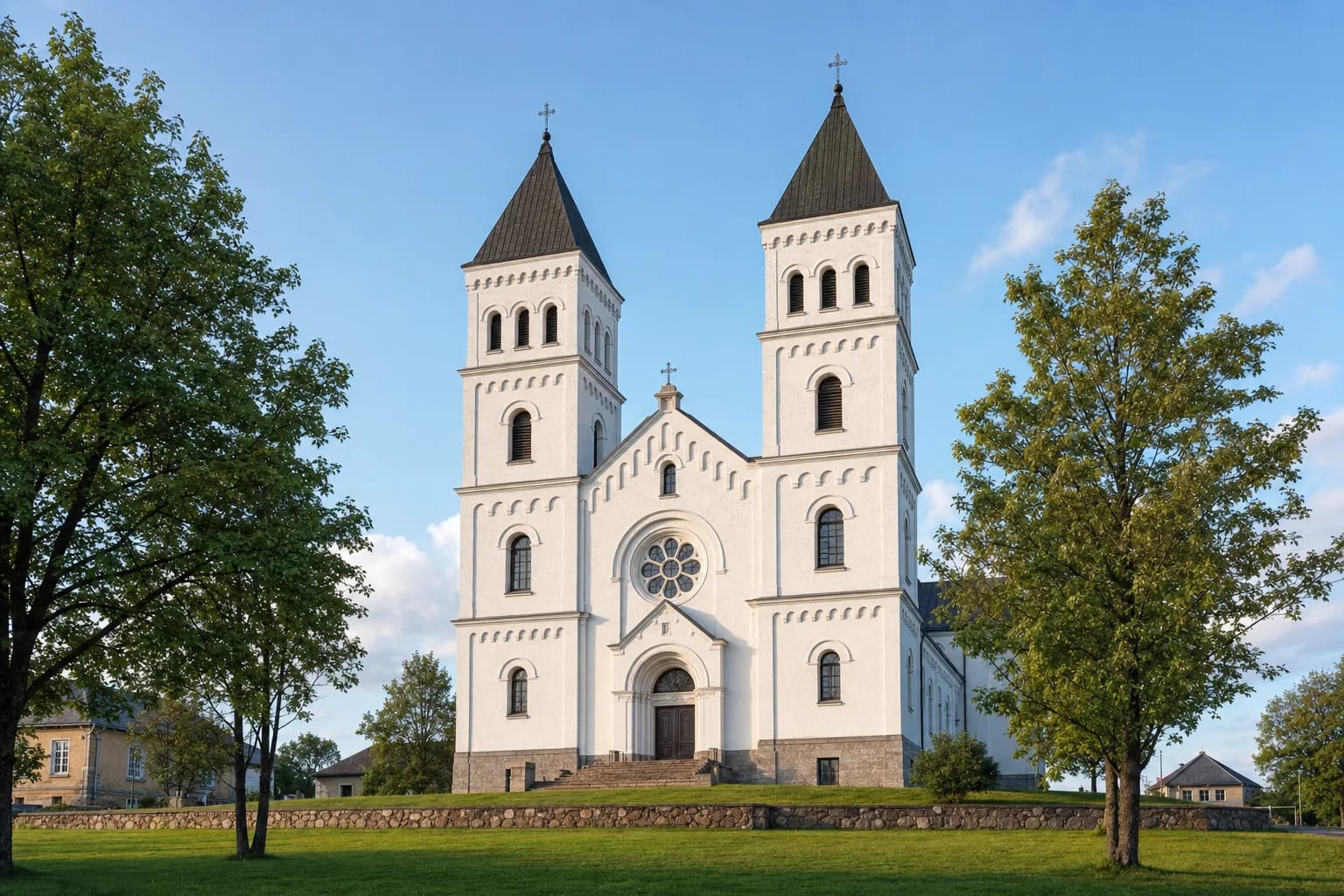
The church occupies the highest point in town on the right bank of the Virinta. Its two 51-metre façade towers rise far above the one-storey houses and trees, making the building Alanta's landmark from every principal approach.
Views are especially expressive from the east and southeast. The dark pyramidal tower roofs and symmetrical white mass appear first; closer in, the hewn-fieldstone base, circular rose window, recessed portal, and bands of small rounded arches become clear.
A fieldstone wall surrounds the churchyard. Together with the lawns and mature trees, it forms a restrained foreground to the monumental façade. The best sense of scale comes from stepping back toward the market square or viewing the church from the town approaches.
Strandmann's Neo-Romanesque design, not Neo-Gothic
Karl Eduard Strandmann, an architect based in Liepāja who designed several churches in Lithuania, created Alanta's building. Although his work often used Neo-Gothic forms, this church is Neo-Romanesque: round arches, massive towers, arcading, and a circular façade window replace pointed Gothic motifs.
The building is a three-aisled hall church on a Latin-cross plan with a semicircular main apse. Two smaller apses beside it are a distinctive feature. The ends of the transept repeat the rose-window and arched-niche composition, keeping the architectural language coherent on every side.
Inside, grouped piers divide the bright three-aisled hall and repeated round arches continue the exterior style. Even the eclectic altars favour Romanesque motifs. Read the interior as one architectural space, but remember that it remains first and foremost a place of worship.
From a tradition dating to 1504 to consecration in 1921
The diocesan history places Alanta's first church or chapel around 1504, while Jokūbas Astikas endowed it in 1534. The present masonry church is much later, yet continues several centuries of Catholic parish life in the town.
The new project was approved in 1903 and the main construction phase is dated 1904-1912. By 1909, the presbytery was plastered, an altar had been moved from the old church, and services began. This explains why some sources call 1909 the building date even though construction and fitting continued.
The First World War delayed the interior, and German forces removed metal parts from the organ in 1915. Bishop Pranciškus Karevičius consecrated the church in 1921; the altars were rebuilt in 1929-1931 and the interior renewed in 1937. Towers and walls damaged in 1944 were repaired after the war.
Works of art and what should no longer be promised
The official visitor description mentions seven significant works of art in the church. Heritage inventories are not static, however: in 2024, the Cultural Heritage Department stated that four previously protected objects had been transferred permanently to the National Museum of Lithuania.
Visitors should therefore not assume that every work named in an older catalogue remains in its former place. Focus on what is visible on the day, and ask the parish if a particular painting, sculpture, or liturgical object is the reason for your visit.
Avoid flash during services, never photograph people without consent, and do not enter the sanctuary. Modest clothing, a quiet voice, and a pause at the door help you notice whether prayer, a funeral, or another rite is taking place.
Mass, interior access, and a practical visit
On 25 July 2026, the Panevėžys Diocese listed Mass at 10:00 on Saturdays and Sundays and 18:00 on weekdays. Times may change for feasts, funerals, or clergy duties, so verify the schedule on the parish page or by phone.
This is not a ticketed museum, and open doors outside services are not guaranteed. Contact the parish for a group or dedicated interior visit. Its official contact address, Bažnyčios g. 3, differs from the church's map address at Turgaus a. 24; choose the church's own listing for navigation.
The municipality funded a ramp-installation project in 2024, but no authoritative confirmation of a completed accessible route was found. Visitors with limited mobility should ask about the present entrance, thresholds, and door width before travelling and use only marked parking spaces in town.