- Place
- Kaunas City Municipality
- Region
- Kaunas
- Type
- interwar business-institution palace with art and interior heritage
- Address
- K. Donelaičio g. 8, Kaunas
- Coordinates
- 54.89836, 23.92492
PPA Palace, Former Chamber of Commerce, Industry and Crafts Palace, Chamber of Commerce, Industry and Crafts Palace in Kaunas, Prekybos, pramonės ir amatų rūmai
A palace for a business institution
The Chamber of Commerce, Industry and Crafts Palace is one of the richest interwar buildings on K. Donelaičio Street. It is not merely another Kaunas modernist facade. It was the palace of Lithuania's business self-government institution, built so that trade, industry, and craft interests would have a representative address in the temporary capital.
KVR states that the clients were a corporate institution of Lithuanian businesspeople. Its beginning is linked with the Chamber of Commerce and Industry founded in Kaunas in 1925, reorganized by a new 1936 law into the Chamber of Commerce, Industry and Crafts. The building therefore speaks not only about architecture but also about the modernization of the state's economy.
Address on Donelaičio Street
Today the object stands at K. Donelaičio g. 8 in Kaunas Naujamiestis. AUTC describes this street as a highly official artery of the interwar city, where the environment of the Ministry of Justice, banks, museums, and state institutions formed nearby.
This context matters for visitors. From the street, the palace looks solid and somewhat closed, but its location clearly belongs to the institutional map of interwar Kaunas: from Vienybės Square and the Bank of Lithuania to the museum quarter and other buildings that shaped Naujamiestis.
The dispute over the first site
AUTC stresses that in 1937 the palace was first intended for the area near the War Museum. This was a sensitive location, because the War Museum Garden functioned in interwar Kaunas as a space of statehood symbols, so a new economic-institution building there could not be treated simply as a practical office.
After city-council and public discussions, another site was chosen at the corner of K. Donelaičio and historic Lyda streets. KVR states that the plot was bought in 1937 from reserve colonel Ignas Musteikis, and the project was adjusted for the changed location.
Competition and architect
Twenty-eight designs were submitted to the competition. KVR and AUTC agree that the right to build went to Vytautas Landsbergis-Žemkalnis, who had won second prize. VLE calls him one of the pioneers of modernist architecture in Lithuania and includes the Chamber of Commerce, Industry and Crafts Palace among his Kaunas works.
This building is worth seeing alongside Landsbergis-Žemkalnis' earlier Research Laboratory. The laboratory is more technical and functionalist, while the Chamber palace has more official representation. Here, especially, one sees the architect's ability to adapt a modern volume to institutional prestige.
Construction and opening
AUTC object data dates the building to 1937-1939, while KVR generally gives 1938 for construction. KVR's history section allows the dates to be set out more precisely: construction began in early August 1937, the cornerstone was blessed on August 18, the palace received permission to move into the new building on July 13, 1938, and the opening ceremony took place on February 18, 1939.
KVR names engineers S. Gudinskas and S. Milius as contractors. The palace was not just an administrative block: a garage was planned in the courtyard, the building contained offices, halls, representative spaces, and in 1939 a beer bar opened in the shelter for guests and informal business discussions.
Modernism with a memory of classicism
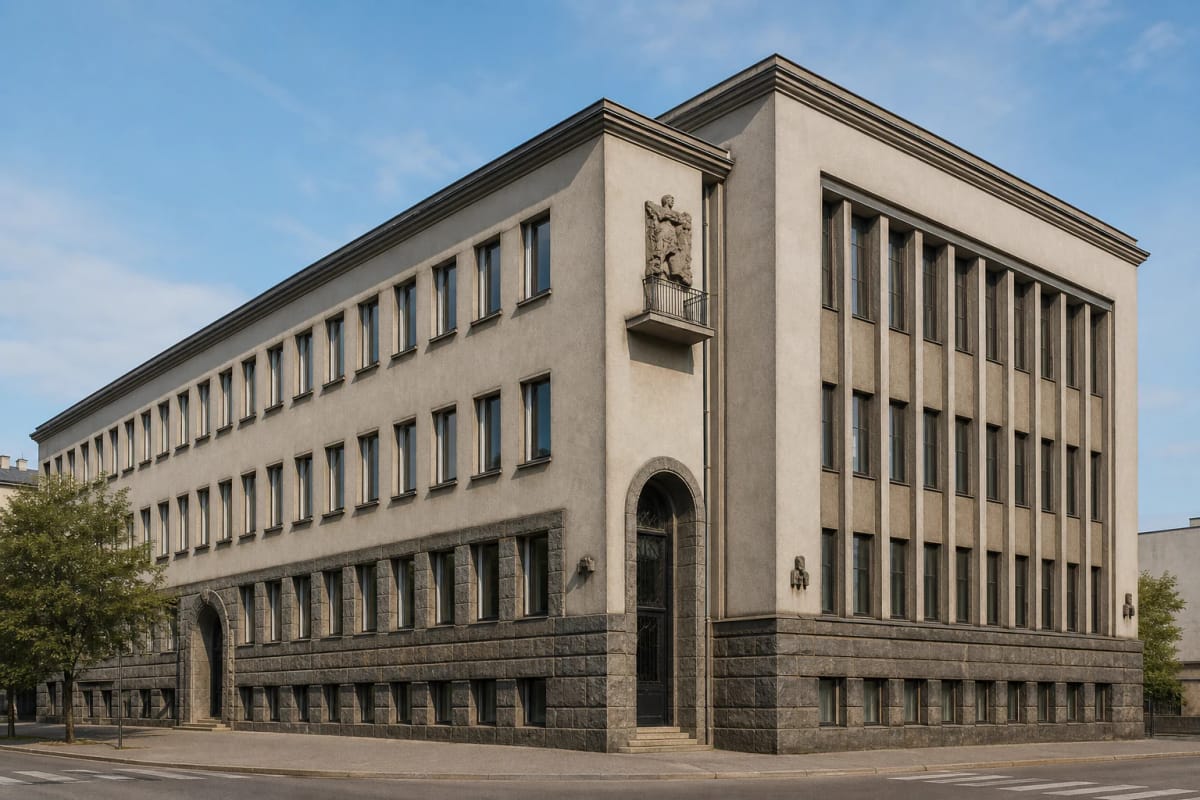
From the street, the building looks rational: clear L-shaped volume, three storeys with attic and semi-basement, regular window rhythm, restrained light facade plane, and darker dressed-granite plinth. KVR classifies the object as modernism.
Yet AUTC importantly explains that the Chamber palace facade retains more signs of classical representation than some more radical Kaunas modernist buildings. The rhythm of half-columns and arched portals is not accidental: it was inherited from the earlier composition planned near the War Museum and was meant to harmonize with the official surroundings there.
Two arched portals
The first thing to look for in person is the pair of profiled dressed-granite arched portals on the main facade. They give the palace not only a clear entrance but also a ceremonial quality that an ordinary office building would not have.
Above the left portal, KVR records a balcony with metal railings; beside the portal, a granite sphere; and above the portals, Bronius Pundzius' granitic-plaster bas-reliefs Trade and Industry. These reliefs have their own KVR code, 7561, so the facade art is not a decorative minor detail but an independently protected heritage layer.
The interior as an art programme
The Chamber palace is exceptional because KVR values not only architecture but also art, engineering, and history. The interior description mentions vestibule and foyer columns with black-marble imitation finish, geometric terrazzo floors, parquet, stairs, openwork metal railings, doors, windows, and even a non-functioning historic lift.
The art programme was high level. KVR states that Petras Kalpokas with J. Jocys created a fresco ensemble, Stasys Ušinskas decorated the main-staircase windows in 1938 with the stained-glass works Lithuanian Girl and Builder, Jonas Buračas painted Lithuania's Access to the Seas, and Bronius Pundzius and Liudvikas Strolis created decorative vases and sculptural works.
Frescoes and stained glass
One of the most sensitive layers is Petras Kalpokas' frescoes. KVR names the staircase fresco Work, created in 1938 and uncovered and restored in 1983. Other vestibule frescoes, Agriculture and Crafts, Kanklininkas, and Timber Rafters, were painted over in 1942, but investigations showed that their recovery may be realistic.
Stasys Ušinskas' stained-glass works Lithuanian Girl and Builder also have a separate KVR code, 8434. This makes the building a strong example of how interwar Kaunas architecture, applied art, and national-style searches worked within one space rather than in separate museum objects.
After the occupations
In summer 1940, after the Soviet Union occupied Lithuania, KVR states that the Chamber was liquidated and the building nationalized. In summer 1941, after the Nazi occupation began, the Lithuanian General Commissariat was installed here. In 1942, at German demand, Kalpokas' vestibule frescoes were painted over.
In September 1944 the building was transferred to the Central State Library, and in 1950 the Kaunas Regional Library was established here, later associated with Kaunas County Public Library. Major repairs in 1967-1968 changed parts of the original plan. This history explains why today the palace is a sign of both interwar optimism and complex twentieth-century institutional change.
Not the current Chamber office
It is important not to confuse the historic building with the current headquarters of the Kaunas Chamber of Commerce, Industry and Crafts. On the official chamber.lt website, the Chamber's address is listed as Gedimino g. 43-1, so K. Donelaičio g. 8 should be visited as the historic palace building, not as today's organizational office.
Interior visiting should also not be promised automatically. The exterior is freely visible from the street, but seeing the interior heritage depends on the building managers, events, tours, or other current opportunities. Check the newest information before planning an interior visit.
UNESCO modernism context
The Chamber of Commerce, Industry and Crafts Palace is part of Kaunas Naujamiestis modernist heritage associated with the UNESCO World Heritage property Modernist Kaunas: Architecture of Optimism, 1919-1939. The most accurate wording is that the building is part of this broader urban modernism fabric, not an individually inscribed UNESCO object.
Its value in that context is clear: the palace shows how the temporary capital created not only state ministries, museums, and banks, but also representation for business self-government, trade, industry, and crafts. This is a modern city caring for the infrastructure of its economic society.
How to visit today
For an independent stop, start on K. Donelaičio Street in front of the main facade. From a distance, the corner volume, window rhythm, granite plinth, and two portals are visible. Up close, look separately at the reliefs, balcony, stonework of the portal, and courtyard entrance zone.
The object is best combined with the Land Bank, Bank of Lithuania, War Museum, Čiurlionis Museum, and other Donelaičio Street and Vienybės Square modernism stops. Such a route shows why one Kaunas street could function in the interwar period as an axis of state, culture, and economy representation.