- Place
- Palanga City Municipality
- Region
- Palanga
- Type
- historic resort avenue with sculptures
- Address
- From Kęstučio Street to the Kurhaus, Palanga
- Coordinates
- 55.91394, 21.06321
Tiškevičiai Avenue, Grafų Tiškevičių alėja
Counts Tiškevičiai Avenue - a historic axis of resort Palanga
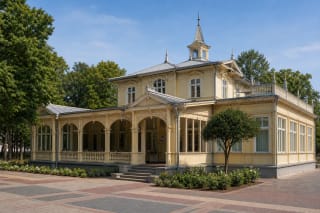
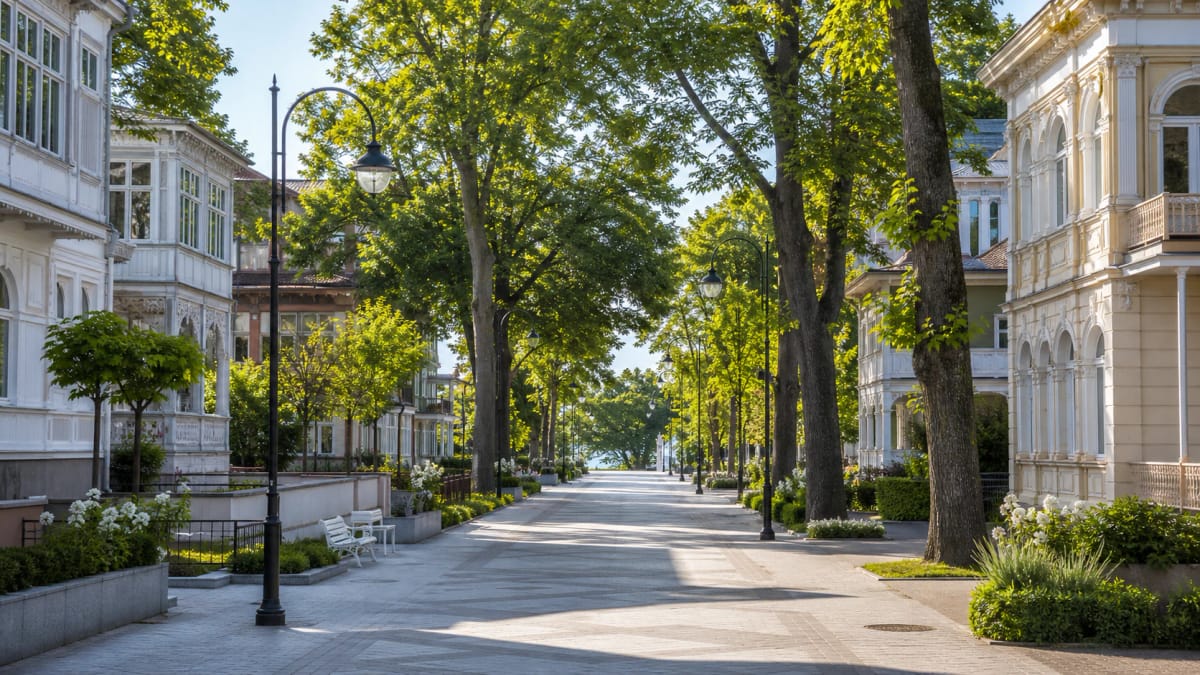
Counts Tiškevičiai Avenue is a short but symbolically important space in central Palanga, running from Kęstučio Street to the Kurhaus. It recalls the time when the Tiškevičiai family shaped the face of the resort - from the Kurhaus to the park, villas, and town promenades.
According to Palanga Municipality, more than 120 years ago the avenue created by Count Juozapas Tiškevičius was Palanga's first park and the resort's centre. It is therefore best understood not as an ordinary path, but as the oldest public axis of the resort, leading into the heart of historic Palanga.
Count Juozapas Tiškevičius's first Palanga avenue
The Tiškevičiai family acquired the Palanga estate in 1824, and in the second half of the nineteenth century Count Juozapas Tiškevičius (1835-1891) began developing the resort in earnest. On his initiative the Kurhaus was built (around 1877), a pier was laid out to the sea, and a representative avenue was created that became the town's first park and centre for promenades.
It was from this creative ambition that today's resort Palanga grew: the avenue linked the guests' life, the Kurhaus entertainments, and the way toward the sea. The restored avenue is presented by the town community as the residents' thanks to the resort's founders, the Counts Tiškevičiai.
Feliksas Tiškevičius, Édouard André, and Birutė Park
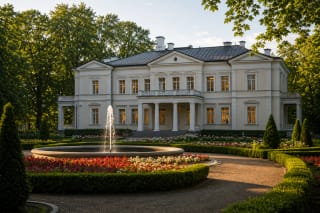
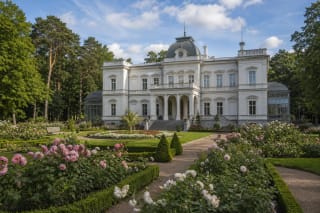
Count Juozapas's son Feliksas Tiškevičius (1869-1932) continued building the resort: in the late nineteenth century he built a Neo-Renaissance palace (now the Palanga Amber Museum) and, on the territory of the former sacred Birutė forest around it, commissioned a landscape park.
It is important not to confuse two objects: Birutė Park was designed at the Counts Tiškevičiai's commission by the famous French architect Édouard François André (1840-1911), while Counts Tiškevičiai Avenue is a separate, older resort promenade in the town centre. Together they form a single Tiškevičiai resort landscape.
The restored avenue and the Tiškevičiai sculptures
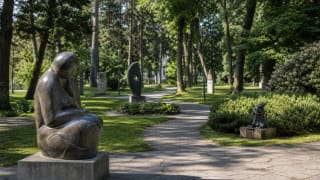
The restored avenue holds two bronze sculptures - "Countess Antanina Sofija Loncka-Tiškevičienė" and "Count Feliksas Tiškevičius". The sculptor is Klaudijus Pūdymas, and the architect is Snieguolė Stripinienė.
The sculptures are joined by a decorative band in the paving, in which the Tiškevičiai family motto is engraved in a repeating rhythm in Latin and Lithuanian - "Deligas quem diligas" and "Choose whom you love". These details create a place where the historic family is presented not only as palace owners, but as symbols of the making of the resort.
Visiting and what to see nearby
The avenue is a public outdoor space visited without a ticket. Evening works well for the lighting and atmosphere, while daylight is better if you want to photograph the sculptures and read the paving inscriptions calmly.
It is convenient to combine it with Palanga Kurhaus, the Sculpture Park, the Amber Museum, and a walk toward Birutė Botanical Park. Such a route shows Palanga as a historic Tiškevičiai resort, not only a beach town.