- Type
- God
- Domain
- Household wealth, fiery flight, carried abundance, household spirit
- Source status
- folkloric
kaukas, pūkis, damavykas
Who is Aitvaras in Lithuanian mythology?
Aitvaras is a Lithuanian mythical being, a household spirit who in legends brings its owner wealth and abundance. In eastern and western Aukštaitian legends he is called aitvaras; in Samogitian material, kaukas; in northern Lithuania sometimes pūkis; in southeastern Lithuania, damavykas, sparyžius, or koklikas; and in some places skalsininkas or gausinėlis.
He is one of the most colorful figures in Lithuanian folklore. Aitvaras belongs to the lowest level of mythology, not to the sky gods but to household spirits encountered in everyday life, in the granary and homestead.
Aitvaras' forms and origin
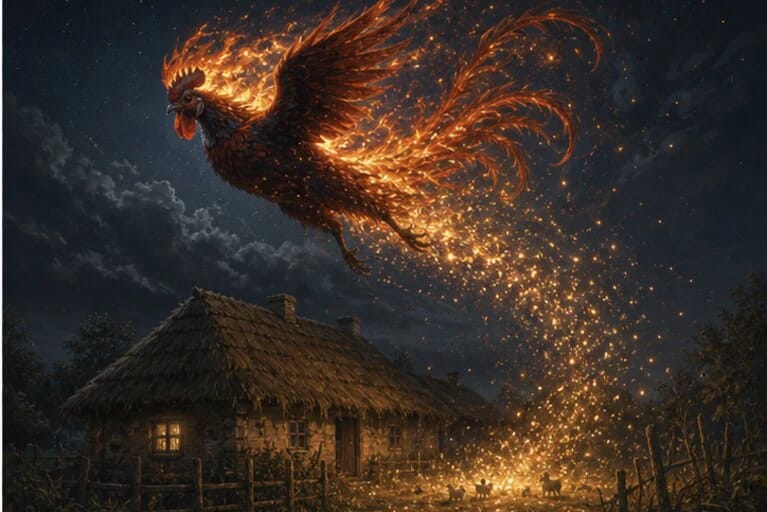
Aitvaras was imagined as a rooster, black cat, toad, small animal, or drone bee, while in flight he looked like a ball of fire, a long pole, or a towel. This fiery tail rushing across the sky is his clearest sign.
People believed Aitvaras was hatched from an egg laid by a rooster nine or twelve years old. It was supposedly possible to buy one in Riga or Königsberg, where it might appear as a little coal, piece of wood, or insect, to find one and bring it home, or to catch one flying and tame it by placing scrambled eggs on millstones.
The abundance Aitvaras brings
Aitvaras is kept in a granary, attic, on millstones, or on a windowsill and fed with scrambled eggs, dumplings, and rooster combs. In return he increases goods: he brings grain, money, hay, loves horses, and feeds them oats.

But the wealth Aitvaras brings has a dark side: he takes it from other people. For that reason the owner of Aitvaras is often condemned in folklore, and the abundance is understood as stolen rather than honestly earned.
Dangerous wealth: why people avoided Aitvaras
Keeping Aitvaras was judged ambivalently. In some legends he is a useful helper whose loss is considered misfortune. In others he is a heavy burden: he exhausts horses, forces the owner to work without measure, and his owners are said to die difficult deaths.
Therefore people who accidentally found or carelessly bought Aitvaras tried to get rid of him. For example, a farmhand deliberately eats the food intended for Aitvaras, and people burn the angered Aitvarai. This shows a double attitude toward sudden, dishonest enrichment.
Aitvaras among other peoples
Many neighboring peoples have similar mythological images: Latvians have pūķis; Russians and Belarusians have domovoy and the fiery grass snake; Poles have latawiec and zmok; Germans have Drack and Puck; Estonians have kratt and puuk; Finns have para.
These counterparts show that Aitvaras belongs to a wide Baltic and northern European circle of wealth-bringing household spirits. All are joined by the same idea: sudden wealth comes from a supernatural helper and has its price.
Aitvaras today
Aitvaras helps explain the Lithuanian attitude toward wealth, work, and honesty: abundance gained not by labor but by supernatural help is always ambiguous. Aitvaras remains a popular figure in folklore and culture.
Aitvaras is best read as a household spirit living in the everyday world, in the granary, on the millstones, above the roof. Through him we see how Lithuanian legends explained good fortune, abundance, and their cost.