- Place
- Vilnius City Municipality
- Region
- Vilnius
- Type
- late-Baroque Dominican church and carillon venue
- Address
- 11 Vasario 16-osios Street, Vilnius
- Coordinates
- 54.69078, 25.27202
- Visit duration
- 30-60 minutes for the church; another 15 minutes for a seasonal short carillon recital
- Best time
- outside Mass; 13:00 or 19:15 from 1 May to 30 September if you wish to hear an officially listed short carillon recital
Lukiškės Dominican Church, Church of St Philip and St James, Church of St James and St Philip
The wooden church of 1642 and the Lukiškės Dominicans
The first Dominican church in Lukiškės was founded in 1642. Jurgis Liutauras Chreptavičius, Castellan of Smolensk, provided funds for a wooden church and monastery in what was then a Vilnius suburb beside a cemetery. The friars who lived here were entrusted with burying poor townspeople and conducting their funeral rites without charge.
The wooden buildings did not survive. The church was damaged during the war in 1655, rebuilt, and burned again in 1684. The Dominicans began a masonry church in 1690. The Register of Cultural Property dates its main construction to 1690-1727 and the completion of its towers to 1727-1737.
Baroque architecture formed in several stages
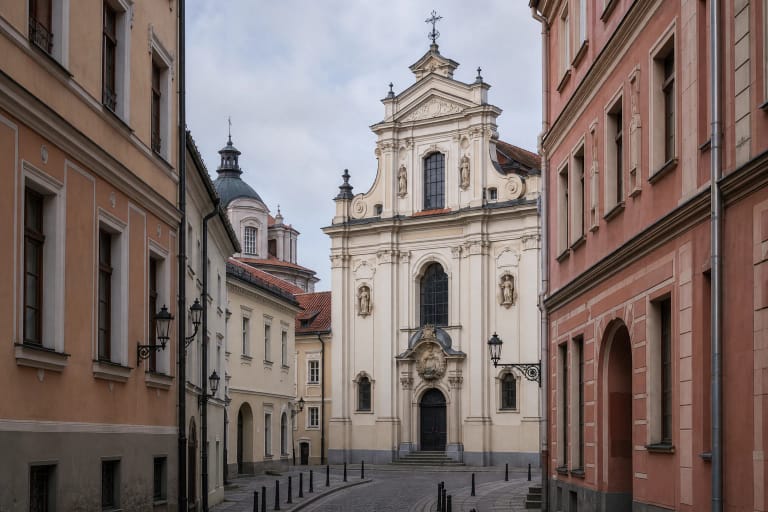
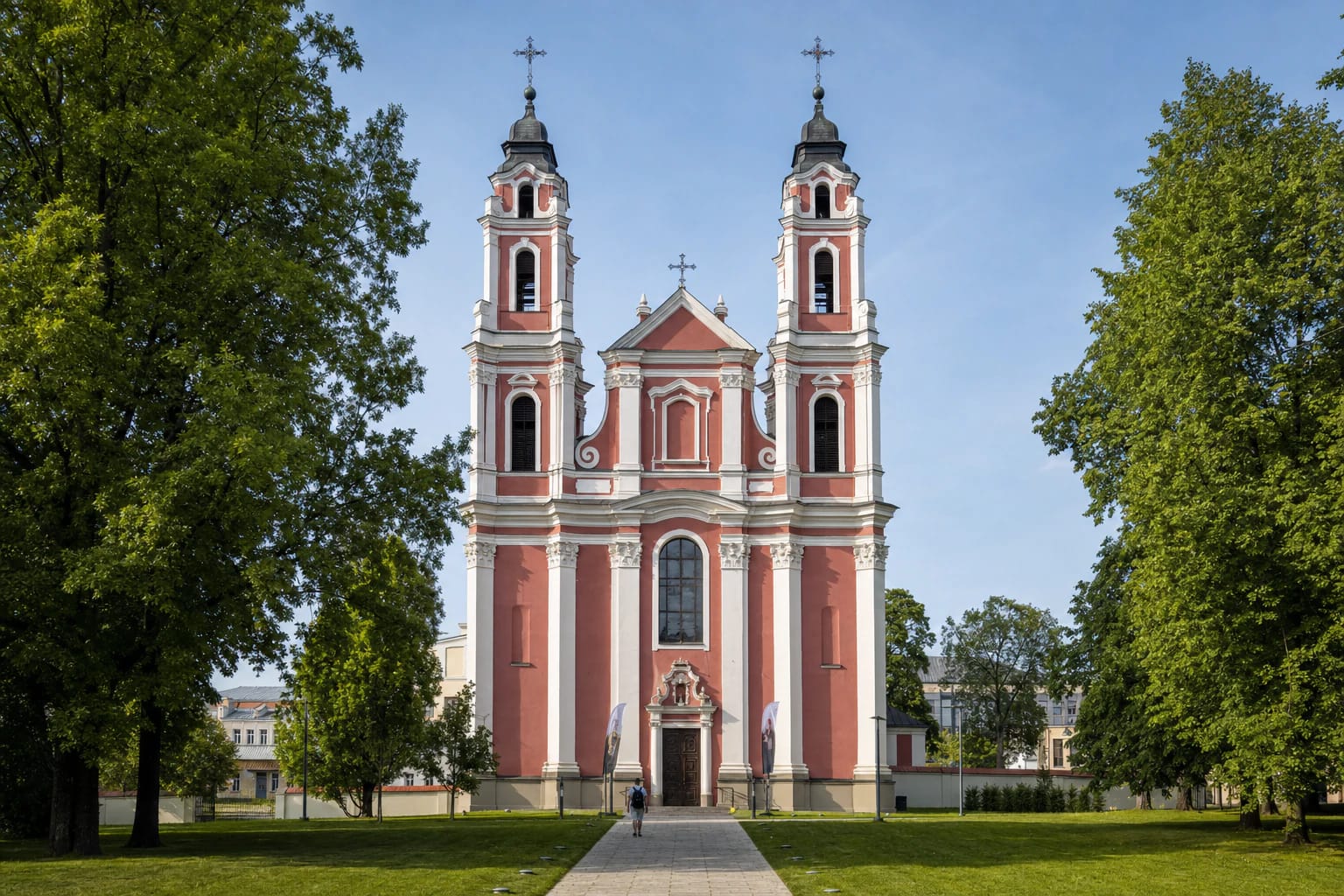
The long construction period explains the church's varied Baroque language. The lower tower stages and pediment were formed earlier, while the taller tapering stages with diagonal corners and graceful helmets belong to the more mature Vilnius Baroque tradition. The twin-towered facade remains a clear landmark in the Lukiškės townscape.
Restoration returned the facade to a rich colour known as Pompeian red, picked out by white pilasters, cornices, window surrounds, and scrolls. A straight path across the green churchyard gives a full frontal view of the symmetrical composition. The church, Dominican monastery, and former St James Hospital buildings form part of a protected heritage complex.
The icon of Our Lady of Lukiškės
One of the church's altars holds the image of Our Lady of Lukiškės with the Child. The Dominican account dates it to the late fifteenth or early sixteenth century and attributes it to the school of icon painter Dionisius. Written sources connect its journey with Motiejus Korvinas Gosievskis, the Dominicans of Sejny, and its transfer to the Lukiškės monastery in 1684.
The faithful venerate the icon as miraculous. The Dominican source states that more than 170 testimonies associated with it were recorded between 1684 and 1688, and that Bishop Konstantinas Bžostovskis of Vilnius recognised the image as miraculous by decree in 1688. For a visitor, this should be understood as the history of a documented religious cult and church tradition, rather than a scientifically verified judgement of the events.
Closure, warehouse use, and the Dominicans' return
The imperial Russian authorities closed the Dominican monastery and expelled the friars in 1844. Soviet authorities closed the church itself in 1948. The neglected building was used for storage, including by the Lithuanian Opera and Ballet Theatre, and demolition was considered during the Soviet period.
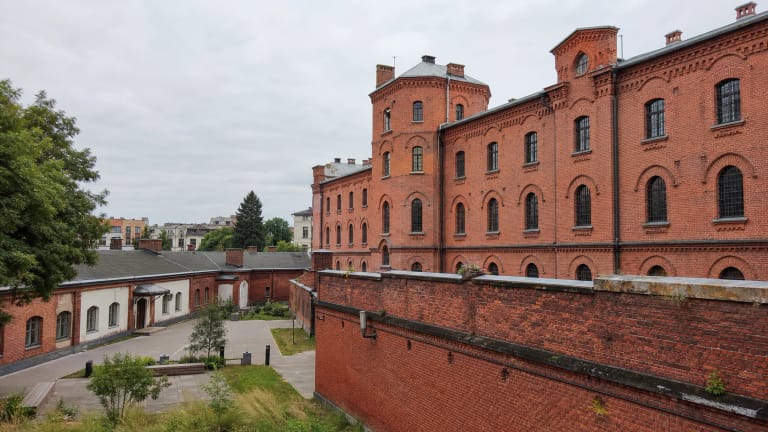
The church was returned to the faithful in 1992, and a restored Dominican community settled in the monastery in 1993. Work on the building renewed its interior and facades, and the icon of Our Lady of Lukiškės returned. The site is now not merely a restored monument but an active rectory, monastery, and religious community.
The 61-bell Vilnius Carillon
A five-octave concert carillon was installed in one of the church towers in 2015. It consists of 61 bells designed and cast by the Royal Eijsbouts foundry in the Netherlands. The smallest weighs 8 kilograms, while the largest, named Our Lady of Lukiškės, weighs 3,360 kilograms. It is Lithuania's largest carillon and one of the largest in the Baltic region.
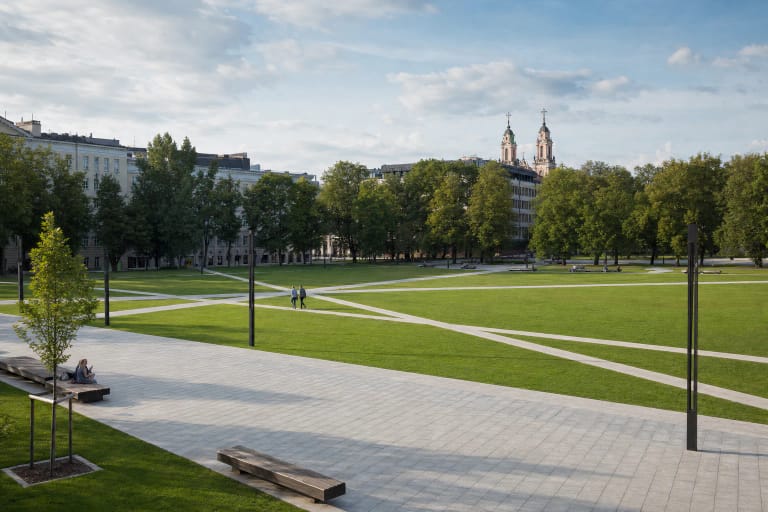
The official Vilnius Carillon website lists free short recitals of about 15 minutes every day at 13:00 and 19:15 from 1 May to 30 September. The churchyard and Lukiškės Square are convenient listening places. Separate live concerts and a festival have their own programmes, so recheck seasonal times before travelling.
Opening hours and respectful visiting
On 25 July 2026, the Archdiocese of Vilnius listed opening hours of 10:00-19:00 Monday-Saturday and 08:00-19:00 on Sunday. Mass was celebrated at 12:00 and 18:00 Monday-Saturday; Sunday services were at 09:00, 11:00, 16:00 in Polish, and 18:00 for young people. Schedules can change, so check the official source.
The Archdiocese page lists no separate sightseeing ticket. Enter outside services where possible, or sit quietly; do not photograph people at prayer without consent or enter closed monastic areas. The official visitor information does not detail wheelchair access, so contact the rectory in advance about thresholds or assistance.