Travel spots in Lithuania

Travel spots in Lithuania

Use English place pages for Lithuanian nature, heritage, museums, towns, castles, and cultural landscapes.

Travel spot guides

Each place page combines cultural context, practical details, and visitor orientation.

Hillforts and historic landscapes

Old hillforts, defensive hills, and historic landscapes tied to them.

Steep slopes of Alytus Hillfort above the Nemunas and Alytupis confluence
Hillforts and historical landscapes · DzūkijaAlytus Hillfort

Alytus Hillfort at the Nemunas and Alytupis confluence is considered the birthplace of the city, where the medieval wooden Alytus Castle once stood. Alytus, first mentioned in 1377, was an important defensive point on the Nemunas line against the Teutonic Order.

Green platform and high rampart of Apuolė Hillfort in the fields of the Skuodas region
Hillforts and historic landscapes · Skuodo kraštasApuolė Hillfort

Apuolė Hillfort is one of the earliest places in present-day Lithuania mentioned in written sources: the Curonian Apulia is linked with Rimbert's account of Swedish king Olaf's campaign around 853-854.

The high green hill of Bilioniai Hillfort with terraced slopes in the Samogitian landscape
Hillforts and Historic Landscapes · Šilalės rajonasBilioniai Hillfort

Bilioniai Hillfort, also called Švedkalnis, is a massive Samogitian hill with an oval summit platform, terraced slopes, and traces of a foot settlement. Together with the 388 ha Bilioniai Landscape Reserve, it is a strong landmark in the region's relief.

Green slopes and a path at Bubiai Hillfort near Bubiai Reservoir and the Dubysa valley
Hillforts and historic landscapes · Šiaulių kraštasBubiai Hillfort

Bubiai Hillfort stands on the Dubysa bank beside Bubiai Reservoir, south-west of Šiauliai. It is a thirteenth- to fourteenth-century Samogitian castle site that some researchers associate with the Dubysa castle, Dobicenas, mentioned in Teutonic Order chronicles. Its steep slopes and earthworks show its defensive role in the land of Šiauliai.

Gegrėnai Hillforts and nature trail in Žemaitija National Park
Hillforts and historic landscapes · Žemaitijos nacionalinis parkasGegrėnai Hillforts

The Gegrėnai Hillforts near Žemaičių Kalvarija are a major Žemaitija National Park archaeological complex. Two hillforts, two cemeteries, an ancient settlement, and presumed barrows mark the likely site of the Curonian castle Gegrė, mentioned in 1253, with a 1.6 km trail around the complex.

Green ridge of the Ginučiai and Papiliakalnė hillforts with wooden steps and an Aukštaitija lake panorama
Hillforts and historic landscapes · Aukštaitijos nacionalinis parkasGinučiai and Papiliakalnė Hillforts

The Ginučiai and Papiliakalnė hillforts in Aukštaitija National Park form one of the strongest historical landscapes in lake-filled Aukštaitija, joining the defensive memory of Linkmenys Castle, a narrow ridge, the Antanas Smetona memorial stone, and the nearby Ladakalnis panorama route.

Green summit of Girnikai Hill with a wide Šiauliai District panorama in Kurtuvėnai Regional Park
Hillforts and historic landscapes · Kurtuvėnų regioninis parkasGirnikai Hill

Girnikai Hill, also called Girnikų šventkalnis, is the highest point in Šiauliai District (183.4 m) in Kurtuvėnai Regional Park. From its summit one can see Šatrija and, according to local saying, 14 church towers, while legends of giants, a 1905 press-restoration cross, First World War graves, and the Baltic Unity fire tradition meet on the hilltop.

Green hill of Imbarė Hillfort above the confluence of the Salantas and Pilsupis in Samogitia
Hillforts and historic landscapes · ŽemaitijaImbarė Hillfort

Imbarė Hillfort, also called Pilalė, is one of the key Curonian hillforts in the Salantai area: from early fortifications to a tenth- to thirteenth-century castle and the 1253 written mention of Imbarė.

Kalnelis Hillfort with chapel and cemetery near the Sidabra River in Joniškis District
Hillforts and historic landscapes · Joniškio rajonasKalnelis Hillfort

Kalnelis Hillfort near Joniškis is the site of the Semigallian Sidabrė castle, described in chronicles as the strongest and last Semigallian fortress, which fell to the Livonian Order in 1290. Sidabrė is also tied to the symbolic beginning of the Joniškis region, while today the hill holds a chapel, cemetery, and monument to the defenders.

Kalniškės (Gargždai) Hillfort with stairs and a viewpoint above the Minija valley
Hillforts and historic landscapes · ŽemaitijaKalniškės (Gargždai) Hillfort

Kalniškės, or Gargždai, Hillfort rises about 20 m above the Minija near Gargždai. This well-kept Curonian hillfort has stairs, paths, and viewpoints, and is associated with Garisda, the castle mentioned in the 1253 Courland division act. A foothill settlement has been studied nearby, and the surrounding field called Raganinė is wrapped in legends.

Green hill of Kalnujai Palendriai Hillfort in the Raseiniai countryside on a quiet day
Hillforts and historic landscapes · Raseinių rajonasKalnujai (Palendriai) Hillfort

Kalnujai (Palendriai) Hillfort in Raseiniai District is a defensive site dated to the first millennium, with two ramparts and a sensitive twentieth-century memory layer: at its foot, in 1941, nearly 1,700 Jews of the Kalnujai area were murdered. The place should be visited as both archaeology and memorial landscape.

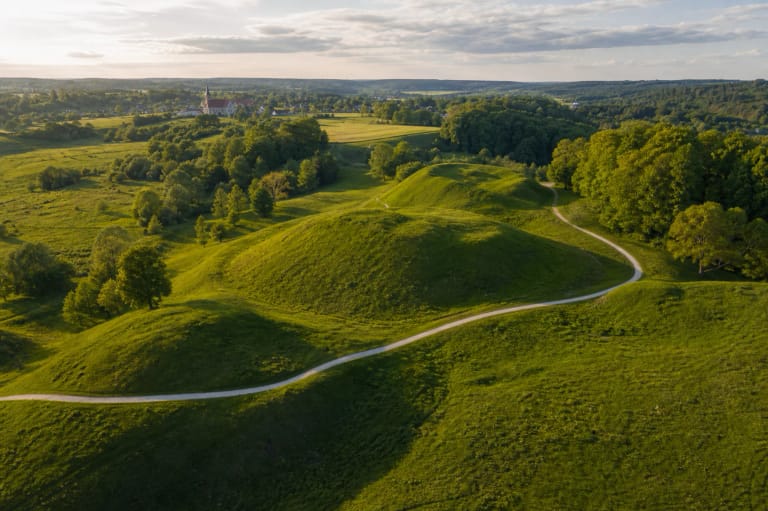
Green hillforts of Kernavė Archaeological Site and paths in Pajauta Valley in summer light
Hillforts and historic landscapes · Kernavės kultūrinis rezervatasKernavė Archaeological Site

Kernavė Archaeological Site is a UNESCO-protected cultural landscape of the Neris valley, Pajauta Valley, and five hillforts, preserving some of the most important layers of early Lithuanian statehood.

Wooded ramparts of Kulionys Hillfort by Lake Želvai
Hillforts and Historic Landscapes · Molėtų rajonasKulionys Hillfort

Kulionys Hillfort is a large wooded peninsula hill between Lakes Želvai and Trinktinis, dated from the 2nd-1st centuries BC to the 12th-14th centuries AD. Sources register it as a hillfort with a foothill settlement, not as a separately confirmed sacred alkas site.

Lepelionys Hillfort, Napoleon's Hat, a regular truncated-pyramid hill near Stakliškės
Hillforts and historical landscapes · Prienų rajonasLepelionys Hillfort

Lepelionys Hillfort near Stakliškės is known for its regular truncated quadrangular-pyramid form, which gave it the nickname Napoleon's Hat. Steep slopes, an oval platform with rampart, and new stairs make it one of the most scenic hillforts of the Prienai region; a first-millennium settlement was found at its foot.

Liškiava Hillfort with brick castle remains above the Nemunas valley in Dzūkija
Hillforts and historic landscapes · Dzūkijos nacionalinis parkasLiškiava Hillfort

Liškiava Hillfort by the Nemunas combines an early settlement layer, a medieval defensive place, and remains of an unfinished brick castle tower, making it one of the clearest Dzūkija sites where landscape merges with history and legend.

Slopes of Lopaičiai Hillfort and the nature-trail boardwalk in the forest
Hillforts and historic landscapes · ŽemaitijaLopaičiai Hillfort

Lopaičiai Hillfort near Tverai is not only an archaeological monument but also one of Samogitia's legend-rich ethnomythological complexes. Beside the hillfort flows the Devynių versmių spring, stones regarded as mythological are scattered through the forest, and a nature trail with a boardwalk winds among them.

Steep slopes and platform of Maišiagala Hillfort by the Dūkšta River
Hillforts and historic landscapes · Vilniaus rajonasMaišiagala Hillfort

Maišiagala Hillfort, popularly called Bona's Castle, rises by the Dūkšta River in Vilnius district. In the Middle Ages it guarded Vilnius from the north, was attacked by the Teutonic Order, and local memory connects it strongly with Grand Duke Algirdas, whose monument stands at the foot.

Green slopes of Medvėgalis Hillfort and a panorama of the Samogitian Uplands
Hillforts and Historic Landscapes · Varnių regioninis parkasMedvėgalis Hillfort

Medvėgalis Hillfort stands on the lower summit of Medvėgalis, called Pilies kalnas; the castle mentioned in 1316 belonged to the Samogitian defence system.

Merkinė Hillfort above a forested Nemunas and Merkys confluence landscape
Hillforts and historic landscapes · Dzūkijos nacionalinis parkasMerkinė Hillfort

Merkinė Hillfort stands near the Nemunas and Merkys confluence on a steep-sided hill that in the fourteenth and fifteenth centuries held one of the important Lithuanian wooden castles in the Nemunas defensive system.

Forest path at Mikytai Sacred Hill with a moss-covered mythological stone in Žemaitija National Park
Hillforts and historic landscapes · ŽemaitijaMikytai Sacred Hill

Mikytai Sacred Hill in Žemaitija National Park is an old sacred-site landscape: a forested hill, the site of an offering well, a mythological stone with a footprint mark, and a short trail in Mikytai Landscape Reserve.

Grassy hills of Molavėnai Hillforts in a Raseiniai District valley landscape
Hillforts and historic landscapes · Raseinių rajonasMolavėnai Hillforts

Molavėnai Hillforts form a two-hillfort landscape by the Šešuvis in Raseiniai District, dated broadly from the first millennium BC to the end of the second millennium AD. Authoritative sources describe them as hillforts, not as separately confirmed sacred hills.

Green hill of Narkūnai Hillfort and the Utenėlė valley in the Aukštaitija landscape
Hillforts and historical landscapes · AukštaitijaNarkūnai Hillfort

Narkūnai Hillfort near Utena is one of the important hillforts of Aukštaitija, also called Utenis Castle and associated with early fortifications, Nalšia tradition, and memory of a 1433 Livonian Order attack.

Grassy ramparts and broad platform of Pajevonys Hillfort in the fields of Suvalkija
Hillforts and historic landscapes · SuvalkijaPajevonys Hillfort

Pajevonys Hillfort in Vilkaviškis District, officially Kunigiškiai Hillfort, is one of the largest and best-fortified Sudovian hillforts, dated to the 2nd-13th centuries and known for Roman coin finds that point to long-distance trade.

Low wooded slope of Pakalniškiai Hillfort by the Daugyvenė valley in Radviliškis District
Hillforts and historic landscapes · Radviliškio rajonasPakalniškiai Hillfort

Pakalniškiai Hillfort, also called Kleboniškiai Hill, in Radviliškis District is a Daugyvenė valley site dated to the first millennium BC, with a foothill settlement and a nearby burial mound. This page specifically describes the Pakalniškiai site in the Radviliškis region, because the place-name repeats elsewhere in Lithuania.

Triangular platform of Pavištytis Hillfort with a view toward Lake Vištytis in Suvalkija
Hillforts and historic landscapes · Vištyčio regioninis parkasPavištytis Hillfort

Pavištytis Hillfort is the highest-rising hillfort in Vilkaviškis District, standing in Vištytis Regional Park near Lake Vištytis and Lithuania's south-western corner. Its triangular platform is framed by deep ravines, with wide views toward the lake and Rominta Forest, and local folklore tells of a church sunk into the hill.

Punia Hillfort above the Nemunas loop and Punia Forest in summer landscape
Hillforts and historical landscapes · Nemuno kilpų regioninis parkasPunia Hillfort

Punia Hillfort, also called Margis Hill, rises at the Nemunas and Punelė confluence. It combines one of the finest Nemunas Loops panoramas, fourteenth- to fifteenth-century castle layers, and the living memory of Margiris and Pilėnai.

Rambynas Hill viewpoint above the lower Nemunas valley and green meadows
Hillforts and Historic Landscapes · Rambyno regioninis parkasRambynas Hill

Rambynas Hill is a cultural and landscape place of Lithuania Minor on the right bank of the Nemunas, important for sacred-site traditions, the memory of the Rambynas stone, and broad views over the lower Nemunas.

Šatrija Hill with steep green slopes and a panorama of Samogitian fields
Hillforts and Historic Landscapes · Šatrijos draustinisŠatrija Hill

Šatrija Hill is one of Samogitia's most recognizable hillforts and viewpoints, known for archaeology, old-belief traditions, and legends about witches gathering on the hill.

Platform of Senoji Įpiltis Hillfort with a high rampart and green slopes
Hillforts and historic landscapes · ŽemaitijaSenoji Įpiltis Hillfort

Senoji Įpiltis Hillfort near Darbėnai is one of Samogitia's most impressive Curonian hillforts. Its strongly ramparted platform protected the castle of Duvzarė land, first mentioned in 1253, and in the thirteenth century it was burned by the Livonian Order.

Seredžius Hillfort, Palemonas Hill, rising above the wide Nemunas valley
Hillforts and historic landscapes · Panemunių regioninis parkasSeredžius Hillfort

Seredžius Hillfort, known as Palemonas Hill, is one of Panemunė's strongest historic points: the fourteenth-century Pieštvė Castle stood here, above the Nemunas and Dubysa confluence landscape.

Sprūdė Hill hillfort with green rampart belts and a panorama of the Varniai Basin
Hillforts and Historic Landscapes · Varnių regioninis parkasSprūdė Hill

Sprūdė Hill is a high Samogitian hillfort with a wide panorama over the Varniai Basin, Lakes Biržulis and Lūkstas, Varniai, Luokė, and other regional hillforts.

Green slopes of the Sudargas Hillfort Complex and a Nemunas panorama from the left bank
Hillforts and historical landscapes · Šakių rajonasSudargas Hillfort Complex

The Sudargas Hillfort Complex consists of five hillforts on the left bank of the Nemunas near Burgaičiai and Grinaičiai villages - Vorpilis, Pilaitė, Bevardis, Balnakalnis, and Žydkapiai. They are dated to the first millennium and the beginning of the second millennium, and are associated with the fourteenth-century Samogitian noble and commander Sudargas.

Green hill of Taurapilis Hillfort beside Lake Tauragnas in Aukštaitija
Hillforts and historic landscapes · AukštaitijaTaurapilis Hillfort

Taurapilis Hillfort stands on the southern shore of Lake Tauragnas. Here the lake panorama, the history of Tauragnai Castle, a foot settlement, a barrow cemetery, and one of the richest mid-first-millennium burials in Lithuania meet in one landscape.

Green slope of Ukmergė Hillfort with a serpentine path and city roofs behind
Hillforts and Historic Landscapes · UkmergėUkmergė Hillfort

Ukmergė Hillfort is the city-centre site of Vilkmergė Castle by the confluence of the Ukmergėlė and Šventoji, dated to the fourteenth-mid-fifteenth century.

Steep slopes and platform of Upytė Hillfort among former marshlands
Hillforts and historic landscapes · AukštaitijaUpytė Hillfort

Upytė Hillfort, known locally as Čičinskas Hill, was the centre of the historic Upytė land, one of the medieval Lithuanian lands recorded in chronicles that repeatedly repelled Livonian Order attacks. The hill is also linked with the famous Čičinskas legend about nobleman Sicinskis, the first to use the liberum veto.

Velikuškės Hillfort with steep slopes above Lake Sartai in Zarasai District
Hillforts and Historic Landscapes · Sartų regioninis parkasVelikuškės Hillfort

Velikuškės Hillfort rises with steep slopes above Lake Sartai in Zarasai District, in Sartai Regional Park. It is one of the park's best-known hillforts, with a wide lake panorama; nearby is a second hillfort of the same complex, called Sala, and excavations revealed rich life from the first millennium BC to the thirteenth century.

Green hills of the Veliuona Hillforts above the Nemunas valley in Panemunių Regional Park
Hillforts and historic landscapes · Panemunių regioninis parkasVeliuona Hillforts

The Veliuona Hillforts by the Nemunas are one of Panemunė's key historic landscapes, linking Gediminas' Grave, Ramybės Hill, and Pilaitės with Junigeda, the Veliuona castle tradition, 1291-1411 wars with the Teutonic Order, Gediminas death legend, and memory of the Nemunas defensive line.

Žvelgaitis Hillfort on the crest of Žagarė Esker with new oak stairs
Hillforts and historic landscapes · Joniškio rajonasŽvelgaitis Hillfort

Žvelgaitis Hillfort is the most impressive part of Žagarė Esker, rising above the left bank of the Švėtė in Joniškis District. It is one of two Žagarė hillforts; a rampart surrounds its trapezoid platform, and new oak stairs make the summit easy to reach. The name is linked with duke Žvelgaitis, though that association comes from a nineteenth-century historian's hypothesis.

Castles, palaces, and manors

Brick castles, ruler residences, manor estates, parks, and exhibitions.

Biržai Castle palace, bastion ramparts, bridge, and water moat beside Lake Širvėna
Castles, Palaces, and Manors · BiržaiBiržai Castle

Biržai Castle is the Radziwiłł bastion-fortress complex beside Lake Širvėna, with reconstructed palace buildings, the Sėla museum, and a visible system of defensive ramparts.

Dubingiai Castle Hill on the Lake Asveja peninsula with the Radziwiłł palace remains display
Castles, palaces, and manors · AukštaitijaDubingiai Castle Site

Dubingiai Castle Site, known as Castle Hill, is one of the key Radziwiłł and Vytautas-era sites in Lithuania. On the Lake Asveja peninsula visitors see palace and church remains, the Radziwiłł burial place, an archaeological display, and a nature trail with lake panoramas.

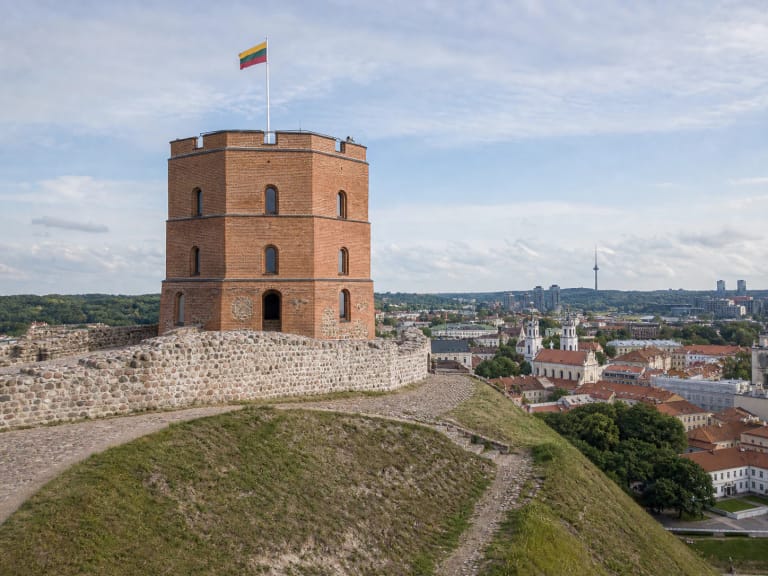
Gediminas Castle Tower on Castle Hill in Vilnius with the old town panorama
Castles, palaces, and manors · VilniusGediminas Castle Tower

Gediminas Castle Tower on Castle Hill is the last strong visible sign of Vilnius Upper Castle and one of the best places to understand the capital from above.

Round red-brick tower and bastion of Kaunas Castle on green defensive slopes
Castles, palaces, and manors · KaunasKaunas Castle

Kaunas Castle at the Nemunas and Neris confluence is one of Lithuania's oldest brick castles and the clearest sign of medieval Kaunas' defensive role.

Klaipėda castle-site bastions, red-brick Castle Museum structures, and a water moat
Castles, palaces, and manors · KlaipėdaKlaipėda Castle Site and Castle Museum

The Klaipėda castle site is where the story of Memel and Klaipėda begins: a castle was built here in 1252, and today the bastions, posterns, and restored curtain-wall spaces hold the Castle Museum.

Stone Liubavas watermill with red-brick window surrounds by the Žalesa River
Castles, palaces, and manors · Vilniaus kraštasLiubavas Manor

Liubavas Manor by the Žalesa River is one of the oldest Vilnius-region manors, now best known for its restored 1902 stone watermill museum, where century-old machinery works and five centuries of estate history are interpreted.

Nineteenth-century wooden Markučiai Manor residence surrounded by parkland in Vilnius
Castles, palaces, and manors · VilniusMarkučiai Manor

Markučiai Manor in Vilnius is a wooden manor residence built in 1867, with an authentic nineteenth-century interior, park, ponds, St Barbara Chapel, and a newly rethought story of Russian imperial heritage.

Red-brick donjon and fieldstone defensive walls of Medininkai Castle with green courtyard
Castles, palaces, and manors · Vilniaus kraštasMedininkai Castle

Medininkai Castle is the largest masonry enclosure castle by area in the Grand Duchy of Lithuania: nearly 570 m of walls surround a quadrangular courtyard, and the restored donjon contains Trakai History Museum exhibitions.

Pakruojis Manor palace, red-roofed farm buildings, park, and the Kruoja River from above
Castles, palaces, and manors · Pakruojo rajonasPakruojis Manor

Pakruojis Manor is the largest surviving manor-building complex in Lithuania, joining a late Classicist palace, farm ensemble, park, Kruoja bridge, and living-history programmes.

White Renaissance facade of the Palace of the Grand Dukes of Lithuania in Vilnius Cathedral Square
Castles, palaces, and manors · VilniusPalace of the Grand Dukes of Lithuania

The Palace of the Grand Dukes of Lithuania in Vilnius is a restored historic residence in the Lower Castle territory, where archaeological foundations, recreated halls, weaponry, everyday finds, and exhibitions tell the story of the political and cultural centre of the Grand Duchy of Lithuania.

Panemunė Castle towers, red-brick wings, and park beside a pond
Castles, palaces, and manors · Jurbarko rajonasPanemunė Castle

Panemunė Castle is one of Lithuania's best-preserved Renaissance residential castles, set on the Nemunas road with a historic park, ponds, and museum activity.

Nemunas valley road on the Panemunė Castles Route with a red-brick castle tower and park ponds
Castles, palaces, and manors · Panemunių regioninis parkasPanemunė Castles Route

The Panemunė Castles Route links the 10,162 ha Panemunių Regional Park's lower Nemunas valley castles, manors, parks, and hillforts, from seventeenth-century Panemunė and sixteenth-century Raudonė to Belvederis, Veliuona, and Seredžius.

Neo-Renaissance Plungė Oginski Manor palace with lawn, circular parterre, and manor ensemble buildings from above
Castles, Palaces, and Manors · PlungėPlungė Oginski Manor

Plungė Oginski Manor is one of Samogitia's strongest manor ensembles: a Neo-Renaissance palace, two service wings, a Neo-Gothic stable, clocktower-orangerie, 58.3 ha park, and the cultural history of Mykolas Oginskis.

Raudondvaris manor ensemble with red-brick palace, tower, orangery, and park
Castles, Palaces, and Manors · Kauno rajonasRaudondvaris Manor

Raudondvaris Manor by the Nevėžis is one of Lithuania's clearest Renaissance manor ensembles, today operating as a cultural, event, and heritage space.

Red-brick facade and towers of Raudonė Castle seen through park trees
Castles, palaces, and manors · Jurbarko rajonasRaudonė Castle

Raudonė Castle on the steep right slope of the Nemunas is one of the most vivid residential castles on the Panemunė road, known for red-brick towers and a park.

Baroque facade of Sapieha Palace in Antakalnis seen from the Sapieha Park side
Castles, palaces, and manors · VilniusSapieha Palace

Sapieha Palace in Antakalnis is the only surviving Baroque-era magnate suburban palace and park ensemble in Lithuania: a late-seventeenth-century Sapieha residence that, after a long history of hospital, military schools, and vacancy, opened to the public in 2024 as a branch of the Contemporary Art Centre.

Taujėnai Manor palace with six-column portico, red roof, park trees, and fountain in front
Castles, Palaces, and Manors · Ukmergės rajonasTaujėnai Manor

Taujėnai Manor is one of the most distinctive manors in the Ukmergė region: a Classical palace with a six-column portico, Radziwiłł and Moriconi history, a 15 ha park, an old wooden granary, and visitor-adapted grounds.

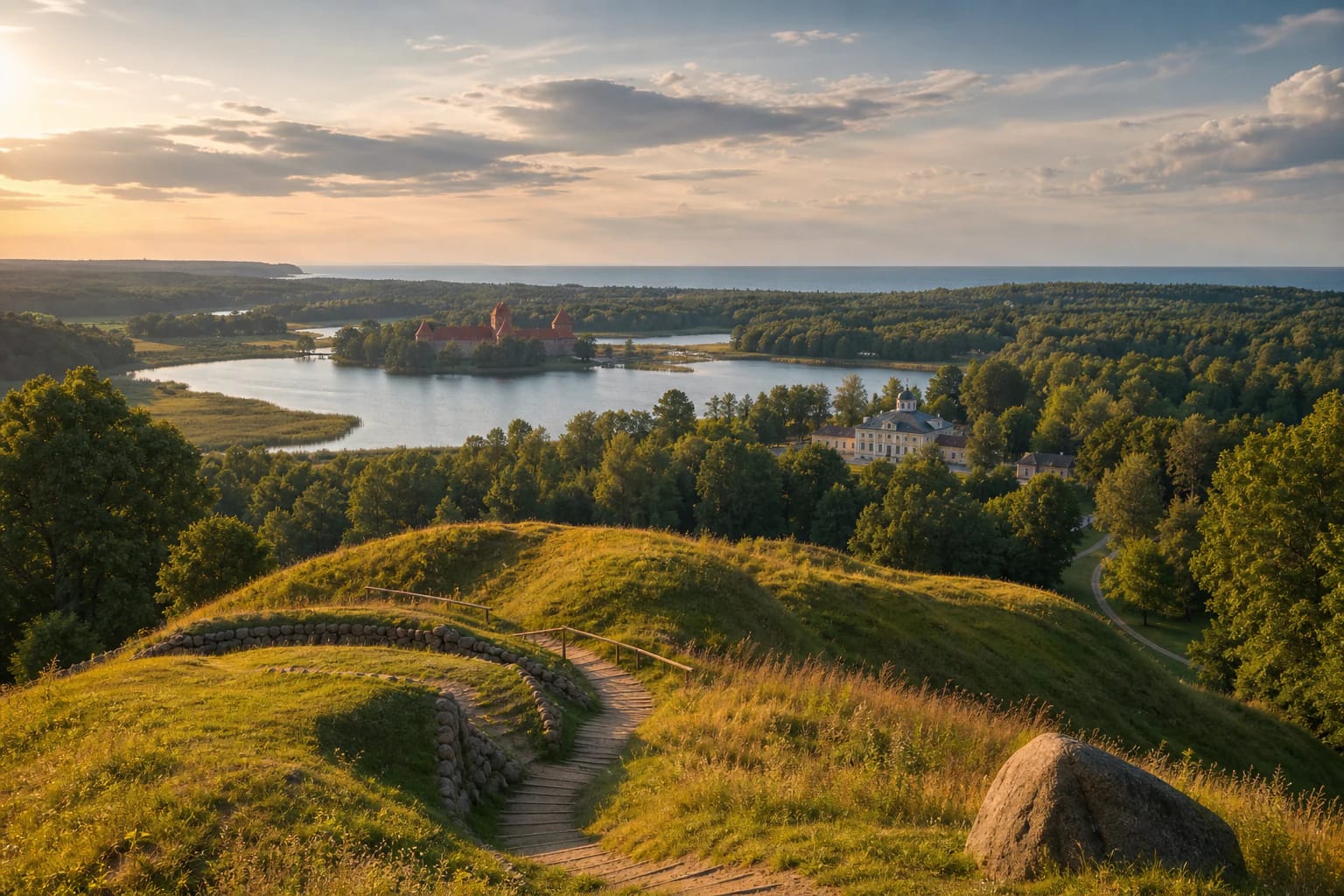
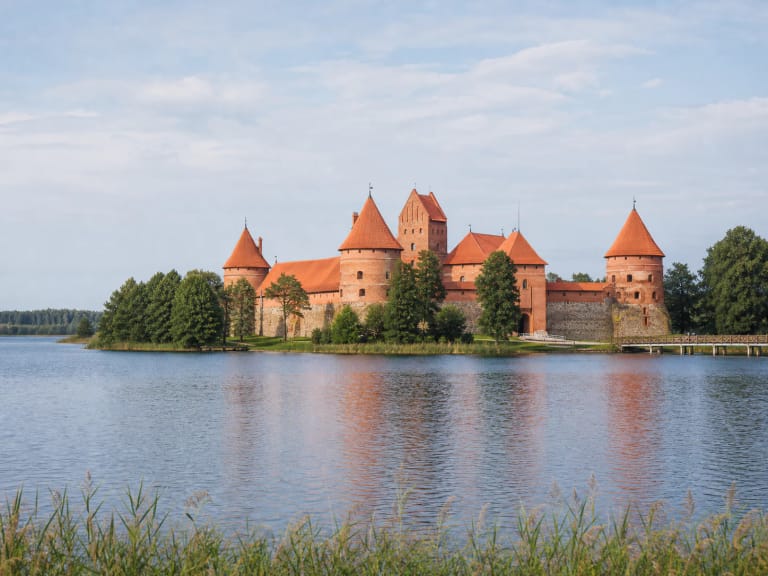
Trakai Island Castle in Lake Galvė with a bridge and red-brick towers
Castles, palaces, and manors · TrakaiTrakai Island Castle

Trakai Island Castle in Lake Galvė is a red-brick Gothic castle begun by Kęstutis and completed by Vytautas, today serving as the core of the Trakai History Museum.

Trakų Vokė Manor palace with a columned portico and formal park in Vilnius
Castles, palaces, and manors · VilniusTrakų Vokė Manor

Trakų Vokė Manor on the edge of Vilnius was the representative residence of the Counts Tiškevičiai: an 1880 neoclassical palace by Leandro Marconi, valuable interiors, a 20 ha park shaped by Édouard François André's ideas, ponds, service buildings, and a reviving cultural space.

White Užutrakis Manor palace with a neoclassical facade, park lawn, path, and mature trees
Castles, palaces, and manors · TrakaiUžutrakis Manor

Užutrakis Manor is one of the most beautiful places in Trakai Historical National Park: Tiškevičiai palace, Édouard François André's park, Lake Galvė shore, and a view toward Trakai Island Castle.

Classical building of Verkiai Manor Estate with a portico and old park in Vilnius
Castles, palaces, and manors · VilniusVerkiai Manor Estate

Verkiai Manor Estate is one of Lithuania's most valuable Classical manor estates: its surviving outbuildings, pavilion, remains of the central palace, 36 ha English-style park structure, Neris valley viewpoints, and Verkiai Regional Park visitor centre form a layered Vilnius heritage landscape.

Museums and cultural spaces

Museums, art collections, and cultural spaces explaining Lithuanian history and heritage.

Adomas Petrauskas Museum homestead with a wooden tower and collected stones in Uoginiai
Museums and cultural spaces · AukštaitijaAdomas Petrauskas Museum

The Adomas Petrauskas Museum in Uoginiai is an idiosyncratic homestead museum founded in 1969 by self-taught local collector Adomas Petrauskas. It holds thousands of ethnographic, archaeological, and folk-art exhibits, with the creator's wood carvings and field stones arranged around the farmstead.

Wooden Lietuvininkai house at Agluonėnai Ethnographic Homestead with a neat yard and farm buildings
Museums and Cultural Spaces · Mažoji LietuvaAgluonėnai Ethnographic Homestead

Agluonėnai Ethnographic Homestead is one of the finest surviving examples of a Lithuania Minor Lietuvininkai homestead: an authentic late-nineteenth-century yard with dwelling house, barn, and farm buildings, now a museum and a living place for barn-theatre tradition.

Aleksandras Griškevičius Memorial Museum house in Viekšniai with a flying-machine model
Museums and cultural spaces · ŽemaitijaAleksandras Griškevičius Memorial Museum

The Aleksandras Griškevičius Memorial Museum in Viekšniai is set in the house where Lithuania's early aviation pioneer spent his final years. Known as the Samogitian Daedalus, he designed the flying machine Žemaičio garlėkys in the mid-nineteenth century, long before powered flight. The museum is a branch of Mažeikiai Museum.

Alytus Regional Museum building on Savanorių Street
Museums and cultural spaces · DzūkijaAlytus Regional Museum

Founded in 1928, Alytus Regional Museum is the main and largest museum of Dzūkija and southern Lithuania, holding more than 124,000 exhibits. Its branches include the Anzelmas Matutis and Antanas Jonynas memorial museums.

Old rectory in Vilkija housing the Antanas and Jonas Juška Ethnic Culture Museum
Museums and Cultural Spaces · Kauno rajonasAntanas and Jonas Juška Ethnic Culture Museum

The Antanas and Jonas Juška Ethnic Culture Museum in Vilkija is housed in the town's oldest building, the former rectory where folklorist Antanas Juška worked. The museum tells the story of the Juška brothers, who collected thousands of Lithuanian songs and words, and presents local ethnic culture.

Gallery of the Antanas Mončys Art Museum in Palanga with modernist wood and stone sculptures
Museums and cultural spaces · PalangaAntanas Mončys Art Museum

The Antanas Mončys Art Museum in Palanga has preserved more than 200 works by the Samogitian-born, Paris-based modernist Antanas Mončys (1921-1993) since 1999: sculptures, masks, whistles, drawings, collages, and pieces that, by the artist's own wish, visitors may sometimes touch.

The Anykščiai narrow-gauge Siaurukas train with green carriages by a historic station and narrow tracks
Museums and cultural spaces · AukštaitijaAnykščiai Narrow-Gauge Railway

The Anykščiai Narrow-Gauge Railway, popularly called the Siaurukas, is living Aukštaitija technical heritage, with regular, short, educational, entertainment, and holiday journeys on a historic 750 mm gauge.

Cellars of the Anykščių vynas factory with wine barrels and bottles
Museums and cultural spaces · Anykščių rajonasAnykščių vynas

Anykščių vynas is a historic fruit and berry winery operating in Anykščiai since 1926 and regarded as the largest wine producer in the Baltic states. Its visitor programme introduces production, Lithuanian beverage history, and tasting, which is why Anykščiai is called Lithuania's wine capital.

Anzelmas Matutis Memorial Museum house and wooden sculptures in a pine grove in Alytus
Museums and cultural spaces · DzūkijaAnzelmas Matutis Memorial Museum

The Anzelmas Matutis Memorial Museum in Alytus is the authentic home of a beloved Lithuanian children's poet, preserving his study and library; in the pine grove nearby, wooden sculptures represent characters from his works.

Interwar apartment interior of the Art Deco Museum in Kaunas at Gedimino g. 48 with geometric furniture and warm lighting
Museums and cultural spaces · KaunasArt Deco Museum in Kaunas

The Art Deco Museum in Kaunas occupies apartment no. 5 in a 1929 apartment building designed by architect Edmundas Alfonsas Frykas at Gedimino g. 48. Restored in 2017-2020, the authentic interwar interior lets visitors see Kaunas modernism from the inside through furniture, materials, colours, and everyday aesthetics.

Atomic Bunker exhibition in Kaunas with KGB communication and surveillance equipment, civil defence signs, and metal doors
Museums and cultural spaces · KaunasAtomic Bunker in Kaunas

Atomic Bunker in Kaunas is a private KGB spy museum at Raudondvario pl. 164A. It displays secret NKVD, KGB, and militia surveillance equipment - listening bugs, encryption devices, miniature hidden cameras, direction finders, and other Cold War devices that help visitors understand the culture of fear and control in the Soviet period.

Aukštaitija National Park Visitor Centre in Palūšė, with the mood of a lake exhibition and wooden village architecture
Museums and cultural spaces · AukštaitijaAukštaitija National Park Visitor Centre in Palūšė

The Aukštaitija National Park Visitor Centre in Palūšė, home to the directorate of Lithuania's oldest national park, helps visitors understand the 127-lake landscape, fishing and timber-rafting traditions, and practical route planning through its Lake Districts exhibition.

Hundreds of different teddy bears in the Bear Museum exhibition in Telšiai
Museums and cultural spaces · ŽemaitijaBear Museum

The Bear Museum in Telšiai is a playful space in the tourism information centre, holding almost six thousand teddy bears and bear figures donated from Lithuania and abroad. The collection connects with the bear on the Telšiai coat of arms and the city's image as a city of bears.

The restored Marijampolė synagogue housing the Kleizaitė-Vasaris Art Gallery
Museums and cultural spaces · SuvalkijaBeatričė Kleizaitė-Vasaris Art Gallery

Beatričė Kleizaitė-Vasaris Art Gallery is a Marijampolė art gallery located in a restored late-nineteenth-century Jewish synagogue. It preserves more than 470 works of Lithuanian diaspora art collected abroad over a lifetime and donated to Lithuania by art historian and patron Beatričė Kleizaitė-Vasaris. It is a rare place where diaspora art is permanently shown in a regional city, while the building itself preserves the memory of Jewish heritage.

Wooden hives, sculptures, and green Aukštaitija National Park surroundings at the Beekeeping Museum in Stripeikiai
Museums and cultural spaces · AukštaitijaBeekeeping Museum in Stripeikiai

The Beekeeping Museum in Stripeikiai is a 4 ha indoor and outdoor exhibition site in Aukštaitija National Park, where hives, sculptures, educational activities, and buildings tell the story of bees, honey, and Lithuanian beekeeping tradition.

Wooden Birštonas rectory with verandas, now housing the sacral museum
Museums and cultural spaces · DzūkijaBirštonas Sacral Museum

Birštonas Sacral Museum is housed in a wooden nineteenth-century rectory beside St Anthony of Padua Church. Ten rooms present sacred art and memorial rooms for Blessed Teofilius Matulionis and Cardinal Vincentas Sladkevičius; on Christmas Day 1957 Matulionis secretly consecrated Sladkevičius as bishop here.

Blacksmithing Museum display with a hearth, bellows, tools, iron crosses, and forged weathervanes
Museums and cultural spaces · KlaipėdaBlacksmithing Museum in Klaipėda

The Blacksmithing Museum in Klaipėda Old Town operates beside Gustav Katzke's forge and shows authentic blacksmith tools, a hearth, bellows, forged weathervanes, old cemetery crosses, and grave railings.

Chaim Frenkel Villa in Šiauliai with Art Nouveau facade, park, fountain, and rose garden
Museums and cultural spaces · Šiaulių kraštasChaim Frenkel Villa

Chaim Frenkel Villa in Šiauliai is an Art Nouveau family residence built in 1908 for an industrialist household. Today it is an Aušra Museum branch with authentic interiors, the Frenkel family and leather-factory story, a park, fountain, and rose garden.

Interior of St Michael's Church at the Church Heritage Museum, with sacred art displayed in the historic church space
Museums and cultural spaces · VilniusChurch Heritage Museum

The Church Heritage Museum, founded in 2005 and opened to visitors in 2009, operates in the ensemble of St Michael's Church and the former Bernardine nuns' monastery. Its core is the Vilnius Cathedral treasury with 988 liturgical valuables and Lithuania's largest collection of liturgical textiles.

Historic nineteenth-century villa of the Clock Museum in Klaipėda with sundials arranged in the courtyard
Museums and cultural spaces · KlaipėdaClock Museum in Klaipėda

The Clock Museum in Klaipėda is the only museum of its kind in Lithuania and the Northern European region: an LNDM branch in a nineteenth-century villa on Liepų g. 12, founded in 1984, presenting time measurement from sundials and clepsydras to quantum clocks and clock forms from the Renaissance to Art Nouveau.

Concrete silo and underground entrance of the former missile base at the Cold War Museum in Plokštinė
Museums and Cultural Spaces · ŽemaitijaCold War Museum in Plokštinė

The Cold War Museum in Plokštinė operates in a former secret Soviet underground ballistic missile base near Plateliai, one of Lithuania's strongest twentieth-century military-history sites.

Curonian Spit History Museum display with a fishing boat, weathervanes, nets, and archaeological finds in Nida
Museums and cultural spaces · NeringaCuronian Spit History Museum

The Curonian Spit History Museum in Nida, opened in 1969 in a former Lutheran church, presents spit fishing, crow catching, Stone Age finds from the 1974-1978 Nida excavations, the postal road, and daily life by the lagoon.

Kleboniškiai village homesteads of the Daugyvenė Museum with wooden houses and thatched roofs
Museums and cultural spaces · Šiaulių kraštasDaugyvenė Cultural History Museum-Reserve

The Daugyvenė Cultural History Museum-Reserve, founded in 1991, links several heritage sites in the Daugyvenė river valley: Burbiškis Manor, the Kleboniškiai open-air village household museum, the Šeduva local-history exposition, and the Raginėnai archaeological complex. Together they tell one story of local village life, manor culture, and ancient communities.

Devils' Museum in Kaunas exhibition with wooden devil carvings and dark display halls
Museums and cultural spaces · KaunasDevils' Museum in Kaunas

The Devils' Museum in Kaunas is one of Lithuania's most distinctive museums. Opened in 1982, it continues the devil collection gathered by artist Antanas Žmuidzinavičius, which grew from about 260 items to roughly 3,000 objects from Lithuania and more than 70 countries - a story of folk imagination, humour, fear, and Christian iconography.

Dieveniškės Historic Regional Park Visitor Centre building in Poškonys and details of its ethnocultural exhibition
Museums and cultural spaces · Dieveniškių istorinis regioninis parkasDieveniškės Historic Regional Park Visitor Centre

The Dieveniškės Historic Regional Park Visitor Centre in Poškonys presents the park's ethnocultural heritage: street-strip villages, the Dieveniškės urban complex, traditional architecture in Poškonys and Žižmai, and the character of this borderland.

Dionizas Poška's Baubliai in Bijotai, two hollow oak trunks protected in wooden and glass pavilions
Museums and cultural spaces · ŽemaitijaDionizas Poška's Baubliai

Dionizas Poška's Baubliai in Bijotai is a small but nationally important site: an antiquities space made inside hollow oak trunks, regarded as one of Lithuania's earliest museums and an important marker of Lithuanian literary history.

Display of dolls from around the world at the Doll House Museum in Bajorai
Museums and cultural spaces · AukštaitijaDoll House Museum

The Doll House Museum in Bajorai, near Rokiškis, holds about 1,500 dolls from around the world and is closely connected with the home puppet theatre ČIZ. Dalia Ziemelienė has displayed the private collection since 1999, while the theatre's dolls are sewn by hand by the three women who founded it. After performances, visitors can play with the dolls, making it a lively museum for children and adults.

Villa Linksma, home of Druskininkai City Museum, beside Lake Druskonis and the resort park
Museums and cultural spaces · DruskininkaiDruskininkai City Museum

Druskininkai City Museum operates in the representative Villa Linksma by Lake Druskonis. It is the best place to understand how Druskininkai grew from the mineral-water treatment facility established in 1837-1838 into a centre of culture, therapy, leisure, and town identity.

Indoor ski slope with snow and a lift inside Druskininkai Snow Arena
Museums and cultural spaces · DzūkijaDruskininkai Snow Arena

Druskininkai Snow Arena is the only year-round indoor skiing and snowboarding complex in the Baltic States. It turns Druskininkai into a four-season resort, while the nearby Aqua water park in town broadens the leisure offer.

Dusetos Art Gallery exhibition hall with contemporary works by Selonia-region artists
Museums and cultural spaces · AukštaitijaDusetos Art Gallery

Dusetos Art Gallery is one of Lithuania's clearest examples of professional art activity in a small town. Since 1995 it has brought together Dusetos and Selonia-region artists and photographers, including miniature exhibitions and horse-themed art linked with Sartai.

Former power-plant hall of the Energy and Technology Museum in Vilnius with turbines and industrial details
Museums and cultural spaces · VilniusEnergy and Technology Museum in Vilnius

The Energy and Technology Museum in Vilnius operates in the former Vilnius city power plant, which began work in 1903. Industrial architecture, turbines, boilers, city infrastructure, and interactive exhibitions tell the story of modernizing Vilnius.

Forest path in Europos Parkas with contemporary stone and metal sculptures among trees
Museums and cultural spaces · Vilniaus kraštasEuropos Parkas

Europos Parkas near Vilnius is an open-air contemporary art museum: more than 100 works are placed across a 55 ha landscape, and the park's idea is linked with searches for the geographical centre of Europe.

Old Utena narrow-gauge railway station housing the Freedom Fights Museum
Museums and cultural spaces · AukštaitijaFreedom Fights Museum in Utena

The Freedom Fights Museum in Utena is housed in the old narrow-gauge railway station and is a branch of the Utena Regional Museum. Its modern thematic exhibition presents the 1940-1965 history of Utena and Lithuania: Soviet occupation, deportations, post-war partisan resistance, and the contrast with free Europe.

The white Petrauskas house in Lazdijai, now the Freedom Fights Museum
Museums and cultural spaces · Lazdijų rajonasFreedom Fights Museum, Lazdijai

The Freedom Fights Museum in Lazdijai is an interactive museum of the partisan war and Soviet repression, housed in the authentic former NKVD-MGB security building known as the white Petrauskas house. The basement preserves interrogation cells, punishment cell, and prison yard. The exhibition tells the story of Dainava district's Šarūnas detachment partisans and regional deportees, and the museum is a branch of Lazdijai Region Museum.

Gargždai Area Museum building on Sodo Street
Museums and cultural spaces · ŽemaitijaGargždai Area Museum

Gargždai Area Museum tells the story of an old border town where Samogitia and Lithuania Minor meet along the Minija. Holding about 15,000 exhibits, it is known for the interactive Interwar Gargždai 1918-1939 exhibition and connects four distinctive branches, including Lithuania's only surviving boatbuilder's homestead and the Ieva Simonaitytė Museum.

White granite column of the Geographical Centre of Europe with a crown of stars in an open field near Vilnius
Museums and cultural spaces · Vilniaus kraštasGeographical Centre of Europe

The Geographical Centre of Europe near Vilnius marks the point calculated in 1989 by France's National Geographic Institute as Europe's centre, distinguishing a geodetic fact from the nearby Europos Parkas art idea.

Wooden building of Ginučiai Watermill beside water in Aukštaitija National Park
Museums and cultural spaces · Aukštaitijos nacionalinis parkasGinučiai Watermill

Ginučiai Watermill is one of the clearest technical-heritage sites in Aukštaitija National Park: a mill from the second half of the nineteenth century beside flowing water, preserving milling equipment, a turbine, wooden gears, and layers of village-economy history.

Distinctive wooden Girios Aidas Forest Museum building in the pine forest of Druskininkai
Museums and cultural spaces · DruskininkaiGirios Aidas Forest Museum

Girios Aidas Forest Museum is a distinctive wooden forest museum on the south-eastern edge of Druskininkai, in a pine forest. Inside its fairy-tale wooden building are displays of Lithuanian animal and bird taxidermy, old forestry tools, and folk carving; outside, a short trail passes sculptures and rare trees. It is one of the most visited nature-learning spaces in Druskininkai and is now maintained by the State Forest Enterprise.

Forest path in Grūtas Park with Soviet sculptures and guard-tower motifs
Museums and cultural spaces · DruskininkaiGrūtas Park

Grūtas Park near Druskininkai is an open-air exhibition of Soviet monuments and propaganda. Ideological monuments, documents, museum halls, and the park setting help visitors read the layers of occupation memory.

Light yellow historicist Historical Presidential Palace in Kaunas with balcony, flagpole, and ceremonial garden
Museums and cultural spaces · KaunasHistorical Presidential Palace in Kaunas

The Historical Presidential Palace in Kaunas is a statehood museum at Vilniaus g. 33, located in the former Presidential Palace. In 1919-1940 Antanas Smetona, Aleksandras Stulginskis, and Kazys Grinius resided here; the building hosted receptions, presidential work, and the last moments of free Lithuanian decision-making before the Soviet occupation.

History Museum of Lithuania Minor display with a map of Klaipėda Region, Curonian finds, and Lietuvininkai cultural objects
Museums and cultural spaces · KlaipėdaHistory Museum of Lithuania Minor

The History Museum of Lithuania Minor in Klaipėda Old Town tells the story of the western Balts, Klaipėda Region, Lietuvininkai culture, book history, and the difficult memory of the first half of the twentieth century.

Aukštaitija homesteads, carts, and live horses in the summer courtyard of the Horse Museum in Niūronys
Museums and cultural spaces · Anykščių rajonasHorse Museum

The Horse Museum in Niūronys is an ethnographic museum about the horse's place in the Lithuanian village, preserving horse-drawn implements, carts, sleighs, harnesses, craft tools, Aukštaitija homesteads, and living horse-culture traditions.

Historic wooden Villa Aldona on Palanga's Basanavičiaus Street, home to House of Illusions Eureka
Museums and cultural spaces · PalangaHouse of Illusions Eureka

House of Illusions Eureka is an interactive optical-illusion and science-entertainment space in Palanga, set in the historic Tiškevičiai Villa Aldona beside the Basanavičiaus promenade. Across three floors it has about 50 exhibits where the visitor becomes part of the illusion, making it a popular all-weather stop for families and children.

Ignalina Nuclear Power Plant buildings by Lake Drūkšiai in north-eastern Lithuania
Museums and cultural spaces · AukštaitijaIgnalina Nuclear Power Plant

Ignalina Nuclear Power Plant near Visaginas was the world's most powerful RBMK-type plant, operating in 1983-2009 and for a time supplying about 80 percent of Lithuania's electricity. Today it is being decommissioned, while visitors can access the information centre and a full-size reactor-control-room simulator.

Wooden house of J. Gižas Ethnographic Homestead in Dreverna with boatbuilding details in the yard
Museums and Cultural Spaces · PamarysJ. Gižas Ethnographic Homestead

J. Gižas Ethnographic Homestead in Dreverna (Žvejų g. 13) is Lithuania's only surviving boatbuilder's homestead. Its four-part interactive exhibition, opened in 2010, 'J. Gižas. Opening the Boatbuilder's Chest...', presents the famous Pamarys boatbuilder Jonas Gižas (1867-1940) and Curonian Lagoon boatbuilding.

Jonava Regional Museum building, a Classicist horse-post station with portico
Museums and cultural spaces · AukštaitijaJonava Regional Museum

Jonava Regional Museum is housed in a Classicist horse-post station built in 1833-1835 on the old Saint Petersburg-Warsaw route. It stores more than 58,000 exhibits on Jonava-region history, ethnography, and art; its cellar displays the only surviving material from vanished Skaruliai Manor: archaeological finds.

Old wooden Pamarys fisherman's homestead in Rusnė with a granary and cowshed
Museums and Cultural Spaces · PamarysK. Banys Ethnographic Fisherman's Homestead

K. Banys Ethnographic Fisherman's Homestead in Rusnė is a more than 200-year-old Pamarys fisherman's farmstead that Kazimieras Banys turned into a private ethnographic museum in 1997. Three traditional Nemunas Delta buildings preserve fishing gear, household items, and furniture showing how a fisher and meadow farmer lived in the flood country.

Kapčiamiestis Emilija Pliaterytė Museum exhibition with 1831 uprising memory signs
Museums and cultural spaces · Lazdijų rajonasKapčiamiestis Emilija Pliaterytė Museum

Kapčiamiestis Emilija Pliaterytė Museum is the main Lazdijai-region place linked with the memory of the 1831 uprising heroine, who died nearby at Justinavas manor and was buried in Kapčiamiestis. The museum connects her biography, the uprising, local ethnography, and southern Lithuanian memory.

Kaunas Fortress Sixth Fort territory with green ramparts and objects of the military-technology exhibition
Museums and cultural spaces · KaunasKaunas Fortress Sixth Fort

Kaunas Fortress Sixth Fort in Petrasiunai is a hexagonal Tsarist fortress fort built in 1882-1889, one of its strongest masonry fortifications. Today it is best known through the Vytautas the Great War Museum's Military Technology Exhibition, where ramparts meet tanks and artillery.

Modern exhibition building of Kaunas Picture Gallery on K. Donelaičio Street with bright gallery halls
Museums and cultural spaces · KaunasKaunas Picture Gallery

Kaunas Picture Gallery is a branch of the National M. K. Čiurlionis Museum of Art opened in 1979 at K. Donelaičio g. 16, where temporary exhibitions by Lithuanian and international artists meet the Jurgis Mačiūnas Fluxus Cabinet and the story of Kaunas modern culture.

Cream-coloured Neo-Baroque facade of Kaunas State Musical Theatre in the City Garden with three arched windows, curved pediment, and trees
Museums and cultural spaces · KaunasKaunas State Musical Theatre

Kaunas State Musical Theatre in the City Garden is Lithuania's first building constructed specifically for theatre, opened in 1892 and later transformed into the State Theatre stage. Professional Lithuanian opera, drama, and ballet began here, the Constituent Seimas met here in 1920, and the Neo-Baroque and Art Deco interior layers still make it one of Kaunas's most important cultural spaces.

Room of the Kazys Varnelis House-Museum with optical art paintings and collection objects
Museums and cultural spaces · VilniusKazys Varnelis House-Museum

The Kazys Varnelis House-Museum on Didžioji Street is a branch of the Lithuanian National Museum where the home space of an optical art creator merges with his collection of prints, maps, sculpture, furniture, and applied art.

The 1705 school building of Kintai Vydūnas Cultural Centre with a light facade, red roof, and green yard
Museums and Cultural Spaces · PamarysKintai Vydūnas Cultural Centre

Kintai Vydūnas Cultural Centre operates in the former Kintai school built in 1705, where Vydūnas taught in 1888-1892. Today it brings together the Vydūnas Museum founded in 1994, the Pamarys Signs enamel gallery, an artist residence, and Lithuania Minor cultural activity.

Modernist granite sculptures in Klaipėda Sculpture Park among mature trees and paths
Museums and cultural spaces · KlaipėdaKlaipėda Sculpture Park

Klaipėda Sculpture Park is an open-air modernist sculpture display in the city centre that also preserves the memory of a former city cemetery, prisoners of war, and Klaipėda Region history.

Krekenava Regional Park Visitor Centre exhibition with Nevėžis oxbow motifs and green surroundings
Museums and cultural spaces · AukštaitijaKrekenava Regional Park Visitor Centre

The Krekenava Regional Park Visitor Centre in Dobrovolė is the best place to begin exploring the Nevėžis valley. Its exhibition explains oxbow lakes, terraces, meadows, plants, animals, and human life by the river.

Kruonis Pumped Storage Hydroelectric Plant complex beside Kauno Marios
Museums and Cultural Spaces · Kaišiadorių rajonasKruonis Pumped Storage Hydroelectric Plant

Kruonis Pumped Storage Hydroelectric Plant beside Kauno Marios is the only power plant of its type in the Baltic States. At night it pumps water to an upper reservoir on the hilltop; when power is needed, the water is released back down to generate electricity. Operator Ignitis gamyba offers free guided tours with advance registration.

Kupiškis Ethnography Museum in a Classicist brick building from 1823
Museums and cultural spaces · AukštaitijaKupiškis Ethnography Museum

Kupiškis Ethnography Museum is housed in an 1823 brick former parish school and holds more than 60,000 exhibits about the Kupiškis region. Its best-known section is the old Kupiškis wedding exhibition, presenting a distinctive local wedding tradition.

Old fishing tools and a dugout boat in the Lake Fishing Museum in Mindūnai
Museums and cultural spaces · AukštaitijaLake Fishing Museum

The Lake Fishing Museum in Mindūnai is Lithuania's only museum devoted to traditional lake fishing. In a reconstructed nineteenth-century fisherman's homestead in Labanoras Regional Park, it preserves about 870 exhibits, from fifteenth-century dugout boats raised from lake bottoms to old nets, eel traps, and fishing tools.

Traditional wooden Babickas homestead in Laukminiškiai near Kupiškis Reservoir
Museums and cultural spaces · AukštaitijaLaukminiškiai Village Museum

Laukminiškiai Village Museum near Kupiškis Reservoir occupies a traditional Aukštaitija homestead: the parental home of the notable Babickas family. It combines the memory of radio and photography pioneer Petras Babickas and actress Unė Babickaitė with late nineteenth- and early twentieth-century village life. It is a branch of Kupiškis Ethnography Museum.

Literatų Street wall in Vilnius Old Town with small art dedications to writers and poets
Museums and cultural spaces · VilniusLiteratų Street

Literatų Street in Vilnius Old Town is known for a wall of small artworks dedicated to writers, poets, translators, and supporters of literature connected with Lithuania, Vilnius, or readers' memory.

Lithuanian Aviation Museum exhibition at historic Kaunas Aerodrome with aircraft and a hangar
Museums and cultural spaces · KaunasLithuanian Aviation Museum

The Lithuanian Aviation Museum in Aleksotas operates at the historic S. Darius and S. Girėnas Aerodrome. Founded in 1990, it preserves more than 24,000 exhibits and over 50 flying machines, including a flyable Lituanica replica, Bronius Oškinis gliders, and ANBO-IV drawings.

Lithuanian Education Museum exhibition with rows of old school desks and textbooks
Museums and cultural spaces · KaunasLithuanian Education Museum

The Lithuanian Museum of Education History in Kaunas, renamed the Lithuanian Education Museum in 2023, is a school and pedagogy history site founded in 1922. It preserves more than 55,000 museum valuables, including old textbooks, writing tools, school furniture, and education documents.

Silver towers of the Lithuanian Museum of Ethnocosmology on a forested hill with a stone circle and evening stars
Museums and cultural spaces · AukštaitijaLithuanian Museum of Ethnocosmology

The Lithuanian Museum of Ethnocosmology in Kulionys is a distinctive science-and-culture site that explains the human relationship with the cosmos through mythology, the calendar, astronomy, technology, and night-sky observation.

Representative facade of the Lithuanian Officers' Club on A. Mickevičiaus Street in Kaunas
Museums and cultural spaces · KaunasLithuanian Officers' Club in Kaunas

The Lithuanian Officers' Club in Kaunas is one of the most ceremonial representative buildings of the late interwar period. Built in 1935-1937 with officers' funds, it combines modernized historicism, national-style symbolism, Bronius Pundzius' Three Giants, and exceptional second-floor interiors.

Lithuanian Sea Museum in Nerija Fort in Smiltynė, with red-brick gates, bridge, pines, and maritime exhibits
Museums and cultural spaces · Klaipėdos kraštasLithuanian Sea Museum

The Lithuanian Sea Museum in Smiltynė combines the nineteenth-century Nerija Fort, an aquarium, maritime-history displays, outdoor ships, and a dolphinarium, making it one of Klaipėda's strongest family and cultural-tourism sites.

Red-brick Liudvikas Rėza Cultural Centre in Juodkrantė with a historical exhibition, gallery, and Curonian Spit cultural atmosphere
Museums and Cultural Spaces · NeringaLiudvikas Rėza Cultural Centre

Liudvikas Rėza Cultural Centre in Juodkrantė operates in a red-brick school building from 1902-1903 and combines exhibitions, events, a historical display about Martynas Liudvikas Rėza, and the memory of Juodkrantė as a fishing village and resort.

Modern Lost Shtetl Museum building in Šeduva beside the historic Jewish cemetery landscape
Museums and cultural spaces · Šiaulių kraštasLost Shtetl Museum in Šeduva

The Lost Shtetl Museum in Šeduva, opened on September 20, 2025, is an approximately 3,000 sq. m memory site for Lithuanian Jewish towns in a building designed by Finnish architect Rainer Mahlamäki beside the old Jewish cemetery. It tells not only the Holocaust, but also the shtetl world that flourished before the catastrophe.

The Lost Shtetl Museum building in Šeduva, with roof silhouettes recalling shtetl houses and a synagogue
Museums and cultural spaces · Šeduva, Radviliškio rajonasLost Shtetl Museum in Šeduva

The Lost Shtetl Museum in Šeduva, opened in September 2025, is the largest museum in the Baltic states dedicated to shtetl culture and history. It presents the everyday life of Šeduva's Jewish community, the world of the interwar shtetl, and the tragedy of the Holocaust, while connecting the museum building with a memorial park and the restored old Jewish cemetery.

Red-brick facade and enclosed historic prison courtyard of Lukiškės Prison 2.0 in Vilnius
Museums and cultural spaces · VilniusLukiškės Prison 2.0

Lukiškės Prison 2.0 is the former Lukiškės Prison complex in central Vilnius, first used in 1904 and now operating as a place for guided walks, concerts, creative studios, and city culture.

Wooden house of the M. K. Čiurlionis Memorial Museum in Druskininkai with a quiet courtyard
Museums and cultural spaces · DruskininkaiM. K. Čiurlionis Memorial Museum in Druskininkai

The M. K. Čiurlionis Memorial Museum in Druskininkai, officially the M. K. Čiurlionis House-Museum, has operated since 1963 in the homes where the artist and composer lived and created. This intimate four-building site returns Čiurlionis' work to the context of childhood, family, and the Dzūkija landscape.

Yellow late-Baroque palace of the Maironis Lithuanian Literature Museum on Kaunas Town Hall Square with a red roof and columned balcony
Museums and cultural spaces · KaunasMaironis Lithuanian Literature Museum

Maironis Lithuanian Literature Museum on Kaunas Town Hall Square occupies an eighteenth-century late-Baroque palace bought by the poet Jonas Mačiulis-Maironis in 1909. It preserves his memorial apartment, restored decor by Tadas Daugirdas, literature-history exhibitions, Gothic cellars, and a garden layered with complex city memory.

The 1905 wooden house, barn, and forest-village yard of Marcinkonys Ethnographic Homestead
Museums and cultural spaces · Dzūkijos nacionalinis parkasMarcinkonys Ethnographic Homestead

Marcinkonys Ethnographic Homestead is a 1905 house-and-barn homestead in Dzūkija National Park, open to visitors since 1994. Through forest-village everyday life, tools, straw gardens, and mushroom-picking objects, it shows how the sandy-forest Dzūkians lived among pinewoods and poor soils.

Wooden barn of Margionys Barn Theatre in a Dzūkija village, prepared for a summer performance
Museums and cultural spaces · Dzūkijos nacionalinis parkasMargionys Barn Theatre

Margionys Barn Theatre is a living Dzūkija village theatre founded in 1929 and long shaped by Juozas Gaidys's dramas. Its barn burned down in 2022, so today the tradition continues through rebuilding, performances, and the Citnaginė festival.

The Marijampolė Regional and President Kazys Grinius Museum building on Vytauto Street
Museums and cultural spaces · SuvalkijaMarijampolė Regional and President Kazys Grinius Museum

The Marijampolė Regional and President Kazys Grinius Museum is one of Suvalkija's oldest museums, founded in 1933. It preserves rich collections of regional archaeology, ethnography, and history, the several-thousand-year-old Turlojiškė Man, and the memory of Lithuanian president Kazys Grinius.

Martynas Jankus Museum printing-house exhibition with an old printing press, type cases, and paper in Bitėnai
Museums and cultural spaces · Mažoji LietuvaMartynas Jankus Museum

Martynas Jankus Museum in Bitėnai, founded in 1981, operates in a reconstructed Lithuania Minor printing house with a working printing press; it tells the story of the Patriarch of Lithuania Minor, Martynas Jankus, Aušra, a banned-press warehouse, and a signatory of the Act of Tilsit.

Mažeikiai Museum exhibition hall with archaeological finds, national costume, textiles, and industrial-history photographs
Museums and cultural spaces · ŽemaitijaMažeikiai Museum

Founded in 1928 on the initiative of teacher Stasys Ličkūnas, Mažeikiai Museum manages four branches and holds more than 79,000 objects covering regional archaeology, ethnography, folk art, art, and the history of the oil industry.

Concrete bunkers of the Memel Nord coastal artillery battery in the seaside pine forest at Kukuliškiai near the Baltic Sea
Museums and Cultural Spaces · Klaipėdos rajonasMemel Nord

Memel Nord at Kukuliškiai near Giruliai is Lithuania's only surviving fortification of this type: a 1939 Nazi coastal-defence battery with concrete bunkers in two artillery blocks, four 150 mm guns, later adapted for anti-aircraft defence and converted in the twenty-first century into a military heritage museum.

Merkinė Region Museum exhibition with town-history objects and Nemunas-region views
Museums and cultural spaces · Varėnos rajonasMerkinė Region Museum

Merkinė Region Museum operates in an 1888 Orthodox church built on the foundations of the sixteenth to seventeenth-century town hall, and since 1968 has preserved the memory of one of Dzūkija's historically most important towns. Merkinė Castle, Magdeburg rights, the Nemunas and Merkys confluence, Jewish community, crafts, and partisan struggles come together here in one regional story.

White modern MO Museum building on Pylimo Street with an angular entrance and open terrace
Museums and cultural spaces · VilniusMO Museum

MO Museum in Vilnius is a private museum of modern and contemporary Lithuanian art on Pylimo Street, combining a collection of about 6,000 works, Daniel Libeskind architecture, exhibitions, education, and open urban leisure spaces.

White telescope domes of Molėtai Astronomical Observatory on a forested hill under an evening starry sky
Museums and cultural spaces · AukštaitijaMolėtai Astronomical Observatory

Molėtai Astronomical Observatory is Lithuania's professional astronomy site in Kulionys: a forested hill with telescope domes, scientific observations, and the more public ethnocosmology route nearby.

Money Museum exhibition in Vilnius with coins, banknotes, and interactive screens
Museums and cultural spaces · VilniusMoney Museum in Vilnius

The Money Museum in Vilnius is the Bank of Lithuania museum on Totorių Street, where five halls present the history of money, banking, numismatics, and finance from barter to modern payments.

Outdoor exhibition of Mosėdis Stone Museum with large boulders, paths, plantings, and the museum building
Museums and cultural spaces · ŽemaitijaMosėdis Stone Museum

Mosėdis Stone Museum, officially the Republican Vaclovas Intas Stone Museum, is a unique geology and landscape site where boulders collected by physician Vaclovas Intas turned the town into a stone park.

Museum of Applied Arts and Design in the restored Old Arsenal Palace near Gediminas Hill
Museums and cultural spaces · VilniusMuseum of Applied Arts and Design

The Museum of Applied Arts and Design is housed in the restored Old Arsenal Palace of Vilnius Lower Castle, beside Gediminas Hill. It is a branch of the Lithuanian National Museum of Art, hosting applied arts and design exhibitions, while the building itself preserves authentic sixteenth-century arsenal walls.

Museum of Freedom Fights and Deportation History in Priekulė with a deportation wagon in the yard
Museums and Cultural Spaces · Mažoji LietuvaMuseum of Freedom Fights and Deportation History

The Museum of Freedom Fights and Deportation History in Priekulė tells the story of postwar partisan war and Stalinist deportations. It is installed in the building that served in 1945-1953 as a Soviet security headquarters and detention site, with a reconstructed cellar prison cell, an authentic deportation wagon, and a rebuilt partisan bunker in the yard. It is a branch of Gargždai Area Museum.

Contemporary exhibition of the Museum of Lithuanian Jewish Culture and Identity inside the historic Tarbut Gymnasium building
Museums and cultural spaces · VilniusMuseum of Lithuanian Jewish Culture and Identity

The Museum of Lithuanian Jewish Culture and Identity on Pylimo Street is the newest and largest branch of the Vilna Gaon Museum, presenting Litvak religion, languages, shtetl life, art, and identity stories across four floors.

Building of the Museum of Occupations and Freedom Fights in Vilnius and a sombre former KGB prison exhibition
Museums and cultural spaces · VilniusMuseum of Occupations and Freedom Fights

The Museum of Occupations and Freedom Fights in Vilnius operates in the former Soviet security and KGB building on Aukų Street, where exhibitions, documents, and the surviving internal prison tell the story of occupations, repression, and Lithuania's freedom struggles.

Museum of the Samogitian Diocese in Varniai, the former priest seminary building with historic facade and bell tower
Museums and cultural spaces · ŽemaitijaMuseum of the Samogitian Diocese

The Museum of the Samogitian Diocese operates in the 1770 Samogitian priest seminary building in Varniai; it is a branch of Žemaičių Museum Alka and presents diocesan history, sacred heritage reaching the 15th-16th centuries, and Lithuania's largest ringing bells.

Postmodernist building of Mykolas Žilinskas Art Gallery on Nepriklausomybės Square in Kaunas
Museums and cultural spaces · KaunasMykolas Žilinskas Art Gallery

Mykolas Žilinskas Art Gallery is a branch of the National M. K. Čiurlionis Museum of Art on Nepriklausomybės Square in Kaunas, known for Western European art donated by collector Mykolas Žilinskas and for its striking 1989 postmodernist building with the nude male sculpture Human. At the time of research, the gallery was closed for reconstruction.

Nalšia Museum building on Laisvės Square in Švenčionys
Museums and cultural spaces · AukštaitijaNalšia Museum

Nalšia Museum in Švenčionys is the local-history museum of the old Nalšia land, holding more than 60,000 exhibits from Stone Age Kretuonas settlements to the archive of the Tiger partisan detachment. Founded in 1945 as Švenčionys Local History Museum and renamed Nalšia Museum in 1992, it also has a Reškutėnai branch continuing living craft traditions.

Modernist building of the National Gallery of Art on Konstitucijos Avenue in Vilnius
Museums and cultural spaces · VilniusNational Gallery of Art

The National Gallery of Art is an LNDM branch in the 1980 former revolution museum building on Konstitucijos Avenue, presenting a collection of more than 46,000 works of twentieth- and twenty-first-century Lithuanian and diaspora art, temporary exhibitions, and cultural events.

National Kaunas Drama Theatre building on Laisvės alėja with sculptures on the facade
Museums and cultural spaces · KaunasNational Kaunas Drama Theatre

National Kaunas Drama Theatre on Laisvės alėja is the first professional permanent Lithuanian drama theatre, founded in 1920 in the then temporary capital. Over a century it became a cradle of modern Lithuanian directing, from Dauguvietis and M. Chekhov to Soviet-period risk-takers Jurašas and Vaitkus.

National M. K. Čiurlionis Museum of Art building and tower in Kaunas
Museums and cultural spaces · KaunasNational M. K. Čiurlionis Museum of Art

The National M. K. Čiurlionis Museum of Art in Kaunas is Lithuania's largest state art museum and the most important place to understand M. K. Čiurlionis' work. Its history begins with the 1921 Čiurlionis Gallery law, while the present museum complex grew from the Vytautas the Great Museum built in 1930-1936.

Obeliai Freedom Fights History Museum building with the Lithuanian tricolour and a partisan bunker in the yard
Museums and cultural spaces · AukštaitijaObeliai Freedom Fights History Museum

The Obeliai Freedom Fights History Museum tells the story of the partisan war and deportations in north-eastern Lithuania. It grew from a collection secretly preserved for decades by partisan Andrius Dručkus, now numbering more than 12,000 exhibits, with a partisan bunker in the museum yard. It is a branch of the Rokiškis Regional Museum.

Path through Orvidai Homestead among large stones, wooden crosses, folk sculptures, and old metal details
Museums and cultural spaces · ŽemaitijaOrvidai Homestead

Orvidai Homestead in Gargždelė is one of Lithuania's most unusual museum spaces: the environment created by Vilius Orvidas and the Orvidas family joins stones, wooden crosses, religious signs, Soviet-era nonconformism, and rough Samogitian creativity.

Paberžė 1863 Uprising Museum manor building and wooden church in a quiet village setting
Museums and Cultural Spaces · Kauno regionasPaberžė and the 1863 Uprising Museum

Paberžė is one of central Lithuania's most sensitive memory places: since 1993 the 1863 Uprising Museum has operated in a 1793 manor house; priest Antanas Mackevičius served here and launched the uprising, and the wooden church, cemetery, and legacy of Tėvas Stanislovas, who made Paberžė famous in 1966-2005, shape the place today.

Villa Anapilis, home of Palanga Resort Museum, with a decorative wooden veranda and resort park setting
Museums and cultural spaces · PalangaPalanga Resort Museum

Palanga Resort Museum operates in Villa Anapilis, a Tiškevičiai villa dated to about 1898 and listed in the Cultural Heritage Register under code 1290. Founded in 2013, the museum preserves archaeology, art, photography, history, and manuscript collections and explains how Palanga became a resort.

Panevėžys narrow-gauge railway red-brick depot with a steam locomotive
Museums and cultural spaces · AukštaitijaPanevėžys Narrow-Gauge Railway Station and Depot

Panevėžys Narrow-Gauge Railway Station and Depot is the administrative and technical heart of the Siaurukas, Europe's longest operating 750 mm narrow-gauge railway. It includes the 1938-1939 red-brick depot, rare KP4-708 steam locomotive, wooden carriages, rail trolleys, and retro train journeys from Panevėžys.

Panevėžys Regional Museum exhibition with objects of city history and regional studies
Museums and cultural spaces · AukštaitijaPanevėžys Regional Museum

Panevėžys Regional Museum on Vasario 16-osios Street is a city and regional history centre founded in 1925, holding more than 120,000 exhibits, presenting the Dialogues of Epochs exhibition, and operating across several historic buildings.

The Potato Museum in a former pumping station in Kudirkos Naumiestis with a wooden monument to the potato
Museums and cultural spaces · SuvalkijaPotato Museum

The Potato Museum is Lithuania's first and only museum dedicated to the potato. It was founded in 2019 in Kudirkos Naumiestis, in the former town pumping station, by agronomist Jonas Valaitis. Across three floors it presents potato history and cultivation, old farm implements, a collection of about 300 horseshoes, Colorado potato beetles, a viewing platform, and potato-variety tastings in the cellar. A wooden monument to the potato stands in the yard.

Reed-roofed birthplace homestead of Povilas Višinskis in Ušnėnai
Museums and cultural spaces · ŽemaitijaPovilas Višinskis Birthplace

Povilas Višinskis Birthplace in Ušnėnai is a reed-roofed Samogitian homestead where the national-revival organiser, critic, and publicist Povilas Višinskis was born in 1875. He encouraged Žemaitė, Šatrijos Ragana, and Lazdynų Pelėda to write; the museum also tells the story of nearby neighbour Žemaitė.

Pranas Domšaitis Gallery hall in Klaipėda with expressionist paintings, light walls, and the mood of historic Liepų Street architecture
Museums and cultural spaces · KlaipėdaPranas Domšaitis Gallery

Pranas Domšaitis Gallery in Klaipėda is a branch of the Lithuanian National Museum of Art in four late-nineteenth- to early-twentieth-century buildings on Liepų Street; it holds the world's largest collection of Expressionist Pranas Domšaitis' work, 665 pieces.

Ieva Simonaitytė Memorial Museum house in Priekulė with a garden
Museums and Cultural Spaces · Mažoji LietuvaPriekulė Ieva Simonaitytė Memorial Museum

Priekulė Ieva Simonaitytė Memorial Museum presents the writer regarded as the most important Lithuanian prose chronicler of life in Lithuania Minor. Her summer house preserves an authentic setting, personal library, and first editions of all her books.

Old radio receivers and television sets displayed in the Radio and Television Museum in Šiauliai
Museums and cultural spaces · ŽemaitijaRadio and Television Museum in Šiauliai

The Radio and Television Museum in Šiauliai presents the history of sound and image technology in one building: about 5,000 music boxes, phonographs, gramophones, radio receivers, and television sets from the late nineteenth century to the present. It is located in the city where Lithuania's only television factory operated, so some exhibits were made in Šiauliai. The museum is a branch of the Šiauliai Aušra Museum.

Courtyard and historic wings of the Radvila Palace Museum of Art on Vilniaus Street
Museums and cultural spaces · VilniusRadvila Palace Museum of Art

Radvila Palace Museum of Art operates in the Jonušas Radvila palace complex at Vilniaus g. 24: in the remains of a U-shaped Renaissance palace begun in 1646 to a design by Jonas Ulrich, the Lithuanian National Museum of Art has since 1990 combined old European art collections with contemporary exhibitions.

Red-brick building of Rietavas Oginskiai Cultural History Museum in the manor-park setting
Museums and cultural spaces · ŽemaitijaRietavas Oginskiai Cultural History Museum

Rietavas Oginskiai Cultural History Museum operates in the former Rietavas manor music-school building and tells the story of Oginskiai rule, manor culture, music, technical innovations, and the first Lithuanian power station built here in 1892.

Old wooden beer tubs in the Rinkuškiai Brewery beer museum in Biržai
Museums and cultural spaces · AukštaitijaRinkuškiai Brewery

Rinkuškiai Brewery in Biržai is a family brewery in the region often called Lithuania's beer capital. Visitors can see production, view the old tubs and equipment of brewer Jonas Čygas in a museum described as Lithuania's only beer museum, and taste beer made in a home-brewing tradition. The Alaus kelias restaurant operates next door.

Facade of Romuva Cinema with a glass tower on Laisvės alėja in Kaunas
Museums and cultural spaces · KaunasRomuva Cinema in Kaunas

Romuva Cinema on Laisvės alėja is a Kaunas modernism site built in 1940 that has kept its cinema function to this day. Its setback from the street, small public forecourt, glass tower, and oval auditorium logic make Romuva one of Lithuania's clearest surviving traces of interwar cinema culture.

Rumšiškės open-air ethnography museum with wooden thatched homesteads, fences, and Kauno Marios landscape
Museums and Cultural Spaces · Kauno regionasRumšiškės Open-Air Museum

Rumšiškės Open-Air Museum, now officially the Lithuanian Ethnography Museum, is a huge open-air museum beside Kauno Marios where relocated homesteads, a town area, crafts, and regional architecture reveal the scale of Lithuanian rural life.

Rūta Chocolate Museum exhibition in Šiauliai with a cacao tree and historic chocolate vessels
Museums and cultural spaces · ŽemaitijaRūta Chocolate Museum

Rūta Chocolate Museum in Šiauliai occupies a historic interwar factory building and, according to the company, is the only chocolate museum in Lithuania. Visitors can follow 4,000 years of chocolate history, see an almost thousand-year-old Maya cup, and become chocolate makers themselves. Rūta, founded in 1913, is Lithuania's oldest operating confectionery company.

Samuel Bak Museum hall with paintings and a restrained Vilnius Jewish memory exhibition
Museums and cultural spaces · VilniusSamuel Bak Museum

The Samuel Bak Museum at Naugarduko g. 10 opened in 2017 as the first museum in the world dedicated solely to Samuel Bak, presenting the Vilnius-born artist's path from childhood drawings in the Vilnius Ghetto to later canvases about memory, loss, and survival.

Modern Science Island building in Kaunas with a 27 m-diameter disk on Nemunas Island and interactive science exhibitions inside
Museums and cultural spaces · KaunasScience Island in Kaunas

Science Island in Kaunas is Lithuania's first science and innovation popularization centre, located on Nemunas Island. The building by SMAR Architecture Studio, marked by a 27 m-diameter disk, contains the Human. Nature. Machine exhibition with 140 interactive exhibits, a planetarium, and 4 STEAM laboratories.

Ship-Museum Sūduvis by the Danė quay in Klaipėda, with a grey naval hull, deck, and Pilies Bridge surroundings
Museums and cultural spaces · KlaipėdaShip-Museum Sūduvis

Ship-Museum M52 Sūduvis by the Danė quay lets visitors board a former Lindau-class mine countermeasure vessel: 47.1 m long, built in Germany in 1958 as M1071 Koblenz, transferred to the Lithuanian Naval Force in 1999, and made a museum exhibit in 2021.

Historic Aušros Alley Palace building of the Šiauliai Aušra Museum in Šiauliai
Museums and cultural spaces · ŽemaitijaŠiauliai Aušra Museum

Šiauliai Aušra Museum, founded in 1923 and named after the first Lithuanian newspaper Aušra, is one of Lithuania's oldest and largest museums. Its main history exhibition operates in the Aušros Alley Palace, while several well-known branches are grouped around it.

Historic and modern bicycles displayed inside the Šiauliai Bicycle Museum
Museums and cultural spaces · ŽemaitijaŠiauliai Bicycle Museum

Šiauliai Bicycle Museum is Lithuania's only museum devoted to the bicycle. It tells both the development of bicycle design and the story of Šiauliai as Lithuania's bicycle-production centre. It operates as a branch of the Šiauliai Aušra Museum and is known for interactive displays.

Šiauliai Photography Museum exhibition with old cameras and a view from the city-centre terrace
Museums and cultural spaces · ŽemaitijaŠiauliai Photography Museum

Šiauliai Photography Museum, founded in 1973 through the initiative of photographer Antanas Dilys, is Lithuania's only specialized museum of photographic art and technology. It brings together a collection of almost 150,000 exhibits and valuables, exhibitions, educational activities, the Vitas Luckus Photography Centre, and a city-centre terrace.

Old steam locomotive in the open-air Šiauliai Railway Museum display by the depot
Museums and cultural spaces · ŽemaitijaŠiauliai Railway Museum

Šiauliai Railway Museum is an approximately 13 ha open-air steam-locomotive display by the Šiauliai railway depot and a branch of the Lithuanian Railway Museum. Exhibits include narrow- and broad-gauge steam locomotives, draisines, and a deportation wagon, while the indoor exhibition explains Šiauliai as an important railway junction from 1871.

Wooden cottages of Šilavotas Davatkynas on a pine-forest slope with a trail of saint sculptures
Museums and cultural spaces · SuvalkijaŠilavotas Davatkynas

Šilavotas Davatkynas is a rare surviving davatkynas, where devout village women, called davatkėlės, settled in the late nineteenth century. They cared for the church, nursed the sick, and secretly taught children. Today their cottages and a trail of saint sculptures form a unique open-air ethnographic museum, a branch of the Prienai Regional Museum.

Low yellow Skuodas Museum building with a red roof among trees in the former manor environment
Museums and cultural spaces · ŽemaitijaSkuodas Museum

Skuodas Museum in the historic town manor site is a gateway to the Skuodas region: founded in 1991, it holds more than 20,000 exhibits, including Curonian finds from Apuolė, Klaišiai, and Klauseikiai, as well as ethnography and folk art.

Tractors and engines at Smalininkai Museum of Ancient Technology in Jurbarkas District
Museums and Cultural Spaces · Mažoji LietuvaSmalininkai Museum of Ancient Technology

Smalininkai Museum of Ancient Technology by the Nemunas in Jurbarkas District preserves more than 7000 exhibits, from old tractors, engines, and locomobiles to radio, cinema, and household technology. Founded by Justinas Stonys in 2004, it presents 34 old production technologies and 19 crafts.

Wooden St Faustina's House in Antakalnis, Vilnius, in a quiet green setting
Museums and cultural spaces · VilniusSt Faustina's House

St Faustina's House in Antakalnis, at V. Grybo g. 29A, is the only surviving wooden building of the convent of the Sisters of Our Lady of Mercy, where St Faustina lived in 1929 and 1933-1936 and experienced revelations of Jesus. Restored in 2008, it includes a reconstructed probable cell of the saint.

Stačiūnai cap windmill with a stone-masonry ground floor
Museums and cultural spaces · AukštaitijaStačiūnai Windmill

Stačiūnai Windmill in Pakruojis District is a wooden cap windmill built in 1890, notable for its decorated stone-masonry ground floor and the district's only internal cap-turning mechanism. It stopped operating in 1938, was later restored, and in 2006 received a milling and old household exhibition; today it is a community-maintained windmill-museum.

White modern Stasys Museum building in Panevėžys with a roof terrace
Museums and cultural spaces · AukštaitijaStasys Museum

Stasys Museum in Panevėžys is a contemporary art museum opened in 2024 and dedicated to internationally known graphic artist, poster master, and poet Stasys Eidrigevičius. It displays his posters, graphic works, masks, and painting, and a roof terrace opens views over the city.

Subartonys Vincas Krėvė-Mickevičius Memorial Museum homestead in a Dzūkija village landscape
Museums and cultural spaces · Dzūkijos nacionalinis parkasSubartonys Vincas Krėvė-Mickevičius Memorial Museum

Subartonys Vincas Krėvė-Mickevičius Memorial Museum operates in the writer's birthplace homestead, opened in 1966, where the Dainava classic was born in 1882 and reburied in 1992. After a 2019-2020 renewal, the house returns V. Krėvė's writing about Dzūkija and its legends to a specific landscape.

Light interwar Sugihara House in Kaunas with a red tiled roof, entrance steps, flags, and trees in Žaliakalnis
Museums and cultural spaces · KaunasSugihara House in Kaunas

Sugihara House in Kaunas is the former Japanese consulate site at Vaizganto g. 30, where diplomat Chiune Sugihara lived in 1939-1940. The memorial museum tells the story of the visas issued by Sugihara and Dutch consul Jan Zwartendijk, which opened a route for thousands of war refugees from Lithuania through the Soviet Union and Japan.

Exhibition hall of Tadas Ivanauskas Zoological Museum in Kaunas with lit displays of birds, fish, reptiles, and mammals
Museums and cultural spaces · KaunasTadas Ivanauskas Zoological Museum in Kaunas

Tadas Ivanauskas Zoological Museum at Laisvės al. 106 in Kaunas is one of Lithuania's oldest museums and the country's largest zoological collection. Its history began in 1919 with the Nature Research Station, and today visitors find seven halls, about 17,000 displayed animal specimens, and collections holding more than 300,000 items.

Tadas Ivanauskas' Obelynė Homestead house and dendrological park in summer
Museums and Cultural Spaces · Kauno rajonasTadas Ivanauskas' Obelynė Homestead

Tadas Ivanauskas' Obelynė Homestead in Akademija near Kaunas is the naturalist's home, with his roughly 4 ha dendrological park, ginkgo and dawn redwoods, a heritage apple orchard, and the site of Lithuania's first fox farm. Today it is a memorial museum, a branch of Kaunas District Museum.

Tauragnai Regional Museum near Lake Tauragnas
Museums and cultural spaces · AukštaitijaTauragnai Regional Museum

Tauragnai Regional Museum is a branch of the Utena Regional Museum in Tauragnai. It began in 1971 as a memorial museum for poet Teofilis Tilvytis and was reorganized around 2000 as a broader local-history museum. It presents the Tauragnai area from 1261 onward and stands near Lake Tauragnas, Lithuania's deepest lake, and Taurapilis Hillfort.

Exhibition of the Tauro District Partisans and Deportation Museum in Marijampolė
Museums and cultural spaces · SuvalkijaTauro District Partisans and Deportation Museum

The Tauro District Partisans and Deportation Museum in Marijampolė tells the history of the 1945-1952 partisan war in Suvalkija and Soviet deportations. Founded in 1993, the museum displays partisan weapons, documents, and photographs, and includes a reconstructed NKVD and KGB interrogator's office and prison cell.

Restored red-brick Telšiai Yeshiva building on Iždinės Street with arched windows
Museums and Cultural Spaces · ŽemaitijaTelšiai Yeshiva

Telšiai Yeshiva, founded in 1875, became one of Eastern Europe's most important Talmudic study centres; Rabbi Eliezer Gordon modernized its teaching from 1884.

Thomas Mann Memorial Museum wooden summer house in Nida with blue shutters on Mother-in-Law Hill above the Curonian Lagoon
Museums and Cultural Spaces · NeringaThomas Mann Memorial Museum

Thomas Mann Memorial Museum in Nida operates in the Nobel Prize laureate's summer house, built in 1930 on Mother-in-Law Hill, where the Mann family spent the summers of 1930-1932; it is one of the most visited museums in western Lithuania.

Historic building of Utena Regional Museum beside Utenio Square
Museums and cultural spaces · AukštaitijaUtena Regional Museum

Utena Regional Museum is the main museum of the Utena area, housed in a historic merchant's building beside Utenio Square, where the first Utena municipality operated in 1918. Founded in 1929, it holds about 78,000 exhibits, presents regional history from the fifteenth century, and unites six branches across the district.

Wooden Samogitian Užgavėnės masks hanging on a wall in the Plateliai exhibition
Museums and cultural spaces · ŽemaitijaUžgavėnės Mask Exhibition

The Užgavėnės Mask Exhibition in the Plateliai manor stables is Lithuania's first museum exhibition dedicated to Užgavėnės. It holds more than 300 Samogitian masks, called lėčynos, and explains the living festival tradition with Lašininis, Kanapinis, and Morė in Žemaitija National Park.

Interwar Venclauskiai House-Museum villa in Šiauliai with garden and restored interior fragments
Museums and cultural spaces · ŽemaitijaVenclauskiai House-Museum

Venclauskiai House-Museum in Šiauliai is a refined interwar urban house and a civic-memory site for the Venclauskiai family. The building designed by Karolis Reisonas preserves layers connected with Kazimieras Venclauskis, the first mayor of Šiauliai, more than 100 fostered children, authentic interiors, and the Orphans' Garden.

Recreated wooden Biržiškos family house near Viekšniai church
Museums and cultural spaces · ŽemaitijaViekšniai Biržiška Family Memorial Museum

Viekšniai Biržiška Family Memorial Museum is housed in the recreated home of the famous Biržiška family near the Viekšniai church. Three professor brothers were born here: Mykolas, Vaclovas, and Viktoras Biržiška; Mykolas signed Lithuania's Act of Independence of February 16, 1918. The memorial exhibition belongs to Mažeikiai Museum, and the town library also operates in the house.

Old pharmacy interior at Viekšniai Pharmacy Museum with wooden cabinets, vessels, scales, and prescription desk
Museums and cultural spaces · ŽemaitijaViekšniai Pharmacy Museum

Viekšniai Pharmacy Museum is Lithuania's only rural-type pharmacy museum: an authentic pharmacy founded in 1860 in an eighteenth-century house, with the prescription room Oficina, the pharmacist's family apartment, a handwritten history of the pharmacy, and a restored medicinal-herb garden.

Vilnius Railway Museum exhibition with historical railway exhibits and rolling-stock motifs
Museums and cultural spaces · VilniusVilnius Railway Museum

Vilnius Railway Museum, whose institutional history dates from 1966, operates in the passenger building of Vilnius railway station. Together with the outdoor Track Park, it tells the story of Lithuanian railways, stations, journeys, rolling stock, drivers' work, and railway technologies.

Vincas Grybas Memorial Museum homestead and sculptures in Jurbarkas
Museums and cultural spaces · Jurbarko rajonasVincas Grybas Memorial Museum

The Vincas Grybas Memorial Museum in Jurbarkas occupies the sculptor's authentic homestead with workshop, forge, and bathhouse; Grybas was one of Lithuania's major interwar monument makers and was executed by the Nazis in 1941.

Vincas Kudirka Museum in Kudirkos Naumiestis near the town park and monument
Museums and cultural spaces · SuvalkijaVincas Kudirka Museum in Kudirkos Naumiestis

The Vincas Kudirka Museum in Kudirkos Naumiestis, a branch of the National Museum of Lithuania in a 1998 building by architect A. Ambrasas, tells the story of Vincas Kudirka (1858-1899): physician, editor of Varpas, and author of Tautiška giesmė. It operates beside the town square with Kudirka's 1934 monument by V. Grybas.

Vintage motorcycles in the museum exhibition at the Auksinis elnias homestead near Telšiai
Museums and cultural spaces · ŽemaitijaVintage Motorcycle Museum

The Vintage Motorcycle Museum in Rapaliai village near Telšiai is Albinas Monstavičius' private collection at the Auksinis elnias homestead, displaying only working motorcycles made before 1945. It is often described as the largest museum of its kind in the Baltic states.

Restored Vištytis cap windmill with sails on Ilgasis Hill
Museums and cultural spaces · SuvalkijaVištytis Windmill

Vištytis Windmill is a wooden cap windmill built in 1925 by local resident Jonas Kanapkis on Ilgasis Hill. It is the only windmill in Lithuania to have preserved its full authentic technological equipment. Restored in 2019-2020 with recreated sails, it now functions as a small museum and viewing tower near Lake Vištytis and the Kaliningrad-Poland borderland.

Vladas Statkevičius Museum building in central Šilalė
Museums and cultural spaces · ŽemaitijaVladas Statkevičius Museum in Šilalė

The Vladas Statkevičius Museum in Šilalė is the local-history museum of the Šilalė area, presenting the town's history and the material and spiritual culture of Samogitians. It grew out of a local-history society branch founded in 1962 and in 2006 was named after teacher and local historian Vladas Statkevičius, whose collected material formed the museum's basis. Its collections hold more than 24,000 archaeological, historical, numismatic, and ethnographic exhibits.

Vytautas the Great War Museum building with tower and memorial garden in Kaunas
Museums and cultural spaces · KaunasVytautas the Great War Museum

Vytautas the Great War Museum in Kaunas is one of Lithuania's oldest museums, founded at the end of 1919 and opened on February 16, 1921. The present 1936 buildings, shared with the Čiurlionis Museum, the tower, and the memorial garden form one of interwar Kaunas' key state-memory ensembles.

Display of Lithuanian ceramic pots and jugs in the Vytautas Valiušis Ceramics Museum in Leliūnai
Museums and cultural spaces · AukštaitijaVytautas Valiušis Ceramics Museum

The Vytautas Valiušis Ceramics Museum in Leliūnai, Utena District, is one of Lithuania's largest ceramics museums. Founded in 2001 by folk artist and ceramicist Vytautas Valiušis, it presents the development of Lithuanian pottery, black ceramics, and practical pottery-craft education.

Restored wooden house on Polocko Street that houses the Wooden Architecture Centre
Museums and cultural spaces · VilniusWooden Urban Architecture Museum in Vilnius

The Wooden Urban Architecture Museum, now operating as the Wooden Architecture Centre, is set in a restored wooden house in Užupis and explains Vilnius wooden houses, crafts, heritage, and contemporary timber construction.

Žaliūkiai windmill and miller's homestead in Šiauliai in summer greenery
Museums and cultural spaces · Šiaulių kraštasŽaliūkiai Miller's Homestead-Museum

Žaliūkiai Miller's Homestead-Museum in Šiauliai preserves a Dutch-type windmill built around 1875-1880, a state-protected cultural heritage object, together with a reconstructed miller's house, ethnographic exposition, and living bread-baking and calendar-festival education.

Zanavykai Museum exhibition in the former carriage house of Zypliai Manor
Museums and cultural spaces · SuvalkijaZanavykai Museum

The Zanavykai Museum is the regional ethnography and history museum of the Zanavykai, one of Suvalkija's subethnic groups. It is located in the Zypliai Manor homestead in Lukšiai. More than 50,000 exhibits tell the history of Zanavykija, rural crafts, and everyday life; the museum occupies two former manor farm buildings, the carriage house and the Crafts House opened in 2022. It is the main museum of the Šakiai region and is best visited together with Zypliai Manor itself.

Zarasai Regional Museum building and the mood of local-history exhibitions on D. Bukonto Street
Museums and cultural spaces · AukštaitijaZarasai Regional Museum

Zarasai Regional Museum, founded in 1934 by teacher Stasys Jauniškis, is the district's main storehouse of history, ethnic culture, and regional studies. It holds more than 24,600 exhibits and includes a hall of folk religious sculpture, the M. Šileikis gallery, and three branches.

Educational workshop at Žasliai Traditional Crafts Centre with weaving, wood, and ceramics tools
Museums and cultural spaces · AukštaitijaŽasliai Traditional Crafts Centre

Žasliai Traditional Crafts Centre can be included in a Kaišiadorys-area crafts and education route, but during research no stable official centre page was found with confirmed address, opening hours, and prices. Before travelling, contact local cultural or municipal channels.

White modernist building of Žemaičių Museum "Alka" on a green slope near Lake Mastis in Telšiai
Museums and cultural spaces · ŽemaitijaŽemaičių Museum "Alka"

Žemaičių Museum "Alka" in Telšiai, founded in 1932 by Pranas Genys and the Alka society, is one of Samogitia's key museums: more than 155,000 exhibits, a 1938 museum palace, manor archives, and an 8.5 ha Samogitian village exhibition with žemaitukai horses.

Homestead of the Žemaitė Memorial Museum at Bukantė Manor in Samogitia
Museums and cultural spaces · ŽemaitijaŽemaitė Memorial Museum

The Žemaitė Memorial Museum is located at Bukantė Manor, the birthplace of classic Lithuanian writer Žemaitė. The restored homestead tells the story of her life and writing and also presents Samogitian folk art and sacred heritage.

Urban places and sacred heritage

Squares, streets, churches, and other city or sacred-heritage places.

Grassy Angel Hill in Trakai with wooden angel sculptures and the Trakai lakes landscape
Urban landmarks and sacred heritage · TrakaiAngel Hill in Trakai

Angel Hill in Trakai is an open-air place of wooden angels, wayside shrines, and prayer signs in Būdos village, created in 2009 to mark the millennium of Lithuania's name and the 600th anniversary of Trakai Basilica.

Twin-towered late Baroque Carmelite church of Antalieptė in Zarasai District
Urban Objects and Sacred Heritage · Zarasų rajonasAntalieptė Carmelite Monastery

The Discalced Carmelite monastery of Antalieptė with the Church of the Discovery of the Holy Cross is a late Baroque ensemble by the Šventoji River in Zarasai District. The twin-towered church was built in 1732-1760 with funds from Livonian castellan Jonas Mykolas Strutinskis; beneath it extends a three-nave crypt with twelve cellars. The former monastery is now adapted for visitors.

The Neo-Gothic twin towers of Anykščiai St. Matthew Church above the town and the Šventoji valley
Urban sites and sacred heritage · Anykščių rajonasAnykščiai Church of St. Matthew the Apostle and Evangelist

Anykščiai Church of St. Matthew the Apostle and Evangelist is Lithuania's tallest twin-towered Neo-Gothic church, with towers reaching 79 m. Built in 1899-1909, it dominates Anykščiai, and one tower has a viewing platform over the Šventoji valley.

Light five-storey facade of the Ateitininkai Union Palace in Kaunas on Laisvės aleja with rectangular windows, shallow projections, and trees
Urban landmarks and sacred heritage · KaunasAteitininkai Union Palace in Kaunas

The Ateitininkai Union Palace at Laisvės al. 13 is one of the most interesting transition buildings in interwar Kaunas architecture. Begun in 1926 as an Ateitininkai student dormitory based on Feliksas Vizbaras's historicist design, the palace was probably completed around 1929 and modernized by Algirdas Šalkauskis in 1931. Today it functions as KTU Building III.

Corner facade of the Bank of Lithuania Palace in Kaunas with dome and columns
Urban landmarks and sacred heritage · KaunasBank of Lithuania Palace in Kaunas

The Bank of Lithuania Palace in Kaunas is a central-bank palace designed by Mykolas Songaila and built in 1925-1928, as the temporary capital consolidated the litas and a modern financial system. Its monumental exterior, operations hall, vaults, Milners doors, old lift, and Voldemaras apartment make it one of the most luxurious interiors of interwar Kaunas.

Conserved roofless masonry walls of the old Bartninkai church in Suvalkija
Urban sites and sacred heritage · SuvalkijaBartninkai Church Ruins

The Bartninkai Church Ruins in Suvalkija are the conserved remains of the 1790 masonry church where Jonas Basanavičius was baptized. Destroyed during the Second World War, the roofless walls have become an open-air venue for concerts, art festivals, film screenings, and local memory.

Paths, flowerbeds, and fountain in Bernardine Garden in Vilnius Old Town by the Vilnelė
Urban landmarks and sacred heritage · VilniusBernardine Garden

Bernardine Garden is a historic Vilnius Old Town park in a bend of the Vilnelė, linking the layers of Bernardine monastery gardens, the Vilnius University Botanical Garden, a nineteenth-century public garden, and today's city park.

Neo-Gothic tower and red-brick facade of Biržai Evangelical Reformed Church
Urban sights and sacred heritage · AukštaitijaBiržai Evangelical Reformed Church

Biržai Evangelical Reformed Church is a red-brick Neo-Gothic church built in 1867-1874 to a design by Riga architect Heinrich Schell. It continues the history of a Radziwiłł-supported Reformed community known from 1584 and remains a key Reformation centre in northern Lithuania.

Corner facade of the Chamber of Commerce, Industry and Crafts Palace in Kaunas with granite plinth, arched portals, and reliefs
Urban landmarks and sacred heritage · KaunasChamber of Commerce, Industry and Crafts Palace

The Chamber of Commerce, Industry and Crafts Palace on K. Donelaičio Street is an interwar Lithuanian business-institution building designed by Vytautas Landsbergis-Žemkalnis in 1937-1939. From outside it is a restrained blend of modernism and classical representation with arched granite portals; inside, KVR records Petras Kalpokas frescoes, Stasys Ušinskas stained glass, Bronius Pundzius reliefs, and other rare art and interior heritage.

Christ's Resurrection Basilica in Kaunas Žaliakalnis with a tall Modernist tower and city panorama
Urban landmarks and sacred heritage · KaunasChrist's Resurrection Basilica

Christ's Resurrection Basilica in Žaliakalnis is a symbol of Kaunas Modernism and statehood: an interwar independence monument idea, Soviet interruption, white vertical architecture, and a city panorama from the terrace.

Facade and towers of the Dominican Church of the Holy Spirit on narrow Dominikonų Street in Vilnius
Urban landmarks and sacred heritage · VilniusDominican Church of the Holy Spirit in Vilnius

The Holy Spirit, or Dominican, Church at Dominikonų g. 8 in Vilnius is one of Lithuania's most valuable late-Baroque and Rococo interiors, with 16 artificial-marble altars, A. G. Casparini's 1776 organ, an oval domed space, and famous underground crypts with naturally mummified remains.

Dotnuva monastery ensemble with church and monastery buildings in the town center
Urban Sites and Sacred Heritage · Kauno regionasDotnuva Monastery Ensemble

Dotnuva Monastery Ensemble is a sacred-heritage site in the Kėdainiai region, where the history of a Bernardine monastery founded in 1701 and a masonry church built in 1773-1810 intertwines with the memory of the 1830-1831 and 1863-1864 uprisings, the monastery's 1864 closure, and the Capuchin revival here in 1990.

Modern mass of Elektrėnai Church of the Blessed Virgin Mary, Queen of Martyrs with two towers
Urban landmarks and sacred heritage · Elektrėnų savivaldybėElektrėnai Church of the Blessed Virgin Mary, Queen of Martyrs

Elektrėnai Church of the Blessed Virgin Mary, Queen of Martyrs is a huge modern sanctuary and the main symbol of a Soviet-era energy-workers' town. Built in 1990-1996 to a design by architect Henrikas Kęstutis Šilgalis, the two-towered church dominates the city's typical apartment-block skyline.

Curved light facade of the Firefighters' Palace in Kaunas with garage doors and a corner tower
Urban landmarks and sacred heritage · KaunasFirefighters' Palace in Kaunas

The Firefighters' Palace in Kaunas is a modernist and Art Deco fire station built in 1929-1930 and designed by engineer-architect Edmundas Frykas with structural engineer Pranas Markūnas. Its curved facade with garage doors, towers, and city-service programme shows how interwar Kaunas gave even utilitarian infrastructure a representative capital-city scale.

Modernist facade of the former Kaunas Central Post Office on Laisvės aleja in Kaunas
Urban landmarks and sacred heritage · KaunasFormer Kaunas Central Post Office

The former Kaunas Central Post Office on Laisvės aleja is one of the key buildings of interwar Kaunas modernism. Designed by Feliksas Vizbaras and built in 1930-1932 as a state communications centre, it combines functional planning, national-style decoration, and the context of UNESCO-recognized Modernist Kaunas.

Gates of Dawn in Vilnius Old Town with an arch, chapel above the gate, and a narrow stone street
Urban landmarks and sacred heritage · VilniusGates of Dawn

The Gates of Dawn are the only surviving gate of the Vilnius city wall and one of Lithuania's most important pilgrimage sites, where the image of Our Lady of Mercy is venerated.

Long light interwar facade of the Higher Technical School in Kaunas with a central projection, stairs, and green Tvirtoves aleja surroundings
Urban landmarks and sacred heritage · KaunasHigher Technical School in Kaunas

The Higher Technical School in Kaunas is the 1937-1938 technical-education palace designed by Stasys Kudokas at Tvirtoves al. 35. The building marks interwar Lithuania's ambition to train engineers, the growth of northern Kaunas, and the direction of modernized historicism. Today it functions as part of the Lithuanian Engineering College.

Hill of Crosses densely covered with wooden and metal crosses on Jurgaičiai Hillfort
Urban sites and sacred heritage · Šiaulių kraštasHill of Crosses

The Hill of Crosses near Šiauliai is one of Lithuania's strongest places of pilgrimage and memory: hundreds of thousands of crosses stand on Jurgaičiai Hillfort, where faith, resistance, and the Lithuanian cross-crafting tradition meet.

Red-brick Gothic facade of the House of Perkūnas in Kaunas with steep tiled roof, ornate gable, black-brick ornament, and wooden shutters
Urban landmarks and sacred heritage · KaunasHouse of Perkūnas in Kaunas

The House of Perkūnas in Kaunas is one of Lithuania's clearest late-Gothic burgher-architecture sites. Although its name comes from an 1818 figurine find and a Romantic legend about a temple to Perkūnas, documents point to a more earthly beginning: a wealthy Kaunas resident's house that later became a Jesuit chapel, theatre, clergy residence, and restored heritage object.

Historical reconstruction of the Jewish Bank passage in Kaunas with rows of shops, Art Deco lamps, and the central bank volume
Urban landmarks and sacred heritage · KaunasJewish Bank in Kaunas

The Jewish Bank in Kaunas was the Central Jewish Bank and commercial passage complex built at Laisvės al. 106 in 1924-1925, designed by Grigorijus Mazelis and Mikas Grodzenskis. Today the Kaunas Tadas Ivanauskas Zoological Museum operates here, while the bank passage is a lost heritage layer protected as a significant former building site in the KVR territory of Kaunas Naujamiestis.

White and Red synagogues of Joniškis in the town square
Urban sites and sacred heritage · Joniškio rajonasJoniškis Synagogue Complex

The Joniškis Synagogue Complex is a rare surviving ensemble of a summer White Synagogue and winter Red Synagogue in the town centre. Restored synagogues now serve as spaces of the Joniškis History and Culture Museum, telling the history of the region's Jewish community.

Kaišiadorys Neo-Gothic Cathedral of the Transfiguration of Christ with a tall tower
Urban Sites and Sacred Heritage · Kaišiadorių rajonasKaišiadorys Cathedral

Kaišiadorys Cathedral of the Transfiguration of Christ is the Neo-Gothic main church of the Kaišiadorys Diocese, completed in 1932 and consecrated as a cathedral in 1936. Since 2017 it has housed a chapel of Blessed Teofilius Matulionis with his relics, while the crypt holds the first shepherds of the diocese.

The Kalvarija Synagogue Complex with synagogue buildings and a red-brick Talmud school in a green courtyard
Urban sites and sacred heritage · SuvalkijaKalvarija Synagogue Complex

The Kalvarija Synagogue Complex in Suvalkija is a rare surviving group of three synagogue-related buildings on one enclosed site by the Šešupė: a Baroque summer synagogue, an eclectic winter synagogue, and a brick Talmud school. It testifies to the town's rich Litvak history and is widely described as the only surviving ensemble of its kind in Lithuania.

Red-brick Gothic facade of Kaunas Archcathedral Basilica on Vilniaus Street
Urban landmarks and sacred heritage · KaunasKaunas Archcathedral Basilica

Kaunas Archcathedral Basilica on Vilniaus Street is the main church of the Archdiocese of Kaunas and one of Lithuania's largest Gothic sacred buildings, connected with the city's fifteenth-century growth, cathedral status, and interwar church history.

Light historicist facade of Kaunas Choral Synagogue with arched windows, Star of David, dome, and metal fence on E. Ožeškienės Street
Urban landmarks and sacred heritage · KaunasKaunas Choral Synagogue

Kaunas Choral Synagogue at E. Ožeškienės g. 13 is the Ohel Yaakov Synagogue built in 1872 and one of the most important surviving Jewish sacred-heritage sites in Kaunas. This state-protected object of national significance remains an active prayer house, and its history connects guberniya-period architecture, interwar Litvak culture, Holocaust memory, and a postwar meeting place for survivors.

Modernist corner facade of the Kaunas City Sickness Fund Palace with curved volume, vertical window rows, and modest entrance canopy
Urban landmarks and sacred heritage · KaunasKaunas City Sickness Fund Palace

Kaunas City Sickness Fund Palace is a healthcare-modernism building designed by Vytautas Landsbergis-Žemkalnis and Antanas Novickis and built in 1933-1935 at the corner of A. Mickevičiaus and Miško streets. It served Sickness Fund administration, insurance operations, and outpatient clinics; today it houses the Centre branch of Kaunas City Polyclinic.

Historic white blocks of Kaunas Clinics Complex with red roofs, green areas, and a tall chimney in the Eivenių Street grounds
Urban landmarks and sacred heritage · KaunasKaunas Clinics Complex

Kaunas Clinics Complex at Eivenių g. 2 is the Vytautas Magnus University hospital built in 1937-1939, still preserving its original medical, teaching, and research function. It was one of interwar Lithuania's largest construction projects: a university hospital designed by French architect Urbain Cassan with Elie Ouchanoff, with underground tunnels, a 75 m chimney, red-roofed blocks, and national cultural-monument status.

Corner facade of Kaunas County Municipality Palace with light walls, dark pilasters, and a granite portal
Urban landmarks and sacred heritage · KaunasKaunas County Municipality Palace

Kaunas County Municipality Palace at Vytauto pr. 91 is one of the largest administrative buildings of interwar Lithuania, designed by Vytautas Landsbergis-Žemkalnis in 1932-1934. Its light granite facade, dark labradorite portals, and modern reinforced-concrete structure show the representative ambition of the temporary capital, while the later Soviet security history gives the building a heavy memory layer.

Yellowish modernist facade of Kaunas Evangelical Reformed Church with central tower, arched entrance window, and narrow vertical windows
Urban landmarks and sacred heritage · KaunasKaunas Evangelical Reformed Church

Kaunas Evangelical Reformed Church at E. Ožeškienės g. 41 is a rare example of interwar modernist sacred architecture. Karolis Reisonas's 1937 project replaced Vaclovas Michnevičius's neo-Gothic idea, and the church's history runs from services that never began, through Soviet warehouses and a sports hall, to its 2019 return to believers and the tower-restoration story that began in 2026.

Kaunas Ninth Fort memorial field with low fort ramparts and a tall concrete monument
Urban landmarks and sacred heritage · KaunasKaunas Ninth Fort

Kaunas Ninth Fort is part of Kaunas Fortress, later turned into a prison, NKVD transfer point, and Nazi mass-murder site. Today it is a museum and one of Lithuania's most important places of memory.

Restored light facade of Kaunas Sports Hall with dark steel-line grid among the trees of Azuolynas
Urban landmarks and sacred heritage · KaunasKaunas Sports Hall

Kaunas Sports Hall at Perkuno al. 5 is the first arena in Europe designed specifically for basketball, built in 1939. Anatolijus Rozenbliumas's engineering solution with four 60 m steel arches and Stasys Kudokas's architectural work created the venue for the 1939 European Men's Basketball Championship and the long memory of Kaunas Zalgiris.

Light facade of Kaunas State Philharmonic with semicircular column portico, rusticated base, and small domed tower
Urban landmarks and sacred heritage · KaunasKaunas State Philharmonic

Kaunas State Philharmonic occupies the former Ministry of Justice and Seimas Palace of the Republic of Lithuania, one of the most prestigious interwar state-institution buildings in Kaunas, designed by Edmundas Frykas and built in 1925-1929. It housed the Ministry of Justice and Supreme Tribunal, hosted the Neumann-Sass trial, served the Fourth Seimas in 1936-1940, and from 1961 became an important Kaunas concert venue.

White Kaunas Tatar Mosque in Ramybes Park with central dome, one minaret, arched windows, and tree-framed facade
Urban landmarks and sacred heritage · KaunasKaunas Tatar Mosque

Kaunas Tatar Mosque is a masonry mosque at Totoriu g. 6 in Ramybes Park, built in 1930-1932 as a Vytautas the Great jubilee-period monument to Lithuania's Tatar community. It is a state-protected object of national significance and today again functions as a Muslim prayer house in Kaunas.

White Kaunas Town Hall with a high tower in Town Hall Square on a sunny day
Urban landmarks and sacred heritage · KaunasKaunas Town Hall

Kaunas Town Hall, known as the White Swan, is the axis of Town Hall Square and one of old Kaunas' main self-government buildings, begun in masonry in the sixteenth century and now operating as a Kaunas City Museum space.

Kavarskas St. John Spring on the Šventoji slope with a chapel-post and stone masonry steps
Urban sites and sacred heritage · Anykščių rajonasKavarskas St. John Spring and Lourdes

Kavarskas St. John Spring by the Šventoji is a tufa spring and old sacred site, protected as a hydrogeological natural-heritage object and shown in the town coat of arms. A separate Lourdes grotto stands in the town cemetery, so Kavarskas links two sacred places visited around the St. John feast.

Two-towered wooden St Joseph's Church in Kėdainiai with its belfry
Urban sites and sacred heritage · AukštaitijaKėdainiai St Joseph's Church

Kėdainiai St Joseph's Church is a two-towered late Baroque wooden church built by the Carmelites in 1766 on masonry foundations. This cruciform, three-nave church with a separate wooden belfry and venerated St Joseph painting was used as a warehouse in the Soviet period, reconsecrated in 1991, and later became an archdiocesan pilgrimage shrine.

Klaipėda Mary Queen of Peace Church with a tall slender tower resembling a wooden bell tower
Urban landmarks and sacred heritage · KlaipėdaKlaipėda Mary Queen of Peace Church

Klaipėda Mary Queen of Peace Church is one of the few Lithuanian churches built during the Soviet period: constructed in 1957-1960, confiscated and turned into a philharmonic hall, then returned to believers in 1988 with its tower rebuilt and the Peace Bell installed.

Half-timbered buildings of Klaipėda Old Town with red-tile roofs and a cobbled street
Urban landmarks and sacred heritage · KlaipėdaKlaipėda Old Town

Klaipėda Old Town is Lithuania's distinctive port-city core: its plan is tied to medieval Memel, the Danė River, the castle, trading quays, and half-timbered warehouses unlike the old towns of Vilnius or Kaunas.

Kražiai town with its historic Jesuit college and church by the Kražantė
Urban landmarks and sacred heritage · Kelmės rajonasKražiai

Kražiai on the Kražantė is one of historic Samogitia's key small towns: a famous Jesuit college worked here from the seventeenth to nineteenth centuries, the Kražiai massacre took place in 1893, and today visitors still find sacred heritage, the restored college building with a museum, and the Medžiokalnis nature reserve.

Red-brick two-towered facade of Krekenava Minor Basilica of the Assumption of the Blessed Virgin Mary
Urban sites and sacred heritage · AukštaitijaKrekenava Basilica

Krekenava Basilica is one of the most important Marian shrines in the Panevėžys region: a two-towered brick church built in 1902, with Neo-Gothic features, a venerated image of Mary, and minor-basilica status.

Kretinga Franciscan Monastery and Church of the Annunciation ensemble with a tower
Urban sites and sacred heritage · ŽemaitijaKretinga Franciscan Monastery

Kretinga Franciscan Monastery with the Church of the Annunciation to the Blessed Virgin Mary is one of Samogitia's oldest sacred ensembles, founded by Grand Hetman Jonas Karolis Chodkevičius in the early seventeenth century; its church is considered the oldest surviving church in Samogitia.

Strict grey modernist facade of the Labour Palace in Kaunas with vertical ribs and a light entrance portal
Urban landmarks and sacred heritage · KaunasLabour Palace in Kaunas

The Labour Palace in Kaunas, now the Kaunas Cultural Centre, is an interwar workers' culture and self-education centre formed in 1938-1940. The building by Adolfas Lukosaitis and Antanas Novickis at Vytauto pr. 79 combines a strict modernist facade, a rich cultural programme, the memory of the Nazi Gestapo, and a public cultural function that continues today.

Light facade of the Land Bank Palace in Kaunas with vertical window bands and raised entrance
Urban landmarks and sacred heritage · KaunasLand Bank Palace in Kaunas

The Land Bank Palace in Kaunas is a 1933-1935 bank building by Karolis Reisonas near Vienybės Square, now used as the KTU central building. Its restrained architecture shows how interwar Kaunas bank buildings moved from historicist representation toward light, hygiene, function, and modernism.

Courtyard of Linkuva Carmelite monastery with the Church of Our Lady of Mount Carmel and masonry wings
Urban sites and sacred heritage · Šiaulių kraštasLinkuva Carmelite Monastery

Linkuva Church of Our Lady of Mount Carmel and the former Carmelite monastery form one of the largest surviving monastery ensembles in the region. Founded in 1634, the monastery is known for the old Scapular feast tradition, while the Renaissance church is surrounded by a three-wing masonry monastery with a courtyard.

Liškiava Holy Trinity Church and former Dominican monastery ensemble above the Nemunas valley
Urban landmarks and sacred heritage · Dzūkijos nacionalinis parkasLiškiava Monastery Ensemble

Liškiava Monastery Ensemble is one of Dzūkija's strongest sacred-heritage sites: the late Baroque Holy Trinity Church, former Dominican monastery, crypts, liturgical exhibition, and Nemunas valley landscape.

Marijampolė Basilica of St Michael the Archangel with two towers in Suvalkija
Urban sites and sacred heritage · SuvalkijaMarijampolė Basilica

Marijampolė's minor basilica of St Michael the Archangel is the city's main shrine, linked with the Marian Fathers, whose settlement gave the city its name. Built in 1824 and granted the title of basilica in 1992, it preserves the relics of Blessed Archbishop Jurgis Matulaitis and is a stop on the John Paul II Pilgrim Route.

Glass dome of Merkinė Pyramid in a forest clearing with three crosses
Urban landmarks and sacred heritage · Varėnos rajonasMerkinė Pyramid

Merkinė Pyramid in Česukai is a contemporary spiritual space near Merkinė, where a 12.5 m geodesic dome, a triangular pyramid, crosses, and quiet practice form not an archaeological site but a living object of contemporary faith-based visiting.

Minčia Watermill by a pond, surrounded by Aukštaitija forests
Urban sites and sacred heritage · AukštaitijaMinčia Watermill

Minčia Watermill in Tauragnai eldership is a registered cultural heritage object in Aukštaitija National Park: a wooden watermill by the Minčia stream, linked with a 1792 rebuilding, the memory of the 1863 uprising, and today's recreation and entertainment homestead.

Yellow historicist facade of the Neo-Lithuania Student Corporation Palace in Kaunas with a columned terrace, balcony, pediment, small tower, and trees on Parodos Hill
Urban landmarks and sacred heritage · KaunasNeo-Lithuania Student Corporation Palace in Kaunas

The Neo-Lithuania Student Corporation Palace at Parodos g. 26, beside Vytautas Park, is a historicist building designed by Edmundas Alfonsas Frykas. Opened on February 16, 1928, it served as the organizational centre of a nationalist Lithuanian student corporation, with a hall, library, editorial offices, dining and residential rooms. Today the building is linked with youth education and performing-arts functions.

Neo-Gothic red-brick Nida Evangelical Lutheran Church on a pine-covered dune
Urban sites and sacral heritage · NeringaNida Evangelical Lutheran Church

Nida Evangelical Lutheran Church is a neo-Gothic red-brick church on a pine-covered dune, built in 1888. During the Soviet period it housed the Curonian Spit History Museum, and the old cemetery with krikštai grave markers survives beside it.

Old Zapyškis red-brick Gothic church standing in a meadow beside the Nemunas
Urban Sites and Sacred Heritage · Kauno rajonasOld Zapyškis Church

Old Zapyškis Church of St John the Baptist is one of Lithuania's most iconic Gothic churches, standing alone in an open meadow on the Nemunas bank, without a tower. The sixteenth-century red-brick church was repeatedly struck by Nemunas floods; today it serves as a cultural and concert space.

Palėvenė Church of St. Dominic and Dominican monastery in Kupiškis District
Urban sights and sacred heritage · AukštaitijaPalėvenė Dominican Monastery

Palėvenė Church of St. Dominic and Dominican Monastery form the most important late Baroque ensemble in Aukštaitija, with origins in 1676. The cross-plan church preserves one of Lithuania's most original folk-Baroque altar groups, and in 1858 Bishop Motiejus Valančius founded one of Lithuania's first temperance brotherhoods here.

Wooden Palūšė Church of St. Joseph and its octagonal bell tower in an Aukštaitija National Park village
Urban sights and sacred heritage · AukštaitijaPalūšė Church of St. Joseph

Palūšė Church of St. Joseph is one of the most recognizable sacred sites in Aukštaitija National Park: a wooden church built in 1757, with a separate octagonal bell tower, standing in the landscape of Lake Lūšiai and Palūšė village.

Neo-Baroque facade and tower of Panevėžys Cathedral of Christ the King on Cathedral Square
Urban sights and sacred heritage · AukštaitijaPanevėžys Cathedral of Christ the King

Panevėžys Cathedral of Christ the King is the centre of the Diocese of Panevėžys, designated as a future cathedral in 1926 and consecrated in 1933. The 55 m long Neo-Baroque church contains a grand fresco, 1931 Goebel organ, bells cast in Apolda, and a memory of Maironis.

Pažaislis Monastery Baroque ensemble with two towers, central dome, and greenery by the Kaunas Reservoir
Urban landmarks and sacred heritage · KaunasPažaislis Monastery

Pažaislis Monastery by the Kaunas Reservoir is Lithuania's most important Baroque ensemble, linked with the Pac family, Camaldolese monks, Italian architecture, frescoes, and a living sacred and cultural space.

Grey facade of Pažanga Palace on Laisvės alėja with central balconies and curved display windows
Urban landmarks and sacred heritage · KaunasPažanga Palace

Pažanga Palace on Laisvės alėja is a representative interwar office building designed by Feliksas Vizbaras in 1933-1934. It housed AB Pažanga, the leadership of the Lithuanian Nationalist Union, Lietuvos aidas editorial offices, and other political and cultural organizations. Its facade brings together modern office logic, national-style decoration, balconies, curved display windows, and the urban stage of Laisvės alėja.

Light symmetrical facade of the Physical Education Palace in Kaunas with a central portal and Azuolynas greenery
Urban landmarks and sacred heritage · KaunasPhysical Education Palace in Kaunas

The Physical Education Palace at Sporto g. 6 is the core of interwar Kaunas's state project for sport and physical culture. Designed by Vytautas Landsbergis-Žemkalnis in 1932-1934, it was intended to train physical-education teachers, army instructors, and sports specialists. Today it is the central building of Lithuanian Sports University.

Curved corner facade of Pienocentras Palace on Laisvės alėja in Kaunas
Urban landmarks and sacred heritage · KaunasPienocentras Palace

Pienocentras Palace at the corner of Laisvės alėja and S. Daukanto Street is one of the clearest functionalist buildings of interwar Kaunas. Designed in 1931-1934 by Vytautas Landsbergis-Žemkalnis and Karolis Reisonas, this administrative, commercial, and residential building showed the economic and representative power of Lithuania's dairy cooperative system.

Pivašiūnai wooden Church of the Assumption on the shrine hill
Urban sites and sacred heritage · DzūkijaPivašiūnai Church

Pivašiūnai Church is one of Dzūkija's main pilgrimage sites: a classicist wooden Church of the Assumption built in 1825, preserving the famous Comforter of the Afflicted image crowned in 1988.

White functionalist facade of the Research Laboratory in Kaunas with ribbon windows and green ventilation turrets on the roof
Urban landmarks and sacred heritage · KaunasResearch Laboratory in Kaunas

The Research Laboratory in Kaunas is the 1933-1935 Armament Board building designed by Vytautas Landsbergis-Žemkalnis for military chemistry, ballistics, metallurgy, and technical research. Today it is used by the KTU Faculty of Chemical Technology and remains one of the strongest examples of interwar functionalism in Kaunas.

Red-brick Rusnė Evangelical Lutheran Church with a tower in the Pamarys town setting
Urban Sites and Sacred Heritage · PamarysRusnė Evangelical Lutheran Church

Rusnė Evangelical Lutheran Church is a historic Lithuania Minor sacred site on Rusnė Island: a red-brick single-nave church built in 1809-1854 with a square bell tower, octagonal apse, and a weather-vane date of 1419 recalling an older parish tradition.

Fieldstone masonry and tower of Salakas Church of Our Lady of Sorrows
Urban sights and sacred heritage · AukštaitijaSalakas Church of Our Lady of Sorrows

Salakas Church of Our Lady of Sorrows is an imposing Neo-Romanesque church with Neo-Gothic features, built in 1906-1911 from fieldstones. Its tower reaches about 72 m and is considered one of the tallest stone church towers in Lithuania.

Two high towers of Salantai Neo-Gothic church above the Samogitian town
Urban sites and sacred heritage · ŽemaitijaSalantai Church of the Assumption of the Blessed Virgin Mary

Salantai Church of the Assumption of the Blessed Virgin Mary is a tall twin-towered Neo-Gothic sanctuary built in 1906-1911 to a design by architect Karl Eduard Strandmann. Its towers are the strongest accent of Salantai and Salantai Regional Park, visible from far across the valley.

The large wooden Seda Church with steep roofs and small towers in Mažeikiai District
Urban sites and sacred heritage · ŽemaitijaSeda Church

Seda Church of the Assumption of the Blessed Virgin Mary is one of the largest and most ornate eighteenth-century wooden churches in Samogitia and among Lithuania's most valuable wooden churches. Rebuilt in 1768-1770, the Latin-cross hall church has a transept, two-storey sacristies, columned galleries, and five wooden Baroque altars.

Wooden Seda St John Nepomuk Church with a small tower in a bend of the Varduva
Urban sites and sacred heritage · ŽemaitijaSeda St John Nepomuk Church

Seda St John Nepomuk Church is a small eighteenth-century wooden folk-architecture church in a bend of the Varduva River. Built in 1781 by a Seda landowner as a votive chapel to his name saint and enlarged into a church in 1783, it is the humbler neighbour of the famous great church of Seda.

Neo-Gothic church of Senieji Trakai with small towers on a former castle site
Urban landmarks and sacred heritage · Trakų rajonasSenieji Trakai Church and Monastery

Senieji Trakai Church and Monastery stand where Gediminas founded one of Lithuania's earliest masonry castles in the early fourteenth century and where tradition places the birth of Vytautas the Great. In 1405 Vytautas founded a Benedictine monastery here, one of Lithuania's oldest, and the present Neo-Gothic church grew out of the old monastery building.

White facade and high tower of Šiauliai Cathedral of Sts Peter and Paul in the city centre
Urban sights and sacred heritage · ŽemaitijaŠiauliai Cathedral of Sts Peter and Paul

Šiauliai Cathedral of Sts Peter and Paul is the dominant landmark of the city centre and one of Lithuania's clearest examples of Renaissance Mannerist sacred architecture: an approximately 70 m tower, early seventeenth-century construction, consecration in 1634, and cathedral status granted in 1997 when the Diocese of Šiauliai was established.

Šiluva Shrine square with red-brick basilica and white Apparition Chapel
Urban landmarks and sacred heritage · ŽemaitijaŠiluva Shrine

Šiluva Shrine is one of Lithuania's most important pilgrimage centres, where the 1608 tradition of the Marian apparition, the late-Baroque basilica, the white Apparition Chapel, and the living Šilinės indulgence tradition meet.

Simnas Church with white masonry, red roof, and churchyard gate near a lake
Urban sites and sacred heritage · DzūkijaSimnas Church

Simnas Church of the Assumption is a rare Renaissance masonry church, built in the early sixteenth century on a narrow isthmus between Lakes Simnas and Giluitis. It is Lithuania's only cross-plan Renaissance church and one of the oldest buildings in Užnemunė.

Red-brick Skaruliai Church of St. Anne in its churchyard with industrial towers in the distance
Urban sights and sacred heritage · AukštaitijaSkaruliai Church of St. Anne

Skaruliai Church of St. Anne near Jonava is one of the region's oldest and most valuable Renaissance Gothic churches, built in 1622 by Andriejus Skorulskis. It preserves an old carved altar and apostle sculptures, while the surrounding Skaruliai village was moved during construction of the Azotas, now Achema, factory, leaving the church standing alone beside industry.

Red-brick Gothic facade of St Anne's Church in Vilnius Old Town
Urban landmarks and sacred heritage · VilniusSt Anne's Church

St Anne's Church is one of the clearest symbols of late Gothic Vilnius: a compact red-brick facade, almost unchanged across the centuries and closely connected with the Bernardine ensemble.

St Anne's Church in Lenkimai with a stone bell tower and churchyard fence
Urban sites and sacred heritage · ŽemaitijaSt Anne's Church in Lenkimai

St Anne's Church in Lenkimai, north-western Samogitia, is a masonry folk-architecture sanctuary with a bell tower and fieldstone churchyard fence, protected as a state-listed building complex. It is also linked with historian Simonas Daukantas: he was baptized here, and his mother is buried in the churchyard.

Wooden St Casimir's Church in Vėžaičiai with a high pitched roof and small tower
Urban sites and sacred heritage · ŽemaitijaSt Casimir's Church in Vėžaičiai

St Casimir's Church in Vėžaičiai is one of the oldest wooden churches in Samogitia: a folk-architecture shrine with Baroque features, built in 1784 by the Volmer manor owners, known for old indulgence feasts and altars consecrated by bishops.

Twin-towered facade of St. Francis Xavier Jesuit Church in Kaunas on Town Hall Square
Urban landmarks and sacred heritage · KaunasSt. Francis Xavier (Jesuit) Church in Kaunas

St. Francis Xavier (Jesuit) Church in Kaunas dominates the southern side of Town Hall Square with two Baroque towers. Together with the Jesuit monastery and gymnasium, it forms a whole old-town block; over the centuries the church belonged to Jesuits and Franciscans, was converted into an Orthodox cathedral and a Soviet sports hall, and finally returned to the Jesuits.

Red-brick Gothic facade of St. George the Martyr Church in Kaunas beside Kaunas Castle
Urban landmarks and sacred heritage · KaunasSt. George the Martyr Church and Bernardine Monastery in Kaunas

St. George the Martyr Church and the Bernardine Monastery beside Kaunas Castle form one of Kaunas's oldest sacred complexes: a late Gothic red-brick ensemble returned to the Franciscan community after a difficult twentieth century.

Red-brick Gothic tower of St. Gertrude Church in Kaunas in a courtyard off Laisvės aleja
Urban landmarks and sacred heritage · KaunasSt. Gertrude Church in Kaunas

St. Gertrude Church in Kaunas is one of Lithuania's oldest and most distinctive Gothic churches, hidden in a small courtyard off Laisvės aleja. The single-nave red-brick church is cared for by the Marian Fathers; it holds the famous Miraculous Cross, and a candle shrine operates in the basement.

Light Neo-Byzantine facade of St. Michael the Archangel Garrison Church in Kaunas with five grey domes, arched porticoes, and broad Nepriklausomybes Square
Urban landmarks and sacred heritage · KaunasSt. Michael the Archangel (Garrison) Church in Kaunas

St. Michael the Archangel (Garrison) Church in Kaunas, often called Soboras, is one of the strongest landmarks of Laisvės aleja and Nepriklausomybes Square. Built in 1890-1895 as the Orthodox garrison cathedral of Kaunas Fortress, it became a Catholic Lithuanian army garrison church in 1919, was turned into a stained-glass and sculpture gallery in the Soviet period, and was returned to the Kaunas Archdiocese after 1991.

Light facade of the State Savings Bank Palace on Laisvės aleja in Kaunas with strict vertical rhythms
Urban landmarks and sacred heritage · KaunasState Savings Bank Palace in Kaunas

The State Savings Bank Palace at Laisvės al. 96 is the last major interwar architectural accent on Laisvės aleja: a functionalist state finance and administration building constructed in 1938-1940 and designed by Arnas Funkas, Adolfas Lukosaitis, and Bronius Elsbergas. It was not opened before the Soviet occupation, but still preserves the scale of a modernist temporary capital.

Wooden Stelmužė Church of the Cross of the Lord Jesus in the manor-estate setting
Urban sights and sacred heritage · AukštaitijaStelmužė Church of the Cross of the Lord Jesus

Stelmužė Church of the Cross of the Lord Jesus, dated 1650, is considered Lithuania's oldest wooden church: a filial manor church with a 12-column portico around three sides, a 1650 Baroque altar and pulpit, a bell tower with bells cast in 1613, and a church-art exhibition.

Švėkšna St James the Apostle Neo-Gothic church with two towers in the perspective of the town square
Urban Sites and Sacred Heritage · PamarysŠvėkšna St James the Apostle Church

Švėkšna St James the Apostle Church is a nationally significant Neo-Gothic sanctuary built in 1900-1905 to a design by Karl Eduard Strandmann, in red brick and connected to Švėkšna Manor Park by a red-brick viaduct.

Tauragė Church of the Most Holy Trinity with its octagonal tower in the old town
Urban Sites and Sacred Heritage · Tauragės kraštasTauragė Church of the Most Holy Trinity

Tauragė Church of the Most Holy Trinity is the dominant historicist Catholic church in Tauragė old town, consecrated in 1904. Its single octagonal tower rises above the city, while the Latin-cross-plan building with Neo-Romanesque and Classicist features recalls a border city where Catholic and Lutheran communities lived side by side for centuries. The church was built through the efforts of parish priest Fabijonas Kemėšis on the site of earlier wooden churches.

Telšiai Cathedral of St Anthony of Padua on Insula Hill above Lake Mastis
Urban Sites and Sacred Heritage · ŽemaitijaTelšiai Cathedral of St Anthony of Padua

Telšiai Cathedral of St Anthony of Padua stands on Insula Hill above Lake Mastis; completed in 1791 as a Bernardine church, it has served as the cathedral of the Telšiai Diocese since 1926.

Trakai Karaim Kenesa on Karaimų Street among wooden houses and Trakai old-town surroundings
Urban sites and sacral heritage · TrakaiTrakai Karaim Kenesa

The Trakai Karaim Kenesa on Karaimų Street is the first kenesa established in Lithuania, with roots in the fifteenth century, and during the Soviet period it was the only functioning Karaim temple in Europe. It is one of the most important religious and cultural heritage sites of Lithuania's Karaims.

Baroque Trinapolis church with towers and monastery wings among the trees of Verkiai
Urban landmarks and sacred heritage · VilniusTrinapolis Church and Trinitarian Monastery

Trinapolis Church of the Holy Trinity and the former Trinitarian monastery stand on the bank of the Neris in Verkiai, in northern Vilnius. The Baroque ensemble was founded in 1700 by Vilnius Bishop Konstantinas Kazimieras Bžostovskis, who named the place Trinapolis. Today it is a Vilnius Archdiocese retreat house in a quiet, scenic setting.

Troškūnai late Baroque Church of the Holy Trinity with a portico in Anykščiai District
Urban sites and sacred heritage · AukštaitijaTroškūnai Church and Monastery

Troškūnai Church of the Holy Trinity and the former Bernardine monastery form a late Baroque ensemble in Anykščiai District. The brick church was built in 1774-1787 according to architect Martynas Knakfusas; all four pediments are decorated with wrought-iron crosses, and inside is the oldest organ in the Anykščiai region.

Two-towered wooden Tverai Church and churchyard gate in Samogitia
Urban sites and sacred heritage · ŽemaitijaTverai Church

Tverai Church of the Visitation of the Blessed Virgin Mary is Lithuania's largest wooden church, built in 1897 in the old Samogitian centre of Tverai. It is known for the country's only Samogitian Baroque churchyard gate, a separate belfry, and an old revered image of the Mother of God that has long drawn pilgrims.

Courtyard of Tytuvėnai Church and Bernardine Monastery Ensemble with church towers and galleries
Urban landmarks and sacred heritage · ŽemaitijaTytuvėnai Church and Bernardine Monastery Ensemble

Tytuvėnai Church and Bernardine Monastery Ensemble is one of Lithuania's most important sacred complexes and a pilgrimage New Jerusalem: church, monastery, Holy Stairs Chapel, and Stations of the Cross galleries unite seventeenth- and eighteenth-century architecture with devotional tradition.

Užupis street with the Užupis Angel, Constitution wall plaques, and Vilnius old-town buildings
Urban landmarks and sacred heritage · VilniusUžupis Republic

Užupis Republic is Vilnius' artistic quarter across the Vilnia River, known for its symbolic independence declared in 1997, Constitution wall, Užupis Angel, and slow walking route.

Yellow wooden Vandžiogala Holy Trinity Church with bell tower and churchyard trees
Urban Sites and Sacred Heritage · Kauno rajonasVandžiogala Holy Trinity Church

Vandžiogala Holy Trinity Church is a wooden folk-architecture church built in 1830 in a multicultural Kaunas district town. Vandžiogala is known for Lithuanian, Polish, Jewish, and Russian history, and the church is one of the few in central Lithuania where Polish-language Mass is still celebrated on Sundays. Ancestors of Nobel laureate Czesław Miłosz are buried in the old cemetery.

Former Varniai Cathedral, the Church of Saints Peter and Paul, with towers in a Samogitian town setting
Urban Sites and Sacred Heritage · ŽemaitijaVarniai Cathedral

Varniai Cathedral, officially the Church of Saints Peter and Paul, is the former cathedral of the Samogitian Diocese: a Baroque twin-towered church built in 1680-1691, with 13 bishops buried in its crypt.

Videniškiai St Lawrence Church with Renaissance tower and former monastery building
Urban Objects and Sacred Heritage · Molėtų rajonasVideniškiai Monastery

Videniškiai Monastery in Molėtai District is a rare sacred ensemble at the turn from Renaissance to Baroque, a Giedraitis family foundation and the only centre of the Canons Regular of Penance, known in Lithuania as the White Augustinians. Beside St Lawrence Church stands the former monastery, now a museum.

Rebuilt facade and towers of Vilkaviškis Cathedral of the Visitation of the Blessed Virgin Mary in the city centre
Urban sites and sacred heritage · SuvalkijaVilkaviškis Cathedral

Vilkaviškis Cathedral is a symbol of loss and rebuilding: the 1884 Church of the Visitation of the Blessed Virgin Mary was damaged in World War II, destroyed by Soviet order, and rebuilt in 1998 as the cathedral of the Vilkaviškis Diocese.

Vilkyškiai town street with the Evangelical Lutheran church and old brick buildings
Urban Sites and Sacred Heritage · Mažoji LietuvaVilkyškiai

Vilkyškiai is a distinctive Lithuania Minor town in Rambynas Regional Park: a radial-plan settlement with an Evangelical Lutheran church, manor estate, memory of Salzburg colonists, and Witches' Spruce growing nearby.

Ornate Baroque gate of the Vilnius Basilian Monastery and the courtyard of Holy Trinity Church
Urban landmarks and sacred heritage · VilniusVilnius Basilian Monastery and Holy Trinity Church

The Vilnius Basilian Monastery and Holy Trinity Church on Aušros Vartų Street is a Greek Catholic ensemble, famous for its impressive late-Baroque gate designed in 1761 by Johann Christoph Glaubitz. The history of Adam Mickiewicz is also connected with the monastery prison.

Masonry chapel of the Vilnius Calvary Way of the Cross in the green Verkiai landscape
Urban landmarks and sacred heritage · VilniusVilnius Calvary Way of the Cross

The Vilnius Calvary Way of the Cross is a 35-station pilgrimage route laid out in Verkiai in 1664-1669, with masonry and wooden chapels, gates, a bridge over the Cedron stream, and the Church of the Discovery of the Holy Cross. It is one of Lithuania's most important Calvaries.

Vilnius Cathedral and separate bell tower in Cathedral Square with Gediminas Hill behind
Urban landmarks and sacred heritage · VilniusVilnius Cathedral and Bell Tower

Vilnius Cathedral and Bell Tower form the central sacred and state-memory ensemble of the capital: neoclassical facade, crypts, St Casimir's Chapel, separate bell tower, and Cathedral Square history.

Light-coloured Moorish-style facade of Vilnius Choral Synagogue on Pylimo Street
Urban landmarks and sacred heritage · VilniusVilnius Choral Synagogue

Vilnius Choral Synagogue on Pylimo Street is an eclectic synagogue built in 1903 and decorated with Moorish and Neo-Romanesque motifs. It is the only one of more than one hundred prewar Vilnius synagogues and prayer houses that survived and still functions, and it remains a centre of religious life for Lithuania's Jewish community.

Red-brick Gothic volume of Vilnius Bernardine Church beside St Anne's Church
Urban landmarks and sacred heritage · VilniusVilnius Church of St Francis of Assisi (Bernardine Church)

Vilnius Church of St Francis of Assisi, usually called the Bernardine Church, is one of Lithuania's largest and most mature Gothic monuments. Together with neighbouring St Anne's Church it forms the country's best-known Gothic ensemble, while the defensive attic with firing openings shows that the church once also formed part of city defence.

White Baroque facade of Vilnius Church of St Peter and St Paul in Antakalnis and its richly decorated bright interior
Urban landmarks and sacred heritage · VilniusVilnius Church of St Peter and St Paul

The Church of St Peter and St Paul in Antakalnis is one of the strongest Baroque landmarks in Vilnius. Its restrained twin-towered facade hides a luminous seventeenth-century interior filled with thousands of white stucco figures and linked to the foundation of Mykolas Kazimieras Pacas.

Interior of Vilnius Holy Spirit Orthodox Church with iconostasis, candles, and Baroque spatial details
Urban landmarks and sacred heritage · VilniusVilnius Holy Spirit Orthodox Church

Vilnius Holy Spirit Orthodox Church on Aušros Vartų Street is Lithuania's main Orthodox shrine: a monastery cathedral of Baroque origin, preserving the memory and veneration of the relics of the Vilnius martyrs Anthony, John, and Eustathius.

Slender Baroque towers of Vilnius Missionaries Church on Saviour Hill above the old town
Urban landmarks and sacred heritage · VilniusVilnius Missionaries Church

Vilnius Missionaries Church, formally the Church of the Ascension of the Lord, is one of the most graceful late Baroque silhouettes in the old town. Its two slender towers rise on Saviour Hill above Subačiaus Street and form a recognizable Vilnius panorama accent shaped by Jonas Kristupas Glaubicas, the leading architect of Vilnius Baroque.

Early Baroque facade of Vilnius St Casimir's Church and dome with crown-shaped helmet on Didžioji Street
Urban landmarks and sacred heritage · VilniusVilnius St Casimir's Church

Vilnius St Casimir's Church on Didžioji Street is one of the first Baroque churches of the Grand Duchy of Lithuania, begun by the Jesuits in 1604. It is marked by a 40 m dome crowned with a helmet shaped like the crown of a Grand Duke of Lithuania and by the memory of St Casimir, Lithuania's patron saint.

Twin-towered late Baroque facade of Vilnius St Catherine's Church on Vilniaus Street
Urban landmarks and sacred heritage · VilniusVilnius St Catherine's Church

Vilnius St Catherine's Church on Vilniaus Street is part of a sixteenth- to nineteenth-century Benedictine ensemble. Jonas Kristupas Glaubicas gave it its present twin-towered late Baroque form in 1741-1753, and since 2006 it has served as a concert and cultural space.

Great Courtyard of Vilnius University with the Baroque facade of St John's Church and the tall bell tower
Urban landmarks and sacred heritage · VilniusVilnius St John's Church and Bell Tower

Vilnius St John's Church and Bell Tower form the core of the Vilnius University ensemble: a late Baroque university church, academic ceremonies, a bell tower with 193 steps, a Foucault pendulum, and one of the best panoramas of the old town.

Red-brick Gothic facade of Vilnius St Nicholas Church in an old-town quarter
Urban landmarks and sacred heritage · VilniusVilnius St Nicholas Church

Vilnius St Nicholas Church is the oldest surviving Gothic shrine in Lithuania, first mentioned in 1387. The modest red-brick hall church preserves Gothic vaults and the memory of Lithuanian-language worship: during the interwar period it was the only Vilnius church with regular Lithuanian services.

Baroque facade of Vilnius St Teresa's Church by the Gates of Dawn in the old town
Urban landmarks and sacred heritage · VilniusVilnius St Teresa's Church

Vilnius St Teresa's Church stands beside the Gates of Dawn and is considered one of the first and most beautiful Baroque buildings in Lithuania. Built in the mid-seventeenth century with Pac family funding for the Discalced Carmelites, it has a facade of Swedish sandstone and marble and a rich Rococo interior with frescoes from the life of St Teresa.

Historic Vilnius University courtyard with arcades, St Johns' Church, and bell tower
Urban landmarks and sacred heritage · VilniusVilnius University Ensemble

The Vilnius University Ensemble links the courtyards, St Johns' Church, bell tower, and architecture of the university founded in 1579 into one of Vilnius Old Town's densest historic spaces.

Light interwar facade of the Vytautas Magnus University Medical Faculty Palace on A. Mickevičiaus Street with central portal, projections, and trees
Urban landmarks and sacred heritage · KaunasVytautas Magnus University Medical Faculty Palace

The Vytautas Magnus University Medical Faculty Palace at A. Mickevičiaus g. 9 is an interwar Kaunas medical-science building designed by Vladimiras Dubeneckis and built in 1931-1933. Today it is the LSMU central building, and its history connects university expansion, modern laboratories, Lithuania's first crematorium, and the 1944 concealment of the remains of Steponas Darius and Stasys Girėnas in its cellars.

Red-brick Gothic tower of Vytautas the Great Church in Kaunas on the bank of the Nemunas
Urban landmarks and sacred heritage · KaunasVytautas the Great Church in Kaunas

Vytautas the Great Church in Kaunas, often called Vytautinė by locals, is regarded as the oldest church in Kaunas and the only Gothic church of Latin-cross plan in Lithuania. Standing on the bank of the Nemunas, it is linked with the memory of Vytautas the Great, preserves flood marks on its wall, and holds the grave of Canon Juozas Tumas-Vaižgantas.

Lower station of the Žaliakalnis Funicular in Kaunas with a red car on the slope
Urban landmarks and sacred heritage · KaunasŽaliakalnis Funicular

Žaliakalnis Funicular is a Kaunas technical heritage object operating since 1931, connecting V. Putvinskio Street with Žaliakalnis. Its 142 m route with a 14-degree incline takes about 1.5 minutes and shows how interwar Kaunas solved transport between a growing city centre and its slopes.

White twin-towered Žemaičių Kalvarija Basilica with nearby Calvary chapels and Samogitian greenery
Urban Objects and Sacred Heritage · ŽemaitijaŽemaičių Kalvarija Basilica

Žemaičių Kalvarija Basilica is one of Samogitia's most important pilgrimage centres, joining seventeenth-century Dominican tradition, a venerated image of the Mother of God, and the Calvary Hills route of 19 chapels.

Žiežmariai wooden synagogue with an asymmetrical facade and timber cladding
Urban Sites and Sacred Heritage · Kaišiadorių rajonasŽiežmariai Synagogue

Žiežmariai Synagogue is one of the few surviving wooden synagogues in Lithuania. The Architecture and Urbanism Research Centre dates the present building to 1782; after Soviet-era neglect it was restored and opened in 2021 as a cultural space preserving the memory of Žiežmariai's Jewish community.

Waters and protected areas

Lakes, rivers, national parks, regional parks, and protected landscapes.

Island labyrinth and wooded shores of Antalieptė Reservoir in Gražutė Regional Park
Waters and Protected Areas · Gražutės regioninis parkasAntalieptė Reservoir

Antalieptė Reservoir is an artificial water body in Gražutė Regional Park, formed in 1959 when the Antalieptė Hydroelectric Power Plant dammed the Šventoji. Flooding a hilly landscape created a labyrinth of islands, making the reservoir a favourite kayaking place in Aukštaitija.

Wooden Aukštumala bog trail through sphagnum, bog pools, and dwarf pines
Waters and Protected Areas · Šilutės rajonasAukštumala Raised Bog

Aukštumala Raised Bog in the Pamarys region stands out for its wooden trail across the bog, the memory of an old kūlgrinda causeway, restoration work, and international importance for early peatland science.

Small water hollow, mosses, sedges, and a Dzūkija pinewood edge at Bakanauskai Bog
Waters and protected areas · Dzūkijos nacionalinis parkasBakanauskai Bog

Bakanauskai Bog, more often called Bakanauskų pelkutė in official route descriptions, is a small wet stop on the Skroblus Nature Trail between Margionys and Kapiniškiai, important as an example of Dzūkija forest wetland and thermokarst landscape.

Baltoji Ančia winding through a forested Lazdijai-region valley
Waters and protected areas · Lazdijų rajonasBaltoji Ančia

Baltoji Ančia in the Lazdijai region combines a 29.2 km Nemunas tributary, a hydrographic reserve, and the Baltoji Ančia Reservoir formed in 1955, so plan by the river, reserve, or shoreline section you want to visit.

Baluošas Ilgasalė island with its inner lakelet among the waters and forests of Aukštaitija National Park
Waters and protected areas · Aukštaitijos nacionalinis parkasBaluošas Ilgasalė

Baluošas Ilgasalė is a rare place in Aukštaitija National Park: on an island in Lake Baluošas lies another small lakelet, so the site is best understood not as a beach but as a protected water-landscape phenomenon.

Čepkeliai raised bog with a wooden trail, small lakes, and low pines
Waters and protected areas · Varėnos rajonasČepkeliai Mire

Čepkeliai Mire is Lithuania's largest raised bog and a strictly protected nature reserve, where visitors experience the wetland only on a marked trail and under seasonal rules.

Dubysa Valley with river, green slopes, and the silhouette of Lyduvėnai railway bridge
Waters and Protected Areas · Vidurio LietuvaDubysa Valley

Dubysa Valley in Dubysa Regional Park protects one of Lithuania's most expressive erosional river landscapes: slopes cut by ravines, Maironis memory sites, the Lyduvėnai bridge, and slow routes along the river.

High wooded banks of Lake Glynas in Dzūkija National Park
Waters and protected areas · Dzūkijos nacionalinis parkasGlynas Landscape Reserve

Glynas Landscape Reserve is a 281 ha protected area deep in Dzūkija National Park, about 6.5 km east of Merkinė. It protects the expressive hollow of Lake Glynas, the Glynupis stream, and one of Lithuania's richest clusters of Stone Age settlements, including some of the country's oldest Magdalenian-type flint arrowheads. It is a quiet wooded Dainava Forest place with high lake banks.

A lake in Gražutė Regional Park among dense forests and hilly shores
Waters and protected areas · Zarasų rajonasGražutė Regional Park

Gražutė Regional Park in the Zarasai and Ignalina area protects the lake-filled, forested upper Šventoji landscape with Lakes Luodis, Dūkštas, and Šventas, the Antalieptė Reservoir, the cultural layer of Salakas, and long water and cycling routes.

Shallow reed-fringed Kalotė Lake in Seaside Regional Park
Waters and Protected Areas · Pajūrio regioninis parkasKalotė Lake

Kalotė Lake in Seaside Regional Park is a shallow, reed-fringed coastal lake of lagoon origin only a few kilometres from the Baltic. Once an open sea bay cut off by dunes, it is now an important bird-migration place in Kalotė Botanical-Zoological Reserve, reachable through forest from Giruliai.

Wide water of Kauno Marios with wooded slopes and an outcrop shore in the regional park
Waters and Protected Areas · Kauno rajonasKauno Marios

Kauno Marios is Lithuania's largest artificial body of water, created by damming the Nemunas. Today it connects regional-park trails, outcrops, a monastery, and the memory of flooded settlements.

Kirkilai karst lakes with water-filled sinkholes, boardwalk, and observation tower
Waters and Protected Areas · Biržų rajonasKirkilai Karst Lakes

The Kirkilai karst lakes in Biržai Regional Park are a system of water-filled sinkholes where gypsum karst, a pontoon trail, and the observation tower help visitors understand northern Lithuania's relief from close range.

Krokų Lanka Lake with broad reedbeds and low marshy shores in the Nemunas Delta
Waters and Protected Areas · PamarysKrokų Lanka Lake

Krokų Lanka is a shallow lagoon-origin lake in the Nemunas Delta, formed when Nemunas alluvium cut off part of the Curonian Lagoon. The nearly 800 ha water body with reedbeds and polders is an important bird place in Nemunas Delta Regional Park.

Kupiškis Reservoir water landscape with islands and green shores
Waters and protected areas · AukštaitijaKupiškis Reservoir

Kupiškis Reservoir, officially the Kupiškis or Lėvuo Reservoir, is a large Aukštaitija water body formed by damming the Lėvuo in 1986. It has long shorelines, islands, recreation areas, and the Uošvės Liežuvis dendrological park.

Lake Asveja near Dubingiai with a long narrow water section, wooded shores, and bridge
Waters and Protected Areas · Molėtų ir Švenčionių rajonaiLake Asveja

Lake Asveja, also called Lake Dubingiai, is Lithuania's longest lake: a narrow, deep, winding waterway with Dubingiai Bridge, a castle site, and wooded slopes.

Shore of Lake Beržoras with a small island, trees, and the village landscape of Žemaitija National Park
Waters and protected areas · Žemaitijos nacionalinis parkasLake Beržoras

Lake Beržoras is a small but important landscape point in Žemaitija National Park beside old Beržoras village, linking a 52 ha lake with an island, the Beržuoja flow, a 1746 wooden church, and an 18th-century Calvary chapel route.

Open waters of Lake Drūkšiai with islands and a forested shore in summer light near Visaginas
Waters and protected areas · AukštaitijaLake Drūkšiai

Lake Drūkšiai is Lithuania's largest lake, spreading across the country's north-east by Visaginas, reaching the Belarusian border and lying close to Latvia. It is known not only for its 4,480 ha area and numerous islands, but also because from 1983 to 2009 it served as the cooling-water source for the Ignalina Nuclear Power Plant.

Broad water horizon of Lake Dusia with reedbeds, low shores, and birds in Meteliai Regional Park
Waters and protected areas · Lazdijų rajonasLake Dusia

Lake Dusia in Meteliai Regional Park is one of Lithuania's largest lakes and a key southern Lithuanian water landscape, important for recreation, birds, and Dzūkija routes.

Lake Galvė islands with Trakai Island Castle, blue water, and green Trakai shores
Waters and protected areas · Trakų istorinis nacionalinis parkasLake Galvė islands

The islands of Lake Galvė form one of the most recognizable landscapes of Trakai Historical National Park: 21 islands, 14.9 ha in total, in a 361 ha lake. Castle Island with the fourteenth- and fifteenth-century Trakai Island Castle connects water, defence, town, and tourism history in one panorama.

Lake Kretuonas with islands and reedbeds in Aukštaitija National Park
Waters and Protected Areas · Aukštaitijos nacionalinis parkasLake Kretuonas

Lake Kretuonas is the largest and one of the oldest lakes in Aukštaitija National Park, known for bird colonies and Stone Age settlements on its shores. Nearby, on Lygumai Hill, an observation tower opens views toward Kretuonas, Kretuonykštis, and Vajuonis.

Lake Lūkstas shore with reeds, sandy bank, and distant Samogitian hills
Waters and Protected Areas · Varnių regioninis parkasLake Lūkstas

Lake Lūkstas near Varniai is a large Samogitian lake in Varniai Regional Park, linked with amber, Debesnas Bog, ancient settlements, and the Sietuva kūlgrinda.

Broad water, reedbeds, and summer shores of Lake Metelys in Meteliai Regional Park
Waters and protected areas · Metelių regioninis parkasLake Metelys

Lake Metelys is one of the three great water bodies of Meteliai Regional Park: a 1,289.5 ha mixed-origin lake between Dusia and Obelija, important for waterbirds, with Meteliai Landscape Reserve, Papėčiai Hillfort, and mythological Laumė Stone on its shores.

Calm water, reedbeds, and green shores of Lake Obelija in Meteliai Regional Park
Waters and protected areas · Metelių regioninis parkasLake Obelija

Lake Obelija is the third great water body of Meteliai Regional Park: a 573.4 ha elliptical lake with shallower habitat-rich shores, the Obelytė outflow, boating restrictions, nearby Obelytė Strict Nature Reserve, and hillforts on the southeastern shore.

Lake Orija near Kalvarija with high shores and a lakeside rest area
Waters and protected areas · SuvalkijaLake Orija

Lake Orija, also called simply Orija, is the largest lake in Kalvarija Municipality: a tunnel-valley lake with high, steep shores about 3 km south of Kalvarija. Encyclopedic data gives its area as about 86 ha, length 1.9 km, and maximum depth 7.7 m. A rest area with a beach, stage, and water-bike rental makes it a popular local place for swimming, fishing, and summer events such as Joninės.

Lake Plateliai with wooded islands, blue water, and the shores of Žemaitija National Park
Waters and Protected Areas · Plungės rajonasLake Plateliai

Lake Plateliai is the largest lake in Samogitia and the centre of Žemaitija National Park, with islands, Castle Island history, a viewpoint, trails, and water-recreation routes.

Branches and wooded shores of Lake Sartai in the summer landscape of Sartai Regional Park
Waters and Protected Areas · Sartų regioninis parkasLake Sartai

Lake Sartai is a branched Aukštaitija lake known for Lithuania's longest lake shoreline, the Šventoji flow, panoramas of Sartai Regional Park, and the Dusetos horse-racing tradition, which today does not always take place on the lake ice.

Lake Tauragnas in Aukštaitija with dark blue water and wooded shores
Waters and Protected Areas · Utenos rajonasLake Tauragnas

Lake Tauragnas in Aukštaitija National Park is Lithuania's deepest lake, a long and narrow water body between wooded shores and the landscapes of Tauragnai and Taurapilis.

Two round basins of Mergelių Akys Lake in the pine forest near Druskininkai
Waters and protected areas · DruskininkaiMergelių Akys Lake

Mergelių Akys Lake is a small marshy lake in a pine-forest hollow on the edge of Druskininkai, made up of two round basins that resemble eyes. Its poetic name is tied to a legend, but the main meaning of the place is tragic: a memorial beside the lake honours Dainava District partisans whose bodies were thrown into this lake in 1944-1953. The site is easy to reach by a walking path from Vijūnėlė Park.

A bend of the Minija River in the ancient valley with steep green slopes and a western Lithuanian landscape
Waters and Protected Areas · Klaipėdos rajonasMinija Ancient Valley

The Minija Ancient Valley is a protected Klaipėda District landscape where the 202 km Minija River, steep slopes, ravines, and erosional forms show how a western Lithuanian river carved a broad ancient valley up to 1 km wide in the Coastal Lowland over millennia.

Flooded Nemunas Delta meadows, water channels, reedbeds, and bird flocks over the Pamarys landscape
Waters and Protected Areas · Šilutės rajonasNemunas Delta

The Nemunas Delta is a Pamarys landscape where river branches, spring floods, polders, Rusnė Island, and bird migration create one of Lithuania's most distinctive travel experiences.

A birdwatching tower beside the waters of Novaraistis bog
Waters and protected areas · SuvalkijaNovaraistis Ornithological Reserve

Novaraistis Ornithological Reserve is the largest ornithological reserve in Lithuania: about 827 ha of raised bog and water in a former peat-extraction area near Lekėčiai. Established in 1988, it protects bird breeding and migration-resting sites, and is best known for autumn crane gatherings, when up to 2,000 cranes concentrate here. Birdwatching is convenient from a tower on the eastern edge of the bog.

Pajauta Valley in Kernavė with green hillforts, wooden path, and open Neris valley panorama
Waters and protected areas · KernavėPajauta Valley

Pajauta Valley in Kernavė is part of a UNESCO-protected cultural landscape where hillforts, the lower town, the Neris valley, and archaeology combine into a story of early Lithuanian statehood.

Panemunių Regional Park Visitor Centre and Nemunas valley exhibition in Šilinė
Waters and protected areas · Panemunių regioninis parkasPanemunių Regional Park Visitor Centre

The Panemunių Regional Park Visitor Centre in Šilinė is the gateway to the lower Nemunas castles route, with an interactive exhibition on valley nature, medieval defensive castles, and traditional river trades such as timber rafting, fishing, and navigation.

European bison in the Pašiliai Bison Enclosure by the forest
Waters and Protected Areas · Krekenavos regioninis parkasPašiliai Bison Enclosure

Pašiliai Bison Enclosure in Krekenava Regional Park is where European bison restoration in Lithuania began in 1969. From a viewing platform visitors can see Europe's largest land animal close up, while the park area holds the country's largest free-ranging bison herd.

Vilnia River valley in Pavilniai Regional Park with the cliff of Pūčkoriai Outcrop
Waters and protected areas · VilniusPavilniai Regional Park

Pavilniai Regional Park is a protected area created in 1992 within Vilnius itself, preserving the scenic, deeply carved Vilnia River valley with ravines, slopes, and the impressive Pūčkoriai Outcrop. Often described as one of Lithuania's smallest regional parks, it is also one of the capital's favourite green escapes.

Shallow Plazė Lake between seaside forest and wetlands with a birdwatching shelter
Waters and Protected Areas · Pajūrio regioninis parkasPlazė (Plocis) Lake

Plazė (Plocis) Lake near Karklė is Lithuania's lake closest to the Baltic Sea, only a few hundred metres from the shore. It is a shallow, overgrowing relict lake in strict Plocis Nature Reserve and may be observed only from a special birdwatching shelter; more than a thousand pairs of cormorants breed here.

Raigardas Valley panorama with broad meadows, field strips, and a distant forest line near Švendubrė
Waters and protected areas · DruskininkaiRaigardas Valley

Raigardas Valley near Druskininkai is Lithuania's largest suffosion cirque, a protected landscape, and one of Dzūkija's strongest panoramas, connected with legends and the work of M. K. Čiurlionis.

Open Reiskiai raised bog with bog pools and sparse trees
Waters and Protected Areas · ŽemaitijaReiskių Tyras

Reiskių tyras is the largest wetland in Samogitia, a typical western Lithuanian raised bog with bog pools, islands, and abundant birdlife. It is a protected Natura 2000 reserve near Kuliai, with no installed educational trail or observation tower; it should be visited only with a guide.

Ancient Minija River valley in Salantai Regional Park with wooded slopes
Waters and protected areas · ŽemaitijaSalantai Regional Park

Salantai Regional Park protects the scenic ancient valleys of the Minija, Salantas, and Erla rivers and the karst landscape of Samogitia. It includes Imbarė Hillfort, Šaukliai Boulder Field, Orvidai Homestead, and many natural and cultural values, linking several famous sites into one route.

Lake and wooded hills of Sirvėta Regional Park near Šventa
Waters and protected areas · AukštaitijaSirvėta Regional Park

Sirvėta Regional Park in Švenčionys District protects a lake-rich watershed landscape between the Daugava and Žeimena basins. Visitors can climb two observation towers, walk a mythological trail with Baltic deity sculptures, and explore the old village of Didžiasalis.

Clear Skroblus stream with sandy banks and a Dzūkija forest edge
Waters and protected areas · Dzūkijos nacionalinis parkasSkroblus Stream

Skroblus Stream, also searched for as Skroblaus upelis, is a 20.31 km spring-fed left tributary of the Merkys in Dzūkija National Park. From the thermokarst Bobos Daržas springs near Margionys to its mouth at Trasninkas, it is considered one of Lithuania's cleanest rivers.

Wet meadow at Svilė Springs with clear bubbling spring eyes and green vegetation
Waters and protected areas · ŽemaitijaSvilė Springs

Svilė Springs, also called Spaudžių Verdenė, are one of Lithuania's most impressive groups of springs: more than 100 spring eyes bubble in a wet meadow, and their water flows into the cold Svilė stream.

Hilly Samogitian landscape of Varniai Regional Park with lake, wetland, and distant hillfort panorama
Waters and Protected Areas · Varnių regioninis parkasVarniai Regional Park

Varniai Regional Park protects the lake-filled and hillfort-rich landscape of the Samogitian Uplands, including Lūkstas, Biržulis, Paršežeris, Medvėgalis, Sprūdė, Šatrija, and wetlands.

A lake and pine forests in Veisiejai Regional Park near Veisiejai
Waters and protected areas · DzūkijaVeisiejai Regional Park

Veisiejai Regional Park in Lazdijai District protects the forested Šlavantai-Veisiejai-Kapčiamiestis lake district with 37 lakes. In Veisiejai, Esperanto creator Ludwik Zamenhof lived and worked, joining natural richness with a rare cultural history.

Winding Venta River valley with outcrops in Venta Regional Park
Waters and protected areas · ŽemaitijaVenta Regional Park

Venta Regional Park protects the winding Venta River valley in Samogitia, an area of about 9,800 hectares across Akmenė, Mažeikiai, and Šiauliai districts. Its best-known value is Lithuania's richest Jurassic outcrops with fossil fauna about 160 million years old, especially Papilė Outcrop.

Vepriai Lake with reed-covered floating islands and the town shoreline
Waters and protected areas · AukštaitijaVepriai Lake

Vepriai Lake by Vepriai town in Ukmergė District is known for an unusual natural sight: floating islands of reed roots and peat that can move across the lake in strong wind. The small dammed lake has beaches, while nearby lie the historic Vepriai Calvary and remains of the former manor.

Versva stream valley in Kaunas with trees, meadow, and a narrow natural path
Waters and protected areas · KaunasVersva Landscape Reserve

Versva Landscape Reserve in Kaunas protects the Versva stream valley as an integral natural-cultural territorial complex. The 108 ha protected area, established in 1995, holds geological, geomorphological, hydrographic, botanical, and zoological values on the edge of the city.

Raised bog and pine forest in Viešvilė Reserve in Karšuva Forest
Waters and Protected Areas · Mažoji LietuvaViešvilė State Nature Reserve

Viešvilė State Nature Reserve in Karšuva Forest is one of Lithuania's most strictly protected territories. Established in 1991, it protects the natural Viešvilė basin with raised bogs, old forest, and rare species, and since 1993 it has been a Ramsar wetland of international importance.

Lake Vištytis and forested Sūduva Highland hills in Vištytis Regional Park
Waters and protected areas · SuvalkijaVištytis Regional Park

Vištytis Regional Park in south-western Suvalkija protects the highest part of the Sūduva Highland and scenic Lake Vištytis, where deep lakes, moraine hills, old forests, and the Lithuanian-Polish-Russian border landscape meet.

Bend of the clear Žeimena River with sandy bank and Aukštaitija forests
Waters and protected areas · AukštaitijaŽeimena River

The Žeimena is an 80 km right tributary of the Neris, flowing from Lake Žeimenys near Kaltanėnai. Its clear, little-regulated course links Aukštaitija's lake country with the Neris valley, protects salmon, sea trout, and river lamprey spawning grounds, and in summer becomes one of Lithuania's popular canoeing rivers.

Reedbeds, shallow lake water, and a birdwatching point in Žuvintas Biosphere Reserve
Waters and protected areas · Alytaus rajonasŽuvintas Biosphere Reserve

Žuvintas Biosphere Reserve is Lithuania's oldest protected area and the country's only UNESCO biosphere reserve, where a shallow lake, reedbeds, mires, and meadows protect a world of bird migration.

Natural monuments and geology

Stones, outcrops, geological formations, and other natural monuments.

Steep clay slopes of Balbieriškis Exposure above a Nemunas loop
Natural monuments and geology · Nemuno kilpų regioninis parkasBalbieriškis Exposure

Balbieriškis Exposure is an approximately 40 m high and 1.7 km long geological natural monument on the left bank of the Nemunas in Nemunas Loops Regional Park. It reveals Ice Age clays and moraine loams, while the viewpoint above opens a wide panorama of the Nemunas loop.

Barstyčiai or Puokė Stone, a huge reddish-grey boulder on green grass near trees
Natural monuments and geology · Skuodo rajonasBarstyčiai Stone

Barstyčiai Stone, also called Puokė Stone, is Lithuania's largest boulder: a roughly 680-ton Ice Age granite brought by a glacier to Puokė village in Skuodas District.

Cow Cave karst sinkhole with dolomite walls and wooden stairs in Biržai Regional Park
Natural Monuments and Geology · Biržų rajonasCow Cave

Cow Cave is the best-known karst sinkhole in the Biržai region: an almost circular collapse formed in gypsum and dolomite layers, with an underground cavity and cave passages.

Devil's Pit forest hollow with a wooden viewing platform and steep green slopes
Natural monuments and geology · Trakų rajonasDevil's Pit

Devil's Pit is one of Lithuania's most striking hollows in Aukštadvaris Regional Park: a funnel-shaped natural monument about 40-42 m deep, with a marshy bottom.

Pale sand opening of Gaidžiai Dune in a Dzūkija pine forest
Natural monuments and geology · DzūkijaGaidžiai Dune (Klonių Hill)

Gaidžiai Dune, also called Klonių Hill, is an inland sand dune in Dzūkija National Park on the edge of Marcinkonys. This open wind-blown sand hill in the forest feels like a beach without the sea, formed after the Ice Age. Most other Dzūkija inland dunes are already overgrown, so Gaidžiai Dune stands out.

Relict Ginučiai oak grove with meadows between lakes in Aukštaitija National Park
Natural monuments and geology · Aukštaitijos nacionalinis parkasGinučiai Oak Grove

Ginučiai Oak Grove is a relict oak grove between Lakes Linkmenas and Asėkas in Aukštaitija National Park. It is a rare wooded pasture, once remarkable to botanists for its wealth of rare plants. After grazing was banned, the grove became overgrown; under a LIFE project, cattle returned in 2024 after a break of almost half a century.

Jiesia valley outcrops and Napoleon Hill panorama in Kaunas on a sunny autumn day
Natural monuments and geology · KaunasJiesia Landscape Reserve and Napoleon Hill

Jiesia Landscape Reserve, 447 ha and established in 1960, protects the Jiesia valley outcrops and erosional slopes near the Nemunas in Kaunas. Napoleon Hill is the first-millennium Jiesia hillfort, with a 45 x 22 m platform and a height of 63.6 m, linked by local tradition with the French army's 1812 campaign.

Juozapinė Hill summit with a memorial stone and forest in the Medininkai Upland
Natural monuments and geology · Vilniaus rajonasJuozapinė Hill

Juozapinė Hill, 292.83 m above sea level, was long considered Lithuania's highest place until nearby Aukštojas was measured as slightly higher in 2004. The hill has a monument to King Mindaugas, a loop path, and belongs to the Juozapinė Geomorphological Reserve.

Laumės Pėda Spring flowing from a forest slope near Biržuvėnai
Natural Monuments and Geology · Telšių rajonasLaumės Pėda Spring

Laumės Pėda is a small but memorable Samogitian spring near Biržuvėnai, where water, a foot-shaped hollow, the Virvytė Valley, and a mythological name meet.

Pale rock walls, artificial lakes, and mining machinery in Menčiai Limestone Quarry
Natural monuments and geology · Akmenės rajonasMenčiai Limestone Quarry

Menčiai Limestone Quarry in Akmenė District is one of Lithuania's most striking places of industrial geology, with Upper Permian limestone outcrops, artificial water bodies, and giant mining machinery, but independent visiting is officially prohibited.

Mikieriai Outcrop viewing platform above a winding Šventoji River valley
Natural monuments and geology · Anykščių rajonasMikieriai Outcrop

Mikieriai Outcrop, also presented as the Skardis viewing platform, is one of the most scenic places in the Šventoji River valley within Anykščiai Regional Park.

Old Mingėla Oak at the edge of fields and woodland in Plungė District
Natural Monuments and Geology · Plungės rajonasMingėla Oak

Mingėla Oak is a protected botanical natural monument in Plungė District, listed by VLE among the district's six botanical natural monuments. The tree should be clearly distinguished from Mingė village in the Nemunas Delta.

Mokas and Mokas's Son, two large mossy boulders in a clearing in Šaltupė Forest
Natural Monuments and Geology · Ukmergės rajonasMokas and Mokas's Son

Mokas and Mokas's Son are two large boulders in Šaltupė Forest near Sukiniai, linked with legends about the Mokai family, old memory, and archaeological investigations.

Ožkų Pečius conglomerate exposure in the Verknė valley slope near water
Natural monuments and geology · Nemuno kilpų regioninis parkasOžkų Pečius

Ožkų Pečius is a conglomerate natural monument on the right slope of the Verknė in Nemunas Loops Regional Park, best understood as a fragile erosional bluff formation rather than a climbing object.

Jurassic clay layers of Papilė Outcrop above the Venta riverbank
Natural monuments and geology · ŽemaitijaPapilė Outcrop

Papilė Outcrop by the Venta is one of Lithuania's most important geological natural monuments. It exposes 164-155-million-year-old Jurassic rocks with many ammonites and belemnites; since 2006 it has been adapted for visitors and protected by a shelter.

Grassy karst hollow with paths in Pasvalys Sinkhole Park on the edge of town
Natural monuments and geology · AukštaitijaPasvalys Sinkhole Park

Pasvalys Sinkhole Park is an 8 ha town park begun in 2004 and opened in 2009 in the former Avižonis Pits. It concentrates dozens of karst sinkholes of different ages, gypsum-karst terrain, an amphitheatre in the largest hollow, and a monument to B. Brazdžionis.

Puntukas Stone in Anykščių šilelis with the carved Darius and Girėnas bas-relief field
Natural monuments and geology · Anykščių rajonasPuntukas Stone

Puntukas Stone is one of Lithuania's most famous boulders: a glacier-carried rapakivi granite near Anykščiai, known for its Darius and Girėnas bas-relief and legends.

Puntukas' Brother stone in the pine forest of Anykščių šilelis
Natural monuments and geology · Anykščių regioninis parkasPuntukas' Brother

Puntukas' Brother, or Pašventupys Stone, is a large glacial boulder on the right bank of the Šventoji in Anykščių šilelis. Less famous than Puntukas, it is still important as a geological natural monument, mythological place, and landscape object.

Huge reddish-grey Šilalės Kūlis boulder beside the green Šakalė stream valley in Samogitia
Natural monuments and geology · ŽemaitijaŠilalės Kūlis Boulder

Šilalės Kūlis is one of Lithuania's largest boulders, a rapakivi granite stone in Skuodas District beside the Šakalė stream. Its scale, local name, and the surrounding stone traditions connect geology with the cultural landscape of Samogitia.

Conglomerate niche of Skališkiai Rock with dripping spring water in a forest ravine by the Neris
Natural monuments and geology · Vilniaus rajonasSkališkiai Rock

Skališkiai Rock is a rare conglomerate rock and cave-like niche near the right bank of the Neris by Liucionys, known for dripping 'cave tears' and a sacred-place tradition.

Škėvonys Exposure above a Nemunas bend with forest, layered bluff, and viewpoint railings
Natural monuments and geology · BirštonasŠkėvonys Exposure

Škėvonys Exposure is a 31 m high, more than half-kilometre-long Nemunas bluff near Birštonas, revealing Ice Age layers and the Nemunas Loops landscape.

Skroblus spring in a forest hollow with a boardwalk above clear water
Natural monuments and geology · Dzūkijos nacionalinis parkasSkroblus Springs

The Skroblus Springs near Margionys form the Skroblus source area with the Bobos Daržas spring, a 5.64 ha thermokarst hollow, cold clear water, and the 13 km Skroblus Nature Trail.

Ancient hollow trunk of Stelmužė Oak with moss, supports, and a protective fence
Natural Monuments and Geology · Zarasų rajonasStelmužė Oak

Stelmužė Oak is a pedunculate oak considered Lithuania's oldest oak, protected as a natural monument and botanical natural heritage object in Stelmužė village.

Large Švendubrė Devil's Stone at the forest edge near Raigardas Valley
Natural monuments and geology · Druskininkų savivaldybėŠvendubrė Devil's Stone

Švendubrė Devil's Stone is a 6.29 m long natural-heritage boulder in Raigardas Valley near Druskininkai, where a granite-gneiss block with carved cup marks meets legends about the devil trying to dam the Nemunas.

Tabokinė dolomite exposure on the left bank of the Nemunėlis in Biržai District
Natural Monuments and Geology · Biržų rajonasTabokinė Exposure

Tabokinė Exposure is a Late Devonian dolomite wall on the left bank of the Nemunėlis, close to the Latvian border, in Biržai Regional Park. Up to 11.2 m high and about 130 m long, it reveals Įstras and Tatula Formation dolomites with shell imprints.

Ūla Eye, a small bubbling spring hollow in a meadow with a wooden viewing platform
Natural monuments and geology · Varėnos rajonasŪla Eye

Ūla Eye is a Dzūkija National Park spring where water rises from deep layers and constantly stirs sand in a small suffosion hollow.

Old Varniškės oak in a forest clearing in Aukštaitija
Natural monuments and geology · Aukštaitijos nacionalinis parkasVarniškės Oaks

The Varniškės Oaks page is based on the officially confirmed Varniškės II Oak, a common oak more than 400 years old in Aukštaitija National Park, with a trunk circumference of 5.7 m and a height of 22 m.

Sand layers of Vetygala Outcrop above the Šventoji River in Anykščiai District
Natural monuments and geology · Anykščių rajonasVetygala Outcrop

Vetygala Outcrop is an approximately 26 m high geological outcrop on the right bank of the Šventoji in Anykščiai Regional Park. It exposes rare pre-Quaternary layers, from glacial cover to Late Devonian sand with mica plates; the oldest armoured-fish remains found in Lithuania are linked with Devonian rocks of this valley.

Vištytis Stone, a large dark boulder with a bowl-shaped hollow on top
Natural monuments and geology · Vilkaviškio rajonasVištytis Stone

Vištytis Stone is one of Lithuania's largest boulders and an important mythological object in Vištytis Regional Park, with a bowl-shaped hollow on top known as the Devil's Foot.

Multi-stemmed Witches' Spruce in Vilkyškiai Forest, Rambynas Regional Park
Natural Monuments and Geology · Rambyno regioninis parkasWitches' Spruce

Witches' Spruce is an old multi-stemmed Norway spruce in Vilkyškiai Forest, Rambynas Regional Park. At about 80 cm above the ground its trunk branches into more than a dozen stems, making the tree look like a forest sculpture; in 2017 it was chosen as Lithuania's Tree of the Year.

Long grassy ridge of Žagarė Esker with a wooden viewing platform and Joniškis lowland panorama
Natural monuments and geology · Joniškio rajonasŽagarė Esker

Žagarė Esker is an Ice Age ridge of sand, gravel, and pebble deposits in Žagarė Regional Park. Its most scenic part is linked with Žvelgaitis Hillfort and a 3.6 km educational trail.

Clear greenish water of Žalsvasis Spring in a stony spring basin by the Lėvuo
Natural monuments and geology · AukštaitijaŽalsvasis Spring

Žalsvasis Spring in Pasvalys is a karst mineral-water spring that emerged through a collapsed sinkhole. Grey-green deposits give it its greenish shade, while the water smells of sulphur. Beneath the spring lies Lithuania's deepest underwater cave, about 20 m deep, making it one of the most distinctive natural monuments of the northern Lithuanian karst region.

Coast, Curonian Spit, and Nemunas delta

Dunes, coastal nature, lagoon landscapes, and the lower Nemunas region.

Wooden acoustic horn of the Juodkrantė Sound Catcher in a pine forest with the Curonian Lagoon behind the trees
Seaside and the Curonian Spit · NeringaAmber Bay and the Sound Catcher

Amber Bay in Juodkrantė recalls the nineteenth-century Stantien & Becker amber mine, the largest industrial site in the Klaipėda Region at the time and the place where the 434-piece Juodkrantė amber hoard was found; nearby, the Sound Catcher on the dendrological trail invites visitors to listen to the sounds of the Curonian Spit.

Birutė Hill in Palanga with pine trees, a sandy path, and the Neo-Gothic chapel on the summit
Seaside and the Curonian Spit · PalangaBirutė Hill

Birutė Hill in Palanga is a 21 m pine-covered hill in Birutė Park, where coastal landscape, Curonian archaeology, the memory of an old sacred site, and the legend of Birutė meet.

Boats at Dreverna small boat harbour, observation tower, Curonian Lagoon, and distant Curonian Spit dunes
Seaside and the Curonian Spit · PamarysDreverna Small Boat Harbour and Observation Tower

Dreverna Small Boat Harbour, established in 2009, and the 15 m observation tower are one of the best short Pamarys stops: here you see the Curonian Lagoon, distant dunes of the Curonian Spit, harbour life, and the layer of a fishing settlement by King Wilhelm Canal with roots reaching the thirteenth century.

Gliders' Dune near Nida with an open sand ridge, Curonian Lagoon horizon, and a marker recalling gliding history
Seaside and the Curonian Spit · Kuršių nerijaGliders' Dune

Gliders' Dune, also called the Great Dune, lies south of Nida. This wind-shaped dune matters not only as landscape but also for the history of the Nida Gliding School, which operated in 1933-1939.

Hill of Witches in Juodkrantė with wooden witch and devil sculptures along a pine-forest trail
Seaside and the Curonian Spit · Kuršių nerijaHill of Witches

The Hill of Witches in Juodkrantė is a wooden sculpture trail in a pine forest, where the world of Lithuanian fairy tales, legends, witches, and devils is turned into an exhibition of more than 80 oak sculptures.

Juodkrantė cormorant and grey heron colony with birds in treetops and white-marked pine trunks
Seaside and the Curonian Spit · Kuršių nerijaJuodkrantė cormorant and grey heron colony

The Juodkrantė cormorant and grey heron colony around Garnių Hill is one of the most striking natural stops on the Curonian Spit, where visitors see not only birds but also their visible impact on the forest.

Wild Karklė coast with dunes, pine forest, and a boulder-strewn beach
Seaside and the Curonian Spit · Pajūrio regioninis parkasKarklė Coast and Health Trails

Karklė coast is probably the only undeveloped, wild stretch of Lithuania's mainland Baltic shore: dunes, seaside pine forest, a boulder-strewn beach, and an old fishing village inside Seaside Regional Park. The park's health-trail network crosses the coast and leads past Olando Kepurė, Kalotė Lake, and old Karklė.

Melnragė north pier at the Klaipėda port gates with Baltic waves, pale walking surfaces, and a ship entering in the distance
Seaside and the Curonian Spit · KlaipėdaMelnragė Piers

The Melnragė piers are the landscape of the Klaipėda port gates: the 733.66 m north pier in Melnragė and the 1,374 m south pier in Smiltynė let visitors watch ships, the sea, the harbour entrance, the White Lighthouse, and infrastructure renewed in 2020-2024.

Mingė Village homesteads on both banks of the Minija River in the Nemunas Delta landscape
Pamarys and the Nemunas Delta · PamarysMingė Village

Mingė Village in the Nemunas Delta is the protected Minija ethno-architectural village, where the main axis is not a street but the Minija River, and homesteads stand on both banks.

Nagliai Nature Reserve educational trail with a wooden path through grey and white Curonian Spit dunes
Seaside and the Curonian Spit · Kuršių nerijaNagliai Nature Reserve educational trail

The Nagliai Nature Reserve educational trail crosses one of the most sensitive Curonian Spit landscapes: grey and white dunes, protected-species habitats, and the memory of villages buried by sand.

Nida Lighthouse on Urbas Hill among pines and a sandy path in the Curonian Spit
Seaside and the Curonian Spit · NeringaNida Lighthouse

Nida Lighthouse stands on 51 m Urbas Hill: the first 23 m tower was built in 1874 and blown up in 1944, while the current 29 m lighthouse was built in 1953; its light is visible for about 41 km and 132 steps lead up to the viewing level.

Olando Kepurė cliff by the Baltic Sea near Karklė with an eroding moraine coast
Seaside and the Curonian Spit · Pajūrio regioninis parkasOlando Kepurė

Olando Kepurė is the highest Lithuanian sea-coast cliff near Karklė in Seaside Regional Park. It is an erosional cliff of glacial moraine deposits, constantly cut by waves, with a wide Baltic Sea panorama from the top; Lithuania has no other sea coast of this height and steepness.

Olandų Kepurė sea cliff near Karklė with pines, sand and clay slope, and Baltic waves below
Seaside and the Curonian Spit · Pajūrio regioninis parkasOlandų Kepurė

Olandų Kepurė is Lithuania's highest seaside cliff: a moraine ridge rising about 24 m above the sea, where the wave-eroded shore opens one of the strongest Baltic coast views.

Palanga Amber Museum in the Tiškevičiai Palace with parterre, fountain, and Birutė Park trees
Seaside and the Curonian Spit · PalangaPalanga Amber Museum

Palanga Amber Museum operates in the Tiškevičiai Palace at the centre of Birutė Park and preserves one of Lithuania's most important amber collections, from inclusions and archaeological finds to the Sun Stone.

Palanga Pier stretching into the Baltic Sea with wooden walkway, railings, benches, and sunset light
Seaside and the Curonian Spit · PalangaPalanga Pier

Palanga Pier is the classic symbol of the resort: a 470 m pedestrian pier into the Baltic Sea whose history began with a ship landing built by the Tiškevičiai.

Parnidis Dune in Nida with the sundial obelisk, wooden path, white sand, and Curonian Lagoon horizon
Seaside and the Curonian Spit · Kuršių nerijaParnidis Dune

Parnidis Dune is one of Nida's strongest viewpoints: a 54.2 m dune ridge, white-dune landscape, directions toward the Curonian Lagoon and Baltic Sea, and a granite sundial on the top.

Pervalka Lighthouse in the Curonian Lagoon on a small artificial islet by Žirgai Cape, seen from Pervalka shore on calm evening water
Seaside and the Curonian Spit · NeringaPervalka Lighthouse

Pervalka Lighthouse is one of the most distinctive Curonian Spit lighthouses: a 14 m metal lighthouse built in 1900, standing not on shore but in the Curonian Lagoon on a small artificial island by Žirgai Cape.

Mood of Smiltynė Kurhaus and the old villa quarter in the Curonian Spit, with wooden resort architecture, pines, and paths to the sea
Seaside and the Curonian Spit · Kuršių nerijaSmiltynė Kurhaus

Smiltynė Kurhaus recalls the time when former Sandberg and Sandkrug inns and a postal-road stop became a resort space in the early twentieth century: the kurhaus founded in 1901, with concerts and a restaurant, encouraged promenades, beach paths, and the old villa quarter.

Svencelė coast by the Curonian Lagoon with kitesurfers and a modern small harbour
Pamarys and the Nemunas Delta · PamarysSvencelė

Svencelė is a Curonian Lagoon village between Dreverna and Kintai, now known as one of Lithuania's clearest kitesurfing and water-sports places. Its landscape is shaped by shallow lagoon water, wind, a canal-planned settlement, and nearby protected bogs and meadows.

Uostadvaris red-brick lighthouse in the Nemunas Delta polder landscape with green fields and water channels
Pamarys and the Nemunas Delta · PamarysUostadvaris Lighthouse

Uostadvaris Lighthouse on the Atmata bank of Rusnė Island is an 18 m octagonal red-brick tower built in 1873-1876, with 48 spiral steps and a viewing platform. Today it matters not for navigation but for the technical heritage of the Nemunas Delta and Pakalnė polders.

Uostadvaris Water-Lifting Station red-brick building beside a polder canal in the Nemunas Delta
Pamarys and the Nemunas Delta · PamarysUostadvaris Water-Lifting Station

Uostadvaris Water-Lifting Station on the Vilkinė bank is the first station of its kind in Lithuania (1907) and the oldest hydrotechnical installation on the right bank of the Nemunas Delta; today it houses the Šilutė Polder Museum.

Vecekrugas Dune on the Curonian Spit with a high pine-covered dune ridge, sandy path, and Curonian Lagoon panorama
Seaside and the Curonian Spit · Kuršių nerijaVecekrugas Dune

Vecekrugas Dune near Preila is one of the highest dunes on the Curonian Spit: a 67.2 m geomorphological natural monument with views across forest, sand, and the Curonian Lagoon.

Ventė Cape with ornithological station bird traps, lighthouse, reeds, and the Curonian Lagoon
Pamarys and the Nemunas Delta · Nemuno deltos regioninis parkasVentė Cape

Ventė Cape is one of Lithuania's strongest bird-migration places: a narrow Curonian Lagoon peninsula with an ornithological station, bird traps, museum, and a lighthouse considered a technical monument.

Oak posts of Žemaičių Alkas in Šventoji on a coastal dune beside pine trees
Seaside and the Curonian Spit · PalangaŽemaičių Alkas in Šventoji

Žemaičių Alkas in Šventoji is Lithuania's only reconstructed pagan sacred site with a paleoastronomical observatory: in 1998, twelve oak posts were erected on a coastal dune, echoing the fourteenth- and fifteenth-century sky-observation system investigated on Palanga's Birutė Hill.

Nature trails

Walking and nature-learning trails for active, themed outings.

Ąžuolija Reserve trail in an old Utena District oakwood with deciduous trees and a forest stream
Nature Trails · Utenos rajonasĄžuolija Reserve Educational Nature Trail

Ąžuolija Reserve Educational Nature Trail leads through an old deciduous forest in Utena District, where oaks, aspens, ashes, a stream valley, tree hollows, and learning stops introduce one of the region's most valuable oakwoods.

Sinkholes and wooden steps on the Badger Cave Geological Trail in forest near Biržai
Nature trails · AukštaitijaBadger Cave Geological Trail

The Badger Cave Geological Trail leads through the karst sinkhole field of Karajimiškis in the Biržai region. On a 700 m loop you can see sinkholes and collapses formed by gypsum karst, including Badger Cave, a collapse created by the merging of several sinkholes.

A wooden boardwalk of Bukta Nature Trail through wet black alder forest and mature Bukta woods
Nature trails · Žuvinto biosferos rezervatasBukta Nature Trail

Bukta Nature Trail in Žuvintas Biosphere Reserve leads for about 2 km through mature mixed forest: hornbeam stands with oaks, wet black alder woods, rare habitats, boardwalks, and small bridges in Bukta Forest.

Dubrava Strict Nature Reserve Educational Trail with old wet forest, fallen trees, and boardwalk through raised bog
Educational Trails · Kauno rajonasDubrava Strict Nature Reserve Educational Trail

The Dubrava Strict Nature Reserve Educational Trail near Kaunas lets visitors see old forest little affected by human activity and a raised bog, in a place where nature has managed itself for more than 60 years.

Dūkšta Nature Trail with a stony stream, wooden stairs, and steep wooded slopes
Nature trails · Vilniaus rajonasDūkšta Nature Trail

Dūkšta Nature Trail in Neris Regional Park is a physically more demanding route of about 5 km along a fast stream, steep slopes, hillforts, and a forest valley.

Dūkštai Oakwood Nature Trail with old oaks, gravel path, and wooden section in Neris Regional Park
Nature trails · Vilniaus rajonasDūkštai Oakwood Nature Trail

Dūkštai Oakwood Nature Trail in Neris Regional Park leads through one of Lithuania's largest and oldest natural oakwoods, where old oaks, rare species, and forest habitats are protected.

Emerald Lake Balsys with steep forested slopes along the Green Lakes nature trail
Nature trails · VilniusGreen Lakes (Balsys) Nature Trail

The Green Lakes (Balsys) Nature Trail is a roughly 10 km loop around the Green Lakes chain on the northern edge of Vilnius, in Verkiai Regional Park. Emerald water, deep tunnel-valley lakes with steep forested slopes, and the Green Lakes Landscape Reserve make it one of the city's most beautiful walking and swimming areas.

Wooden boardwalk in Jūkainiai Forest with a folk-art sculpture among trees
Nature trails · ŽemaitijaJūkainiai Nature Trail

Jūkainiai Nature Trail in Raseiniai District is a circular forest-boardwalk route that runs from remnants of old oakwood through a wetland with a small viewing tower. Wooden folk-art sculptures of mythological and fairy-tale beings accompany the walk, while local tradition links the place with an old sacred grove called Gojus.

Juniper Valley Educational Trail with a wooden path across a juniper-covered slope and Kauno Marios panorama
Educational Trails · Kauno rajonasJuniper Valley Educational Trail

The Juniper Valley Educational Trail in Arlaviškės crosses a juniper-covered slope above Kauno Marios and opens one of the most beautiful reservoir panoramas toward Dabinta Island and the bend of the water.

Jurakalnis Jurassic-period outcrop and observation tower in the Venta valley near Papilė
Nature trails · Ventos regioninis parkasJurakalnis Trail and Tower

The Jurakalnis geological educational trail and observation tower in Papilė lead to the Jurakalnis outcrop, described by protected-area sources as the only Jurassic-period outcrop in Lithuania currently suitable for research. The roughly 4 km route from the Simonas Daukantas Museum across the Venta reveals 130-150-million-year-old clay layers with ammonites, while a 15 m tower opens views of the Venta valley.

Jurkiškis Stream Nature Trail with a narrow stony stream, mossy boulders, and forest slopes
Nature Trails · Molėtų rajonasJurkiškis Stream Nature Trail

Jurkiškis Stream Nature Trail in Asveja Regional Park is a short but expressive forest-valley route with a stony streambed, boulders, and a damp ravine landscape.

Karmazinai Nature Trail descending over a Neris scarp toward the winding river
Nature trails · Vilniaus rajonasKarmazinai Nature Trail

Karmazinai Nature Trail in Neris Regional Park is a 7 km walking route where a Neris scarp, the park's widest riverbed section, and an Iron Age burial mound cemetery come together.

Path by Lake Lynežeris, wooden homesteads, and pine forest in Dzūkija National Park
Nature trails · Dzūkijos nacionalinis parkasLynežeris Nature Trail

Lynežeris Nature Trail is described here as a walk through the landscape of Lynežeris ethnographic village and Lake Lynas: VLE confirms a sixteenth-century scattered forest village by the lake, but not a separate official trail object.

Long wooden boardwalk through Mūša Tyrelis raised bog, sphagnum, pools, and dwarf pines
Nature trails · Joniškio rajonasMūša Tyrelis Educational Trail

Mūša Tyrelis Educational Trail is one of Lithuania's most striking bog routes: a long boardwalk through raised bog, Miknaičiai Lake, the sources of the Mūša, and the open North Lithuanian tyrelis landscape.

Wooden boardwalk of Paršežeris Nature Trail across a bog and lakeside black alder woodland
Nature Trails · Varnių regioninis parkasParšežeris Nature Trail

Paršežeris Nature Trail is a 15 km Varniai Regional Park route through lake shores, Ežeras bogs, Paršpilis Hillfort, the Sietuva kūlgrinda, and black alder woods.

Wooden signs and pine forest on the Plokštinė Nature Trail in Žemaitija National Park
Nature trails · Žemaitijos nacionalinis parkasPlokštinė Nature Trail

Plokštinė Nature Trail is an approximately 3 km forest trail in Žemaitija National Park, east of Lake Plateliai. It winds through hilly Plokštinė pinewoods, passes the non-freezing Pilelis Spring, and circles the former Soviet missile-base territory, but the trail itself is a free nature walk separate from the underground Cold War Museum.

Pūčkoriai Nature Trail in Pavilniai Regional Park with a forest path, Vilnia valley, and outcrop slopes
Nature trails · VilniusPūčkoriai Nature Trail

Pūčkoriai Nature Trail in Pavilniai Regional Park links the Vilnia valley, Belmontas, Pūčkoriai Outcrop, slopes, and historic objects into one convenient Vilnius nature route.

Educational trail marked with yellow arrows in the old-growth Punia Forest
Educational trails · Nemuno kilpų regioninis parkasPunia Forest Educational Trail

Punia Forest Educational Trail is an approximately 8.8 km circular route through Punia Forest, one of Lithuania's most valuable old-growth forests in a Nemunas loop. The yellow-marked trail passes Panemuninkai Hillfort, a high Nemunas bluff, old-oak Dukes' Avenue, and a reconstructed Dainava district partisan headquarters bunker.

Saulės Trail with wooden benches in the Ratnyčia pine forest in Druskininkai
Educational trails · DruskininkaiSaulės Trail (Druskininkai)

Saulės Trail is a classic Druskininkai resort terrainkur, a measured therapeutic walking trail laid out in 1969 along the Ratnyčia River in Dzūkija pine forests. It continues the therapeutic physical-culture and forest-therapy tradition of K. Dineika Wellness Park: measured distances, hand-carved wooden benches, shelters, and bridges once turned a walk into a resort treatment. Today the trail is popular for forest bathing, Nordic walking, and cycling.

Šilėnai Nature Trail with a village edge, forest road, and green landscape of Neris Regional Park
Nature trails · Vilniaus rajonasŠilėnai Nature Trail

Šilėnai Nature Trail, officially the Šilėnai-Naujoji Rėva route, links the village setting of Neris Regional Park with forest roads, a hillfort, and a quieter hike near Vilnius.

Nature trail through Šilinė oakwood in Panemunių Regional Park
Nature trails · Panemunių regioninis parkasŠilinė Botanical Trail

Šilinė Botanical Trail is an approximately 2 km loop in Šilinė Botanical Reserve, starting at the Panemunių Regional Park Visitor Centre and leading through oakwoods, pinewoods, and deciduous stands with rare plants, two side branches, and bilingual information boards.

Stone deity sculptures on Sirvėta Mythological Trail in the forest by Šventa manor site
Nature Trails · Švenčionių rajonasSirvėta Mythological Trail

Sirvėta Mythological Trail is a 1.3 km forest route from the Sirvėta Regional Park visitor centre, where 17 stone sculptures of mythological deities and beings connect a nature walk, the Šventa manor-site space, and Baltic mythology.

Šventoji Nature Trail in Anykščiai with a sandy Anykščių šilelis road, green trail markers, and the Šventoji valley
Nature trails · AnykščiaiŠventoji Nature Trail in Anykščiai

The Šventoji Nature Trail in Anykščiai leads through Anykščių šilelis, river-valley themes, and 17 educational stops, and naturally connects with Puntukas and the Tree Canopy Walk.

Varnikai Nature Trail boardwalk through Ilgelis bog with dark water pools and mixed forest
Nature trails · Trakų rajonasVarnikai Nature Trail

Varnikai Nature Trail near Trakai leads through forest, Ilgelis bog, and a boardwalk, making it a convenient nature route close to Trakai Island Castle and the lakes.

Vyžuonos Pinewood Nature Trail among pinewoods, bog edge, and Lake Baltis light
Nature Trails · Utenos rajonasVyžuonos Pinewood Nature Trail

Vyžuonos Pinewood Nature Trail in Utena District connects pinewoods, Lake Baltis surroundings, old barrow memory, and the especially valuable bog biodiversity of Vyžuonos Botanical Reserve.

Zackagiris Nature Trail with a sandy Dzūkija pinewood road, lichens, heather, and an open sand clearing
Nature trails · Varėnos rajonasZackagiris Nature Trail

Zackagiris Nature Trail from Marcinkonys is a long Dzūkija National Park route through sandy pinewoods, dunes, wetland stretches, the Grūda valley, and local cultural landscape.

Žiegždriai Geological Trail with a wooden path, outcrop slope, and Kauno Marios water
Educational Trails · Kauno rajonasŽiegždriai Geological Trail

Žiegždriai Geological Trail in Kauno Marios Regional Park is a 1.6 km linear route where the Kalniškiai conglomerates, Žiegždriai outcrop, ravines, and reservoir slopes show Ice Age layers up close.

Observation towers and panoramas

Towers, high points, and viewpoints opening broad Lithuanian landscapes.

The Akmena and Jūra river confluence viewing tower above the valleys of Pagramantis Regional Park
Viewing Towers and Panoramas · Tauragės kraštasAkmena and Jūra Confluence Viewing Tower

The Akmena and Jūra Confluence Viewing Tower in Pagramantis Regional Park lets visitors see the meeting of two Samogitian rivers, their valleys, and one of the park's best adapted viewpoints from several levels.

Akmenė quarries viewpoint with pale limestone quarry slopes, a pond, and a forest belt
Observation towers and viewpoints · Akmenės rajonasAkmenė Quarries Viewpoint

The Akmenė Quarries Viewpoint near Sablauskiai and Menčiai gives a safe look at a limestone-quarry landscape where geology, industry, ponds, and Akmenė regional history meet in an unusual travel stop.

Red Aleksotas Funicular car on a hillside with the Kaunas panorama behind it
Viewpoints and panoramas · KaunasAleksotas Funicular

Aleksotas Funicular is a working Kaunas hillside railway opened in 1935. It links the foot of Aleksotas Hill near Vytautas the Great Bridge with the Linksmadvaris side and the viewpoint above the city. The 132.9 m single-track funicular, set on an 18-degree incline, preserves interwar cars, traction equipment, and one of the best panorama approaches in Kaunas.

Anykščiai Tree Canopy Walk, an elevated walkway among pines in Anykščių šilelis with an observation tower
Viewpoints and panoramas · AnykščiaiAnykščiai Tree Canopy Walk

The Anykščiai Tree Canopy Walk is a 300 m route in Anykščių šilelis, rising to 21 m above the forest floor and ending at a 34 m observation platform.

Aukštagirė metal observation tower on a wooded hill in Varniai Regional Park
Observation Towers and Panoramas · Varnių regioninis parkasAukštagirė Observation Tower

Aukštagirė Observation Tower is a 15 m metal tower on Aukštagirė Hill, one of the high points of the Samogitian Uplands in Varniai Regional Park, with views toward Medvėgalis, hills, forests, ponds, and church towers.

Aukštojas Hill in the Medininkai Upland with an open field panorama and Lithuania's highest-point marker
Viewpoints and panoramas · Vilniaus rajonasAukštojas Hill

Aukštojas, also called Aukštasis Hill, is the highest point in Lithuania at 293.84 m above sea level. On the summit stand a memorial stone, a geodetic marker, the Baltic Sun Wheel sculpture, and a wooden observation tower.

Bijeikiai Observation Tower above the islands of Lake Rubikiai and Lake Dusynas
Viewpoints and panoramas · Anykščių rajonasBijeikiai Observation Tower

Bijeikiai Observation Tower stands on a 163 m hill in Anykščiai Regional Park and opens a panorama of Lakes Rubikiai and Dusynas.

Birštonas Nemunas Loops observation tower on Škėvonys Ridge with a Nemunas valley panorama
Observation towers and panoramas · BirštonasBirštonas Observation Tower

Birštonas Observation Tower is a 51 m Nemunas Loops Regional Park viewpoint on Škėvonys Ridge, with the visitor platform set at 45 m.

Mergakalnis viewpoint at Dovainonys Outcrop above Kauno Marios with forest and water panorama
Observation Towers and Panoramas · Kauno rajonasDovainonys Outcrop

Dovainonys Outcrop, also known as Mergakalnis, is one of the most impressive viewpoints in Kauno Marios Regional Park: a roughly 42 m high cliff opens a panorama of Kauno Marios, islands, and steep wooded slopes.

Druskininkai cable-car cabin above the Nemunas and resort forest panorama
Observation towers and panoramas · DruskininkaiDruskininkai Cable Car

The Druskininkai Cable Car is a suspended cable-car route built over the Nemunas in 2015, linking the resort centre by the water park with the Snow Arena side across the river. The roughly one-kilometre ride in enclosed cabins lets visitors see Druskininkai, the Nemunas, and the pine forests from above.

Three Crosses monument on a Vilnius hill with the old-town panorama
Viewpoints and panoramas · VilniusHill of Three Crosses

The Hill of Three Crosses in Vilnius combines one of the city's best panoramas with a martyr legend, the 1916 monument, Soviet destruction, and 1989 restoration.

Kamanos Strict Nature Reserve observation tower above raised bog and forests in Akmenė District
Observation towers and viewpoints · Akmenės rajonasKamanos Reserve Observation Tower

Kamanos Reserve Observation Tower lets visitors look over one of North Lithuania's most strictly protected bog landscapes, but Kamanos Strict Nature Reserve may be visited only according to the directorate's rules and by prior arrangement.

Kirkilai Observation Tower by karst lakes in Biržai Regional Park
Observation Towers and Panoramas · Biržų rajonasKirkilai Observation Tower

Kirkilai Observation Tower is an almost 32 m high tower shaped like a canoe or sinking boat, standing by the Kirkilai karst lakes in Biržai Regional Park.

Ladakalnis hill with a wooden fence and a panorama of Aukštaitija lakes
Viewpoints and panoramas · Ignalinos rajonasLadakalnis

Ladakalnis is one of the most memorable viewpoints in Aukštaitija National Park: a 176 m hill on the Šiliniškės Ridge, opening a panorama across a chain of lakes.

Merkinė Observation Tower Pušų gojelis with a panorama of the Nemunas and Merkinė
Observation towers and panoramas · Varėnos rajonasMerkinė Observation Tower

Merkinė Observation Tower, also called Pušų gojelis, is a 26 m viewpoint above the Nemunas landscape in Dzūkija National Park.

Meteliai Observation Tower near lake and wetlands in Meteliai Regional Park
Observation towers and panoramas · Lazdijų rajonasMeteliai Observation Tower

Meteliai Observation Tower is a 15 m viewpoint in Meteliai Regional Park, looking over Lake Metelys, Kimsinė meadow, Meteliai village, Papėčiai Hillfort, and the distant strip of Lake Dusia.

Mindūnai Observation Tower above Labanoras Forest and the islands of Lake Siesartis
Observation Towers and Panoramas · Molėtų rajonasMindūnai Observation Tower

Mindūnai Observation Tower is a 36 m high viewpoint in Labanoras Regional Park, opening a panorama over Lake Siesartis, Lakajai, and Labanoras Forest.

Panorama of Nemunas bends and Panemunė meadows from Plokščiai Viewpoint
Observation towers and panoramas · Panemunių regioninis parkasPlokščiai Viewpoint

Plokščiai Viewpoint is a free, open Nemunas valley viewpoint beside Plokščiai church, on the highest surface slope of Panemunių Regional Park and on the Plokščiai Nature Trail.

Layered cliff of Pūčkoriai Outcrop and the Vilnia River valley
Viewpoints and panoramas · VilniusPūčkoriai Outcrop

Pūčkoriai Outcrop is Lithuania's highest outcrop in the Vilnia valley: a 65.2 m high geological natural monument and one of the strongest viewpoints in Pavilniai Regional Park.

Puvočiai Village Observation Tower above the forests of Dainava Forest in Dzūkija National Park
Observation towers and panoramas · Varėnos rajonasPuvočiai Village Observation Tower

Puvočiai Village Observation Tower in Dzūkija National Park is a viewpoint installed in a mobile communication tower, opening views over the sea of Dainava Forest, the Merkys valley, and the Puvočiai surroundings.

Sartai Observation Tower above Lake Sartai and wooded Aukštaitija shores
Observation Towers and Panoramas · Rokiškio rajonasSartai Observation Tower

Sartai Observation Tower, officially Baršėnai Tower, is a 33 m high viewpoint in Sartai Regional Park above one of Aukštaitija's most striking lakes.

Siberijos Observation Tower on a green Žemaitija National Park slope with lake and bog panorama
Observation Towers and Panoramas · ŽemaitijaSiberijos Observation Tower

Siberijos Observation Tower is a 15 m viewpoint on Cidabras, or Būgnas, Hill, 165.7 m above sea level, in Žemaitija National Park, opening views of Lakes Plateliai and Beržoras, the valuable Siberijos bog, Beržoras village, and Liepijai Forest.

Šiliniškės Observation Tower above the forests of Aukštaitija National Park and Lake Pakasas
Viewpoints and panoramas · AukštaitijaŠiliniškės Observation Tower

Šiliniškės Observation Tower in Aukštaitija National Park is one of Lithuania's early observation towers: a platform 30 m up in a 60 m telecommunications tower opens a panorama of Lake Pakasas and the Šiliniškės Ridge.

An observation tower in Tytuvėnai Regional Park above lakes and forests
Viewing Towers and Panoramas · Tytuvėnų regioninis parkasTytuvėnai Observation Towers and Gilius Trail

The observation towers of Tytuvėnai Regional Park and the Lake Gilius nature trail let visitors see the lake-and-forest landscape from above and up close. The park has two towers: the 15 m Tytuvėnai tower on Kokmaniškė Hill and the 21 m Šiaulė tower. Around Lake Gilius runs a several-kilometre trail with wooden boardwalks and viewpoints.

Vilnius TV Tower above the forests of Karoliniškės and the city panorama at sunset
View towers and panoramas · VilniusVilnius TV Tower

Vilnius TV Tower is the tallest structure in Lithuania, a viewpoint above Karoliniškės, and one of modern Lithuania's most sensitive memory sites, connected with the events of January 13, 1991.

Zarasai Observation Circle above Lake Zarasas, with a panorama toward Great Island
Observation towers and panoramas · AukštaitijaZarasai Observation Circle

The Zarasai Observation Circle is a circular raised walkway installed in 2011 above the shore of Lake Zarasas. It is Lithuania's only viewpoint of this type, opening views over the lake islands, shore paths, and the relief of this lake town.

Other travel spots

Other interesting places and travel stops around Lithuania.

Underground room of the "ab" printing press with old printing equipment
Historical and Memorial Sites · Kauno rajonas"ab" Underground Printing Press

The "ab" underground printing press in Saliai village near Domeikava was a Soviet-era secret press hidden under a greenhouse. In 1980-1990 Vytautas Andziulis and Juozas Bacevičius printed banned religious and patriotic literature there without being discovered; today it is a unique resistance museum.

Weathered oak folk sculptures of Ablinga Memorial on a grassy rural hillside near Žvaginiai
Historic and Memorial Sites · Klaipėdos rajonasAblinga Memorial

Ablinga Memorial, on the western slope of Žvaginiai Hillfort, is a 1972 ensemble of 30 oak sculptures commemorating 42 people from Ablinga, Žvaginiai, and nearby places shot by Nazi forces on 23 June 1941. It is regarded as Lithuania's first collectively created monument of monumental folk sculpture.

Light-coloured brick Adakavas Manor palace beyond a pond and old park trees
Manors and castles · ŽemaitijaAdakavas Manor

Adakavas Manor near Skaudvilė in Tauragė District is an 18th-19th-century manor-and-church ensemble whose palace is encircled by a chain of eight interconnected ponds and a landscape park. Nearby stands the wooden St John the Baptist Church, while Roman-period barrows in the area are linked with the antiquarian activity of writer Dionizas Poška.

Wooden Adomynė Manor with white arched foundations reflected in a park pond
Manors and castles · AukštaitijaAdomynė Manor

Adomynė Manor in Kupiškis District is a rare surviving wooden vernacular Classicist manor with authentic interiors: tile stoves, ornamented parquet, and painted ceiling rosettes. In 2024 it was added to Lithuania's Blue Shield list of cultural heritage of exceptional value, while the building remains a living village community space.

Light Neo-Romantic facade of Alanta Manor with a tower and park greenery
Manors and castles · AukštaitijaAlanta Manor

Alanta Manor in Molėtai District is a nineteenth-century Neo-Romantic manor estate now operating as a museum-gallery, with manor history, the Vaidotas Žukas Gallery, the Teofilius Matulionis exhibition, and film-memory links to Tadas Blinda shooting locations.

Pieta sculpture at the Freedom Defenders Memorial in Antakalnis Cemetery, surrounded by candles and graves
Historic and memorial places · VilniusAntakalnis Cemetery

Antakalnis Cemetery is Vilnius' most important necropolis: the 1991 January 13 freedom defenders are buried here beside Stanislovas Kuzma's Pieta memorial, prominent Lithuanian cultural, scientific, and political figures rest here, and several military burial grounds preserve the memory of different wars. The cemetery lies in Antakalnis and dates back to 1809.

Classicist Antašava Manor palace and granary in a Kupiškis District town setting
Manors and castles · AukštaitijaAntašava Manor

Antašava Manor in Kupiškis District is a regional-significance Classicist manor estate by the Pyvesa. Its palace, rectory, and stone granary were begun in 1809-1811 by owner Hiacintas Antašauskas to designs associated with architect Mykolas Šulcas.

Astravas Manor palace by Lake Širvėna in Biržai with its park setting
Manors and castles · AukštaitijaAstravas Manor

Astravas Manor in Biržai is one of Lithuania's clearest nineteenth-century Romantic manor estates: an Italian-villa-like Tiškevičiai palace built in stages in 1842 and 1862 on the Lake Širvėna peninsula, with a watermill, arched bridge over the Apaščia, and an 18 ha park.

Classicist Aštrioji Kirsna Manor house with portico and park in Lazdijai District
Manors and castles · Lazdijų rajonasAštrioji Kirsna Manor

Aštrioji Kirsna Manor in Lazdijai District is one of the largest surviving Užnemunė manor ensembles, with about twenty buildings around enclosed yards and a landscape park. The Sapieha, Karenga, and Gawroński families owned it over centuries, and private owners are gradually restoring it today.

Hilly landscape of Aukštadvaris Regional Park with lakes and forests
Parks and nature routes · Trakų rajonasAukštadvaris Regional Park

Aukštadvaris Regional Park protects one of Dzūkija's hilliest landscapes near the upper Verknė and Strėva rivers. It brings together hundreds of hills, about 90 lakes, hillforts, the famous Devil's Pit, nature trails, and canoe routes.

Brick and stone Babrungėnai Watermill by a pond with water lilies
Urban Objects and Architecture · ŽemaitijaBabrungėnai Watermill

Babrungėnai Watermill on the Babrungas River is the only watermill in Žemaitija National Park. Built by the Choiseul counts by 1816, it ground grain until 1977 and now houses artist Leonardas Černiauskas's gallery.

Babtynas-Žemaitkiemis Manor palace by the Nevėžis with park avenues
Manors and castles · AukštaitijaBabtynas-Žemaitkiemis Manor

Babtynas-Žemaitkiemis Manor by the Nevėžis in Kaunas District is a manor site reaching back to the sixteenth century, later owned by the Prozorai, Tiškevičiai, and interwar general Vladas Nagevičius. Restored by a private owner after Soviet decline, it now hosts concerts, festivals, celebrations, and vintage car and motorcycle collections.

Baisogala manor palace with Classicist facade, rotunda, dome, and historic park
Manors and Castles · Vidurio LietuvaBaisogala Manor

Baisogala Manor beside the Kiršinas is one of central Lithuania's strongest manor ensembles: Komarai noble-family palace with a rotunda and dome, Romantic Classicist decoration, 19 surviving buildings, a 12 ha park with ponds, and today's function as the LSMU Animal Science Institute.

Masonry and grassy rampart of the Bastion of the Vilnius Defensive Wall with an old-town panorama from Bokšto Hill
Urban landmarks and architecture · VilniusBastion of the Vilnius Defensive Wall

The Bastion of the Vilnius Defensive Wall is a first-half-of-the-seventeenth-century fortification on Bokšto Hill: a cannon tower, horseshoe-shaped artillery casemate, and 48 m underground tunnel, housing a National Museum of Lithuania arms exhibition since 1987.

Oaks and carved stogastulpiai in the Battle of Grunwald Memorial Park in Cinkiškiai
Historic and memorial sites · AukštaitijaBattle of Grunwald Memorial Park

The Battle of Grunwald Memorial Park in Cinkiškiai, by the Kaunas-Klaipėda road, was created in 1990 to mark the 580th anniversary of the 1410 Battle of Žalgiris. The 10 ha park contains 580 red oaks, carved stogastulpiai for battle heroes, and pines planted so that the word Žalgiris can be read from the air.

Belmontas watermill by the Vilnia River in Pavilniai Regional Park, Vilnius
Parks and nature routes · VilniusBelmontas Mill

Belmontas Mill is an old watermill and recreation area in the Vilnia valley, inside Pavilniai Regional Park. The Pūčkoriai Educational Trail starts here and leads toward Lithuania's largest outcrop, a hillfort, and the site of an old cannon foundry.

Belvederis Manor house with a viewing turret and old park on the Nemunas slope
Castles, palaces, and manors · Panemunių regioninis parkasBelvederis Manor

Belvederis Manor above the Nemunas near Seredžius is a Neo-Renaissance Tuscan-villa type residence, built around 1830 by Kletas Burba, with a viewing turret, 7 ha park, granary, chapel-mausoleum, and a remembered 372-step approach from the river.

Path through Bernardine Cemetery in Vilnius with old gravestones, trees, and the slope of Užupis
Historic and memorial places · VilniusBernardine Cemetery in Vilnius

Bernardine Cemetery in Vilnius, established in 1810 in Užupis on the right bank of the Vilnia, is a 3.6 ha historic memory site with a hilly landscape, nineteenth-century chapel, multilingual gravestones, and the graves of well-known Vilnius residents.

Classical Bikuškis Manor palace on a peninsula by Lake Alaušas
Manors and Castles · Utenos rajonasBikuškis Manor

Bikuškis Manor stands on a peninsula on the shore of Lake Alaušas, near Sudeikiai in Utena District. Over the centuries it belonged to notable families from the Radziwiłłs to the Proszynskis, who received the privilege to found Sudeikiai; folk-Classical palace buildings, a granary, barn, and old lakeside park survive.

The granary at Simonas Daukantas Birthplace with a reed roof and wooden roadside shrines in Kalviai village
Historic and memorial sites · Skuodo rajonasBirthplace of Simonas Daukantas

Simonas Daukantas Birthplace in Kalviai village, Skuodas District, marks the place where Simonas Daukantas was born in 1793. He was the first person to write a history of Lithuania in Lithuanian. The restored granary survives as a memorial museum, with a memorial stone and wooden roadside shrines in the yard.

Long wooden Biržai pedestrian bridge across Lake Širvėna at sunset
Urban sights and architecture · AukštaitijaBiržai Pedestrian Bridge over Lake Širvėna

The Biržai Pedestrian Bridge over Lake Širvėna is Lithuania's longest pedestrian bridge, 525 m long, linking Biržai town with Astravas Manor. It crosses the country's oldest known artificial lake, created by the Radziwiłłs in the sixteenth century to defend Biržai Castle.

Single-storey wooden palace of Biržuvėnai Manor Estate in a green Samogitian setting by the Virvytė
Manors and castles · ŽemaitijaBiržuvėnai Manor Estate

Biržuvėnai Manor Estate in Telšiai District is one of the most valuable wooden Samogitian manors, linking a place name known from 1253, the Gorskiai family from 1670, a Virvytė watermill, 1907 park renewal, a 1909 cardboard factory, the 2004 fire, the 2005 porcelain find, and the palace restored in 2011.

Bistrampolis Manor palace with park paths, ponds, and tree avenues
Manors and castles · AukštaitijaBistrampolis Manor

Bistrampolis Manor in Panevėžys District is the Bistram family estate, with a nineteenth-century Classicist palace, park, ponds, museum spaces, cultural events, and a restored hospitality function.

Bitėnai-Rambynas cemetery with the gate of the Lithuania Minor pantheon near the Nemunas
Historic and Memorial Places · Rambyno regioninis parkasBitėnai

Bitėnai, beside Rambynas and the Nemunas, is one of the most important memory places of Lithuania Minor. Here are the Bitėnai-Rambynas cemetery, called the pantheon of Lithuania Minor, where Vydūnas and Martynas Jankus were reburied, and the Martynas Jankus Museum with a reconstructed printing house.

Burbiškis Manor palace, park, pond, bridge, and blooming tulip beds
Manors and castles · Šiaulių kraštasBurbiškis Manor

Burbiškis Manor in Radviliškis District is a manor of parks and water composition: palace, ponds, islands, bridges, Ulianskis sculptures, Baženskis family history, and the tulip-bloom tradition come together in one visitor ensemble.

Classicist Čiobiškis Manor palace above the Neris and Musė confluence bluff
Manors and castles · AukštaitijaČiobiškis Manor

Čiobiškis Manor stands on a high bluff by the Neris and Musė confluence. The late Classicist palace was built by the Piłsudski family in the early nineteenth century, while local tradition links the design with Laurynas Gucevičius, an attractive but unproven attribution. In the twentieth century it served as a children's shelter, partisan headquarters, and boarding school.

Cirkliškis Manor palace and park avenue in Švenčionys District
Manors and castles · AukštaitijaCirkliškis Manor

Cirkliškis Manor in Švenčionys District is a nationally significant late Classicist manor estate: the 1826 Mostovskiai palace with a six-Doric-column portico, icehouse, smithy, 34.5 ha English-style park with Cirkliškis Hillfort and lake, and 1863 uprising memory.

Light-colored cliffs of Kauno Marios Regional Park above reservoir water
Outcrops and Geology · Kauno rajonasCliffs of Kauno Marios Regional Park

The cliffs of Kauno Marios Regional Park are not one single site but a system of reservoir-shore outcrops, conglomerates, ravines, and viewpoints where the geology of the Nemunas valley meets the human-made Kauno Marios landscape.

Daugai town by Lake Daugai with its church and old square
Urban sites and architecture · DzūkijaDaugai

Daugai is one of Lithuania's oldest towns, set beside long Lake Daugai in Dzūkija, where a medieval ducal manor past, towerless Church of Divine Providence, old market square, and nearby hillfort meet.

Dauniškis Lake park in Utena with illuminated fountain in the evening
Parks and Nature Routes · Utenos rajonasDauniškis Park and Fountain

Dauniškis Park in Utena is a city recreation space by natural Lake Dauniškis, best known for the illuminated and musical fountain with water screen installed in 2011 for the city's 750th anniversary.

Druskupis mineral water evaporation tower in Birštonas resort park
Urban sites and architecture · DzūkijaDruskupis Mineral Water Evaporation Tower

Druskupis is Lithuania's only open-air mineral-water evaporation tower, set in a Birštonas resort park. Mineral water evaporates here and enriches the air with minerals, creating a seaside-air effect and a distinctive wellness space.

Dubingiai wooden bridge crossing a narrow part of Lake Asveja with forest and water reflections
Urban Objects and Architecture · Asvejos regioninis parkasDubingiai Bridge

Dubingiai Bridge across Lake Asveja is one of the most recognisable objects in Asveja Regional Park: the 1934 wooden bridge designed by engineer Anatolijus Rozenbliumas is considered Lithuania's first wooden bridge across a lake, and underwater archaeologists found older great-bridge piles beneath Asveja.

Sandy square of Dubininkas village with wooden homesteads and Dzūkija forest edge
Historic and memorial places · Dzūkijos nacionalinis parkasDubininkas Village

Dubininkas is a very small ethnographic village in Dzūkija National Park by the Skroblus, valuable for a rare scattered plan with street-village traits: homesteads surround a rectangular square into which four streets converge. It formed in the early eighteenth century on Margionys manor-farm lands and has been mentioned since 1742.

Wooden residential house of Džiuginėnai Manor Estate and park surroundings near Telšiai in Samogitia
Manors and castles · ŽemaitijaDžiuginėnai Manor

Džiuginėnai Manor near Telšiai is a wooden Samogitian manor estate where writer Žemaitė served in 1864-1866 and met her future husband. The protected complex includes the manor house, granary, stable, icehouse, park, and nearby Džiuginėnai Hillfort.

Wooden Neoclassical Gačionys Manor with columned portico by a lake in Rokiškis District
Manors and castles · AukštaitijaGačionys Manor

Gačionys Manor by a lake in Rokiškis District is a well-preserved wooden Neoclassical manor long owned by the Rosen family. Restored by new owners and opened to visitors in 2025, it offers a 13 ha park, pond system, pontoon bridge, and a Ford Model T museum in the former carriage house.

Narrow green ridge of Gardai Esker Educational Trail with a path and ponds below
Parks and Nature Routes · ŽemaitijaGardų Ozas Educational Trail

Gardų Ozas Educational Trail near Žemaičių Kalvarija, formerly called Gardai, follows the largest and clearest esker in Samogitia: an approximately 3.5 km long, 10-15 m high ridge formed by glacial meltwater 12,000-13,000 years ago, with a kame landscape around it.

Old tree alley in Gargždai Manor Park above the Minija River valley
Parks and nature routes · ŽemaitijaGargždai Manor Park

Gargždai Manor Park by the Minija River is the surviving English-style park of the former Rönne barons' manor and today serves as Gargždai's central town park. Although the manor house is gone, old alleys, oaks more than 200 years old, and the restored Baronų Renių Square keep it among the most atmospheric manor-park sites in Samogitia.

The Neoclassical palace of Gelgaudiškis Manor and its park near the slopes of the Nemunas
Castles, palaces, and manors · SuvalkijaGelgaudiškis Manor

Gelgaudiškis Manor (Cultural Heritage Register code 1013) is one of the most appealing manors in Panemunių Regional Park: the 1846 Neoclassical palace with an Ionic portico, the French-style park, and the left-bank slopes of the Nemunas create a manor, town, and river route in the Šakiai region.

White granite column of the Geographic Centre of Europe near Purnuškės with a crown of stars
Historic and memorial sites · Vilniaus rajonasGeographic Centre of Europe

The Geographic Centre of Europe near Purnuškės in Vilnius district marks the point calculated in 1989 by the French National Geographic Institute as the middle of the European continent. A white granite column with a crown of stars marks the site, surrounded by Girija Landscape Reserve.

Narrow street in Vilnius Old Town's Glass Quarter with historic facades and stone paving
Urban landmarks and architecture · VilniusGlass Quarter in Vilnius

The Glass Quarter in Vilnius is a small but dense old-town street fabric between Town Hall, the university, and the former Jewish quarter, where the memory of sixteenth-century goldsmiths and glassblowers, the first printing house of the Grand Duchy of Lithuania, a UNESCO-protected urban layer, and Vilnius Jewish history meet.

Brick-and-steel interior of Halė Market in Vilnius with market stalls
Urban landmarks and architecture · VilniusHalė Market

Halė Market beside Vilnius Old Town is the city's oldest operating covered market, housed in an impressive steel-and-masonry hall built in 1904-1906 to a design by architect Vaclovas Michnevičius. It still functions as a food and urban-culture centre.

Hollow pine with a beekeeping cavity in the Musteika forest of Dzūkija National Park
Parks and nature routes · Dzūkijos nacionalinis parkasHollow Pine in Musteika

Hollow Pine in Musteika is the page name for tree-beekeeping heritage in Gudai Forest: old pines with carved tree hives, a log-hive apiary, and a nature trail near Musteika ethnographic village in Dzūkija National Park.

Facade of the House of Signatories on Vilnius Pilies Street, a historic old-town townhouse
Historic and memorial sites · VilniusHouse of Signatories

The House of Signatories on Pilies Street in Vilnius is the place where, on February 16, 1918, the Council of Lithuania signed the Act of Independence. Today it is a branch of the Lithuanian National Museum and one of the most important memory sites of Lithuania's restored statehood.

The wooden folk-Classicist Ilguva Manor house standing on the bank above the Nemunas
Castles, palaces, and manors · SuvalkijaIlguva Manor

Ilguva Manor stands on the Nemunas bank in Šakiai District, within Panemunių Regional Park. It is one of the best-preserved wooden folk-Classicist manors in Suvalkija, known not only for its architecture but also for early-twentieth-century musical history connected with conductor Emil Młynarski and singer Beatričė Grincevičiūtė.

Ilzenbergas Manor by a lake, park paths, and bridge to Love Island
Manors and castles · AukštaitijaIlzenbergas Manor

Ilzenbergas Manor in Rokiškis District is a restored manor estate between Lakes Ilgis and Apvalasas, where a park-museum, Love Island, sculptures, old oaks, and paths let visitors experience the manor as a landscape complex.

Pond, stones, wooden bridge, and shaped pines in the Japanese Garden in Mažučiai village
Parks and nature routes · ŽemaitijaJapanese Garden

The Japanese Garden in Mažučiai village, Kretinga District, is officially presented as the largest Japanese-tradition landscape garden in Europe, about 16 ha, begun on 10 October 2007 with Japanese master Hajime Watanabe.

Classical Jašiūnai Manor palace with columns and park trees
Manors and castles · Vilniaus kraštasJašiūnai Manor

Jašiūnai Manor is a late-classical palace connected with the Baliński and Śniadecki cultural circle, bringing together Karol Podczaszyński's architecture, nineteenth-century science and literature, and the multicultural memory of the Vilnius region.

Reconstructed Suvalkija farmstead at Jonas Basanavičius Birthplace with wooden buildings and oak-grove landscape
Historic and memorial sites · SuvalkijaJonas Basanavičius Birthplace

Jonas Basanavičius Birthplace in Ožkabaliai is a reconstructed Suvalkija farmstead and a memorial landscape of the Lithuanian National Revival, where the museum, farm buildings, and oak grove connect Basanavičius with statehood and rural culture.

Jonas Biliūnas' grave monument "Laimės žiburys" on Liūdiškiai Hill above Anykščiai
Historical and memorial places · Anykščių rajonasJonas Biliūnas' Grave "Laimės žiburys"

"Laimės žiburys" is the popular name for writer Jonas Biliūnas' grave and monument on Liūdiškiai Hill near Anykščiai. In 1953 the writer, who died in Zakopane, was reburied here; in 1958 a tall grave monument was erected, and the hill opens a broad Šventoji valley panorama.

Joniškėlis Manor palace and park on Karpių Street in Pasvalys District
Manors and castles · AukštaitijaJoniškėlis Manor

Joniškėlis Manor is the nationally significant Karpis family manor estate complex in Pasvalys District. Its palace, offices, farm buildings, park, and Ignotas Karpis' 1808 testament form one of the strongest manor-history narratives in northern Lithuania.

Juodkrantė old cemetery with wooden krikštai-shaped memorial signs, pines, and a quiet Curonian Spit forest path
Historic and Memorial Places · NeringaJuodkrantė Old Cemetery and Krikštai

Juodkrantė's old Evangelical Lutheran cemetery at Miško g. 2A is a small but important Curonian Spit memory point, helping visitors understand the local cemetery landscape, the Lithuania Minor tradition of krikštai, and the history of the Juodkrantė community.

Light-coloured late Classicist service wing with a red roof among trees in Jurbarkas Manor Park
Castles, palaces, and manors · PanemunėJurbarkas Manor

Jurbarkas Manor is visited through two mid-nineteenth-century late Classicist service wings, a workers' house, former Orthodox church, and mixed-plan park; the main palace was lost during the First World War.

Granite-wave memorial with Jewish family names in Jurbarkas Synagogue Square
Historic and memorial sites · PanemunėJurbarkas Synagogue Square Memorial

The Jurbarkas Synagogue Square Memorial, unveiled in 2019 on the site of the destroyed synagogues, commemorates the town's Jewish community and the Holocaust through granite waves bearing about one thousand family names.

Kačėniškė Hillfort hill by Lake Mergežeris with a path and wooded shores
Hillforts and Archaeology · Švenčionių rajonasKačėniškė Hillfort Area

The Kačėniškė Hillfort area in Sirvėta Regional Park combines the Lake Mergežeris shore, Čiūlėnai upland relief, an early archaeological layer, and a nature trail to one of the most beautiful hillforts in the Švenčionys region.

Wooded Karmazinai Hillfort in the valley landscape of Neris Regional Park
Hillforts and archaeology · Neries regioninis parkasKarmazinai Hillfort

Karmazinai Hillfort, also called Viršupis, is a small but important defensive hill in the Dūkšta valley of Neris Regional Park. It is best understood together with the nearby Karmazinai burial mound cemetery, one of the larger complexes in the region, with about 150 surviving mounds.

Green slope of Kartena Hillfort with steps and the Minija River valley in Samogitia
Hillforts and archaeology · ŽemaitijaKartena Hillfort

Kartena Hillfort rises above the Minija valley: a Curonian-period hillfort with a 48 x 40 m platform, two ramparts, and ditches. It is linked with Ceklis land, the Kartena castle mentioned in 1253, and local names Pilis, Pilalė, Švedų kalnas, and Lūžties kalnas.

Green ramparts, ditches, and old fortification remains of Kaunas Fortress First Fort
Historic and memorial sites · KaunasKaunas Fortress First Fort

Kaunas Fortress First Fort in Kazliskiai is a pentagonal Tsarist fortress fort built in 1888-1889 on the western edge of the city. It was later strengthened in 1893 and 1908, and is visited mainly through its relief: ramparts, ditches, and the green landscape of fortification.

Red-brick casemates, grassy ramparts, and museum territory of Kaunas Fortress Seventh Fort
Historic and memorial sites · KaunasKaunas Fortress Seventh Fort

Kaunas Fortress Seventh Fort in Žaliakalnis was built in 1883-1890 as the last masonry fort of the fortress and is also one of the earliest Holocaust sites in Kaunas. The best-preserved two-rampart fort today functions as a museum, education, and memory space.

Kėdainiai Minaret, an Ottoman-style brick tower with a crescent in the manor park
Urban sites and architecture · AukštaitijaKėdainiai Minaret

The Kėdainiai Minaret is a rare Ottoman-style brick tower in the former manor park, built around 1880 by General Eduard Totleben to commemorate the Russo-Turkish War. It is the only freestanding minaret in Lithuania; importantly, it was never a religious building but a park ornament and viewing tower.

Kėdainiai Old Town Great Market Square with historic houses, church towers, and stone paving
Urban sites and architecture · AukštaitijaKėdainiai Old Town

Kėdainiai Old Town is one of Lithuania's most distinctive historic urban centres. Its Great and Old Market squares, Radziwiłł heritage and mausoleum, churches of several confessions, synagogue complex, and Nevėžis riverfront reveal the town's multicultural past.

Kelmė Manor palace and old gate building surrounded by park trees
Manors and castles · ŽemaitijaKelmė Manor

Kelmė Manor is one of the important manor-heritage sites of Samogitia: held by the Gruževskis family from 1591 to 1940, with masonry palace, gate building, park, and the exhibitions of Kelmė Regional Museum.

Kiduliai Manor palace and historic granary in the landscape of the left bank of the Nemunas
Castles, palaces, and manors · SuvalkijaKiduliai Manor

Kiduliai Manor on the left bank of the Nemunas opposite Jurbarkas brings together the history of a royal village mentioned in 1559, the rule of the Kiršenštein and Karpis families, the 1837 grant of the manor to General Offenberg, the surviving nineteenth- to early-twentieth-century homestead with granary and park, and today's events.

The straight watercourse of King Wilhelm Canal with green banks in Klaipėda District
Historic and Memorial Sites · Mažoji LietuvaKing Wilhelm Canal

King Wilhelm Canal is a 24 km waterway dug in 1863-1873 to connect the Minija with Klaipėda and allow vessels and timber rafts to bypass the stormy Curonian Lagoon. Its Lankupiai lock is Lithuania's only lock declared an engineering monument.

Red-brick neo-Gothic facade of Klaipėda Central Post Office with pointed gables on Liepų Street
Urban landmarks and architecture · KlaipėdaKlaipėda Central Post Office

Klaipėda Central Post Office on Liepų Street is one of Lithuania's finest neo-Gothic buildings: a red-brick post-office complex built in 1893, with the country's only carillon sounding in its tower.

Path in Klaipėda University Botanical Garden in the Danė River valley with flowering collections, old trees, and calm water scenery
Parks and nature routes · KlaipėdaKlaipėda University Botanical Garden

Klaipėda University Botanical Garden in northern Klaipėda, in the Danė/Dangė River valley, combines a 1993 research and education space, 9.3 ha of plant collections, dendrological park status, and traces of the former Tauralaukis manor park.

Kretinga Manor palace with the glass Winter Garden orangery and green park
Manors and castles · ŽemaitijaKretinga Manor and Winter Garden

Kretinga Manor and Winter Garden is one of Samogitia's most convenient manor routes: the Tiškevičiai palace with a 16 m high orangery, 693 sq m winter garden with 170 plant species, museum exhibitions, half-timbered watermill, and park in one place.

Sandy path in Kulautuva pinewoods among tall pines with a colored wellness-trail marker
Parks and Nature Routes · Kauno rajonasKulautuva Pinewoods

Kulautuva Pinewoods are the landscape of a climatic resort founded in 1933 on the right bank of the Nemunas: sandy, hilly pinewood wellness routes of 2.6-6 km, healing pine air, a mineral-water pavilion, and the memory of an interwar resort in the Kaunas region.

Eighteenth-century baroque wooden granary, park, and pond landscape at Kurtuvėnai Manor Homestead in summer
Manors and castles · ŽemaitijaKurtuvėnai Manor Homestead

Kurtuvėnai Manor Homestead is one of the oldest manor sites in Samogitia, known from the fifteenth century. The key sights today are not the palace, which burned in 1919, but the eighteenth-century baroque wooden granary, park, fish ponds, riding centre, and the landscape of Kurtuvėnai Regional Park.

Pinewoods of Labanoras Forest and a lake shore in early morning light
Parks and nature routes · AukštaitijaLabanoras Forest

Labanoras Forest is one of Lithuania's largest lake-rich forest landscapes, protected within Labanoras Regional Park, where pinewoods, lakes, wetlands, rare birds, and wooden-village culture meet.

A bend of the Akmena River and the recreation area at Lakštingalų slėnis in Pagramantis Regional Park
Parks and Nature Routes · Pagramančio regioninis parkasLakštingalų slėnis

Lakštingalų slėnis is a spacious woodland recreation area in a bend of the Akmena River, inside Pagramantis Regional Park, in Alijošiškės village about 12 km northwest of Tauragė. Often described as the park's calling card, it has a small pond with an island, a playground, shelters, and a small outdoor stage. The circular Akmena nature trail begins here, with two suspension bridges and stairs up to an outcrop above the river.

Light-coloured Leipalingis Manor palace with park paths in Dzūkija
Manors and castles · DruskininkaiLeipalingis Manor

Leipalingis Manor is a Classical Dzūkija manor estate, KVR code 265, whose palace was probably designed in the late eighteenth or early nineteenth century with input from architect Martynas Knakfusas. Once held by the Sapieha, Masalskis, and Kruševskis families, the manor, park, and town structure form one of the clearest heritage sites in southern Dzūkija.

Neo-Gothic Tyszkiewicz palace at Lentvaris Manor with tower beside the park
Manors and castles · Trakų rajonasLentvaris Manor

Lentvaris Manor in Trakai district is known for two things: the Neo-Gothic Tyszkiewicz palace and one of Lithuania's most important romantic parks, designed in 1898-1900 by French landscape architect Édouard François André. The park with grottoes, cascades, artificial rocks, and ponds survives, while the palace is neglected and awaits revival.

Smardonė Spring basin in Likėnai Park among trees and paths
Parks and nature routes · AukštaitijaLikėnai Park and Smardonė Spring

Likėnai Park and Smardonė Spring in the Biržai region offer a close look at northern Lithuania's karst landscape: a sulphur-scented spring, sinkhole basin, park, and the history of a therapeutic resort area.

Lituania Restituta monument, a white obelisk with Vytis in Ukmergė's Kęstutis Square
Historical and memorial sites · AukštaitijaLituania Restituta Independence Monument

Lituania Restituta is an independence monument built in Ukmergė in 1930 with public donations, demolished and buried in the same square by the Soviets in 1951. During the national revival, the community literally dug it up and rebuilt it; it was solemnly unveiled again on February 16, 1990. Today it is Ukmergė's most important freedom symbol.

Lyduvėnai Railway Bridge above the Dubysa valley with metal trusses
Urban landmarks and architecture · ŽemaitijaLyduvėnai Railway Bridge

Lyduvėnai Railway Bridge over the Dubysa is Lithuania's highest and longest bridge: a 599 m long, about 42 m high, nine-span railway structure whose history begins during the First World War.

Macikai Camp Complex punishment-cell building, memorial crosses, and cemetery field near Šilutė
Historic and Memorial Places · PamarysMacikai Camp Complex

Macikai Camp Complex near Šilutė is one of the most difficult memory sites in the Pamarys region: in 1939-1944 it held the Nazi POW camp Stalag Luft VI, later Soviet POW camp no. 184 and the Šilutė (Macikai) GULAG branch, one of the largest camps in Lithuania.

Maironis Oak Trail between Pasandravys and Bernotai with wayside shrines
Historic and memorial sites · ŽemaitijaMaironis Birthplace and Pasandravys Historical Reserve

Maironis Birthplace and Pasandravys Historical Reserve in Raseiniai District protects the birth and childhood landscape of poet Maironis. Pasandravys held the manor where he was born; nearby Bernotai, his childhood home, has the memorial museum. The two places are linked by the roughly one-kilometre Maironis Oak Trail.

Sandy village road, wooden houses, and Dzūkija pine forest in Marcinkonys
Historic and memorial places · Dzūkijos nacionalinis parkasMarcinkonys

Marcinkonys is one of Lithuania's largest villages by area and the most convenient gateway to Dzūkija National Park: the park directorate, visitor centre, ethnography and Čepkeliai Reserve museums, neo-Gothic Church of Sts Simon and Jude Thaddeus (c. 1880), railway station, and old mushroom and cranberry trade memory are all here.

Wooden buildings, sandy road, and pine forest edge in Margionys village
Historic and memorial places · Dzūkijos nacionalinis parkasMargionys Village

Margionys is a point of Skroblus springs and Dzūkija village culture: the Bobos daržas springs by Margionys are considered Dzūkija's most beautiful spring, and the famous Margionys Barn Theatre has operated here since 1929, with poet and director Juozas Gaidys as its central figure.

Paths, fountains, Šešupė riverbank, and evening lighting in Marijampolė Poetry Park
Parks and nature routes · SuvalkijaMarijampolė Poetry Park

Marijampolė Poetry Park is a 4.36 ha green space in the city centre at the confluence of the Šešupė and Jevonis. Before the war the land belonged to the Marian Fathers, park works began in 1984, the name came from a 1986 Poezijos pavasaris event, and the 2012 reconstruction opened the river view, added fountains, lighting, and an amphitheatre.

Ornate red-brick Marijampolė Railway Station palace with a prominent water-tower volume
Urban sites and architecture · SuvalkijaMarijampolė Railway Station

Marijampolė Railway Station is an ornate red-brick station palace built in 1923-1924 to a design by engineer-architect Edmundas Frykas. One of the most decorative railway buildings of its type in Lithuania and among the first built after independence, it combines early modern architecture with historicist details. The station still operates, and memorials to deportees and freedom fighters stand nearby.

Historic industrial buildings of Marijampolė Sugar Factory with the sugar-beet monument
Urban sites and architecture · SuvalkijaMarijampolė Sugar Factory

Marijampolė Sugar Factory is the oldest symbol of Lithuania's sugar industry. Built in 1931 by the Kaunas joint-stock company Lietuvos cukrus, it was the country's first sugar factory, fitted with Czechoslovak Škoda equipment and able to process 600 tons of beet per day. It still marks the industrial layer of Marijampolė.

Black granite Medininkai Tragedy Memorial with seven crosses
Historic and memorial sites · Vilniaus rajonasMedininkai Tragedy Memorial

The Medininkai Tragedy Memorial by the old Medininkai customs post marks the place where Soviet OMON killed seven Lithuanian border and police officials on 31 July 1991. A black granite monument with seven crosses and the nearby museum preserve one of the most painful memories of Lithuania's independence struggle.

Old wooden homesteads of Meironys village between lakes in Aukštaitija National Park
Historic and memorial places · Aukštaitijos nacionalinis parkasMeironys Ethnographic Village

Meironys Ethnographic Village is a living Aukštaitija street village between Lakes Lūšiai, Asalnai, and Dringykštis in Aukštaitija National Park. It is best known for a roughly century-old tradition, unique in Lithuania: at Pentecost, garlanded cattle are swum across the lake to summer pasture. The Meironys educational trail winds nearby.

Wooden houses, sandy road, and pine forest in Musteika ethnographic village
Historic and memorial places · Dzūkijos nacionalinis parkasMusteika

Musteika is a remote southern Dzūkija National Park forest village by the Musteika stream: a mixed-plan settlement with 5 homestead groups, one-ended and two-ended houses, granaries, and barns from the late nineteenth to early twentieth centuries, memory of Tadas Ivanauskas, and the Old Dzūkian Beekeeping Museum established in 2006 to present tree-beekeeping heritage.

Railcar and sculpture of the Naujoji Vilnia Deportation Memorial by the railway station in Vilnius
Historical and memorial sites · VilniusNaujoji Vilnia Deportation Memorial

The Naujoji Vilnia Deportation Memorial stands by the railway station from which the first echelons of the June 1941 mass deportations to Siberia departed. The sculpture Lost Generation and a preserved cattle railcar recall one of the most painful pages of Lithuania's twentieth-century history.

Norviliškės Castle with masonry wings, enclosed courtyard, and Dieveniškės landscape
Manors and castles · Vilniaus kraštasNorviliškės Castle

Norviliškės Castle is the visitor-friendly name for the former Norviliškės folwark and Franciscan monastery complex in the Dieveniškės loop, where the Szorc family foundation, Renaissance architecture, and borderland landscape meet.

Old hollow tree on a trail in Labanoras Forest
Parks and Nature Routes · Labanoro regioninis parkasOld Hollow Trees of Labanoras

The old hollow trees of Labanoras are not one registered tree but a mature-forest theme: old trunks, hollows, and habitats in Lithuania's largest lake-rich forest massif, protected by the 55,317 ha Labanoras Regional Park with named protected pines as natural heritage objects.

Old Punia Forest oaks and mature forest trail in Nemunas Loops Regional Park
Parks and nature routes · Nemuno kilpų regioninis parkasOld Trees of Punia Forest

The old trees of Punia Forest are not one tree but an old-growth forest experience: five protected oaks up to 31.5 m high, mature stands, a botanical-zoological reserve, and a strict reserve inside a Nemunas loop.

Paežeriai Manor palace beside a lake with park trees and the silhouette of the Belvedere tower
Manors and castles · SuvalkijaPaežeriai Manor

Paežeriai Manor by Lake Paežeriai is one of Suvalkija's most distinctive manor ensembles, associated with a late eighteenth-century palace, Martynas Knakfusas' architecture, a park, and the Neo-Gothic Belvedere tower.

Three-storey interwar building of Pagėgiai Kristijonas Donelaitis Gymnasium
Urban Sites and Architecture · Mažoji LietuvaPagėgiai Kristijonas Donelaitis Gymnasium

Pagėgiai Kristijonas Donelaitis Gymnasium is an impressive interwar school palace built in 1930-1932 to a design by Lithuania Minor artist Adomas Brakas. It clearly shows how Pagėgiai grew after the Klaipėda Region joined Lithuania in 1923, becoming a Lithuanian border administrative and cultural centre. Future poets Henrikas Nagys and Algimantas Mackus studied here. Today the building houses the Vydūnas Library and municipal institutions.

Light layered slopes of Pagramantis Outcrop above a bend of the Akmena River
Outcrops and Geology · Tauragės kraštasPagramantis Outcrop

Pagramantis Outcrop is an erosional Akmena River cliff in Pagramantis Regional Park, 29-31 m high and 203 m long. A geological natural heritage object since 2016, it exposes moraine deposits from several glaciations.

Brick Pajūris Manor brewery building and park with a pond
Manors and castles · ŽemaitijaPajūris Manor

Pajūris Manor is an old estate in Pajūris town, Šilalė District, on the left bank of the Jūra River. Only fragments survive: a brick building called the brewery, once a distillery and in 1935 converted into a Franciscan monastery, later a Soviet agricultural school and now apartments, plus a state-protected park with a system of three connected ponds and an island in the first pond. The wooden manor house has not survived.

Rose garden of Palanga Botanical Park with the Neo-Renaissance Tiškevičiai Palace behind it
Parks and nature routes · PalangaPalanga Botanical Park

Palanga Botanical Park is one of Lithuania's most beautiful and best-preserved manor parks, created by Count Feliksas Tiškevičius at the end of the nineteenth century to a design by the French landscape architect Édouard André. Its 100 ha include the Neo-Renaissance palace with the Amber Museum, the rose garden, and Birutė Hill.

Restored wooden facade of Palanga Kurhaus on Grafų Tiškevičių Avenue with veranda and resort architecture details
Urban sites and architecture · PalangaPalanga Kurhaus

Palanga Kurhaus is the oldest building of the resort: Count Juozapas Tiškevičius had its masonry part built in 1875-1877, the Casino restaurant opened in 1878, and a wooden part was added in the early twentieth century. After the 2002 fire, it was restored as a centre of resort culture.

Palėvenė Komarai Manor buildings and dolomite columns near the Lėvuo River
Manors and castles · AukštaitijaPalėvenė (Komarai) Manor

Palėvenė, or Komarai, Manor stands beside the Lėvuo River in Kupiškis District. From 1654 until nationalisation it belonged to the noble Komarai family; surviving today are local-dolomite farm buildings, a rebuilt officina, parkland, and a four-dolomite-column portico by the river.

Stone horseshoe-plan building and restored grounds of Paliesius Manor estate
Manors and castles · AukštaitijaPaliesius Manor

Paliesius Manor in Ignalina District is a restored manor estate of regional significance, with surviving manor buildings, a unique horseshoe-plan stone stable now adapted as the Pasaga concert hall, and contemporary concert and wellness spaces.

Forest paths, memorial stones, and quiet remembrance areas at Paneriai Memorial
Historical and memorial sites · VilniusPaneriai Memorial

Paneriai Memorial in Vilnius is the largest mass-murder site in Lithuania. During the Nazi occupation about 100,000 people were murdered here, most of them Jews from Vilnius and Lithuania. Today it is a place of silence, learning, and historical responsibility.

Wooden Paplatelė trail through forest by water with a wooden bird sculpture
Parks and Nature Routes · ŽemaitijaPaplatelė Educational Trail

Paplatelė Educational Trail is an approximately 2.3 km forest route on the eastern side of Lake Plateliai in Žemaitija National Park, leading through glacial hilly relief about 13,000 years old, past Sultekis Pond and wooden sculptures.

Red-brick remains of Pavandenė Manor by Lake Gludas in Varniai Regional Park
Manors and Castles · Varnių regioninis parkasPavandenė Manor

Pavandenė Manor in Varniai Regional Park preserves red-brick manor remains by Lake Gludas and a restored Sakeliai mausoleum-columbarium on nearby Sklepkalnis hill.

Perloja Vytautas the Great Monument in the town square by the church
Historic and memorial places · DzūkijaPerloja Vytautas the Great Monument

The Perloja Vytautas the Great Monument in Dzūkija is about 8.3 m high and was unveiled in 1931 for the 500th anniversary of Vytautas the Great's death. It is considered the largest surviving interwar monument to Vytautas and a symbol of the distinctive Perloja Republic, where local people governed themselves in 1918-1923.

Pienionys Manor distillery and landscape park beside a pond in Anykščiai District
Manors and castles · AukštaitijaPienionys Manor

Pienionys Manor in Anykščiai District was known for one of Lithuania's most beautiful wooden Classical manor houses. The wooden house has not survived, but nineteenth-century service buildings, a decorative distillery, a smokehouse like a bell tower, a granary, lion gates, and a 9 ha landscape park remain by the pond.

Plateliai town square with a wooden church and the greenery of Žemaitija National Park
Urban sites and architecture · Žemaitijos nacionalinis parkasPlateliai

Plateliai is the centre of Žemaitija National Park by the largest lake in Samogitia: a radial-plan town with a wooden St Peter and St Paul church (1654-1744), manor estate, Lithuania's thickest ash tree known as the Witch's Ash, 1792 Magdeburg rights, and a strong Užgavėnės mask tradition.

Alley, pond, and old trees in Plateliai Manor Park in Žemaitija National Park
Parks and Nature Routes · ŽemaitijaPlateliai Manor Park

Plateliai Manor Park in Žemaitija National Park is a 6.2 ha mixed landscape park begun in the nineteenth century, with winding alleys, two ponds, and three natural monuments: Plateliai Linden, Plateliai Elm, and Raganos Ash, the thickest ash in Lithuania.

Historicist Plinkšiai Manor palace with a park by Lake Plinkšiai
Manors and Castles · Mažeikių rajonasPlinkšiai Manor

Plinkšiai Manor on Lake Plinkšiai in Mažeikiai District is one of the more valuable Historicist manor estates in Samogitia. The late nineteenth-century palace built by the Pliateriai counts and the old park survive, but restoration of the palace remains unfinished and access to the estate was limited at the time of research.

Concrete silo cover of Plokštinė Missile Base in the forest by the Cold War Museum
Historical and Memorial Sites · ŽemaitijaPlokštinė Missile Base

Plokštinė Missile Base was one of the first Soviet underground ballistic missile bases, built in 1960-1962 in the forests of what is now Žemaitija National Park: four R-12 Dvina missile silos with thermonuclear warheads aimed at Western Europe. Today it is seen through the Cold War Museum.

Wooden farmsteads, fences, and one-sided village street in Poškonys street-strip village
Historic and memorial sites · Dieveniškių istorinis regioninis parkasPoškonys Ethnographic Village

Poškonys Ethnographic Village is officially presented as Poškonys street-strip village: a one-sided street structure, late nineteenth- to early twentieth-century farmsteads, and a 1713 written mention show the distinctive village heritage of the Dieveniškės region.

Path through Preila Ethnographic Cemetery in the forest with old grave signs and krikštai-shaped wooden monuments on the Curonian Spit
Historic and Memorial Places · NeringaPreila Ethnographic Cemetery

Preila Ethnographic Cemetery at Preilos g. 10A is a limited-burial, state-protected old Evangelical Lutheran cemetery (KVR code 22447) linked with Curonian Spit fishing-village memory, the story of sand-buried Nagliai, and the Lithuania Minor krikštai tradition.

White Užugiris Manor palace of President Antanas Smetona with red roof and park by the lake
Castles, palaces, and manors · AukštaitijaPresident Antanas Smetona's Užugiris Manor

President Antanas Smetona's Užugiris Manor beside Lake Lėnas in Ukmergė District was a gift from the Lithuanian Nationalist Union to Lithuania's first president. Built in 1937 in a modern interwar style near his birthplace in Užulėnis, it now operates as a memorial museum and branch of the Ukmergė Regional Museum.

An old tree associated with the President's Oak in the Debeikiai town environment
Historical and memorial places · Anykščių rajonasPresident's Oak in Debeikiai

The President's Oak in Debeikiai is a local memory tree associated by local tradition with Lithuania's first president, Antanas Smetona. Its status is not the same as a registered natural monument, so the page carefully separates local story from what sources confirm.

Facade of the Presidential Palace on S. Daukantas Square in Vilnius Old Town
Urban landmarks and architecture · VilniusPresidential Palace in Vilnius

The Presidential Palace in Vilnius is the complex of the President of the Republic of Lithuania on S. Daukantas Square: from a bishops' residence rooted in the fourteenth century, through Vasily Stasov's 1824-1832 Classical reconstruction, to today's place of state representation with public guided tours.

Queen Louise Bridge over the Nemunas with an ornate portal between Panemunė and Sovetsk
Urban Sites and Architecture · Mažoji LietuvaQueen Louise Bridge

Queen Louise Bridge over the Nemunas connects Panemunė with former Tilsit, now Sovetsk. Opened in 1907, the ornate bridge with an image of Prussian Queen Louise is a clear sign of Lithuania Minor heritage and today marks the Lithuania-Russia border.

Raguvėlė Manor Classical palace with columns and a park by the Juosta River
Manors and castles · Anykščių rajonasRaguvėlė Manor

Raguvėlė Manor by the Juosta River in Anykščiai District is one of Lithuania's largest and most coherently preserved manor estates. In the ensemble owned by the Komarai family for two centuries, more than twenty buildings survive, including Classical palace buildings, octagonal granaries, a wooden church, chapel-mausoleum, and park.

Path in Rasos Cemetery with old gravestones, trees, and the hilly Vilnius cemetery landscape
Historic and memorial sites · VilniusRasos Cemetery

Rasos Cemetery, established in 1801 and covering 10.4 ha, is one of Vilnius' most important historic cemeteries. Old and New Rasos bring together national revival signatories, leaders of the 1863 uprising, multicultural memory, soldiers' graves, and the Vėlinės tradition.

Raudonė Castle Park with the red-brick castle tower, old trees, and a path
Parks and nature routes · Jurbarko rajonasRaudonė Castle Park

Raudonė Castle Park is a 25 ha mixed-plan park, laid out in the 16th-18th centuries around the red-brick castle on the Nemunas slope, with ponds, alleys, a mill, protected trees, a trail, and a 33.5 m tower view.

Restored light-coloured Classicist Renavas Manor palace with a portico and historic green park
Castles, palaces, and manors · ŽemaitijaRenavas Manor

Renavas Manor in Mažeikiai District is a late Classicist residence of the Rönne barons by the Varduva: brick palace from 1830-1833, authentic nineteenth-century interiors, a large English-style park with natural monuments, and a museum exhibition on manor culture.

Rokiškis Manor palace with Classical facade, park, and pond landscape
Manors and castles · AukštaitijaRokiškis Manor

Rokiškis Manor is a Classical Tyzenhauzai and Przeździecki manor ensemble that today houses the Rokiškis Regional Museum, preserving collections on the city, manor, art, and the carvings of Lionginas Šepka.

Yellow Classical Saldutiškis Manor palace with red roof and park trees
Manors and Castles · Utenos rajonasSaldutiškis Manor

Saldutiškis Manor in Utena District is a Classical Jałowiecki family estate with a protected park, long linden alley, and rare trees. Owner Boleslovas Jałowieckis created the park and led construction of the narrow-gauge railway through Saldutiškis, so the town grew by the station.

Classical Salos Manor palace with columned portico on an island in Lake Dviragis and an old park
Manors and Castles · Rokiškio rajonasSalos Manor

Salos Manor stands on an island in Lake Dviragis in Rokiškis District, one of Lithuania's most distinctive manor sites, reached by bridge and causeway. Classical palace buildings, an old park, and a long history of Kęsgailai, Radziwiłłs, Moriconi, and Tyzenhauzai now function as a culture and events residence.

Tree avenue in Sapieha Park with Baroque gates and an old masonry wall in Antakalnis
Parks and nature routes · VilniusSapieha Park

Sapieha Park in Antakalnis is one of Lithuania's oldest and clearest regular-plan Baroque parks. Created by the late-seventeenth-century Sapieha residence together with the palace and monastery, it has recently been opened and maintained as a public Vilnius city park. It is important to distinguish the park from the neighbouring Sapieha Palace.

Raised Šaukliai Boulder Field Nature Trail among large boulders and junipers
Parks and nature routes · ŽemaitijaŠaukliai Boulder Field Nature Trail

Šaukliai Boulder Field in Salantai Regional Park is one of Lithuania's largest boulder fields, about 79 ha with more than 300,000 cubic metres of glacial stones, and the country's largest juniper scrub. The 2.2 km trail, about 850 m raised metal boardwalk plus 1.2 km ground path, crosses a tundra-like landscape.

Scarps of Neris Regional Park and a winding river between wooded slopes
Outcrops and geology · Vilniaus rajonasScarps of Neris Regional Park

The scarps of Neris Regional Park form a system of river loops, terraces, outcrops, conglomerates, ravines, and viewpoints between Vilnius and Kernavė. They are best explored through Paneriškiai viewpoint, Karmazinai Trail, and the Dūkšta area.

Green hill of Šeimyniškėliai Voruta Hillfort with rampart lines and a path
Hillforts and archaeology · Anykščių rajonasŠeimyniškėliai (Voruta) Hillfort

Šeimyniškėliai (Voruta) Hillfort near Anykščiai is one of the most extensively researched hillforts in Lithuania, linked with the possible site of Mindaugas' Voruta castle and adapted for living-history interpretation.

Red-brick English cottage-style Šešuolėliai Manor with park in Širvintos District
Manors and castles · AukštaitijaŠešuolėliai Manor

Šešuolėliai Manor in Širvintos District is a rare English cottage-style manor shaped around 1900 by banker Petras Povilas Končius. In the interwar period it belonged to Colonel Jonas Variakojis and was visited by President Antanas Smetona; after 1998 it was restored by a Lithuanian from the United States and now functions as an events, concerts, and accommodation estate.

Šeteniai Baltasis svirnas, the Czesław Miłosz cultural center in the Nevėžis valley landscape
Historical and Memorial Sites · Kėdainių rajonasŠeteniai

Šeteniai in Kėdainiai district is the place where Nobel Prize-winning writer Czesław Miłosz was born in 1911. The old manor has not survived, but the former manor granary now houses the Baltasis svirnas cultural center dedicated to the poet, surrounded by the Nevėžis valley often associated with his childhood landscape.

Siesikai Castle with two towers, masonry facade, and manor-park surroundings
Manors and Castles · UkmergėSiesikai Castle

Siesikai Castle in Ukmergė District is a sixteenth-seventeenth-century castle and manor ensemble, regarded as the oldest surviving residential building of this type in Lithuania, with towers, vaulted cellars, Months Hall wall painting, and Daumantai-Siesickiai and Daugėla family layers.

Restored Šilutė Hugo Scheu Manor palace with light facade, red roof, and green park
Manors and Castles · PamarysŠilutė Hugo Scheu Manor

Šilutė Hugo Scheu Manor (KVR code 663) is a Lithuania Minor heritage centre, bought in 1889 by Hugo Scheu (Šojus, 1845-1937), who created the first private museum in the Klaipėda Region here; since 2015 the restored complex has housed the Šilutė Hugo Scheu Museum.

Pinewood road in Šimonys Forest with wetland forest and Aukštaitija landscape atmosphere
Parks and nature routes · AukštaitijaŠimonys Forest

Šimonys Forest is a 13,500 ha Aukštaitija forest massif in Anykščiai and Kupiškis districts, combining pinewoods, 15 lakes, wetlands, three reserves, capercaillie leks, and the 1944-1953 partisan history of the Algimantas and Vytautas districts.

Šlyninka Watermill with a wooden water wheel by the Nikaja stream
Urban sights and architecture · AukštaitijaŠlyninka Watermill

Šlyninka Watermill on the Nikaja River near Zarasai is one of the few Lithuanian watermills still operating. Authentic millstone and roller mechanisms still turn, heritage flour is milled, and traditional bread is baked at the neighbouring homestead, keeping the mill alive as technical heritage rather than only a museum.

The stairs with gauges of Smalininkai Water Gauging Station on the Nemunas bank
Historic and Memorial Sites · Mažoji LietuvaSmalininkai Water Gauging Station

Smalininkai Water Gauging Station on the Nemunas is Lithuania's oldest station of this type, operating since 1811, and part of a historic Lithuania Minor port complex known for a long, continuous series of water-level observations valued in European hydrology.

Sundial Square column with the gilded Archer sculpture in Šiauliai
Urban sights and architecture · ŽemaitijaSundial Square in Šiauliai

Sundial Square is the most important symbol of Šiauliai, created in 1986 for the city's 750th anniversary. At its centre rises a tall column with the gilded Archer by sculptor Stanislovas Kuzma; the column works as the gnomon of a sundial and gives material form to Šiauliai as the Sun City.

Švėkšna Manor park alley, historic buildings, and ponds in a green town landscape
Manors and Castles · PamarysŠvėkšna Manor and Park

Švėkšna Manor and Park is a state-protected Šilutė District heritage complex, mentioned from the fifteenth century in the Kęsgaila holdings and long owned by the Plater family (1766-1944): a mixed-plan park with radial linden alleys, ponds, canals, and Diana's sculpture on an island.

Red-brick towers of Tauragė Castle with loophole-like openings and the Santaka Museum facade in the city centre
Manors and Castles · Tauragės kraštasTauragė Castle and Santaka Museum

Tauragė Castle is not a medieval fortress but a tsarist customs and prison complex begun in the 1840s and reshaped in 1881-1886 into a historicist 'Prison Castle' with four towers. Today it houses Tauragė Regional Museum Santaka, operating since 1990.

Rare trees and shrubs in Tervydžiai Dendrological Park
Parks and nature routes · AukštaitijaTervydžiai Dendrological Park

Tervydžiai Dendrological Park in Rokiškis District is a private tree collection of about 5 ha with roughly 300 woody plant species and cultivars, many rare in Lithuania. It was created over decades by former partisan and beekeeper Kazys Jakubonis. Today it is a state-protected natural heritage object shown to visitors free of charge by his son Linas.

Raseiniai Independence monument Žemaitis in the city's central square
Historic and memorial sites · Raseinių rajonasThe Žemaitis Independence Monument in Raseiniai

Žemaitis is the Raseiniai Independence monument unveiled in 1934 and created by sculptor Vincas Grybas. The standing Samogitian figure became a city symbol and national-memory site, and state commemorations still take place around it.

Klaipėda Theatre Square with the Ännchen of Tharau Fountain and the Drama Theatre building in the old town
Urban landmarks and architecture · KlaipėdaTheatre Square and the Ännchen of Tharau Fountain

Theatre Square is the heart of Klaipėda Old Town: it holds Klaipėda Drama Theatre and the famous Ännchen of Tharau Fountain, a monument to the song by Klaipėda-born poet Simon Dach. The square connects architecture, maritime culture, and twentieth-century history.

Remains of a Trakai Peninsula Castle tower and defensive wall near a lake
Manors and castles · TrakaiTrakai Peninsula Castle

Trakai Peninsula Castle is one of Lithuania's largest perimeter-type masonry castles, built in the fourteenth century on a peninsula between Lakes Galvė, Bernardinai, and Totoriškės. It is the older Trakai castle, partly preserved as remains, and should be distinguished from the famous Island Castle; a Dominican monastery later developed inside its territory.

Tuskulėnai Peace Park chapel-columbarium, memorial park, and manor palace surroundings
Historic and memorial sites · VilniusTuskulėnai Peace Park

Tuskulėnai Peace Park in Vilnius is a former manor territory and memorial complex for victims of Soviet terror, where the memory of people secretly buried in 1944-1947 is joined with exhibitions, a chapel-columbarium, and a park.

Old wooden granary of Užventis Manor, now housing the local history museum
Manors and castles · ŽemaitijaUžventis Manor and Šatrijos Ragana Museum

Užventis Manor by the Venta is an old Samogitian manor estate where writer Šatrijos Ragana, Marija Pečkauskaitė, spent her youth and which inspired her novella Sename dvare. The old manor granary houses Užventis Local History Museum, with exhibitions on the writer and on Independence Act signatory Jonas Smilgevičius.

Neo-Gothic red-brick ruins and tower of Vaitkuškis Manor in an old park
Castles, palaces, and manors · AukštaitijaVaitkuškis Manor

Vaitkuškis Manor near Ukmergė is now mostly the ruins of a once-grand neo-Gothic palace of the Kossakowski counts. The mid-nineteenth-century palace was designed by collector Stanislovas Feliksas Kosakovskis, and his son Stanislovas Kazimieras set up one of Lithuania's early manor photo studios here. The surviving photography archive is kept at the National M. K. Čiurlionis Museum of Art.

Green hill of Varnupiai Hillfort and the mythological Padkavinis stone in the Žuvintas Biosphere Reserve landscape
Hillforts and archaeology · Žuvinto biosferos rezervatasVarnupiai Hillfort

Varnupiai Hillfort, with an ancient settlement and the mythological Padkavinis stone between the Žuvintas and Amalvas wetlands, is the largest and most significant archaeological monument in Žuvintas Biosphere Reserve and is linked with Jotvingian culture.

Paths, conservatory, flowering plants, and historic Aukstoji Freda manor park at VDU Botanical Garden in Kaunas
Parks and nature routes · KaunasVDU Botanical Garden in Kaunas

VDU Botanical Garden in Kaunas is Lithuania's oldest and largest university botanical garden. Founded in 1923, the 62.5 ha garden in the former Aukstoji Freda manor park preserves about 14,700 plant species, cultivars, and forms, along with a conservatory, rose gardens, dahlias, medicinal plant displays, and historic ponds.

Veisiejai manor setting and regional museum building among greenery in the lake town
Manors and castles · Lazdijų rajonasVeisiejai Manor

Veisiejai Manor is best understood today through the town plan, the former manor-estate setting, and the Veisiejai Regional Museum founded in 1998. The place links a manor mentioned in 1501, a lake landscape, and the memory of Ludwik Zamenhof, who completed the Esperanto project here in 1885.

Red-brick Viekšniai Water Mill by the Venta dam
Urban sites and architecture · ŽemaitijaViekšniai Water Mill

Viekšniai Water Mill is a red-brick technical heritage site built on the Venta in 1897. It once ground grain, carded wool, and even supplied Viekšniai with electricity. The mill survives almost unchanged and awaits restoration; it should not be confused with Viekšniai Pharmacy Museum.

Blooming daffodils and paths in Vijūnėlė Park by the pond in Druskininkai
Parks and nature routes · DruskininkaiVijūnėlė Park

Vijūnėlė Park is the most popular recreation park in Druskininkai, surrounding Lake Druskonis and the nearby artificial Vijūnėlė Pond. It is best known in spring, when hundreds of thousands of daffodils bloom and a Japanese cherry, or sakura, alley planted in memory of Bronislovas Lubys opens along the path. A roughly 4.5 km cycling and walking route, sandy beach, fountain, and children's areas make the park a favourite resort rest place.

Classicist Vilkaviškis Manor palace with white columns and an old park
Manors and castles · SuvalkijaVilkaviškis Manor

Vilkaviškis Manor in Suvalkija is known above all for the events of June 1812: Napoleon briefly stopped here while the Grande Armée moved toward the Nemunas, and his proclamation effectively declaring war on Russia was read to the army. It is an old Oginski manor that should be distinguished from nearby Paežeriai Manor.

Memorial plaque with a plan of the Vilnius Ghetto at the former Large Ghetto gate on Rūdninkų Street
Historic and memorial places · VilniusVilnius Ghetto Memorial

The Vilnius Ghetto Memorial is not a single monument but a set of plaques and markers across old-town streets that record the boundaries of the Large and Small Ghettos, which existed in 1941-1943. At Rūdninkų g. 18, a plaque with a ghetto plan marks the former Large Ghetto gate; on Mėsinių Street stands a monument to the victims, while the surrounding street network preserves the memory of the destroyed Jerusalem of the North.

Classical facade of Vilnius Town Hall with a Doric portico on Town Hall Square in the old town
Urban landmarks and architecture · VilniusVilnius Town Hall

Vilnius Town Hall is the central old-town place of self-government, trade, and representation. On the site of earlier Gothic town halls, Laurynas Gucevičius designed the present mature Classical building in 1785-1799; today it is still used for representative city events.

Flowering plants and paths by a pond in Vilnius University Botanical Garden in Kairėnai
Parks and nature routes · VilniusVilnius University Botanical Garden in Kairėnai

Vilnius University Botanical Garden in Kairėnai is the largest botanical garden in Lithuania, covering about 191 ha on the former Kairėnai manor lands in eastern Vilnius. It grows more than 10,000 plant species and varieties, while its roots go back to the Vilnius University botanical garden founded in 1781, the oldest in the country.

Pine forest and paths in Vingis Park in a bend of the Neris in Vilnius with the Song Celebration stage
Parks and nature routes · VilniusVingis Park

Vingis Park is the largest park in Vilnius, located in a bend of the Neris. It holds the Song Celebration stage, hosts major events, and carries a long history from the Zakretas estate to Sąjūdis rallies. Today it is a favourite place for walking, sport, and rest.

Soviet-era residential district of Visaginas in a pine forest near Lake Visaginas
Urban sites and architecture · AukštaitijaVisaginas and the Visaginas City Museum

Visaginas is Lithuania's youngest city, built from 1975 as a Soviet atomgrad for workers of the Ignalina Nuclear Power Plant. Planned in the shape of a butterfly in a pine forest beside Lake Visaginas, it became a multiethnic city with a Russian-speaking majority. The Visaginas City Museum, opened in 2024, tells the story of the city and nuclear energy.

Vytautas Mačernis grave stone in a fenced place among Šarnelė trees
Historical and Memorial Sites · ŽemaitijaVytautas Mačernis Grave and Educational Trail

In Šarnelė, inside Žemaitija National Park, Vytautas Mačernis is buried on the hill he loved, marked by a large Seda stone monument. From the grave an educational trail leads through places with stones carved with lines from his Vizijos cycle, the so-called Stone Visions, making this an important Lithuanian literary-memory site.

White Rose pedestrian bridge high above the Nemunas in Alytus
Urban sites and architecture · DzūkijaWhite Rose Bridge

White Rose Bridge in Alytus is Lithuania's highest pedestrian and bicycle bridge, hanging about 38 m above the Nemunas. Built in 2013-2015 on the stone piers of an 1899 railway bridge, it has become a city symbol and a viewpoint over the Nemunas valley and Alytus Hillfort.

Light-coloured Žagarė Manor palace, park lawn, and avenue of old trees
Manors and castles · Joniškio rajonasŽagarė Manor Estate

Žagarė Manor Estate is the historic centre of New Žagarė: a Classicist palace, Naryshkin-period buildings, old stud-farm heritage, a windmill, and a park of more than 70 ha where the Žagarė Regional Park visitor centre now operates.

Classicist Žeimiai Manor palace with a portico of four Ionic columns
Castles, palaces, and manors · AukštaitijaŽeimiai Manor

Žeimiai Manor in Jonava District is one of the better-preserved late classicist manor estates in Aukštaitija. The palace has a rare Ionic-column portico, a 1768 Baroque chapel stands nearby, and farm buildings and a geometric-plan park survive. Today the manor lives as the artist-led Aikas Žado Laboratory.

Sandy road, wooden houses, and pine forest in Zervynos ethnographic village, Dzūkija
Historic and memorial places · Dzūkijos nacionalinis parkasZervynos

Zervynos is one of Lithuania's strongest ethnographic villages: a sparse street-plan village by the Ūla, with 11 protected homesteads, 35 wooden buildings including two-ended houses, granaries, and barns from the late eighteenth to early twentieth centuries, Zervynos Oak, hollow pines, and a railway station by the Ūla.

Sandy road, wooden houses, and pine forest edge in Žiūrai village
Historic and memorial places · Dzūkijos nacionalinis parkasŽiūrai Village

Žiūrai Village is known for the southern sandy-forest Dzūkian singing tradition: since 1971 it has had the Žiūrai folklore ensemble, one of Lithuania's first village folklore ensembles. The place matters less for infrastructure than for living Dzūkian village song and community memory.

Zypliai Manor palace with Neo-Baroque features, park, and restored manor buildings
Castles, palaces, and manors · SuvalkijaZypliai Manor

Zypliai Manor (Cultural Heritage Register code 1616) is one of Suvalkija's most active manors: a Classicist palace built by Jonas Bartkovskis in 1845-1855, a Neo-Baroque reconstruction by Count Tomas Potocki at the turn of the nineteenth and twentieth centuries, a 21 ha park, and a restored ensemble since 2002 with exhibitions, a smithy, and ceramics workshops.