- Place
- Antalieptė, Zarasai District Municipality
- Region
- Zarasai District
- Type
- Late Baroque Discalced Carmelite monastery with twin-towered church
- Address
- M. Reinio g. 4, Antalieptė, Zarasai District
- Coordinates
- 55.66000, 25.86700
Antalieptė Church of the Discovery of the Holy Cross, Discalced Carmelite Monastery Complex
Antalieptė monastery by the Šventoji
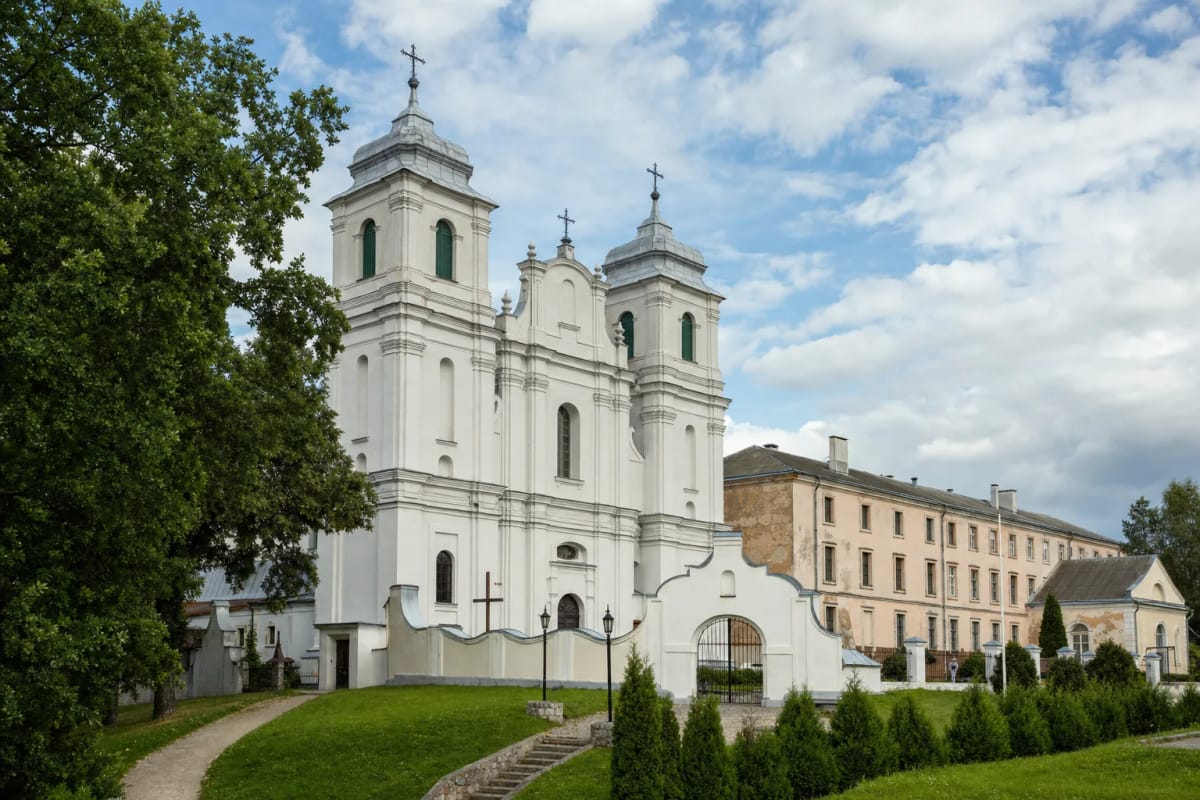
The Discalced Carmelite monastery with the Church of the Discovery of the Holy Cross stands in Antalieptė town, Zarasai District, on the right bank of the Šventoji River, in the surroundings of Gražutė Regional Park. It is a unified late Baroque ensemble: a twin-towered church and neighbouring two-storey monastery building.
Do not confuse it with Antalieptė Reservoir nearby, where the Šventoji valley was turned into a reservoir. The monastery and church complex and the reservoir are separate places, although they are convenient to visit together.
Strutinskis foundation and late Baroque
In the early eighteenth century the Discalced Carmelites came to Antalieptė, invited and supported by Livonian castellan Jonas Mykolas Strutinskis. According to VLE, the late Baroque church was built in 1732-1760 with Strutinskis's funds and consecrated in 1763. The Carmelites also maintained a parish school.
The current masonry monastery building was built later, in 1804-1830, in Classical forms, on the site of the earlier wooden monastery. After the 1831 uprising the tsarist authorities closed the monastery; in 1846-1850 the church was rebuilt as an Orthodox church according to architect Tomas Tišeckis's project, which shaped its present exterior. In 1918 it was returned to Catholics.
Crypt, tunnel, and visiting
Under the whole church extends a three-nave crypt with twelve cellars where, VLE states, monks and monastery founders were buried. An underground tunnel connects the monastery building with the church, one of the complex's most interesting details. The church has three altars and early nineteenth-century Classical organ.
The former monastery is now adapted for visitors as a culture and education space with accommodation options; woodcraft workshops are held in the cellars, along with nature and folklore education. The church remains an active parish church. Check visit, education, accommodation, and service times in advance because they change.
How to visit Antalieptė Monastery
Allow 30-60 minutes to see the twin-towered church, monastery building, and, if arranged, the crypt. The church is an active parish shrine, so entry is free and visiting is best arranged around services or in advance.
Antalieptė combines well with nearby Antalieptė Reservoir, the suspension bridge, the 1855 water mill, and other Gražutė Regional Park and Zarasai-region sites.