- Place
- Klaipėda, Klaipėda City Municipality
- Region
- Klaipėda
- Type
- granite monument unveiled in 2003 to the unity of Lithuania Minor and Lithuania Major and the events of 1923 in the Klaipėda Region
- Address
- Danė Square beside Biržos Bridge, Klaipėda
- Coordinates
- 55.71056, 21.13349
- Visit duration
- 15-30 minutes for the monument; 1-2 hours with Danė Square and Klaipėda Old Town
- Best time
- daylight, when the contrasting granite, deliberately broken beam, and carved inscription are clearest
Arka, United Lithuania Arch, monument to the unity of Lithuania Minor and Lithuania Major
Where the Arch stands and how to identify it
The monument stands in Danė Square on the south side of the river, close to Biržos Bridge and opposite the City Hall bank. Coordinates 55.7105565, 21.1334853 mark the monument itself, not a car park or the centre of the whole square. Approach along Tiltų Street from the Old Town, or cross Biržos Bridge from the north bank.
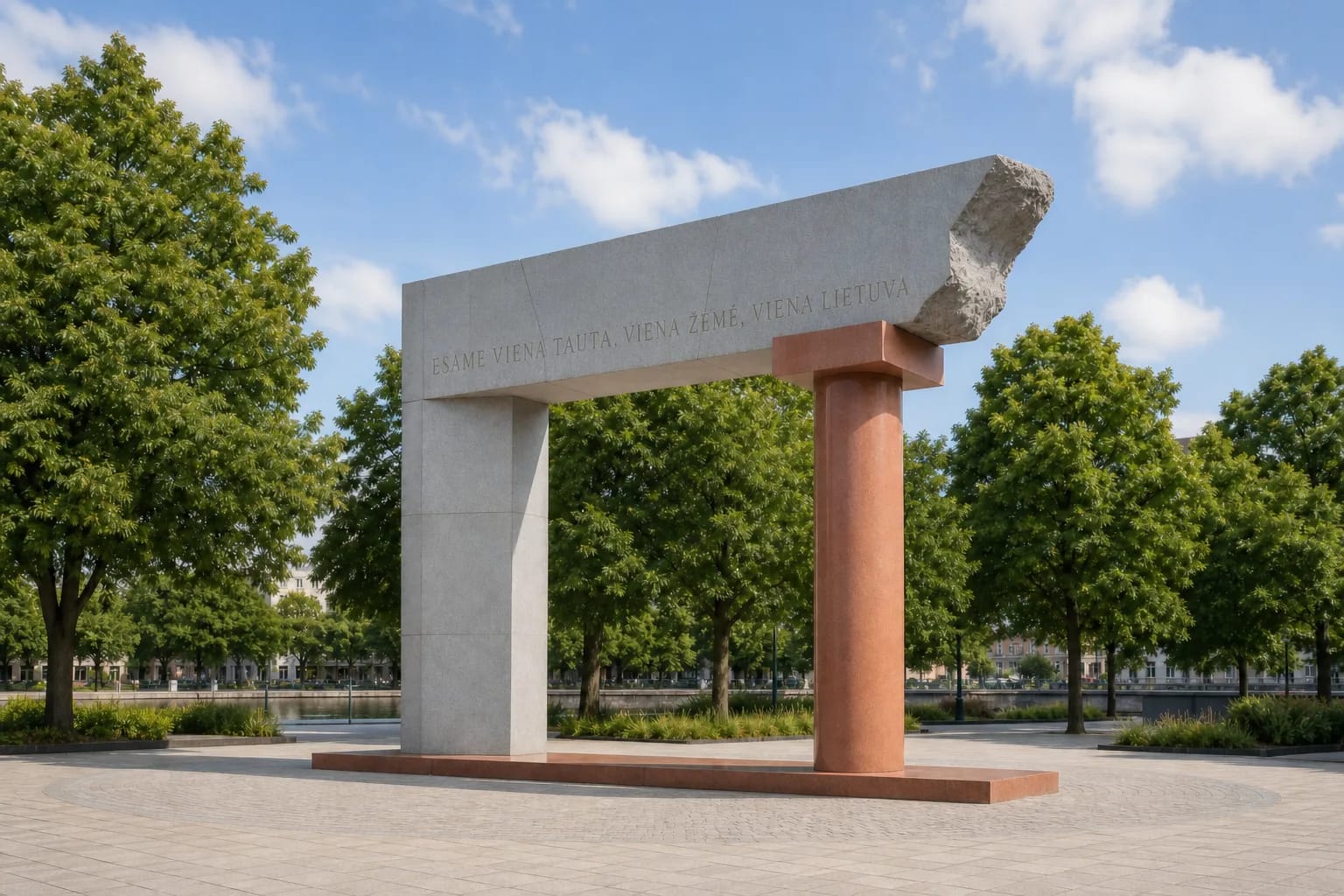
A broad rectangular pier of pale grey granite stands on the left, a much narrower reddish-granite column on the right, and a long grey beam joins them high overhead. The beam does not finish neatly beyond the red column: it ends in a rough, deliberately broken surface. A low red-granite plinth connects the two supports at ground level.
This is not a functioning gateway, a building ruin, or an old piece of harbour machinery. The Arch combines monumental sculpture with an architectural sign. Its identity lies both in its silhouette and in the sentence about one nation, one land, and one Lithuania carved into the grey pier.
Grey and red granite represent two parts of Lithuania
In the artists' concept, the massive grey support represents Lithuania Major, while the slender red-granite column represents Lithuania Minor and its cultural legacy. The beam above turns two unequal elements into one composition. Their difference in colour and scale makes the central idea legible even before the full historical explanation is known.
The irregular end of the beam beyond the red column is intentional, not damage or defective construction. It evokes the portion of historic Lithuania Minor that remained outside Lithuania after the Second World War and now lies in the Kaliningrad region. This is a commemorative artistic interpretation, not a precise map of former borders or a claim that every resident of the region once held the same political view.
Walk around both sides of the monument. A frontal view best reveals the contrast between the supports and the inscription; the side view makes the depth of the horizontal beam and the coarse broken surface much clearer. The grey and red stone is easiest to distinguish in daylight, particularly when rain has not darkened it evenly.
The Act of Tilsit and the events of 1923
The monument's historical narrative begins before 1923. The National Council of Lithuania Minor was established on November 16, 1918, and on November 30 publicly demanded that Lithuania Minor be joined to Lithuania Major. The declaration later became known as the Act of Tilsit. It is a significant political statement for unity, but it should not be presented as a unanimous referendum of every person in the region.
On January 10-15, 1923, a Lithuanian state-backed political and military action was carried out against the French administration of the Klaipėda Region. Historiography calls it the Klaipėda Revolt. On January 19, the Šilutė assembly declared union with Lithuania on autonomous terms, and Lithuanian troops entered after French forces withdrew in February. VLE describes the action as partly implementing the objective expressed in the Act of Tilsit.
Memory of these events is not uniform. Local attitudes differed, and the operation was organised and supported by the Lithuanian government. The Arch is therefore best understood as a commemorative interpretation of unity and incorporation created in 2003, not as a neutral image of every political choice made between 1918 and 1923.
How the monument came to be built in 2003
The Arch was unveiled on August 8, 2003, for the eightieth anniversary of the Klaipėda Region's incorporation into Lithuania. That date explains why the structure bears no traces of construction in 1923: eight decades separate the event from the monument. It was promoted by an initiative group and built with public donations.
Arūnas Sakalauskas created the sculpture, Ričardas Krištapavičius was its architect, and engineer Tautvydas Tubis developed the structural component. The initiative group was led by Valentinas Greičiūnas, then a member of the Seimas. These credits matter because the Arch is not an anonymous city marker or merely a piece of street furniture.
Institutional visitor descriptions most often state that the granite composition is about 8.5 metres high and weighs roughly 150 tonnes. The official catalogue of Arūnas Sakalauskas's work, however, gives a height of 10 metres for the same 2003 monument. Without a primary survey record, the figures should not be blended: 8.5 metres is retained as the widely repeated visitor reference, while 10 metres remains a documented catalogue variant.
Ieva Simonaitytė's words carved into the granite
The grey part bears the capital-letter inscription ESAME VIENA TAUTA, VIENA ŽEMĖ, VIENA LIETUVA: We are one nation, one land, one Lithuania. The words are attributed to Ieva Simonaitytė, the major writer of Lithuania Minor, and are generally linked to the period just after the events of 1923. On the granite they provide the key to the work by stating its theme of unity directly.
Read the sentence together with the structure. The inscription declares unity, while the supports differ in colour and size and the beam ends in a fracture. That combination acknowledges uneven historical experience and the portion of the region left outside Lithuania, preventing the work from reading as an uncomplicated triumphal arch.
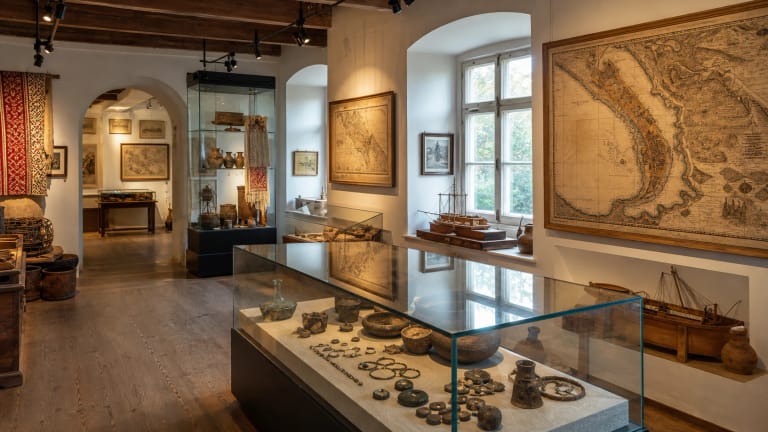
Ieva Simonaitytė was born in the Klaipėda Region and preserved the lives and vanishing world of Lithuania Minor in literature. To place the monument's short quotation within her wider story, continue to her summer-house museum in Priekulė or visit the History Museum of Lithuania Minor in Klaipėda.
Access and a route through Danė Square
The Arch stands in an unfenced public outdoor space, so there is no ticket office, admission charge, or indoor tourist timetable for viewing its form and inscription. An event, quay maintenance, or temporary barrier can still change access. January 15 commemorations follow separately published programmes, so check the municipality's current announcement rather than assuming a fixed annual hour.
The renewed paving around the monument is firm and level, but this observation is not a complete accessibility audit. The map pin does not identify an accessible parking bay, and commemorations may bring crowds or temporary barriers. If you need a verified step-free route or a particular drop-off point, consult current city information before travelling.
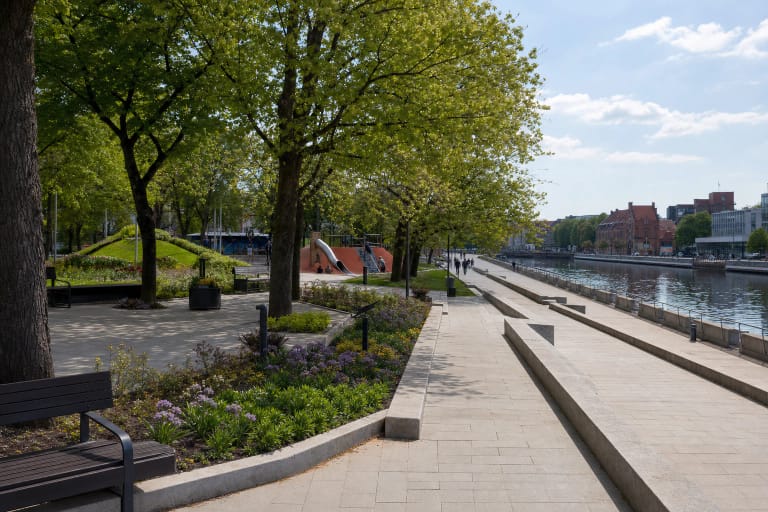
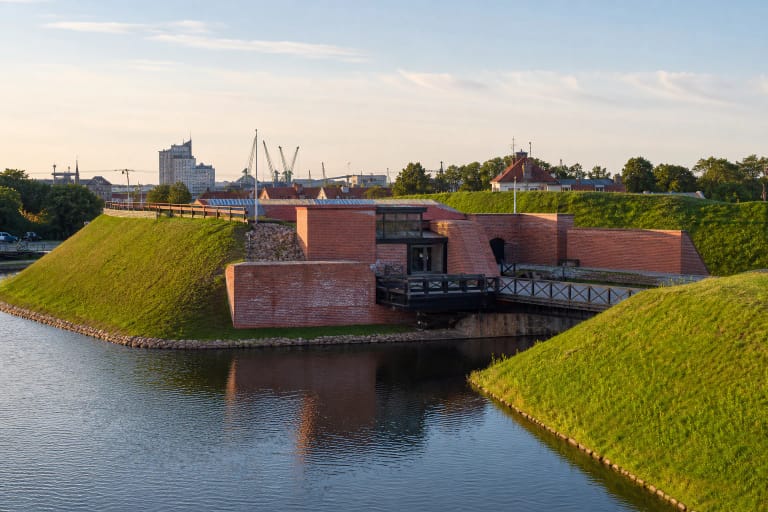
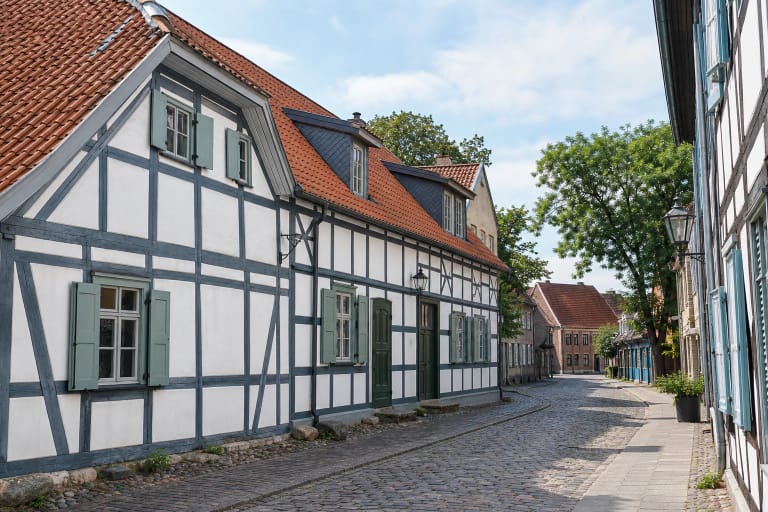
Allow 15-30 minutes for the monument alone, then use its central location for a broader route. Follow the renewed Danė riverside, cross Biržos Bridge into Klaipėda Old Town, visit the History Museum of Lithuania Minor, or continue towards the castle site. Those places give the Arch's compressed symbols the historical setting that a single carved sentence cannot contain.