- Place
- Kretinga District Municipality
- Region
- Samogitia
- Type
- Romantic-era masonry church built in 1838-1842, with one tower, three altars, and a separate nineteenth-century three-tier timber belfry
- Address
- 3 Turgaus Square, Darbėnai, Kretinga district
- Coordinates
- 56.02248, 21.25390
Darbėnai Church, Darbėnai Church of St Peter and St Paul the Apostles, Darbėnų Šv. Petro ir Povilo bažnyčia
The church defines the western edge of historic Turgaus Square
Darbėnai Church of St Peter and St Paul stands at 3 Turgaus Square beside the River Darba, at 56.0224765, 21.2539009. Its white tower is visible from several approaches to town, but navigation should use the official parish address rather than the unclear number sequence sometimes shown in its Google listing. Park only where signs around the square and adjacent streets permit, keeping churchyard gates clear.
The ensemble is more than the principal building. A fieldstone wall encloses the masonry church and a separate timber belfry, while a white sculpture dedicated to Petras Perkumas stands outside towards the square. Walk around all three: the tower dominates from Turgaus Square, whereas the belfry's pyramidal profile reads best from the eastern side of the churchyard.
This is a working parish, not a museum with a permanent attendant. The churchyard is normally open, but interior doors may be locked between services. If the altars, reliquary, or organ matter to your visit, arrive before an officially listed Mass without disrupting preparations, or contact the parish in advance.
The first sanctuary is linked to Chodkevičius, but sources preserve another account
The Telšiai Diocese and regional encyclopaedia associate Darbėnai's first Catholic church, built in 1620, with Jonas Karolis Chodkevičius. A late-nineteenth-century description of the Samogitian diocese instead says local peasants may have built the first small sanctuary in their cemetery because Palanga parish church was distant and reached through heavy forest. Both accounts reveal the community's early need for a local place of worship.
Darbėnai began as a filial church of Palanga and believers supported its resident priest. After 1740, Bishop Antanas Tiškevičius separated Darbėnai from Palanga and granted parish rights. The change transformed a remote chapel into the religious centre of a wider network of villages.
A timber church was built in 1782, although 1730 appears in some older descriptions. It burned during fighting in the 1831 uprising, and services temporarily moved to a chapel arranged in a Darbėnai manor granary. None of that timber body survives in the present building, whose construction began after the fire.
Tiškevičius financed Gasben's design, and Valančius consecrated it
Count Mykolas Tiškevičius, owner of Darbėnai, built the present masonry church in 1838-1842 to a design by architect Friedrich Gasben. Bishop Motiejus Valančius of Samogitia consecrated it in 1855 under the title of the Apostles Peter and Paul. The year 1842 records completion, while 1855 marks liturgical consecration; the dates do not conflict.
The building belongs to the Romantic era. Its rectangular mass has long side elevations articulated by tall round-headed windows, and pale plastered details stand out against the fieldstone masonry. A single tower rises over the front, while a much smaller turret marks the end of the presbytery.
The combination is characteristic of western Samogitia: the heavy grey stone body resembles a small-town stronghold, while the white vertical tower supplies a clear sacred landmark. Despite its pointed spire, the church is not simply Neo-Gothic; its overall character belongs to an earlier Romantic phase and more restrained forms.
The present tower records alterations in 1886, 1911, and after the 1935 fire
The early-nineteenth-century building did not look exactly as it does now. A timber tower was added in 1886 and rebuilt in 1911. The present vertical landmark therefore cannot be treated as an unchanged element of Gasben's 1842 design.
A fire beginning in the tower on 24 October 1935 severely damaged the church. Services moved to the parish hall, and the building was reconstructed in 1936 to a design by engineer S. Fedoravičius. The current Telšiai Diocese page mentions that relocation in its history section; it is not a notice that the church is closed in 2026.
From the churchyard, distinguish the principal layers: the fieldstone body of 1838-1842, the later tradition of the tower, and the silhouette rebuilt after the 1935 fire. This is not a flaw but the biography of an active parish continually adapting and rescuing its building.
Three altars, an Italian painting, and a pyramidal timber belfry
The interior contains three altars and a substantial organ. Count Tiškevičius brought the high-altarpiece of Peter and Paul from Italy. The titular pair thus connects the patron, the circulation of European art, and the dedication bestowed by Valančius in 1855.
Older movable works include an eighteenth-century portrait of Motiejus Trakiškis, the first bishop of Samogitia, and a brass reliquary dated 1759. Both predate the current masonry church and embody continuity with earlier Darbėnai sanctuaries and parish possessions. View them from the public nave and do not enter the presbytery without permission.
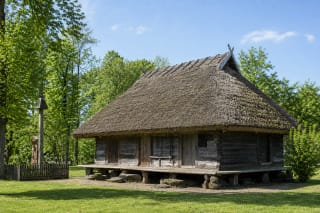
The nineteenth-century timber belfry, Register code 1433, is an independent heritage asset. Built by an unknown folk craftsman, it has a square plan, three diminishing tiers, a sloping lower section, hipped roofs, and sound openings with timber louvres. Its hewn-log frame, shingled first tier, and ornamented double doors deserve as much attention as the main tower.
Petras Perkumas, Mass times, accessibility, and a 4.6 rating
Antanas Ambrulevičius's 1997 monument beside the churchyard commemorates Petras Perkumas, a Salesian pupil from Darbėnai parish who lived from 1916 to 1937. The white figure carries a prayer book and an unopened lily symbolising a vocation cut short. Perkumas died before taking Salesian vows, so it is accurate to call him a Salesian pupil or candidate rather than a canonised saint.
In July 2026, the Telšiai Diocese listed Mass on Sundays at 10:00 and 13:00, Tuesday to Friday at 18:00, and Saturday at 10:00, with no Monday service shown. The Peter and Paul feast is marked on 29 June and transferred to Sunday, and St Michael on 29 September. Schedules can change, so verify them before a dedicated journey.
There is no ticket, but the interior is not an all-day museum. No official detailed statement confirms a fully step-free route, accessible toilet, or visitor ramp; the churchyard includes hard surfaces, but steps remain at the buildings. In July 2026, Google Maps rated the church 4.6 out of 5 from 170 reviews and displayed no separate opening hours.