- Place
- Kaunas City Municipality
- Region
- Kaunas
- Type
- Kaunas Modernist basilica and city viewing terrace
- Address
- Žemaičių g. 31A, Kaunas
- Coordinates
- 54.90200, 23.91700
Resurrection Basilica
An interwar independence monument
Christ's Resurrection Basilica was conceived not as an ordinary parish church but as a national monument to independence. The official history connects the beginning of the idea with 1922.
That gives the basilica a clear statehood layer. It stands in Žaliakalnis and is visible from afar as a sign of modern Lithuania's ambition.
Karolis Reisonas and Modernism
The basilica's design is associated with architect Karolis Reisonas. VLE presents him as a Latvian-born Lithuanian engineer and architect who worked as Kaunas city engineer and head of the construction department in 1930-1938; the basilica is named as his most important project.
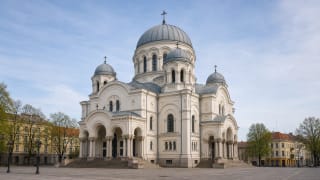
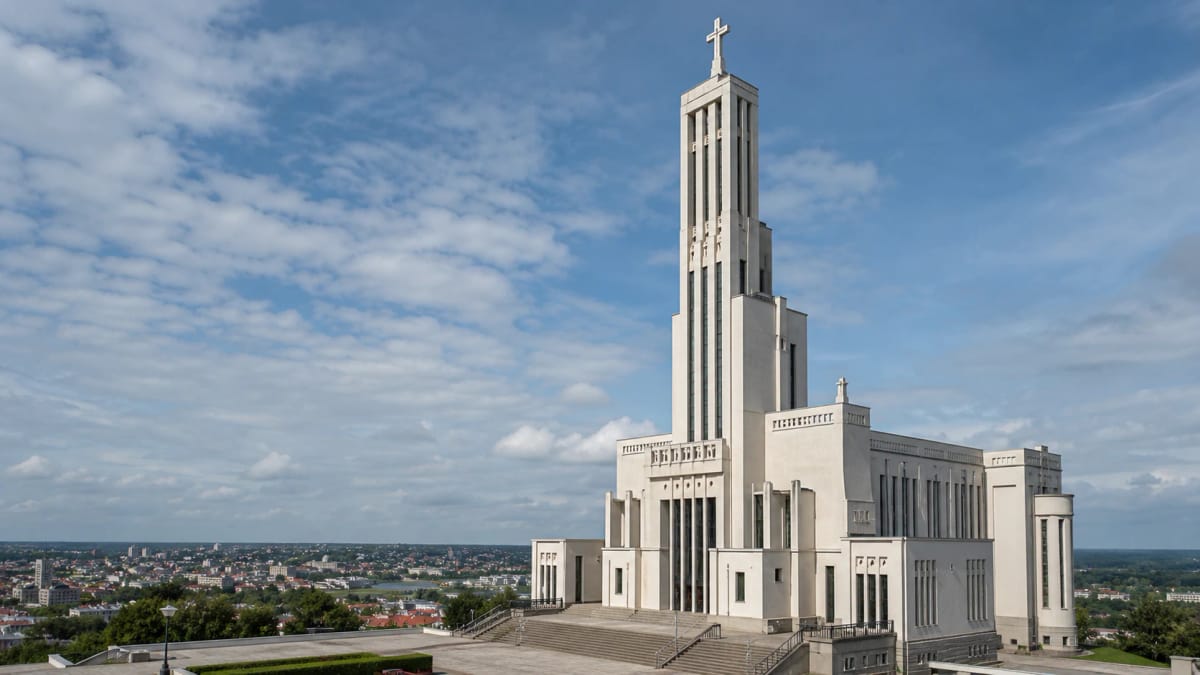
The building deliberately differs from Gothic or Baroque churches. It uses vertical rhythm, a bright volume, rectangular surfaces, and monumental simple geometry. VLE places it within the rationalist direction of the 1930s, so it naturally belongs to the story of Kaunas Modernism. Since 2023, Kaunas Modernist architecture (1919-1940) has been on the UNESCO World Heritage List.
Construction and Soviet interruption
The official basilica history states that the foundations were blessed in 1934 and that a stone from the Mount of Olives was placed in them. VLE links the start of construction with 1933. By 1938-1940, the walls and roof stage had been reached, but the building remained unfinished.
Occupation interrupted the plan. VLE states that from 1952, a radio factory operated in the building. The church was returned to believers in 1990 and reconstructed in 2005. This interruption is central to the basilica's story: a monument to independence was turned into factory space.
Tower and terrace
The main tower reaches about 70 m, and the roof terrace is one of Kaunas' strongest viewpoints. From it you see Žaliakalnis, the centre, and the directions of the Nemunas and Neris landscape.
The official excursions page gives current rules for the terrace, tickets, lift, and stairs. Since such information changes, check the official page before travelling.
How to visit
The basilica is an active church, so during services visitors should behave respectfully and not disturb prayer. If your focus is architecture or the terrace, choose a time outside the main services.
You can reach Žaliakalnis on foot, by public transport, or combine it with the funicular direction. The terrace is best on a clear day, when visibility helps you understand the scale of the city.
What to see nearby
The basilica works well with a Kaunas Modernism route, a Žaliakalnis walk, and Laisvės Avenue. It also completes the city's contrasts: castle, interwar architecture, Soviet interruption, and restored statehood symbols.
With little time, at least see the exterior and go up to the terrace if open. With more time, choose a guided visit that explains the construction and Soviet-period history.