Travel spots in Lithuania
Towns and sacred heritage in Lithuania - page 3
Continue the collection with entries 241-317 of 317.
Town and sacred heritage guides
Each place page combines cultural context, practical details, and visitor orientation.
Miestų objektai ir sakralinis paveldas

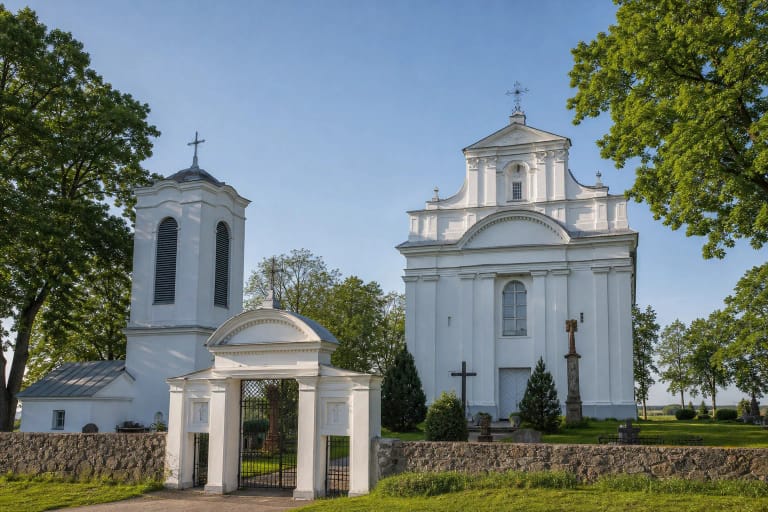
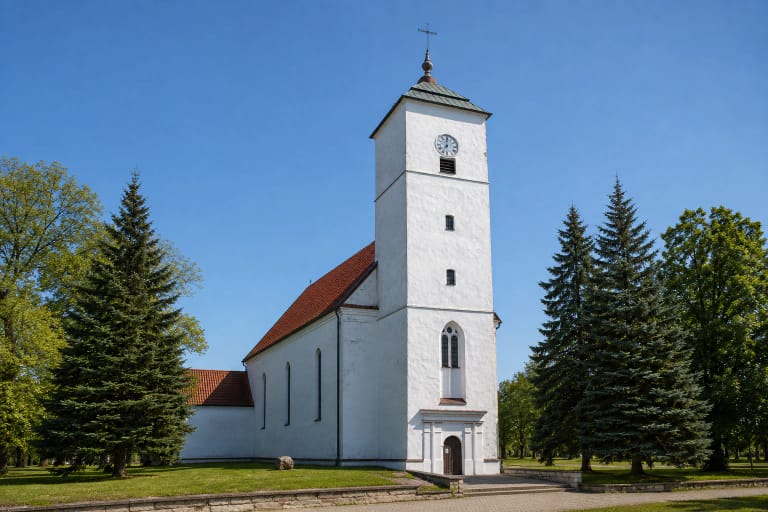
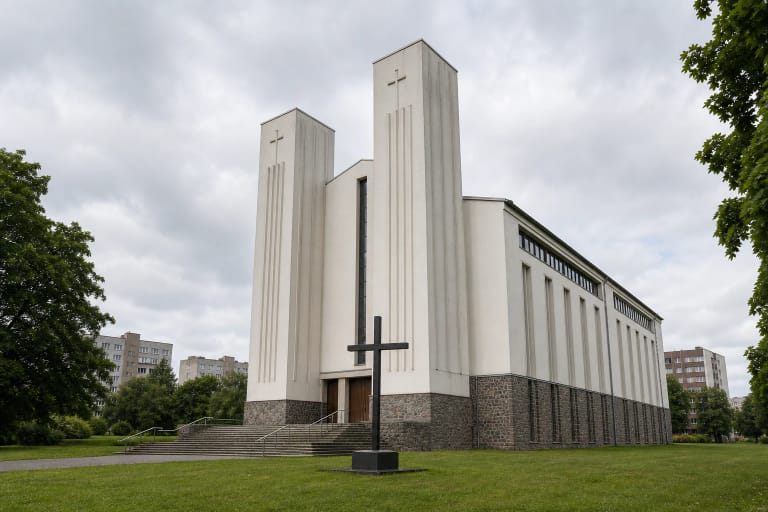
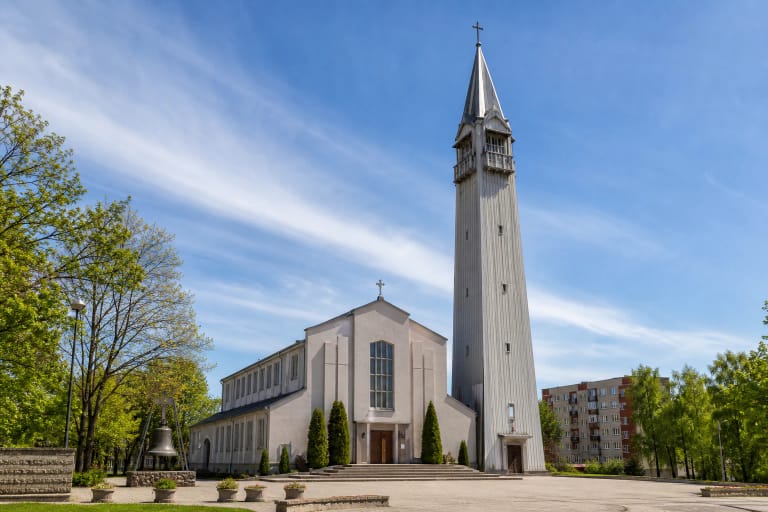
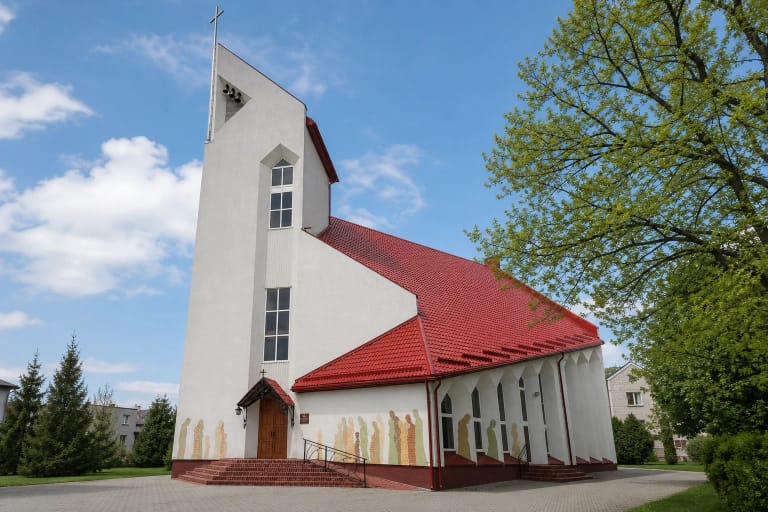
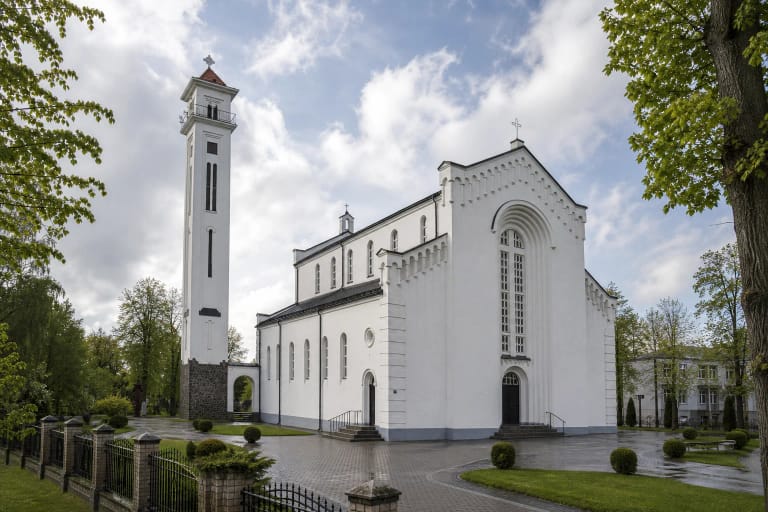
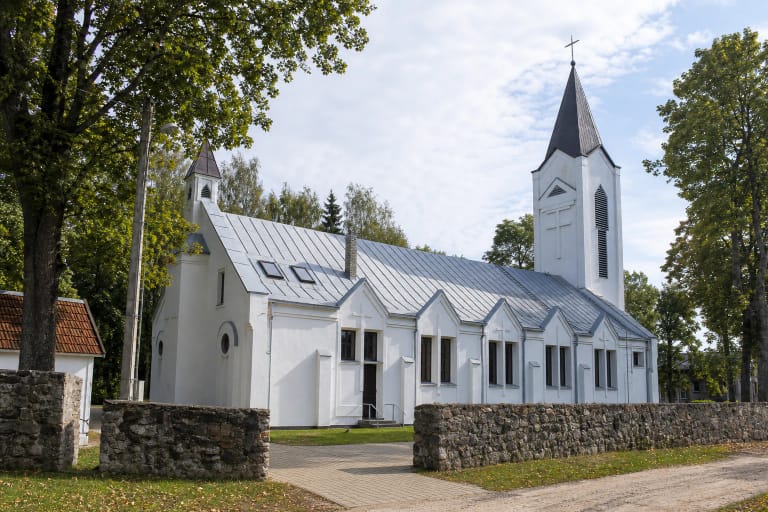
St Michael the Archangel Church in Gargždai is not an old wooden sanctuary but one of Lithuania's clearest sacred-architecture statements from the national Revival period. The white single-tower church designed by Vladas Lučinskas was begun in 1989, largely built in 1990, and consecrated in 1992. Its 22 m body and 53 m clock tower rise within a historic churchyard that preserves the Rönne family mausoleum chapel of about 1840-1841, an 1841 fieldstone belfry, old wall fragments, small chapels, and crosses. In one view, the site brings together a parish history beginning in the 16th century, a 19th-century manor legacy, and the sanctuary built by the late-20th-century congregation.

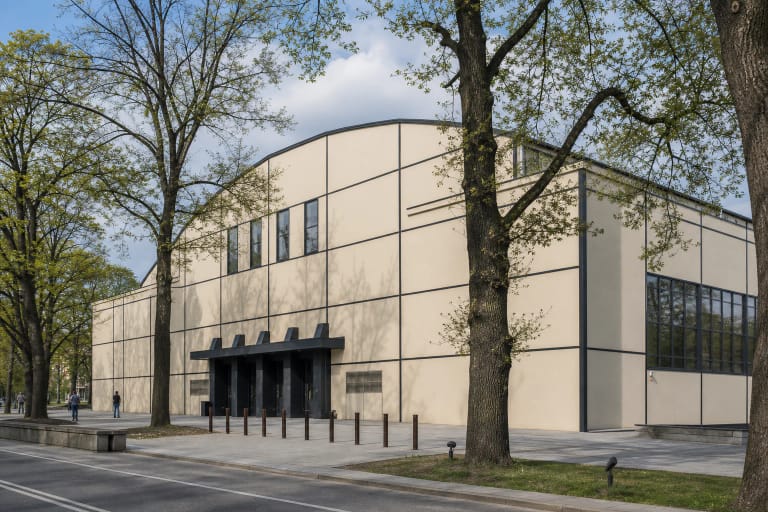
St. Francis Xavier (Jesuit) Church in Kaunas dominates the southern side of Town Hall Square with two Baroque towers. Together with the Jesuit monastery and gymnasium, it forms a whole old-town block; over the centuries the church belonged to Jesuits and Franciscans, was converted into an Orthodox cathedral and a Soviet sports hall, and finally returned to the Jesuits.

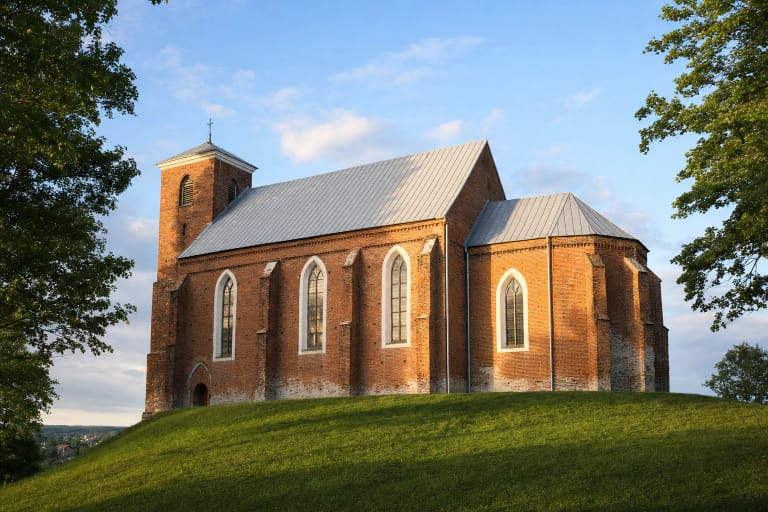
St. George the Martyr Church and the Bernardine Monastery beside Kaunas Castle form one of Kaunas's oldest sacred complexes: a late Gothic red-brick ensemble returned to the Franciscan community after a difficult twentieth century.

St. Gertrude Church in Kaunas is one of Lithuania's oldest and most distinctive Gothic churches, hidden in a small courtyard off Laisvės aleja. The single-nave red-brick church is cared for by the Marian Fathers; it holds the famous Miraculous Cross, and a candle shrine operates in the basement.

St. Michael the Archangel (Garrison) Church in Kaunas, often called Soboras, is one of the strongest landmarks of Laisvės aleja and Nepriklausomybes Square. Built in 1890-1895 as the Orthodox garrison cathedral of Kaunas Fortress, it became a Catholic Lithuanian army garrison church in 1919, was turned into a stained-glass and sculpture gallery in the Soviet period, and was returned to the Kaunas Archdiocese after 1991.

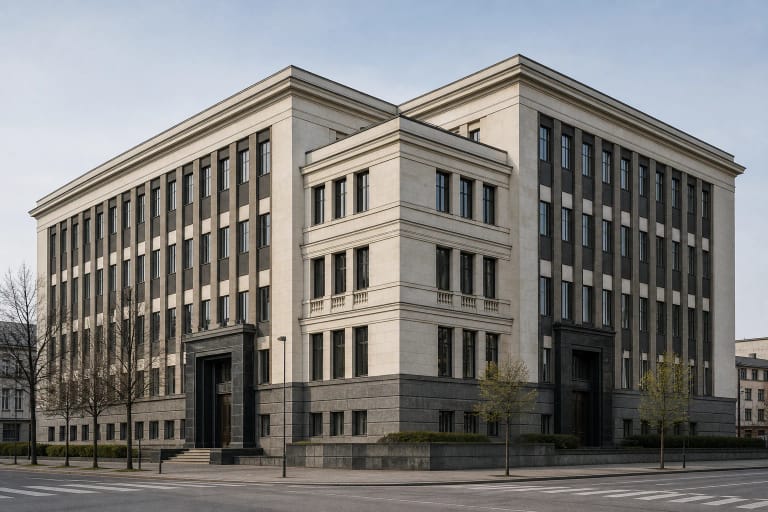
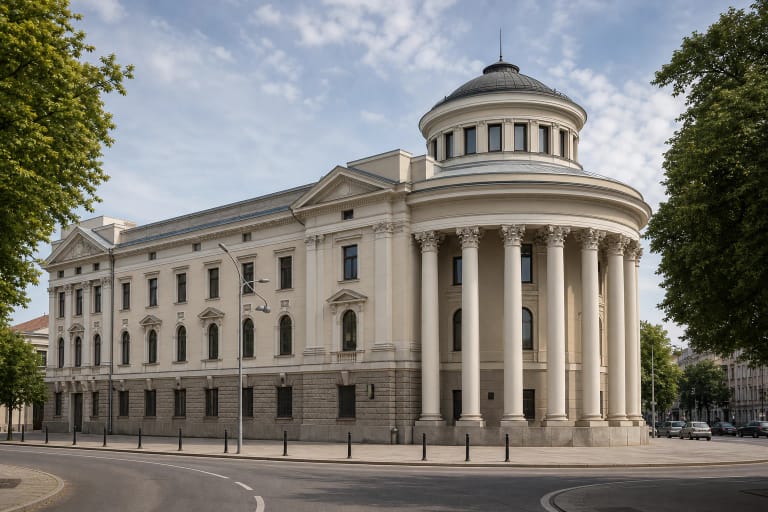
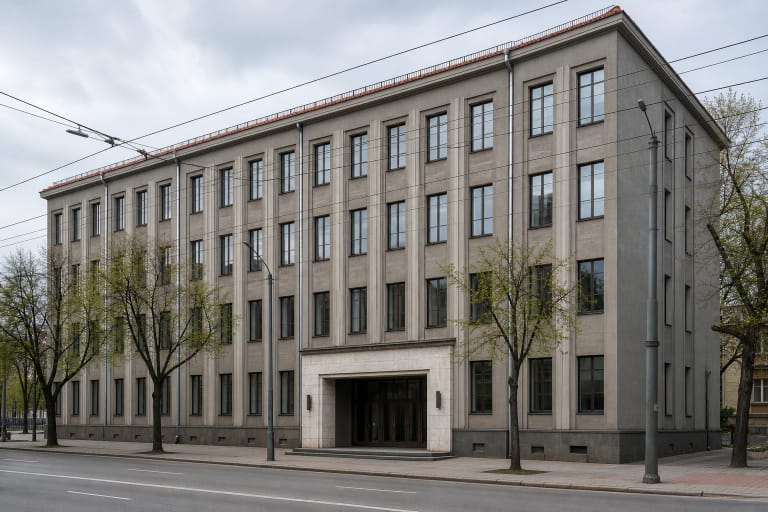
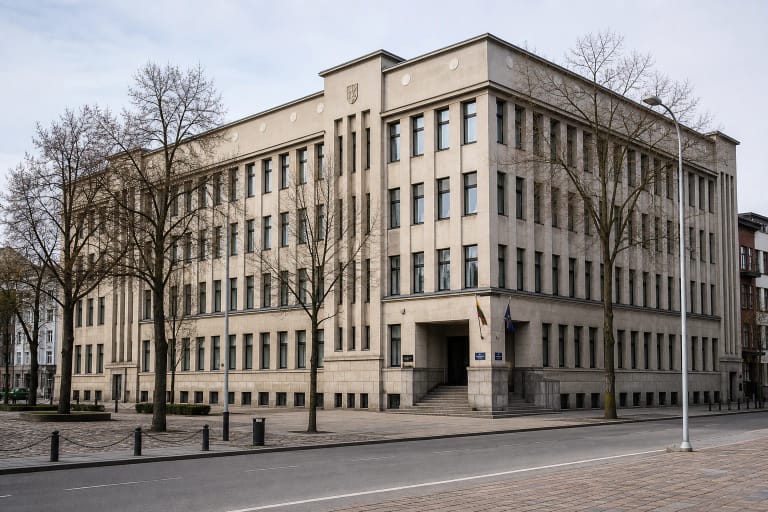
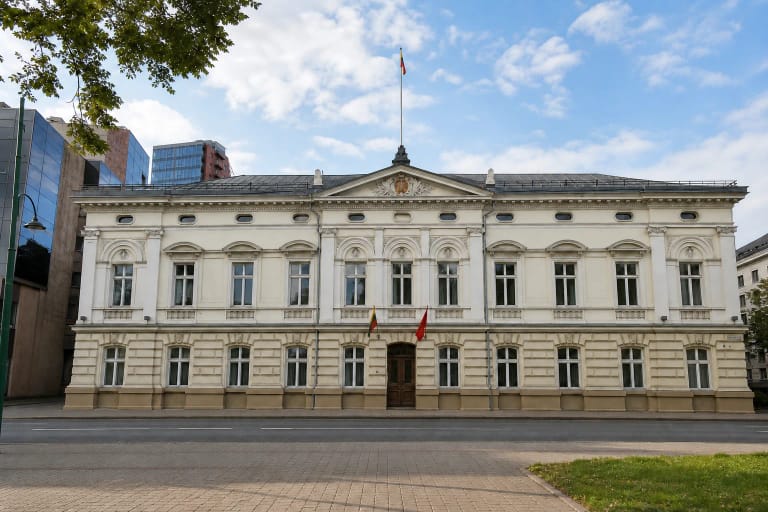
The State Savings Bank Palace at Laisvės al. 96 is the last major interwar architectural accent on Laisvės aleja: a functionalist state finance and administration building constructed in 1938-1940 and designed by Arnas Funkas, Adolfas Lukosaitis, and Bronius Elsbergas. It was not opened before the Soviet occupation, but still preserves the scale of a modernist temporary capital.

Stelmužė Church of the Cross of the Lord Jesus, dated 1650, is considered Lithuania's oldest wooden church: a filial manor church with a 12-column portico around three sides, a 1650 Baroque altar and pulpit, a bell tower with bells cast in 1613, and a church-art exhibition.

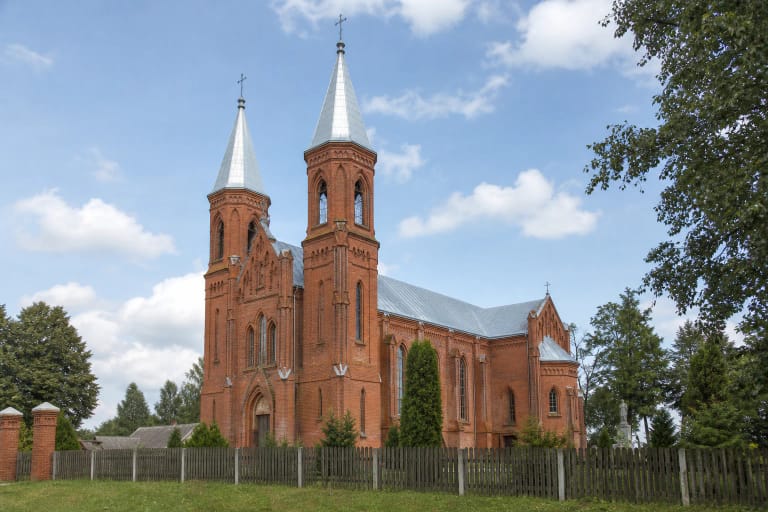
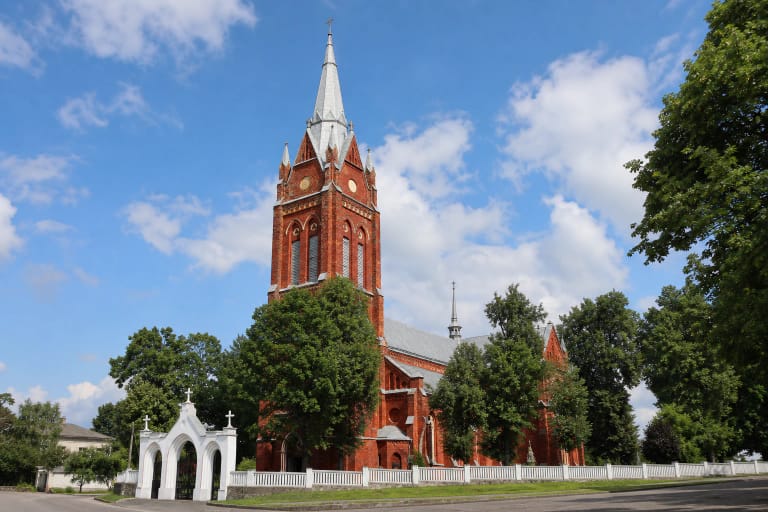
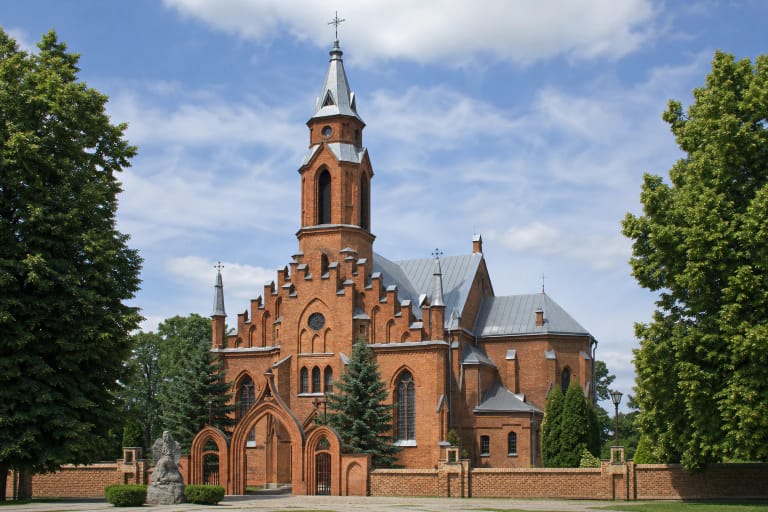
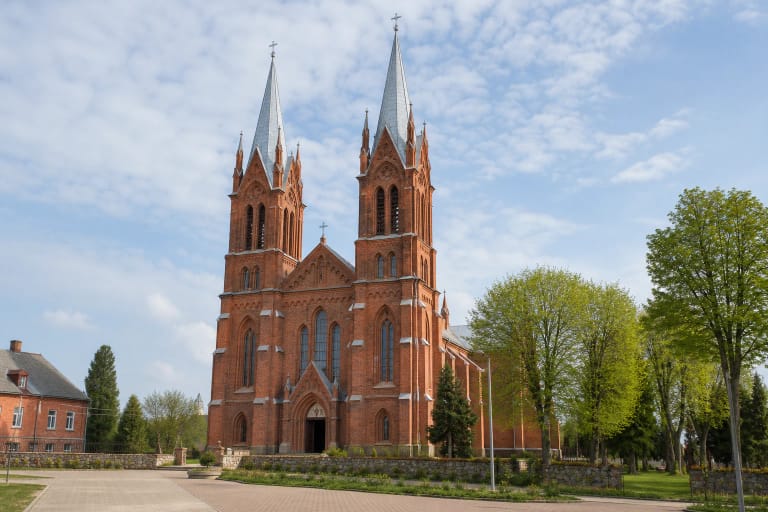
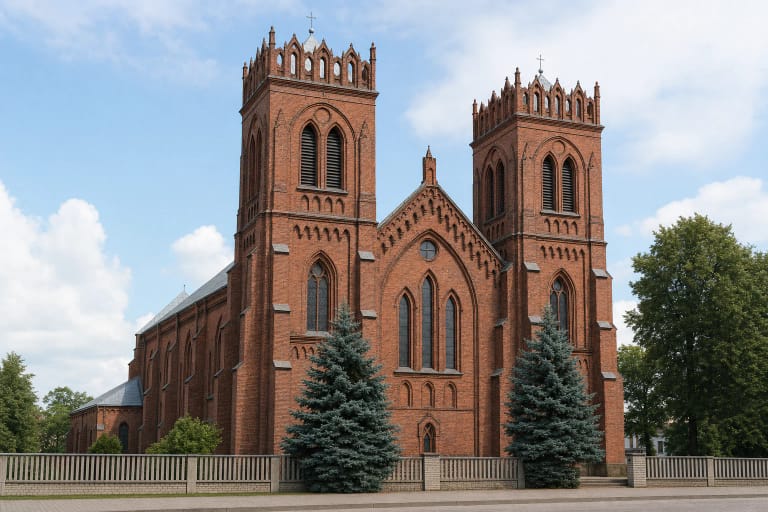
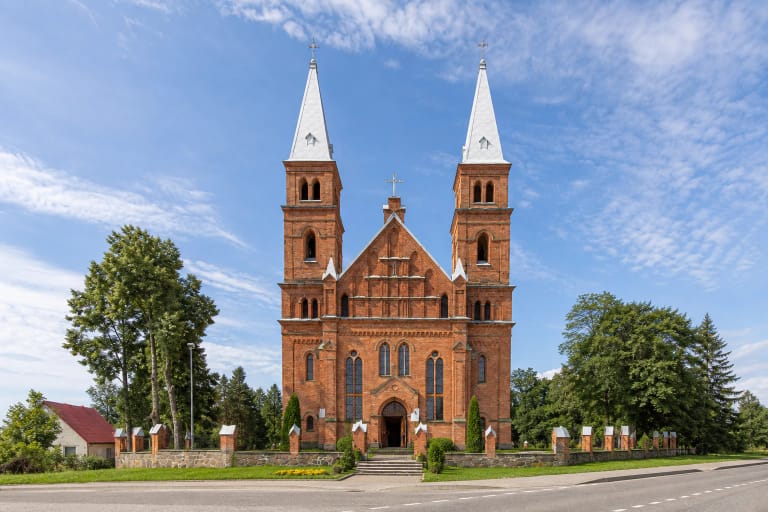
Švėkšna St James the Apostle Church is a nationally significant Neo-Gothic sanctuary built in 1900-1905 to a design by Karl Eduard Strandmann, in red brick and connected to Švėkšna Manor Park by a red-brick viaduct.

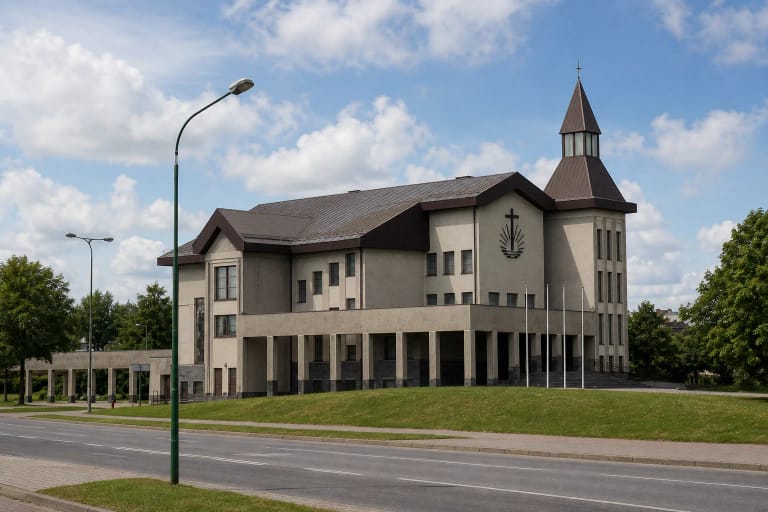
The Šventoji Church of the Blessed Virgin Mary, Star of the Sea is a contemporary brick seaside sanctuary built in 1991-2003 to a design by R. Krištapavičius and G. Aperavičius, and blessed on 20 June 2003 by Telšiai Bishop J. Boruta. Its 62 m tower with an observation deck is one of the tallest landmarks in Palanga, and its Stella Maris name continues the tradition of a 1929 wooden church.

Tauragė Church of the Most Holy Trinity is the dominant historicist Catholic church in Tauragė old town, consecrated in 1904. Its single octagonal tower rises above the city, while the Latin-cross-plan building with Neo-Romanesque and Classicist features recalls a border city where Catholic and Lutheran communities lived side by side for centuries. The church was built through the efforts of parish priest Fabijonas Kemėšis on the site of earlier wooden churches.

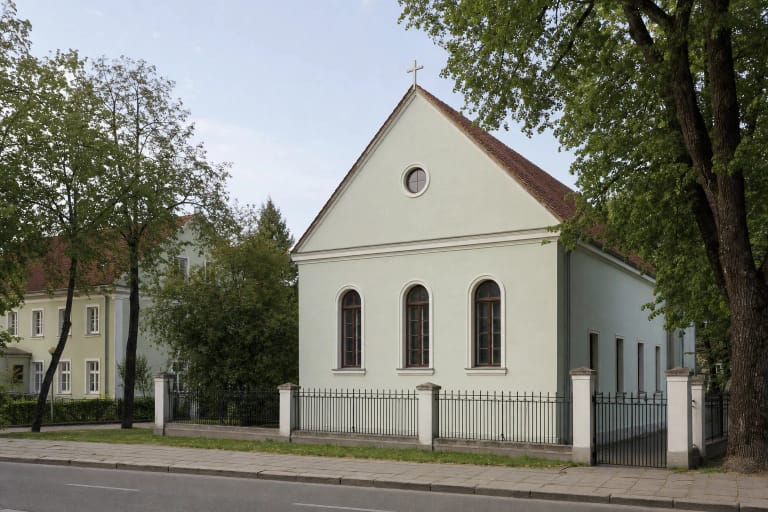
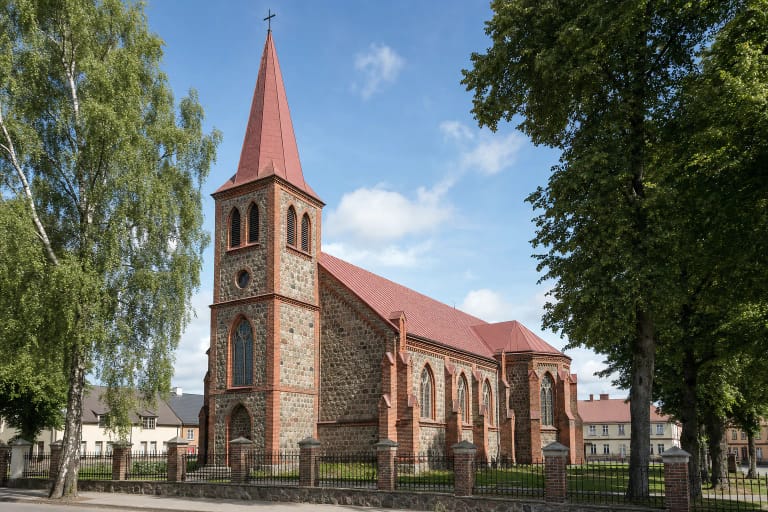
Tauragė Evangelical Lutheran Church is one of the town's oldest confessional communities: the parish was founded in 1567, and the present stone church with a square tower was built after the 1836 fire and consecrated in 1843. In 1947 it was given the name of Martynas Mažvydas.

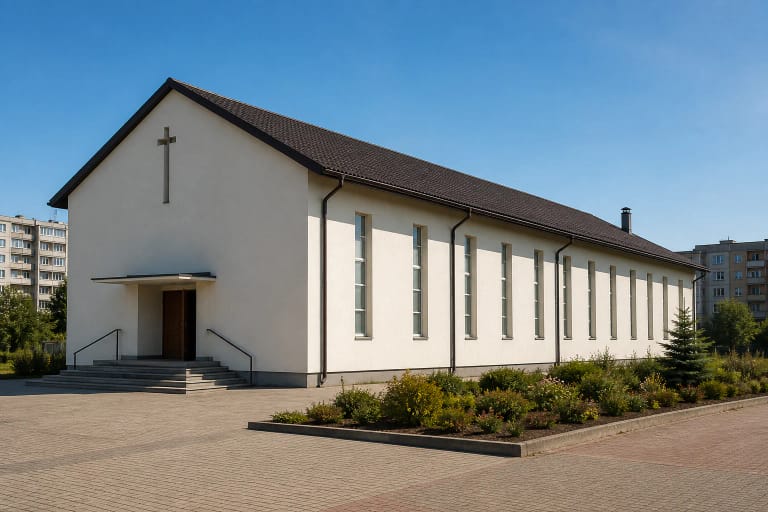
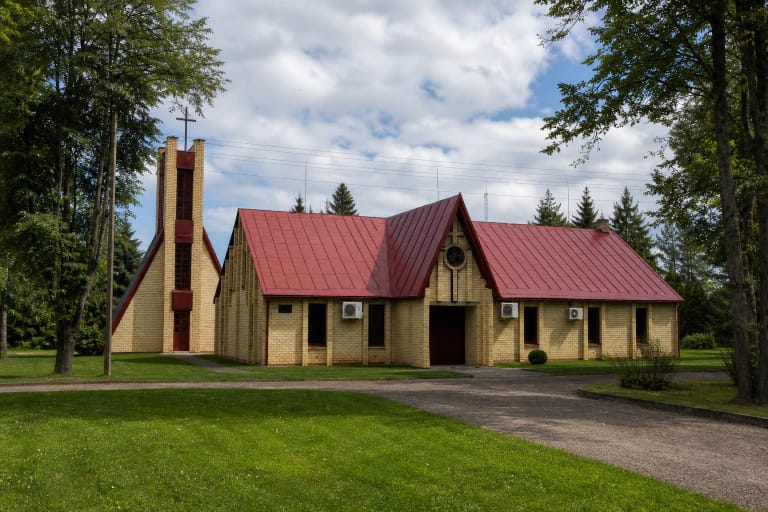
Tauragnai Church of St George is an active parish sanctuary rebuilt in 1969 from a timber house bought in Priepalė village, then renewed to a design by architect Romualdas Mikėnas in 1988, when it was brick-clad and enlarged. Its pale-brick mass is marked by one two-storey entrance-tower volume, while its history must be separated from the 1874 church that burned in 1944 with its belfry, archive, altars, and organ. The exact Google Maps card showed 5.0/5 on 15 July 2026; its Place ID is ChIJeUv7ppFR3UYRqdW6FPQqyrs.

Telšiai Cathedral of St Anthony of Padua stands on Insula Hill above Lake Mastis; completed in 1791 as a Bernardine church, it has served as the cathedral of the Telšiai Diocese since 1926.

Telšiai Old Town is not a single square or a decorative sculpture trail. It is a state-protected heritage area of national significance covering approximately 56.1 hectares, valued for its organically developed radial street plan, elongated Market Square, contrasting relief, and relationship with Lake Mastis. Between two historic landmarks, the cathedral on Insula Hill and the Minor Church on Vilnius Hill, fragments of nineteenth- and twentieth-century masonry, wooden houses, high plinths, and older paving survive. The urban fabric also carries the history of Catholic, Jewish, Orthodox, and Lutheran communities, although fires, war, and post-war demolition erased important buildings.

The Magical Mouse is one of the smallest yet most searched-for sculptures in Klaipėda Old Town. The bronze figure, about 17 cm tall and distinguished by enormous ears, sits on a dark granite hemisphere encircled by the Lithuanian words 'Mintis paversk žodžiais - žodžiai taps stebuklais': turn thoughts into words, and words will become miracles. Sculptors Svajūnas Jurkus and Sergejus Plotnikovas realised architect Vytautas Paulionis's idea and paid for the city's gift themselves in 2006. They also devised its ritual: think of a good wish, whisper it into the Mouse's ear, and believe. This is a contemporary urban legend rather than an old Klaipėda folktale. Because the figure is easy to walk past, use the coordinates at 5 Kepėjų Street and Mėsininkų Street instead of relying only on the frequently quoted Kurpių and Kepėjų junction.

The Sleuth in Klaipėda is a life-size bronze criminal investigator pressed against an old red-brick wall and watching the street corner. Installed in 2020, Sergejus Plotnikovas and Saulius Druskis's work is described as Lithuania's first monumental sculpture devoted to police work and the profession itself. Its public Google Maps rating was 4.9 out of 5 on 13 July 2026.

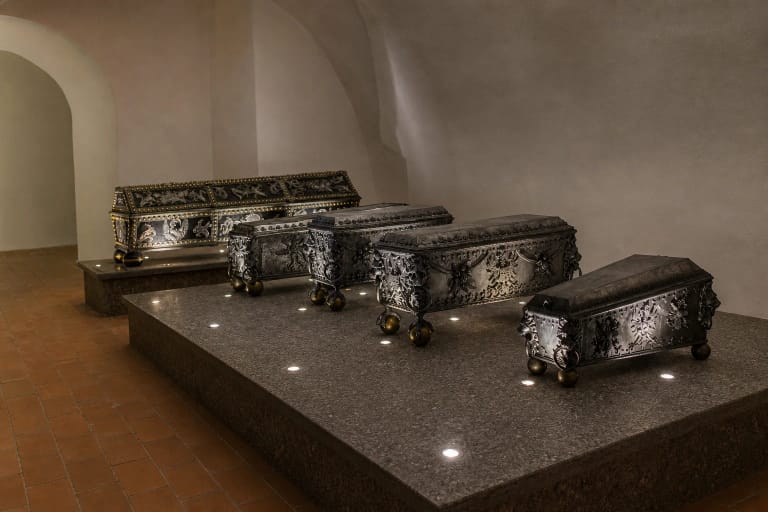
The Tiškevičiai Chapel-Mausoleum in Kretinga's Second Old Cemetery is an 1893 Neo-Gothic work by Karl Eduard Strandmann: a single-nave red-brick chapel rises above a family crypt embraced by an artificial mound. Four concealed metal sarcophagi were discovered inside concrete platforms in 2014. Following restoration in 2017-2018, Kretinga Museum opened an exhibition presenting the restored sarcophagi of Józef and Zofia Tyszkiewicz, grave goods, and sacred art.

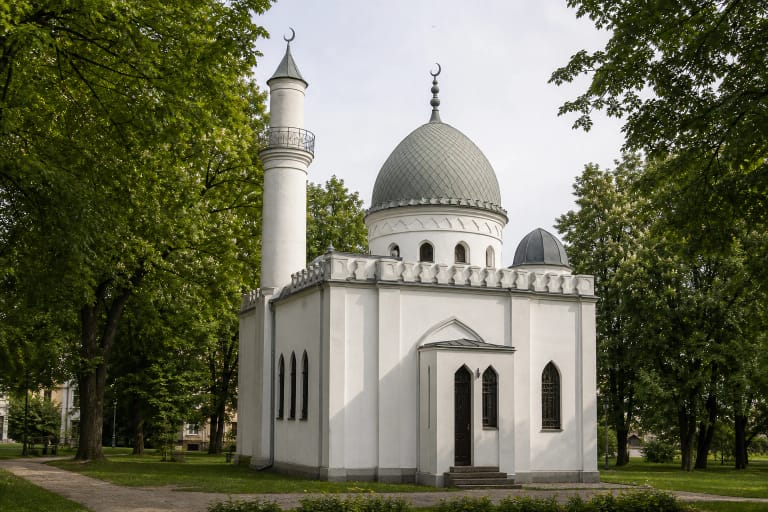
The Trakai Karaim Kenesa on Karaimų Street is the first kenesa established in Lithuania, with roots in the fifteenth century, and during the Soviet period it was the only functioning Karaim temple in Europe. It is one of the most important religious and cultural heritage sites of Lithuania's Karaims.

Trinapolis Church of the Holy Trinity and the former Trinitarian monastery stand on the bank of the Neris in Verkiai, in northern Vilnius. The Baroque ensemble was founded in 1700 by Vilnius Bishop Konstantinas Kazimieras Bžostovskis, who named the place Trinapolis. Today it is a Vilnius Archdiocese retreat house in a quiet, scenic setting.

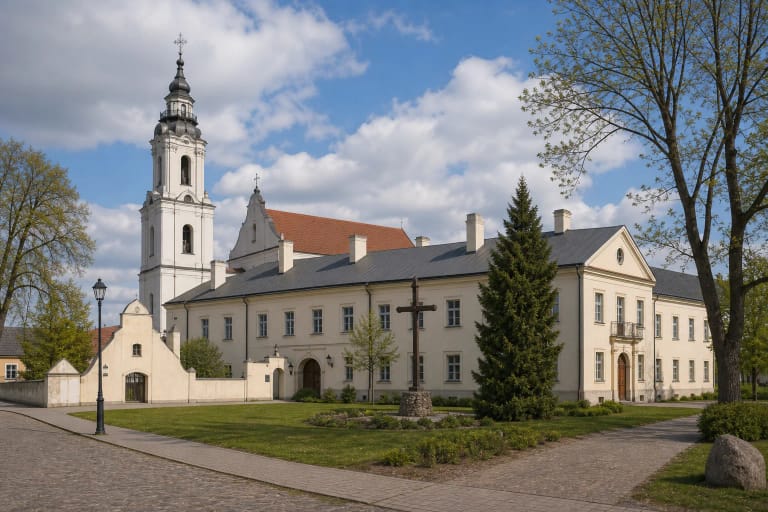
Troškūnai Church of the Holy Trinity and the former Bernardine monastery form a late Baroque ensemble in Anykščiai District. The brick church was built in 1774-1787 according to architect Martynas Knakfusas; all four pediments are decorated with wrought-iron crosses, and inside is the oldest organ in the Anykščiai region.

Tverai Church of the Visitation of the Blessed Virgin Mary is Lithuania's largest wooden church, built in 1897 in the old Samogitian centre of Tverai. It is known for the country's only Samogitian Baroque churchyard gate, a separate belfry, and an old revered image of the Mother of God that has long drawn pilgrims.

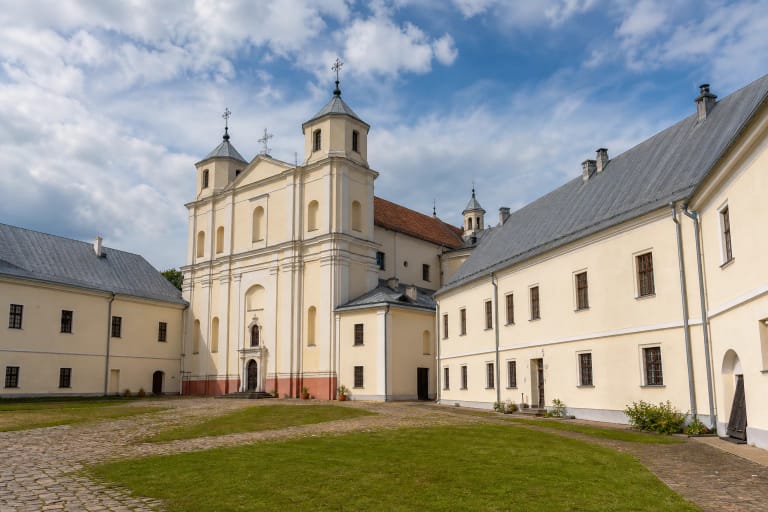
Tytuvėnai Church and Bernardine Monastery Ensemble is one of Lithuania's most important sacred complexes and a pilgrimage New Jerusalem: church, monastery, Holy Stairs Chapel, and Stations of the Cross galleries unite seventeenth- and eighteenth-century architecture with devotional tradition.

Utena Church of Divine Providence is the city's second Catholic parish church, built in 2004-2005 as an oval red-clinker volume marked by a 44-metre bell tower and cross. Its story involves two distinct designs: a pyramid-shaped church begun in the 1990s remained unfinished, while Ričardas Krištapavičius and Mindaugas Jamantas designed the building seen today. Inside, the defining works are Kazys Morkūnas's stained glass, Valentinas Šimonėlis's altar and ambo, a nineteenth-century Virgin and Child, and an electronic organ.

Utena Church of the Ascension of Christ is a red-brick Historicist church built in 1882-1884, with a Greek-cross plan crowned by a large dome and two open towers framing its principal façade. A separate masonry bell tower predates the present church and alone survived the town fire of 1879. The visit gained a new focus in 2026: Antanas Deveikis's original Trumpeting Angel is now displayed in a new chapel in the churchyard after restoration, while a copy is being prepared for the façade.

Užupis Republic is Vilnius' artistic quarter across the Vilnia River, known for its symbolic independence declared in 1997, Constitution wall, Užupis Angel, and slow walking route.

Vabalninkas Church of the Assumption of the Blessed Virgin Mary is a masonry sanctuary built in 1814-1817 and consecrated in 1818. Its Classicist mass gained a twin-towered Neo-Baroque facade in 1879-1880. The three-aisled basilica preserves five altars, an 1890 organ by Juozapas Radavičius, an older pulpit, stained glass, and sacred art spanning several centuries. The church, detached belfry, fieldstone wall with fourteen Stations of the Cross chapels, and mortuary form a state-protected ensemble in the centre of Vabalninkas.

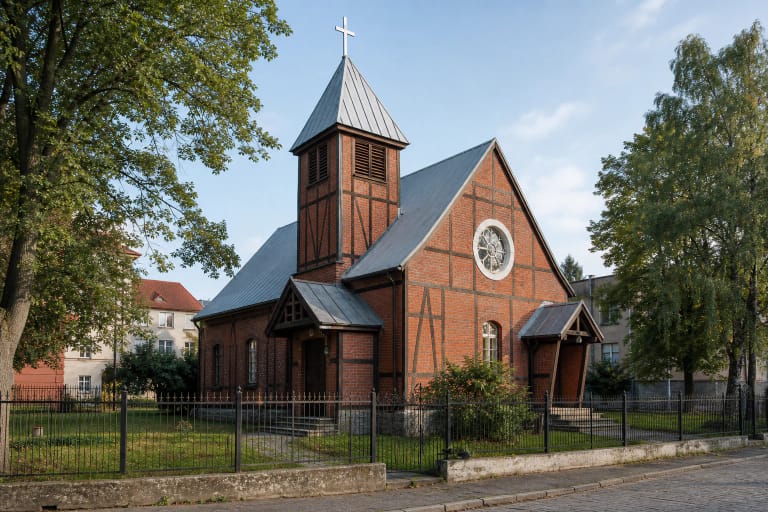
Vanagai Evangelical Lutheran Church is a red-brick Lithuania Minor sanctuary designed in 1907-1909 by the Ragainė master Tamošaitis and protected in the Cultural Heritage Register as part of the Vanagai church building complex. It is known for its neo-Gothic, Art Nouveau, and rationalist features, the stained glass "St Peter" and "St Paul," a 1908 Voelkner organ, and its ties to the writer Ieva Simonaitytė.

Vandžiogala Holy Trinity Church is a wooden folk-architecture church built in 1830 in a multicultural Kaunas district town. Vandžiogala is known for Lithuanian, Polish, Jewish, and Russian history, and the church is one of the few in central Lithuania where Polish-language Mass is still celebrated on Sundays. Ancestors of Nobel laureate Czesław Miłosz are buried in the old cemetery.

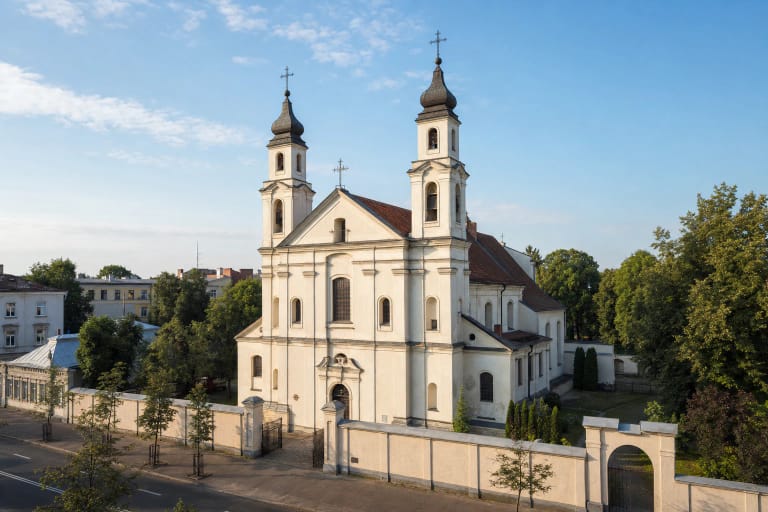
Varniai Cathedral, officially the Church of Saints Peter and Paul, is the former cathedral of the Samogitian Diocese: a Baroque twin-towered church built in 1680-1691, with 13 bishops buried in its crypt.

Veisiejai Church of St George is popularly called the Cathedral of Dzūkija because of its exceptional scale, although it has no cathedral status. Mykolas Masalskis began funding the masonry church in 1762. After a long interruption, Viktorija Oginskaitė-Žynevienė resumed the project, which reached completion in 1817-1818. The early Baroque and Classical facade encloses a three-aisled basilica with five altars, an organ from about 1876, 19th-century paintings, Ogiński epitaphs, and the founders' crypts. The detached timber belfry dates from 1930, but its brass bell is dated to about 1650. This remains an active parish church, so tourist access to the interior depends on services and prior arrangements; on 15 July 2026 its exact Google Maps place listing carried a 4.7/5 rating.

Videniškiai Monastery in Molėtai District is a rare sacred ensemble at the turn from Renaissance to Baroque, a Giedraitis family foundation and the only centre of the Canons Regular of Penance, known in Lithuania as the White Augustinians. Beside St Lawrence Church stands the former monastery, now a museum.

Vilkaviškis Cathedral is a symbol of loss and rebuilding: the 1884 Church of the Visitation of the Blessed Virgin Mary was damaged in World War II, destroyed by Soviet order, and rebuilt in 1998 as the cathedral of the Vilkaviškis Diocese.

Vilkyškiai is a distinctive Lithuania Minor town in Rambynas Regional Park: a radial-plan settlement with an Evangelical Lutheran church, manor estate, memory of Salzburg colonists, and Witches' Spruce growing nearby.

The Vilnius Basilian Monastery and Holy Trinity Church on Aušros Vartų Street is a Greek Catholic ensemble, famous for its impressive late-Baroque gate designed in 1761 by Johann Christoph Glaubitz. The history of Adam Mickiewicz is also connected with the monastery prison.

The Vilnius Calvary Way of the Cross is a 35-station pilgrimage route laid out in Verkiai in 1664-1669, with masonry and wooden chapels, gates, a bridge over the Cedron stream, and the Church of the Discovery of the Holy Cross. It is one of Lithuania's most important Calvaries.

Vilnius Cathedral and Bell Tower form the central sacred and state-memory ensemble of the capital: neoclassical facade, crypts, St Casimir's Chapel, separate bell tower, and Cathedral Square history.

Vilnius Choral Synagogue on Pylimo Street is an eclectic synagogue built in 1903 and decorated with Moorish and Neo-Romanesque motifs. It is the only one of more than one hundred prewar Vilnius synagogues and prayer houses that survived and still functions, and it remains a centre of religious life for Lithuania's Jewish community.

Vilnius Church of St Francis of Assisi, usually called the Bernardine Church, is one of Lithuania's largest and most mature Gothic monuments. Together with neighbouring St Anne's Church it forms the country's best-known Gothic ensemble, while the defensive attic with firing openings shows that the church once also formed part of city defence.

The Church of St Peter and St Paul in Antakalnis is one of the strongest Baroque landmarks in Vilnius. Its restrained twin-towered facade hides a luminous seventeenth-century interior filled with thousands of white stucco figures and linked to the foundation of Mykolas Kazimieras Pacas.

Vilnius Holy Spirit Orthodox Church on Aušros Vartų Street is Lithuania's main Orthodox shrine: a monastery cathedral of Baroque origin, preserving the memory and veneration of the relics of the Vilnius martyrs Anthony, John, and Eustathius.

Vilnius Missionaries Church, formally the Church of the Ascension of the Lord, is one of the most graceful late Baroque silhouettes in the old town. Its two slender towers rise on Saviour Hill above Subačiaus Street and form a recognizable Vilnius panorama accent shaped by Jonas Kristupas Glaubicas, the leading architect of Vilnius Baroque.

Vilnius St Casimir's Church on Didžioji Street is one of the first Baroque churches of the Grand Duchy of Lithuania, begun by the Jesuits in 1604. It is marked by a 40 m dome crowned with a helmet shaped like the crown of a Grand Duke of Lithuania and by the memory of St Casimir, Lithuania's patron saint.

Vilnius St Catherine's Church on Vilniaus Street is part of a sixteenth- to nineteenth-century Benedictine ensemble. Jonas Kristupas Glaubicas gave it its present twin-towered late Baroque form in 1741-1753, and since 2006 it has served as a concert and cultural space.

Vilnius St John's Church and Bell Tower form the core of the Vilnius University ensemble: a late Baroque university church, academic ceremonies, a bell tower with 193 steps, a Foucault pendulum, and one of the best panoramas of the old town.

Vilnius St Nicholas Church is the oldest surviving Gothic shrine in Lithuania, first mentioned in 1387. The modest red-brick hall church preserves Gothic vaults and the memory of Lithuanian-language worship: during the interwar period it was the only Vilnius church with regular Lithuanian services.

Vilnius St Teresa's Church stands beside the Gates of Dawn and is considered one of the first and most beautiful Baroque buildings in Lithuania. Built in the mid-seventeenth century with Pac family funding for the Discalced Carmelites, it has a facade of Swedish sandstone and marble and a rich Rococo interior with frescoes from the life of St Teresa.

The Vilnius University Ensemble links the courtyards, St Johns' Church, bell tower, and architecture of the university founded in 1579 into one of Vilnius Old Town's densest historic spaces.

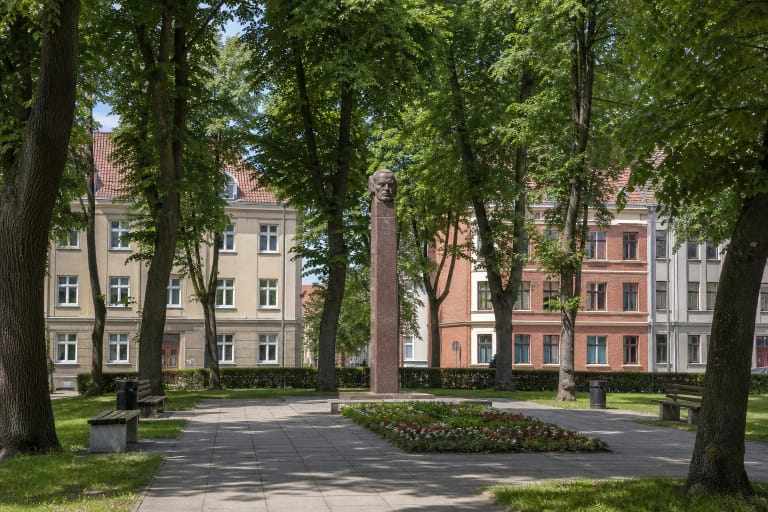
Vincas Kudirka Square is a tree-framed public space on Gediminas Avenue opposite the Government of Lithuania. Its focus is the 2009 monument to the author of the national anthem, designed by sculptor Arūnas Sakalauskas and architect Ričardas Krištapavičius. A stylised bell tower almost 13 metres high carries the words of Tautiška giesmė, accompanied by a 3.7-metre bronze figure, a red-granite base, and a seasonal water feature. The site has a much longer history than its present name: a Russian Orthodox chapel commemorating those who suppressed the 1863-1864 Uprising stood here in the nineteenth century, while a monument to Soviet general Ivan Chernyakhovsky dominated the space from 1950 to 1991. It subsequently became Municipality Square and received Kudirka's name in 2007. The outdoor square is free to enter, but the Government building, underground car park, public toilet, and events are separate facilities with their own rules.

Vingriai Springs Square is a 1.5 ha public space between Mindaugo and Pylimo streets, created on the site of the historic Vingriai water source. From 1501, spring water travelled downhill through wooden pipes into Vilnius; today an open channel with a spiral basin, terraced steps, a viewpoint, and water-themed sculpture interpret that history. Lithuanian official sources also shorten the same place name to Vingrių skveras, so it should not be mistaken for a second nearby Old Town square.

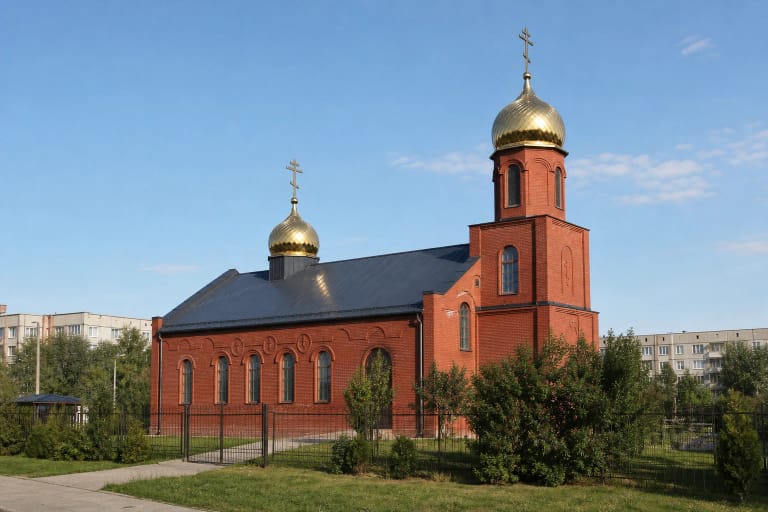
Visaginas Orthodox Church of the Nativity of St John the Baptist is an active sanctuary at 73A Sedulinos Avenue, not the Church of St Panteleimon at 4 Taikos Avenue and not the Catholic Church of St Paul the Apostle. Its parish grew out of a small group that had prayed in an apartment near the end of the Soviet period, formally formed in 1991, and received the present two-storey brick building in 1992. A narrow red-brick front, open metal bell stage, silver onion cupola, and Orthodox cross fit into the tight space between tall grey apartment blocks and pines. Bishop Ambrose performed the full consecration of the church and altar in 2021, while roof, second-floor, and building-services repairs are continuing in 2026.

Vydūnas Square is a public space opened in Klaipėda in 2019 around The Spring composition: a barefoot bronze philosopher rising above water, his shoes left separately, and thoughts carved into a granite surround. The monument to Lithuania Minor cultural figure Wilhelm Storost-Vydūnas followed seven years of work by residents, patrons, artists, and the municipality. Google Maps users rated the square 4.8 out of 5 when checked on 13 July 2026.

The Vytautas Magnus University Medical Faculty Palace at A. Mickevičiaus g. 9 is an interwar Kaunas medical-science building designed by Vladimiras Dubeneckis and built in 1931-1933. Today it is the LSMU central building, and its history connects university expansion, modern laboratories, Lithuania's first crematorium, and the 1944 concealment of the remains of Steponas Darius and Stasys Girėnas in its cellars.

Vytautas the Great Church in Kaunas, often called Vytautinė by locals, is regarded as the oldest church in Kaunas and the only Gothic church of Latin-cross plan in Lithuania. Standing on the bank of the Nemunas, it is linked with the memory of Vytautas the Great, preserves flood marks on its wall, and holds the grave of Canon Juozas Tumas-Vaižgantas.

Žaliakalnis Funicular is a Kaunas technical heritage object operating since 1931, connecting V. Putvinskio Street with Žaliakalnis. Its 142 m route with a 14-degree incline takes about 1.5 minutes and shows how interwar Kaunas solved transport between a growing city centre and its slopes.

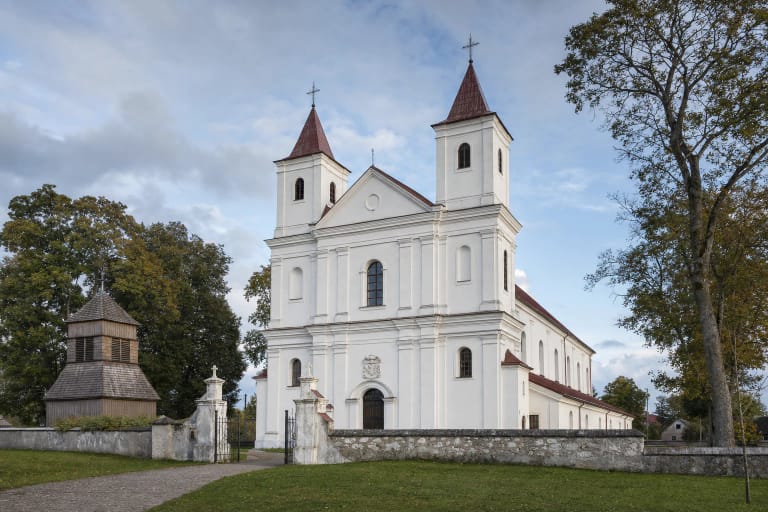
Zarasai Church of the Assumption of the Blessed Virgin Mary is a white-plastered, twin-towered sanctuary in central Zarasai, on one of the town's higher sites. The present building rose in 1862, was structurally strengthened and substantially reshaped in the late 1870s, and was consecrated by Bishop Gasparas Cirtautas in 1906. It preserves a historic image of the Virgin and Child, three altars, a 16-stop mechanical organ, and two bells brought from Russia in 1926. It remains an active parish. On 15 July 2026, the exact Google Maps card showed a mutable 4.6/5 rating.

Žeimelis Evangelical Lutheran Church is a state-protected single-nave church of fieldstone and brick at 4A Vytauto Didžiojo Street. Its present body was built in 1786-1793, while the three-stage tower that dominates the townscape and the sacristy were added in 1889-1890. The tower retains a mechanical clock made by J. Jaksch & Co in Riga in 1895. Inside are a timber altar with a Crucifixion painting, a pulpit bearing Pastor Konrad Schulz's epitaph, an organ gallery, and a memorial tablet to Eriks Leijers. The date 1540 belongs to an earlier timber Lutheran church, not the surviving masonry building; the Reformed church mentioned from about 1595 served a different Protestant tradition.

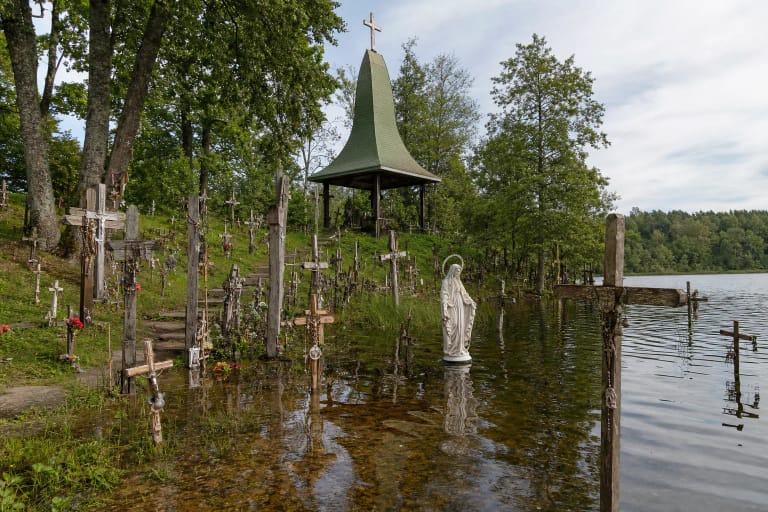
Žemaičių Kalvarija Basilica is one of Samogitia's most important pilgrimage centres, joining seventeenth-century Dominican tradition, a venerated image of the Mother of God, and the Calvary Hills route of 19 chapels.

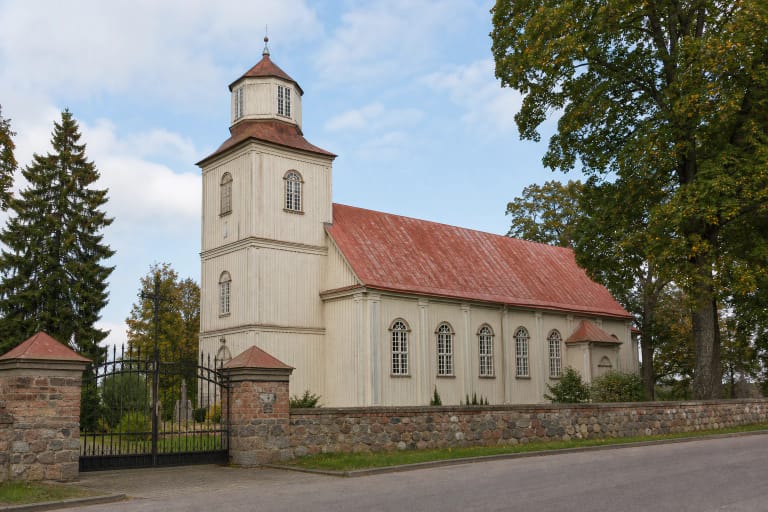
Žemaičių Naumiestis Church of St Michael the Archangel is a wooden, cross-plan parish church with a small roof turret, five altars, and a pulpit. Official sources differ on its date: the diocese gives 1790, while the municipality and VLE give 1782. It stands in a former Russian-Prussian border town that was home to Catholic, Lutheran, and Jewish communities.

Žemaičių Naumiestis Evangelical Lutheran Church is a plastered masonry sanctuary completed in 1842, with a four-column Doric portico and small roof turret forming a restrained classical composition. A detached timber belfry stands beside it, while the parish history describes a single-nave interior with a combined altar and pulpit, a gallery, and an organ installed around 1890. The site also belongs to Lithuanian publishing history: cantor Frydrichas Mėgnis organised a choir here, issued the weekly Svečias, and prepared the Raktelis primer.

Žiežmariai Synagogue is one of the few surviving wooden synagogues in Lithuania. The Architecture and Urbanism Research Centre dates the present building to 1782; after Soviet-era neglect it was restored and opened in 2021 as a cultural space preserving the memory of Žiežmariai's Jewish community.
Miestų objektai ir architektūra

Subačius Observation Deck is a free paved terrace on the southeastern edge of Vilnius Old Town, at the junction of Maironio, Subačiaus, and Markučių streets. Across the wooded hollow of Kūdrų Park, the view layers Užupis, church towers, Gediminas Hill, the Hill of Three Crosses, and the distant modern skyline. The lookout has a low metal railing, a panorama panel, streetlamps, and a planted border; it is not a tower or wooden platform. The present viewpoint was laid out in 2003, and the Old Town silhouette seen from here was later included in the city's continuing panorama monitoring. On 27 November 2024, Vilnius City Council named the public space after architect Jonas Kristupas Glaubicas. Subačius Observation Deck nevertheless remains the familiar name of the viewpoint and its Google Maps listing. The outdoor space has no admission charge and was listed as open around the clock in 2026, but a seasonal café, events, and temporary works follow separate arrangements.

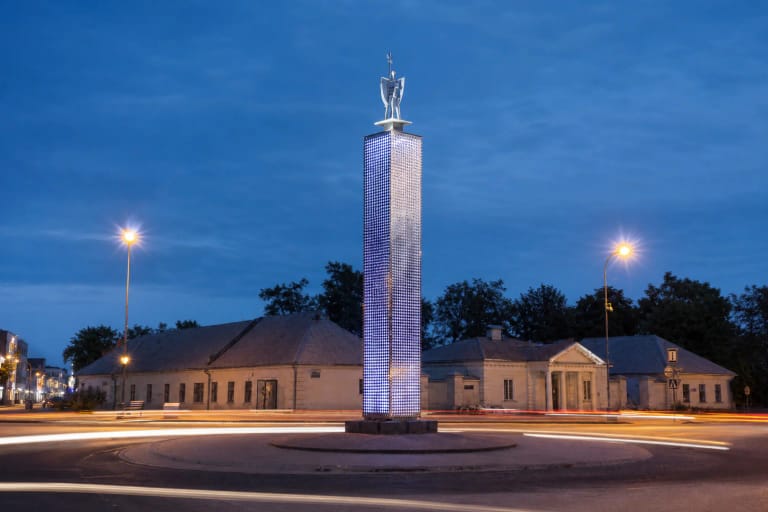
Sundial Square is the most important symbol of Šiauliai, created in 1986 for the city's 750th anniversary. At its centre rises a tall column with the gilded Archer by sculptor Stanislovas Kuzma; the column works as the gnomon of a sundial and gives material form to Šiauliai as the Sun City.

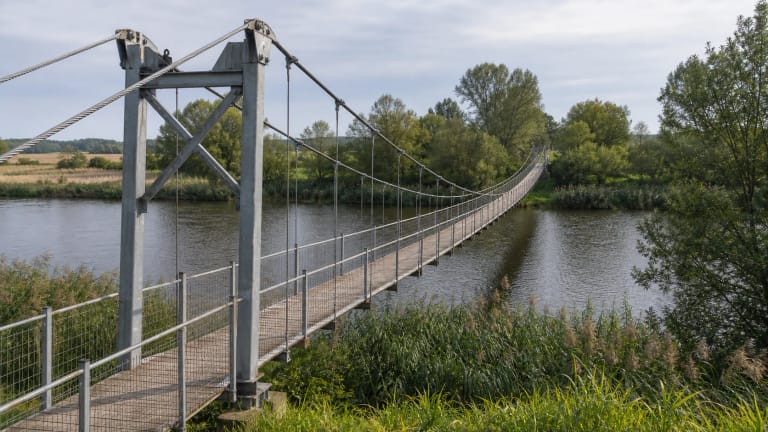
Šventoji Monkey Bridge is a hanging footbridge over the Šventoji River at the end of Kopų Street that sways lightly as you cross it, making it one of the resort's most recognizable landmarks. It is a modern local object with no Register or encyclopedia entry, but a memorable stop beside the river mouth, harbour, and seaside walking routes.

Tauragė Motor Mill is a state-protected industrial building erected beside the Jūra in 1922, although search results oversimplify its history when they present it solely as Hiršas Gitkinas's creation. KVR defines it as a three-storey building over a basement, with timber-framed walls and ceramic-brick infill. Render applied in 1988 now conceals most of that frame, while the south facade retains the date 1922. Inside are two unused double flour-bolter assemblies, a groat-making machine, and transmission elements. A Tauragė Regional Museum publication records a more complex sequence of proprietors, a workers' strike in 1926, and Gitkinas's later role. This is neither an operating mill nor a museum: the municipality's 2024 report describes a managed commercial property in use, with no published tourist hours, tickets, or unrestricted interior admission. The exterior can be studied from Tilžės Plentas and the public riverside route without entering the controlled yard.

The Crane, Visaginas's city symbol, is a silver-coloured bird with spread wings mounted above a tall stele and public display opposite the municipal administration building on Parko Street. The municipality calls it the city's first symbol, while the silver crane on the coat of arms approved in 1996 represents caution and vigilance, qualities associated with a city built to serve a nuclear power plant. The stele is not merely a photo stop: a 2025 structural assessment declared it unsafe, so current barriers and municipal instructions take precedence over older visitor photographs.

Theatre Square is the heart of Klaipėda Old Town: it holds Klaipėda Drama Theatre and the famous Ännchen of Tharau Fountain, a monument to the song by Klaipėda-born poet Simon Dach. The square connects architecture, maritime culture, and twentieth-century history.

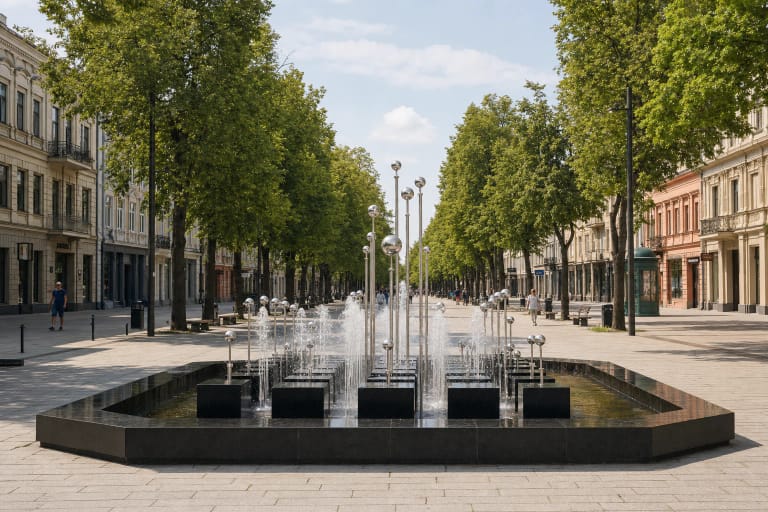
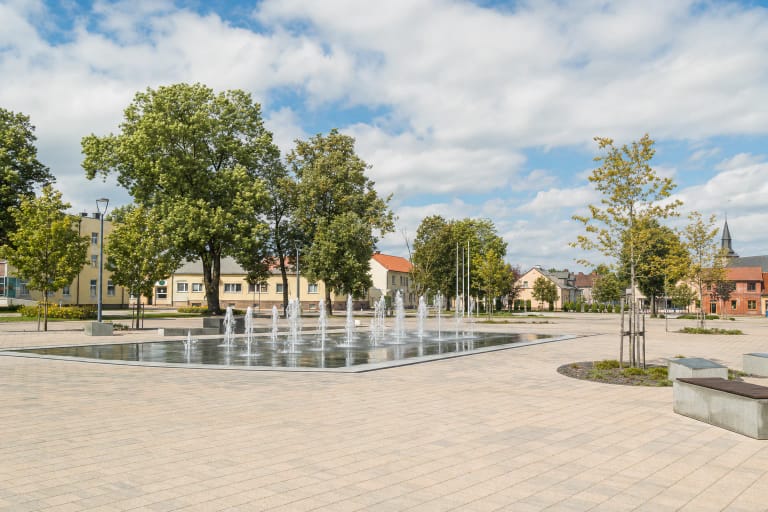
Utenio Square is one of the two principal landmarks of old central Utena, evolving from the market-town core into a place for civic ceremony, rest, art, and remembrance. Its names changed from Market Square and Hindenburg Square during the First World War to Public Square, Utenio Square, and Soviet-era Council Square. Albertas Lamauskas and Regimantas Pilkauskas redesigned the long site in 2005-2006, creating a hard-paved civic area beside the municipal offices and a larger planted garden. Seasonal dancing and illuminated fountains, changing displays in glass cases, the Aukuras partisan memorial, a March 11 memorial stone, a bronze heart for Bernard Lown, and the pavement-level Happiness Tile now form distinct layers rather than one decorative ensemble.

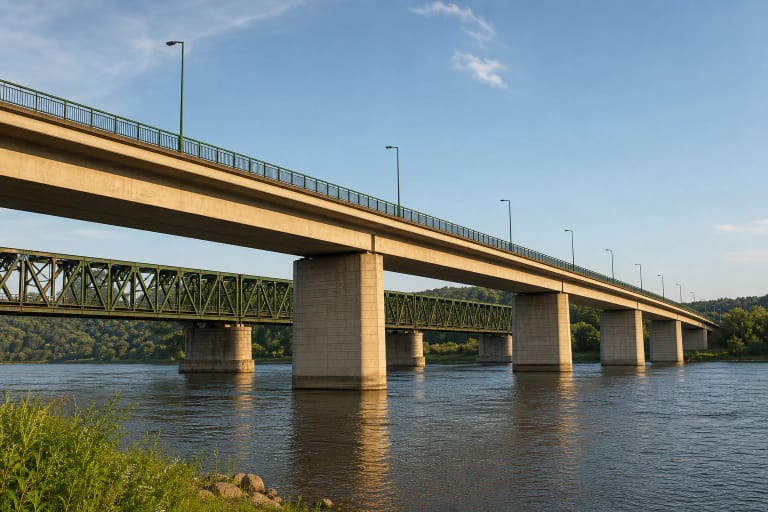
Two very different railway bridges stand side by side over the Venta at Kurmaičiai. The protected old complex comprises a disused 50-metre single-span riveted steel truss, eastern and western four-storey red-brick guardhouses, and two embankments. Rail traffic continues on the newer bridge immediately beside it. KVR dates the complex as a whole to 1871-1875, whereas local histories associate the surviving metal structure with reconstruction in 1918 after the bridge was destroyed in 1915. Detailed research has not resolved that discrepancy, so this guide separates the first crossing, the later timber bridge, and the surviving metal phase. The site also belongs to the history of hydrology: independent Lithuania's first Venta water-gauging station was established beside the bridge in 1924. View the structures only from lawfully accessible approaches near the riverbank and information board, without stepping onto the abandoned fabric or entering the active railway corridor.

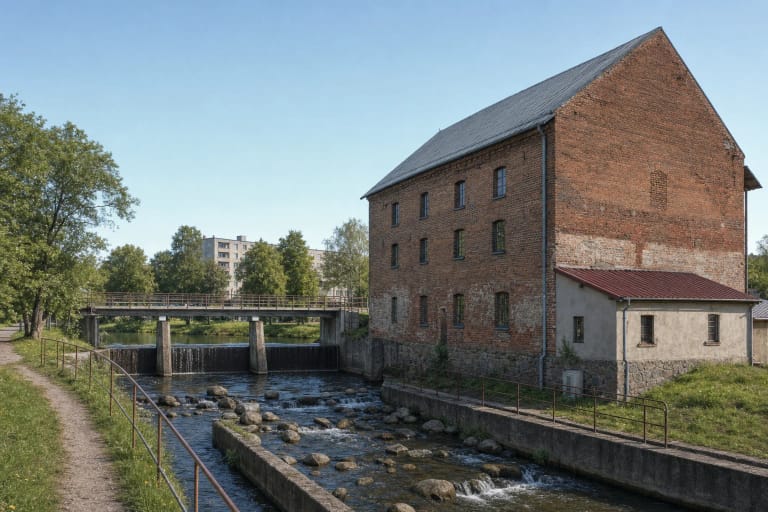
Viekšniai Water Mill is a red-brick technical heritage site built on the Venta in 1897. It once ground grain, carded wool, and even supplied Viekšniai with electricity. The mill survives almost unchanged and awaits restoration; it should not be confused with Viekšniai Pharmacy Museum.

Vilnius Town Hall is the central old-town place of self-government, trade, and representation. On the site of earlier Gothic town halls, Laurynas Gucevičius designed the present mature Classical building in 1785-1799; today it is still used for representative city events.

Visaginas is Lithuania's youngest city, built from 1975 as a Soviet atomgrad for workers of the Ignalina Nuclear Power Plant. Planned in the shape of a butterfly in a pine forest beside Lake Visaginas, it became a multiethnic city with a Russian-speaking majority. The Visaginas City Museum, opened in 2024, tells the story of the city and nuclear energy.

The Visaginas Commemorative City Stone is a large natural boulder on Sedulinos Avenue. Builders of the Ignalina Nuclear Power Plant brought it to the foundations of the first apartment blocks on August 10, 1975. Its bilingual Lithuanian and Russian plaque announces that a city for nuclear power plant workers would be built here and dates that beginning to August 1975. The ceremonial date became Visaginas's birthday, although the settlement was named Sniečkus only in 1977, renamed Visaginas in 1992, and granted city rights in 1995. An official visitor activity lists the boulder's maximum width as approximately 3.46 metres. Many people compare its natural outline to the map of Lithuania, but no checked source says it was carved into that shape.

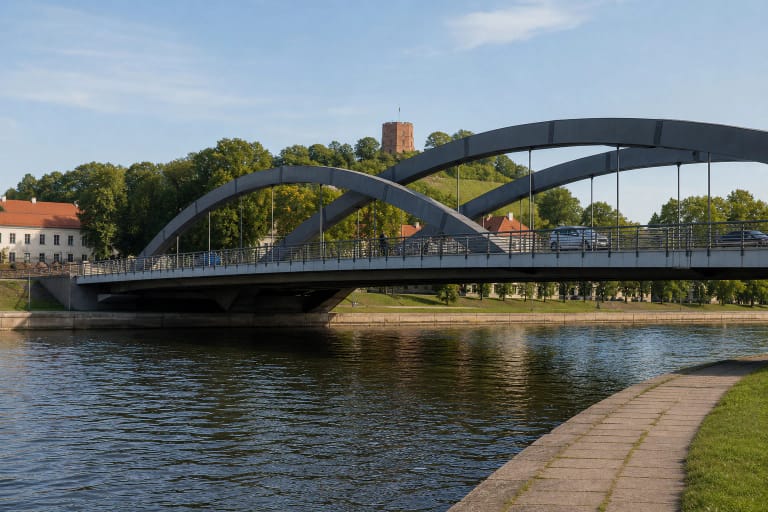
The White Bridge is an approximately 240-metre pedestrian and cycling link across the Neris between Naujamiestis and Šnipiškės. Completed in 1995 to a design by Algimantas Nasvytis, it connects the axis of Gediminas Avenue with the emerging right-bank centre, bringing the river, the older city fabric, and Vilnius's modern high-rise cluster into a single view. Its defining artwork is Spindulys-ietis, or Ray-Spear, a stainless-steel sculpture almost 20 metres high installed in 2010; it is not a load-bearing part of the bridge. A separate sports and recreation complex of almost nine hectares occupies the northern right bank, while CUP, food venues, the landing stage, and Green Bridge are neighbouring destinations with their own functions. The bridge itself is free to use, although events and maintenance can temporarily alter movement.

White Rose Bridge in Alytus is Lithuania's highest pedestrian and bicycle bridge, hanging about 38 m above the Nemunas. Built in 2013-2015 on the stone piers of an 1899 railway bridge, it has become a city symbol and a viewpoint over the Nemunas valley and Alytus Hillfort.

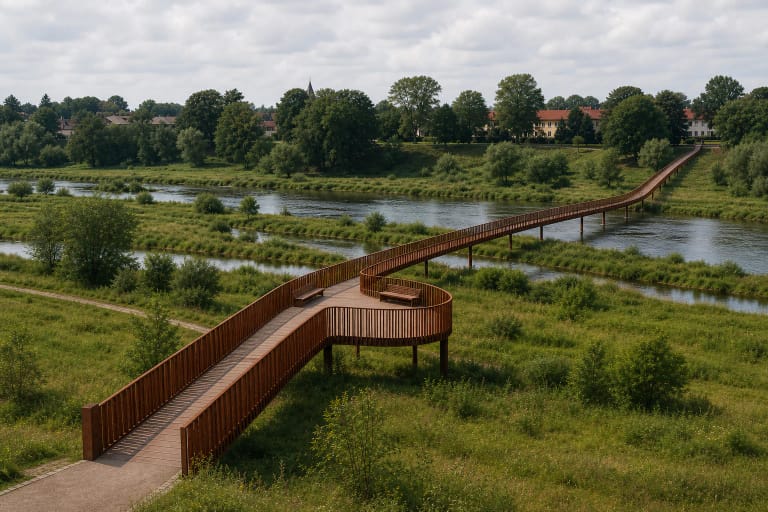
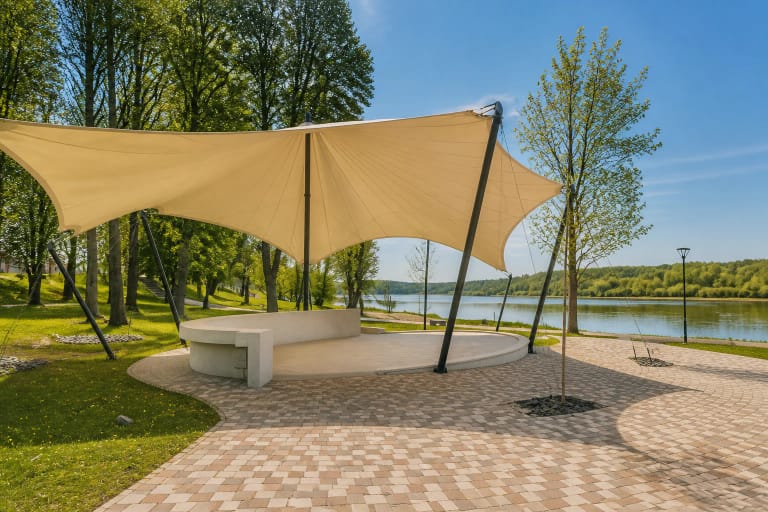
The Winding Bridge over the Apaščia River is an 84 m pedestrian and cycle link at the river mouth in Biržai. Its line deliberately follows the bends of the banks, while LEDs integrated into the handrails pick out the dense rhythm of oak-toned railing profiles. Construction began in 2022 as part of a wider project for the former open-air stage and castle-area public spaces, completed in 2023. The bridge joins the Reformatų Square side to Latvygalos Street and lets walkers or cyclists continue along Lake Širvėna towards the separate 525 m pedestrian bridge and Astravas Manor.

The Žemaitijos Carillon is an automatic instrument of 23 tuned bronze bells mounted in 2017 on the brick façade of Telšiai Culture Centre in Cathedral Square. It is neither the cathedral belfry nor a carillon with a keyboard open to visitors: a pre-programmed system operates its bells. Cast by Royal Eijsbouts in the Netherlands and placed here through an initiative led by architect Algirdas Žebrauskas, it commemorated the 600th anniversary cycle of Samogitia's Christianisation in 2013-2017. A sculptural Samogitian coat of arms by Martynas Gaubas completed the composition in 2023. Public visitor information advertises hourly ringing from 08:00 to 22:00, but this is a technical programme that can change, so anyone travelling specifically to hear a melody should verify the schedule and operation before setting out.

Žvėrynas Bridge is a state-protected, three-span steel truss bridge built across the Neris in 1905-1907, linking A. Mickevičiaus Street in Žvėrynas with the axis of Gedimino Avenue beside the Lithuanian Parliament. Its riveted five-truss deck, cut-stone supports, openwork railings, and historic lamps remain part of Vilnius's everyday transport network. The Google Maps card checked on 2026-07-15 was rated 4.7/5; its exact place ID is ChIJm5jeNvaT3UYRmW4f3VgK44g.