- Place
- Kretinga District Municipality
- Region
- Samogitia
- Type
- three-nave timber Neo-Baroque basilica built in 1875 with a separate 1860 belfry, fourteen churchyard chapels, and a historic organ
- Address
- 4 Kretingos Street (Telšiai Diocese gives 4 Plungės Street), Kartena, Kretinga district
- Coordinates
- 55.92069, 21.47624
Kartenos bažnyčia, Kartenos Švč. M. Marijos Ėmimo į dangų bažnyčia, Kartena Assumption Church
Two street names and the service schedule help plan a visit in the Minija valley
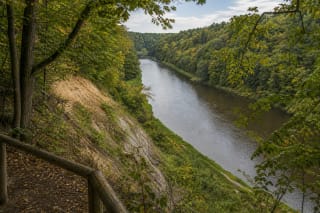
The church stands in central Kartena on the right side of the Minija valley, approximately fifteen kilometres north-east of Kretinga. Google Maps and municipal heritage documents give 4 Kretingos Street, while the current Telšiai Diocese parish page says 4 Plungės Street. The safest navigation choice is the full church name or coordinates 55.9206945, 21.4762377.
This is not a museum with fixed tourist hours every day. The churchyard and timber architecture can be seen outside, but the doors may be locked between services. To see the altars, pulpit, and organ, arrive before a published service or arrange a visit with the parish on +370 445 47271 or +370 682 20328.
The official parish page does not advertise a separate visitor ticket, and attendance at worship is not a tourist service. Leave a donation only if you wish, do not walk around the aisles during a service, and never photograph people without consent. Park legally in the town without obstructing the gates or access to the presbytery.
In July 2026, the Telšiai Diocese listed Mass on Sundays at 10:00 and 12:00; Tuesdays, Thursdays, and Fridays at 18:00; Wednesdays at 10:00; and Saturdays at 12:00, with no Monday Mass. Confessions begin half an hour before Mass, and Eucharistic adoration takes place on Sundays from 11:30 to 12:00.
This timetable describes community worship, not a promise that a tourist can enter throughout every interval. Arrive early without disturbing preparations, or remain briefly after Mass and ask politely whether you may look around. Large groups, organ research, and professional photography require prior permission from the parish.
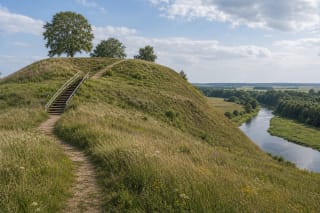
The main entrance has steps, while the official site does not describe access through side doors or available assistance in detail. Wheelchair users and other visitors with mobility needs should call ahead and ask which entrance will be unlocked that day. The most meaningful nearby continuations are Kartena Hillfort across the Minija and Abakai Lourdes outside the town.
The present church followed an 1873 fire and an imperial ban on masonry construction
The first timber church at Kartena, associated with the Sapiega family, appears in written sources in 1619. In 1634, Mykolas Sapiega endowed it with jurisdiction in the town and the Gudeliškė estate with the villages of Abakai, Budriai, and Šmilkščiai; in 1639 he funded a parish school. The early church therefore served worship, local administration, and education.
After that building deteriorated, Kartena's owner Jokūbas Nagurskis and parishioners erected a new three-nave timber church in 1764. It burned down on 23 May 1873. The parish sought permission for a fire-resistant masonry sanctuary, but the Russian imperial authorities allowed only another wooden building in 1874.
Parish priest Izidorius Beresnevičius and the congregation completed the present church in 1875, only two years after the fire. Bishop Aleksandras Beresnevičius, then administrator of the diocese, consecrated it in 1881. The building reached its 150th anniversary in 2025, while some interior treasures are older because equipment survived or was transferred from the predecessor.
A towerless basilica with a small roof turret is not a contradiction
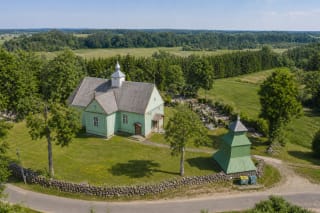
Lithuania's State Service for Protected Areas calls Kartena the only towerless Neo-Baroque basilican church in Samogitia. Here, towerless means that two full-height facade towers do not flank the front. Only a small square roof turret rises over the broad central facade, closer in scale to a miniature belfry.
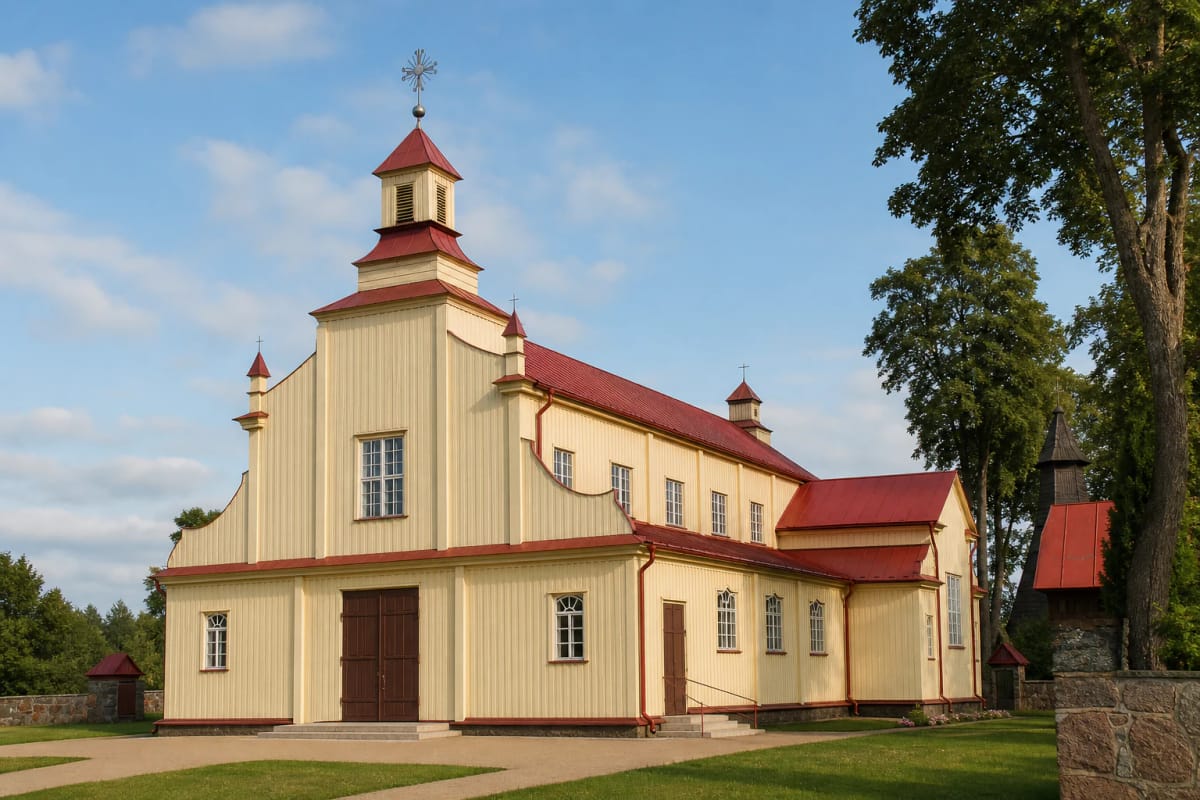
The rectangular timber building is clad in vertical boards beneath a low red metal roof. Instead of straight lines natural to timber framing, its broad front uses Baroque curves, broken cornices, and small corner pinnacles. Pale yellow boarding and red metal accents make the church immediately recognisable from the town street.
The basilican section reads most clearly from the side: a broad, high central nave has its own upper row of windows, while the two aisles are considerably lower. Sacristies adjoin the presbytery. This three-nave volume gives a small-town timber church an unexpectedly spacious and bright interior.
Three altars, a sculpted pulpit, and a reliquary dated 1715
Three altars and an especially elaborate pulpit with four sculptures survive inside. These elements are now protected as attributes of the church itself rather than an incidental collection of separate decoration. They explain how a restrained boarded exterior conceals a substantially richer liturgical space.
A small but chronologically important object is the metal reliquary cross dated 1715. It predates the present building by more than a century and a half, demonstrating continuity with the furnishings of an earlier Kartena church. The reliquary is not an object for visitors to handle freely, so ask the parish where it is kept and whether it can be viewed.
The church remains the living sanctuary of the Assumption parish, not a static architectural exhibit. Its patronal Feast of the Assumption is celebrated on 15 August. That date offers the richest experience of liturgy and community but also the largest congregation, so choose an ordinary Sunday for a quieter architectural visit.
The 1774 organ is the only known surviving work by Paulus Gerardus Zelle
Vilnius organ builder Paulus Gerardus Zelle made the Kartena organ in 1774. He was the son of Gerhardt Arendt Zelle, an organ builder from Königsberg who settled in Vilnius. Inscriptions on several pipes confirm the attribution, including the words fecit Paulus Celle and the date 1774. A specialist historical-organ catalogue identifies it as the maker's only known surviving work.
The original instrument had a single manual with a short bass octave. An unknown builder substantially rebuilt it in 1805 but reused Zelle's old pipes; repairs or alterations are documented in 1824, 1873, and 1936. The present mechanical instrument is catalogued with one manual, eleven stops, a cymbelstern, and an acoustic drum.
The organ came into the present church from the building destroyed by fire in 1873, although details of its transfer and repairs remain uncertain. Marijampolė Organ Workshop restored it in 2009, and the Cultural Heritage Department's 2012 report confirms acceptance of the conservation work. Visitors can hear it only at a particular service or concert; no daily tourist demonstration is advertised.
The churchyard forms its own route through a belfry, gates, and fourteen chapels
The church belongs to a state-protected complex with overall register code 1458. The church building is 23590, the substantial timber belfry of 1860 in the south corner of the yard is 23591, and the stone wall with gates is 23592. The complete ensemble became a state-protected cultural property in 2005.
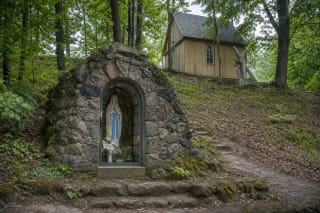
The main gate is built from red brick in a pseudo-Gothic style, with a central pyramidal tower and ornamental crosses made by a blacksmith. Fourteen small masonry Stations of the Cross chapels line the stone wall. Even when the church is locked, the churchyard therefore reveals a complete ensemble rather than only a pale boarded facade.
On 13 July 2026, Google Maps rated Kartena Church 4.5 out of 5 from 93 reviews. This exactly meets the catalogue's minimum threshold, while both score and count can change. Allow 30-45 minutes for the exterior circuit; if the doors are open, add at least 20-30 minutes to study the nave section, pulpit, and organ case.