- Place
- Vilkaviškis District Municipality
- Region
- Suvalkija
- Type
- active modern Catholic church with a historic Loreto Madonna, a churchyard mausoleum chapel, and fragments of the previous sanctuary
- Address
- 32 Širvintos Street, Alvitas, Vilkaviškis District
- Coordinates
- 54.63800, 22.92565
Alvitas Church, St Anne's Church in Alvitas, New Alvitas Church
The curved 28-metre form grew out of an unaffordable O-shaped design
The present church stands at 32 Širvintos Street among mature trees in the old churchyard, coordinates 54.6379985, 22.925652. It cannot be mistaken for a historicist Lithuanian village church: a high russet-red plane rises from the low nave and curves towards the spire, while a narrow white-framed glazed front draws daylight inside. The official consecration account notes comparisons to Noah's Ark and a bishop's mitre.
The first proposal was an oval building shaped like the letter O, a reference to Saint Anne's Lithuanian name Ona, but its structure proved too expensive. Architect Vilius Urbonas simplified the project in 2013 while accommodating foundations already in place; their volume also determined the 28-metre height. The current silhouette is therefore not a free sculptural gesture on an empty site, but a resourceful response to the constraints of an earlier stalled build.
Inside are 208 seats, geothermal heating, and mechanical ventilation. White walls, tall windows, a dark chandelier, and a wooden cross above the stone altar deliberately avoid competing for attention. Local folk artist Raimundas Blažaitis carved the crucified figure, while Bronius Rutkauskas painted the images of St Anne and St Casimir blessed after the church opened.
Two wars separated the wooden church of 1615 from its masonry successor of 1824
Princess Ona Ketlerytė Radvilienė, the administrator of Paširvintys, built the first wooden church around 1615. King Sigismund III Vasa established the parish by an endowment act on 17 October 1617. The dedication to St Anne is associated with the benefactor's name and became a living local tradition: the patronal feast is still held on 26 July and the nearest Sunday.
A masonry church begun by parish priest Adomas Dilevskis took from 1804 until 1824 to complete. It stood in Russian-German crossfire during the First World War and suffered extensive damage, before parish priest Petras Maslauskas and local people rebuilt it in 1921-1924. Services temporarily moved to the Gauronskiai Chapel in the churchyard.
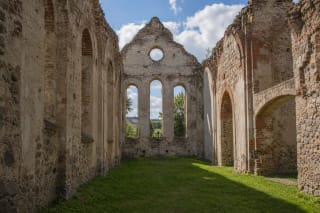
Front-line demolition destroyed the church in 1944, although sources disagree on the precise date: academic research records two German demolitions in late August, while the diocesan parish history and a 2019 commemoration give 16 October. The central fact is uncontested: the Soviet administration prohibited reconstruction, the ruins remained for decades, and the parish moved into the small mausoleum.
For 76 years the Gauronskiai Chapel was the parish church, not a peripheral annex
The surviving Neo-Gothic Gauronskiai chapel-mausoleum in a corner of the grounds dates from the mid-19th century, with members of the local estate-owning family buried in its crypt. Side sacristies were added so that the small building could serve the parish. It substituted briefly after the First World War and continuously from 1944 until 2020.
The last evening Mass in the old chapel took place on 25 July 2020, the eve of the new church's consecration. The building has not become irrelevant: it reopened to visitors during the 2025 Feast of St Anne, but no daily interior hours are advertised. Contact the parish in advance if seeing more than the exterior matters to your visit.
The churchyard also retains a red-brick fragment of the previous church with a statue of Mary, as well as graves of priests who served Alvitas. Together they show why the site is more than a work of 2020 architecture: one enclosure contains an estate burial monument, a trace of a war-destroyed sanctuary, and a contemporary parish church.
The Loreto Madonna is an early 17th-century painting, not a 12th-century icon
The Alvitas image of Our Lady of Loreto is a 66 x 47 cm oil on canvas, dated by art historian Regimanta Stankevičienė to before 1609 and attributed to an unknown Italian painter. It is among Lithuania's earliest copies and the country's oldest surviving painting of this subject. The frequently repeated 12th-century date belongs not to the Alvitas canvas but to its prototype, the venerated ebony statue in Loreto, Italy.
Tradition says Pope Clement VIII gave the image to Ona Radvilienė, but chronology contradicts that version: Clement died in 1605 and the princess reached Loreto in 1609. The researcher considers Pope Paul V, whom the pilgrim did meet, a more plausible donor, although no direct gift document survives. Her son Jonas Albertas Radvila and a retainer named Anna Młodzinowska may both have helped transfer it to the Alvitas church.
Around 1680-1685, silver and gilded-silver coverings associated with votive offerings concealed almost the entire canvas. In 1944 the wall holding it did not collapse; the image merely slid down and was later installed in the Gauronskiai Chapel. Removing the metal in 1999 revealed the original canvas beneath a later repainting of the faces, and it was restored that year. The historic image is now visible inside the new church.
An old foundation stone, ten brick courses, a bell, and organ turn the interior into a structure of memory
A foundation stone from the destroyed church is built into the sanctuary, an old floor tile is set into the rear floor, and ten courses of salvaged brick remain beside the confessional. Their number alludes to the Ten Commandments. These are not decorative imitations of age but physical material recovered from the 1824 building.
The 2020 bell weighs about 420 kg, is dedicated to St Anne and St Casimir, and was cast by the Kruszewski brothers' foundry in Węgrów, Poland. It hangs at approximately 25 metres, slightly below the 28-metre top of the spire. These are two measurements that should not be confused: the bell's position and the total building height.
The German firm Oberlinger made an organ specifically for Alvitas, approximately 5 metres high and 7 metres long. The diocese records 1,500 zinc flue pipes, oak construction, and about 10,000 components, with no loudspeaker amplification. The instrument was blessed at the consecration on 26 July 2020 and German organist Thorsten Mader performed its inaugural concert.
Services are the most reliable way inside because no tourist opening hours are advertised
On 13 July 2026, the official parish page listed Mass at 10 am on Saturdays and Sundays, and at either 9 am or 6 pm on weekdays by arrangement. Confession begins half an hour before Mass, while adoration takes place from 9 to 10 am on the first Sunday of each month. Funerals, feasts, or the priest's travel can alter the schedule, so verify it or telephone the parish before a dedicated journey.
There is no museum admission and the church is not a visitor attraction with fixed daily opening hours. The churchyard and exterior can be viewed quietly in daylight; for the interior, arrive before or after an advertised service or arrange access by telephone. During liturgy, silence devices and ask before photographing an event, the historic image, or the chapel interior.
The Feast of St Anne is celebrated on 26 July and the nearest Sunday, while St Casimir is marked on 4 March or the nearest Sunday. The July event fills the church and neighbouring lime-tree park with liturgy, procession, and a community programme, making it the richest but least quiet time to visit. On 13 July 2026, the exact St. Anna Catholic Church, Alvitas Google listing had 200 reviews averaging 4.7 out of 5.