- Place
- Palanga City Municipality
- Region
- Palanga
- Type
- 1.75-metre bronze decorative sculpture by Robertas Antinis Sr, installed in Birutė Park in 1960
- Address
- Beside the central path in Birutė Park, Palanga
- Coordinates
- 55.90977, 21.06043
Eglė žalčių karalienė Palangoje, Eglė - Queen of the Grass Snakes, Eglė the Queen of Serpents
Finding the sculpture inside the large Birutė Park
The sculpture stands beside Birutė Park's central path at 55.9097652, 21.0604262. It is north of the Tiškevičiai Palace and Amber Museum, not beside Birutė Hill or the main Vytautas Street gates. Navigate to the precise Maps pin because the general park address covers more than one hundred hectares of paths and planting.
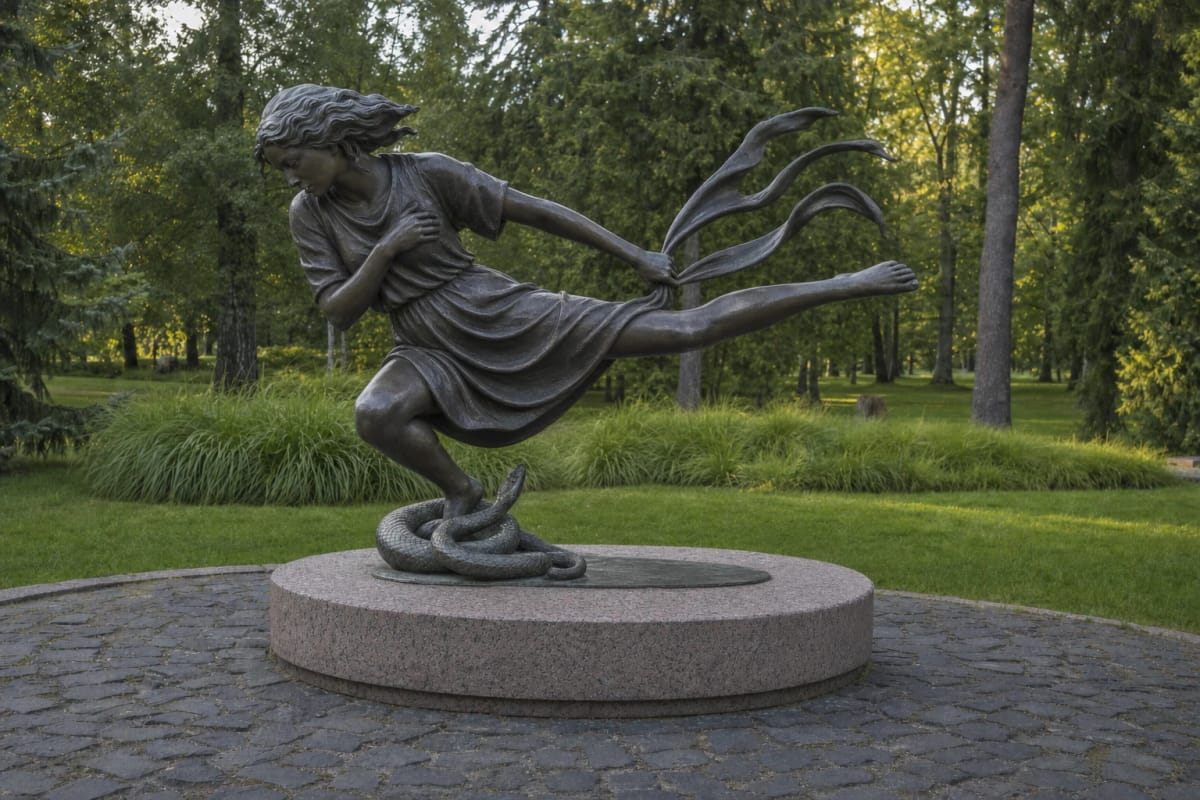
From the main northern entrance on Vytautas Street, follow the broad avenue towards the palace. The bronze figure occupies an open circular space beside the path, raised on a low pinkish stone cylinder and a broader round base. Dense conifers behind it form a dark backdrop, keeping the work visible even in full summer foliage.
Maps may label the address only as Vytautas Street, but cars cannot approach the sculpture. Birutė Park is reserved for pedestrians, and official rules prohibit bicycles, scooters, and motor vehicles. Leave a bicycle at the park entrance and continue on foot.
The precise fairy-tale moment captured in bronze
Antinis chose the tale's opening. After bathing, Eglė finds a grass snake in her clothes, and it refuses to leave until she promises to marry it. The sculpture contains no underwater palace, betrayal by her brothers, bloody foam, or transformation of the children into trees. In the story, all those events are still to come.
The approximately 1.75-metre, life-size Eglė crouches on one leg, throws the other sharply sideways, and pulls her head and torso away from the snake. Fabric escaping her hands billows in an arc overhead, its bronze folds resembling a wave. Intersecting lines of arms, leg, hair, and cloth create movement with remarkably little visual support.
The grass snake coils at her feet and also supports the composition. It is not a decorative ornament or crown, as the title might suggest, but the cause of the unexpected encounter. The work's emotion is therefore alarm and a suspended recoil rather than the serene majesty of a serpent queen.
From a 1935 relief to the 1958 Palanga version
Robertas Antinis Sr began developing the Eglė theme long before the Palanga sculpture appeared. His first known relief was exhibited in 1935, and he returned to the subject in reliefs of 1941, 1944, 1947, 1955, and 1958 and a sculpture in the round in 1957. The final work emerged from a long refinement of one movement and emotion, not a single resort commission.
Some versions made Eglė more static, raising a crown while a snake wound around her legs. The final Palanga work uses the far more compelling first-fright scene. The 1958 version was prominently received at the Baltic Sculpture exhibition in Riga, and the bronze was installed in the park two years later.
Architect Alfredas Paulauskas designed the setting, while Kazimieras Orvidas carried out the stonework. The circular stone apron and low pedestal allow viewing from several sides, and park staff planted a spreading spruce across the path as a restrained echo of Eglė's name. The artwork entered the list of cultural monuments in 1993 and now has Register code 7642.
Robertas Antinis and the work's place in Lithuanian sculpture
Robertas Antinis Sr was born in Kaldabruņa, present-day Latvia, in 1898. He studied at Kaunas Art School and then, from 1928 to 1933, at the School of Decorative Arts and Académie Julian in Paris. Back in Lithuania, he taught and created monuments, portraits, and decorative sculpture before his death in Kaunas in 1981.
VLE identifies two tendencies in his mature work: compact monumental forms and open, dynamic ones. Palanga's Eglė belongs to the second group, where the space between limbs, cloth, and snake matters as much as the bronze mass. Antinis combined constructive control with principles of Lithuanian folk sculpture but expressed the tale through modern movement rather than ethnographic illustration.
The work also marks the arrival of modern public art in Palanga's park. Installed in 1960, it predates Nijolė Gaigalaitė's Jūratė and Kastytis unveiled in 1961 and belongs to the first post-war generation of resort sculpture. Those documented dates matter more than the vague description of it as merely an old park legend.
Free access, park rules, and a 4.8 rating
The sculpture is free to view and has no separate ticket office or indoor exhibition. In July 2026, its Maps listing showed daily hours of 06:00-23:00, but the official park website separately publishes administration and conservatory times rather than sculpture-gate hours. Check park signs and official notices for evening access or temporary restrictions.
A firm park path reaches the site, although the final circular apron uses uneven stones. A wheelchair user can obtain the clearest practical view from the main path rather than circling the pedestal. Do not climb the bronze, seat children on the plinth, or step across lawns for photographs. The park is a sensitive pedestrian environment intended for quiet recreation.
Morning light reveals the snake's coils, while late afternoon more clearly outlines the flying cloth and Eglė against dark trees. The space is small, so groups should step aside and let others see the work from front and side. In July 2026, its Google Maps listing showed 4.8 out of 5 from 482 reviews.