- Place
- Trakai District Municipality
- Region
- Trakai
- Type
- early-fifteenth-century Catholic church rebuilt in Gothic and Baroque phases, a pilgrimage centre and minor basilica
- Address
- 5 Birutės Street, Trakai
- Coordinates
- 54.64276, 24.93412
Trakų bazilika, Trakų Švč. Mergelės Marijos Apsilankymo bažnyčia, Trakai parish church, Basilica of Our Lady of Trakai
The basilica occupies a hill between central Trakai and the peninsula castle
The Basilica of the Visitation of the Blessed Virgin Mary stands at 5 Birutės Street, at coordinates 54.6427617, 24.9341206. A short uphill lane reaches it from the principal Vytauto Street, while the grounds of Peninsula Castle begin only a few minutes away on foot. This church is in the town of Trakai and should not be confused with the church and monastery in Old Trakai beyond the town.
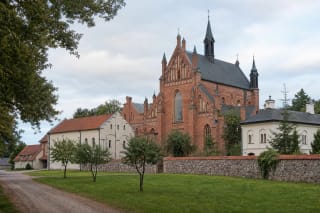
Its elevated position is unusual in the otherwise low landscape of the Trakai lakes. VLE notes that the terrain may also have had defensive value, although this function is not documented as clearly as its religious use. Today the hill helps visitors take in the churchyard wall and gate, twin-towered front, and long red-tiled roof as one ensemble.
The present basilica is a three-aisled building approximately 20 m wide and 26.1 m long, with a central aisle more than twice the width of either side aisle. It did not emerge in a single campaign: fifteenth-century Gothic fabric, the extension of 1497, eighteenth-century Baroque work, and twenty-first-century conservation all remain legible in its plan and masonry.
Vytautas's foundation of 1409 joined the parish to ducal Trakai
Grand Duke Vytautas issued the church's foundation charter on 24 May 1409. The original is lost, but a copy made in 1522 and confirmed by Sigismund the Old preserves its substance. The dedication combined the Visitation of the Blessed Virgin Mary with St John the Evangelist, and the endowment supplied land and income to support a cleric and the keeper of a school.
The precise completion date is unknown, but architectural research places the early church in the second decade of the fifteenth century. VLE associates its first master with Radike or Ratkhe, who also worked at Trakai Island Castle around 1414-1415; materials and masonry techniques point to the same building milieu. The basilica can therefore be read as part of Vytautas's wider construction programme rather than as a monument detached from the castles.
The church held collegiate status even though Trakai never became an episcopal centre with a cathedral. Motiejus, the first bishop of Samogitia, was consecrated here in 1417, followed by his successor Mikalojus in 1423. These events demonstrate the site's importance to the institutional development of Catholic Lithuania.
The hall church was reshaped by the extension of 1497, warfare, and eighteenth-century Baroque work
The early church was an irregular rectangular three-aisled hall with its portal to the north and apse to the south. A rebuilding initiated by Bishop Albertas Taboras of Vilnius in 1497 added a long three-bay presbytery and sacristy to the east and changed the roof's direction. Exposed Gothic masonry and fragments of the north portal now reveal parts of these earlier volumes.
A porch followed in 1610, while the old wall paintings were whitewashed in 1645. The war with Muscovy in 1655-1661 caused major destruction. The Römer family chapel appeared in 1700, and by 1718 the church had been substantially recast in Baroque form: two three-stage towers rose above the front, the central aisle was heightened, the hall became a basilican space, and barrel and cross vaults were installed.
Fires in 1794 and 1900 prompted further repairs. Conservation in 2006-2008 exposed early masonry, the northern portal, and fragments of wall painting. The roof was raised to the height supported by research, tiles returned, and a taller ridge turret installed. The renewed church marked the 600th anniversary of its foundation in 2009.
The documented history of Our Lady of Trakai is not the same as the later legend
The image of the Virgin and Child at the centre of the high altar began as a Western late-Gothic work. Its panel was adapted to a new altar and the image repainted in a Byzantine-influenced manner in the early seventeenth century. What visitors see is consequently the result of several historical phases, not an unchanged fifteenth-century icon.
A later inscription claimed that Byzantine emperor Manuel II Palaiologos gave the image to Vytautas at his baptism and identified it as the Nikopoia Mother of God. The basilica's own research summary stresses that reliable historical evidence supports neither such a gift nor Vytautas's role in acquiring the painting. The account belongs to tradition rather than established provenance.
Sources increasingly recorded graces associated with the image from the sixteenth century. It was removed for safety during the war of 1655-1661, spent a period in St Casimir's Chapel at Vilnius Cathedral, and returned to Trakai on 8 September 1667. Catholics, Orthodox Christians, and local Muslims all revered it, giving the image a reach beyond any one community.
The 1718 coronation, votive offerings, and murals turn the interior into a historical narrative of its own
On 4 September 1718, the image was crowned with crowns sent by Pope Clement XI, becoming the first Marian image in Lithuania to receive an official papal coronation. It was given the title Intercessor of the Sick. Vilnius goldsmith Johann Friedrich Szemnick made its gilded silver cover in 1723-1724, while the votive offerings around the altar record personal gratitude for perceived graces.
Rare fragments of Gothic mural painting survive beneath the later Baroque decoration. Identified subjects include scenes associated with the Last Judgement, the Bosom of the Patriarchs, a procession, images of Jacob, and Cyrillic inscriptions. They may bear witness to a local Byzantine painting tradition, but their fragmentary state makes expert interpretation especially valuable.
The treasury includes a Gothic pax dating from the late fifteenth or early sixteenth century, a silver sanctuary lamp of 1730, and other liturgical works. An organ installed in 1800 was rebuilt by Wacław Biernacki's workshop in 1912 and later repaired. Look beyond the celebrated image to the altar, silver cover, votives, exposed murals, Römer Chapel, and organ loft.
Pilgrimage remains alive, and visits must accommodate worship
When plague struck Vilnius in 1603, Bishop Benediktas Vaina led a procession from the city to Trakai. The annual feast of Our Lady of Trakai, known as Trakinės, continues this pilgrimage tradition on 1-8 September. Pope Francis granted the church the title of minor basilica in 2017, formally proclaimed on 3 September, making it the eighth minor basilica in Lithuania.
The parish states that the church is open daily from 09:00 to 19:00. Sunday Mass is celebrated in Polish at 10:00 and Lithuanian at 12:00; weekday Mass is in Polish at 17:00 and Lithuanian at 18:00. A special Mass at 12:00 on the fourth day of every month recalls the date of the coronation. Ordinary entry is free, but do not tour the aisles during worship and verify the current schedule on the official site before travelling.
On 13 July 2026, the public Google Maps listing showed a rating of 4.8 out of 5 from 960 reviews; both figures will change over time. The official site gives no comprehensive accessibility description, while the historic hill and churchyard include slopes and thresholds. Contact the parish in advance about mobility or group requirements.