- Place
- Leipalingis, Druskininkai Municipality
- Region
- Druskininkai
- Type
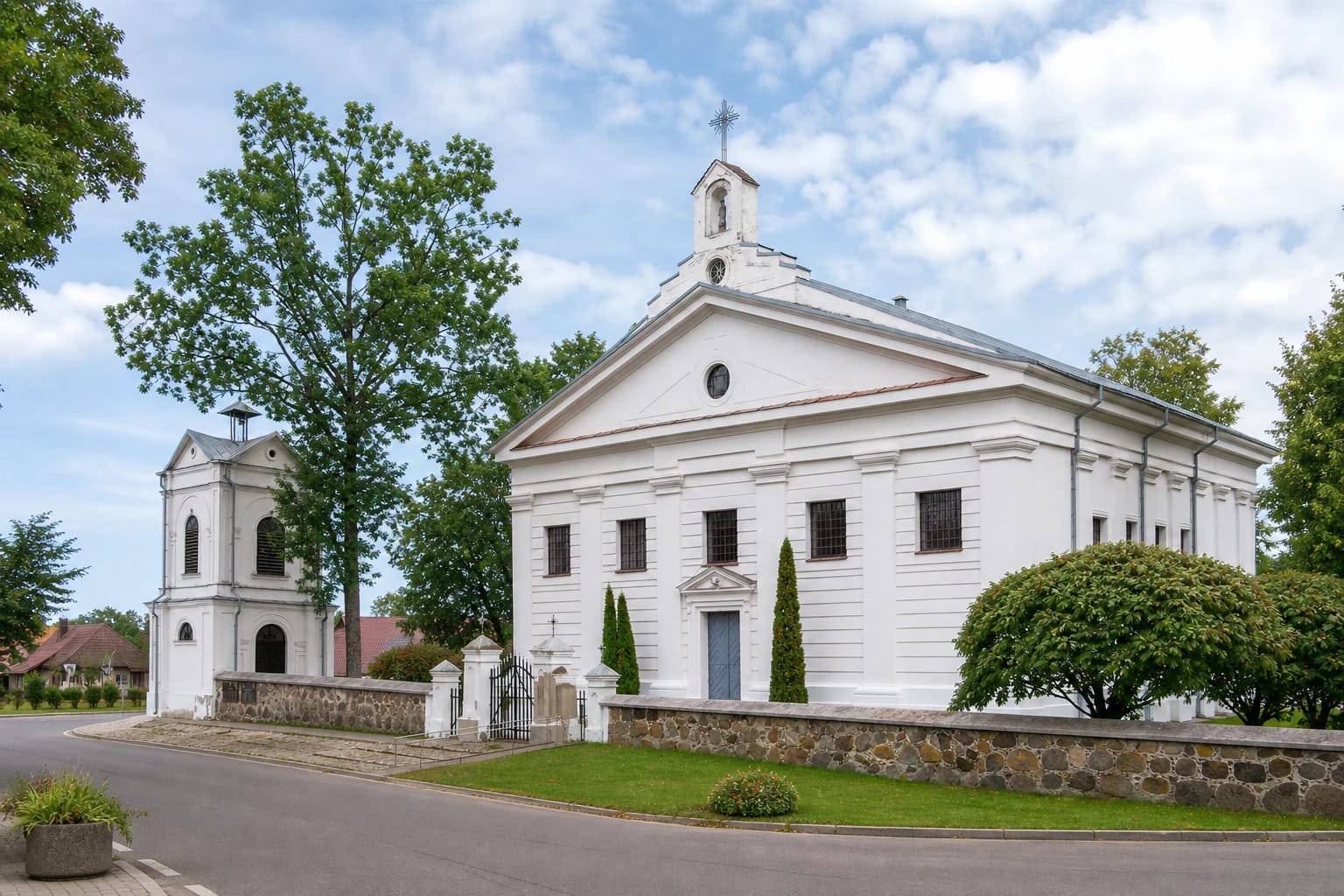
- three-aisled masonry hall church built in 1806-1821 in the late-classical style, with a small roof turret, a detached historicist belfry, and a stone churchyard wall
- Address
- 2 Kapų Street, Leipalingis
- Coordinates
- 54.08763, 23.85910
- Visit duration
- 30-45 minutes for the exterior and interior when the church is open; 1-1.5 hours together with Leipalingis Manor and the town centre
- Best time
- before or after an advertised parish Mass for a view of the interior; choose the period around 15 August for the titular feast
Leipalingio Švč. Mergelės Marijos Ėmimo į dangų bažnyčia, Leipalingis Assumption Church, Leipalingis Catholic Church
This active parish church publishes no separate tourist opening hours
The church stands at 2 Kapų Street in Leipalingis, coordinates 54.0876342, 23.8590999. The map pin identifies the church site within its churchyard rather than a surveyed threshold at one particular door. On 15 July 2026, the exact Google Maps listing linked to Place ID ChIJLRkamUiX4EYR7YoSlxa6KjY showed 4.5/5 from 83 reviews; both the average and the review count can change.
On 15 July 2026, the parish page of the Diocese of Vilkaviškis advertised Mass at 10:00 on Sundays, at 18:00 or by arrangement on weekdays, and at 10:00 or by arrangement on Saturdays. Confession was offered from 30 minutes before Mass. These are service times, not guaranteed tourist opening hours, so the most reliable chance to see the interior is shortly before or after Mass after checking the official page again.
The parish publishes neither a separate ticket policy nor a detailed account of step-free access. The exterior and stone churchyard wall can be viewed from public approaches, but contact the parish in advance if an open door, a group visit, or step-free entry is essential. During worship, keep silent, do not photograph without permission, and do not enter the sanctuary.
A broad facade without major towers gives the Leipalingis church its unmistakable profile
The masonry church belongs to late Classicism, while the official parish description also identifies Baroque traits. It is a rectangular hall church without a portico or two large facade towers. Six flat pilasters divide the principal facade into five bays, shallow horizontal grooves articulate the wall planes, and a modest central doorway carries a small triangular hood mould.
A large triangular pediment with an oculus rises above the broad facade, followed by stepped side screens and a tiny roof turret. White rendered walls, a grey metal gabled roof, and relatively low windows produce an emphatically horizontal composition scaled to the small town. The detached two-stage masonry belfry has arched openings and occupies a corner of the churchyard wall, its design deliberately harmonised with the church.
Inside, massive piers and arches separate three aisles. Ionic pilasters carry a broad entablature, two Ionic columns mark the sanctuary, and Doric columns support the organ gallery. Cross vaults survive over the side aisles. These elements reveal a carefully ordered classical interior behind the restrained horizontal exterior.
The present building followed centuries of churches marked by war, fire, and reconstruction
A Catholic church in Leipalingis is associated with 1611, but sources do not explain the earliest foundation in exactly the same way. The official parish history links it to members of the Sapieha family who became Catholic, while historians studying a seventeenth-century visitation also name Mykolas Pranckevičius as a founder. It is therefore safest to say that a Catholic church functioned here in the early seventeenth century without assigning its entire foundation to one undisputed patron.
The church burned during the wars of the mid-seventeenth century, and another timber building was recorded by 1674. The parish was established in 1778, but the church, belfry, and churchyard wall burned again in 1785. A temporary building then served the community until work began on the present masonry church.
Canon Antanas Kruševskis of the Vilnius Cathedral Chapter started the present church in 1806, financed its construction, and was buried in the building in 1820. It was completed and consecrated in 1821. Father Jurgis Andriušis oversaw repairs in 1873, when a high altar was installed by the Warsaw artist E. Ceglarskis. Further repairs followed after the Second World War.
The date of the detached belfry remains inconsistent across authoritative sources. The Diocese of Vilkaviškis and Druskininkai Municipality give 1885, while VLE gives 1889; all attribute the design to E. Lipskis. Until a primary document explains the four-year difference, both dates should be reported as a source discrepancy rather than silently collapsed into one.
An 1816 bell, 1920 confessionals, and a 2020 altar reveal the layered interior
The belfry contains a brass bell cast by I. Weneris in 1816. Inside the church, the wooden confessionals made in 1920 by professional sculptor Antanas Aleksandravičius deserve particular attention. VLE identifies them as an example of professional sacred carving from the early twentieth century, so the interior offers more than the view towards the high altar.
The present sanctuary is not a reconstruction of a single 1821 state. The previous liturgical altar was dismantled on 10 October 2019, and Eugenijus Sabaliauskas designed new pews, altar, and lectern. The new altar was consecrated on 21 June 2020 with a relic of St Eustace placed inside it. The historic high-altarpiece remains visible behind, allowing several periods of liturgical furnishing to be read in one space.
Begin a quiet interior visit from the centre of the nave: follow the rhythm of piers, arches, and entablature, compare the Ionic sanctuary supports with the Doric organ-gallery columns, and then examine the confessionals and altar layers. If a service is taking place, leave architectural and art viewing for another time.
Church and manor together explain the radial centre of Leipalingis
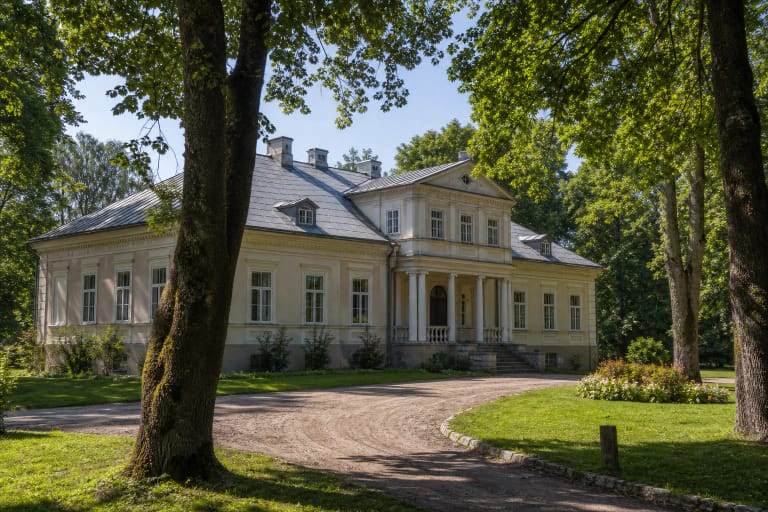
The church occupies one of the key points in the radial plan of Leipalingis, while the nearby classical manor forms the centre's other historic anchor. Antanas Kruševskis links the two: he owned Leipalingis, developed the estate, and funded construction of the present church. Seeing both on one short walk makes it possible to read the space between the landmarks rather than treating each facade in isolation.
The parish lists two indulgenced feasts: St Anne on 26 July, transferred to the nearest Sunday, and the titular Assumption of the Blessed Virgin Mary on 15 August. On those occasions the church functions above all as a gathering place for its community, and attendance can be larger. Choose another date for a quieter architectural visit, and check current parish information before travelling.