- Place
- Vilnius City Municipality
- Region
- Vilnius
- Type
- Baroque church of the late seventeenth and early eighteenth century and part of the former Trinitarian monastery ensemble
- Address
- Antakalnio g. 27, Vilnius
- Coordinates
- 54.70042, 25.31238
- Visit duration
- 20-40 minutes; longer for a service, concert, or community event
- Best time
- during official opening hours but outside the heart of a ceremony, when the dome and surviving stucco can be viewed quietly
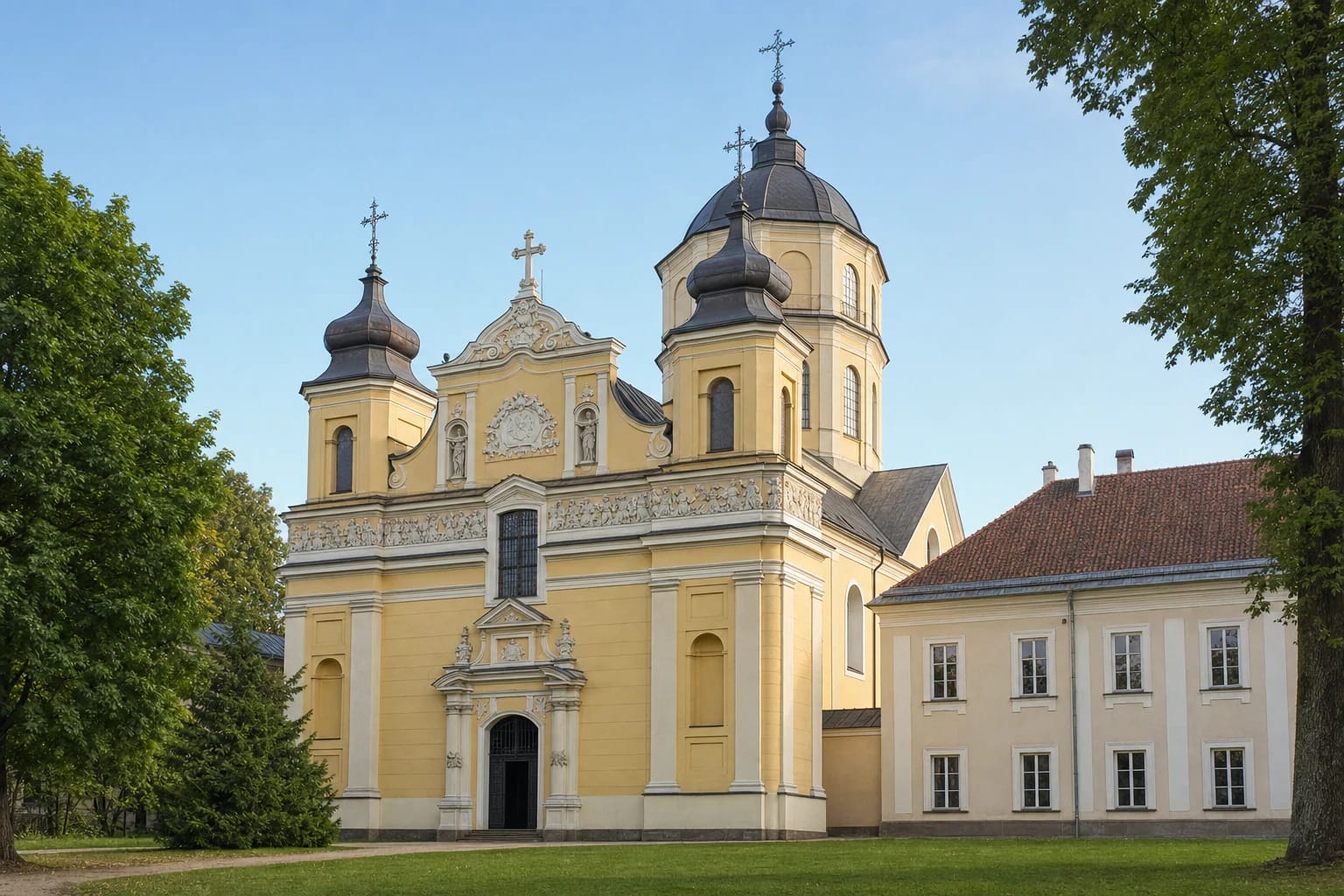
Vilniaus Išganytojo bažnyčia, Vilnius Trinitarian Church, Church of Our Lord Jesus, St John Community Church
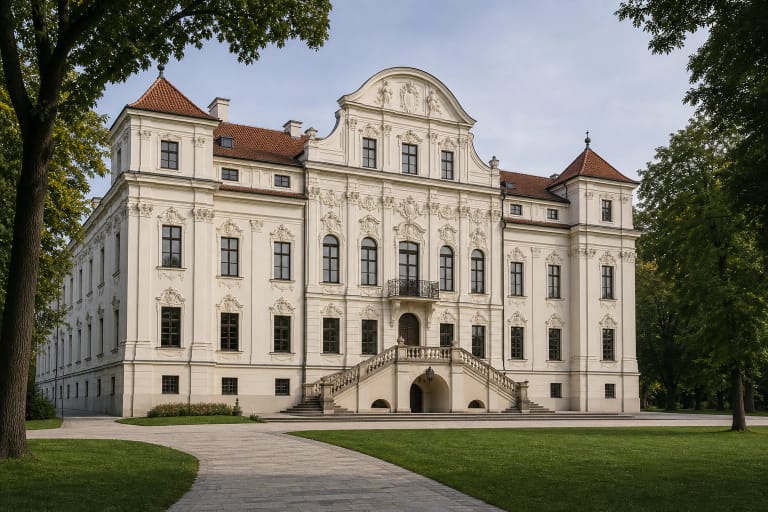
The church completes the axis of the Sapieha Baroque ensemble
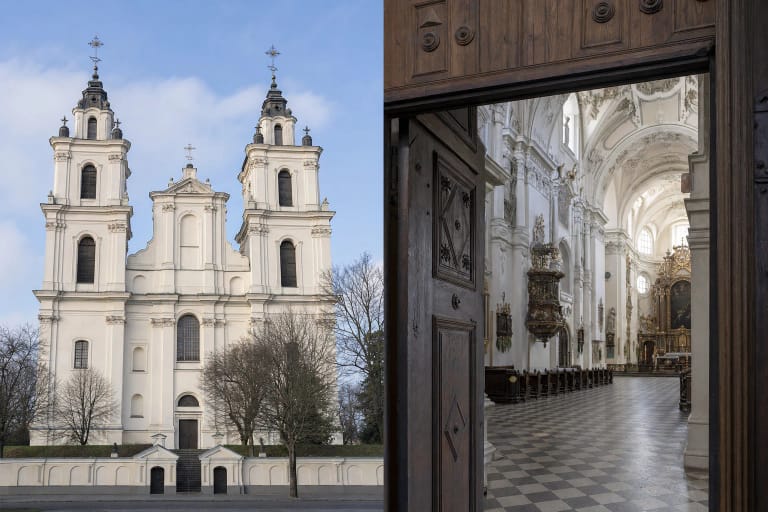
The Trinitarians arrived in Vilnius in 1693, and work on their church and monastery began within Kazimierz Jan Sapieha's estate in 1694. The sanctuary was first consecrated in 1716 under the title of the Most Holy Redeemer, Jesus of Nazareth, although building work continued until 1717.
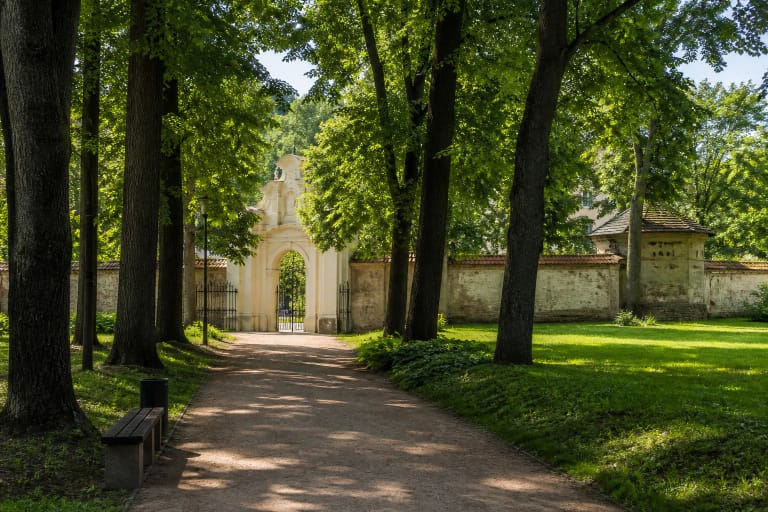
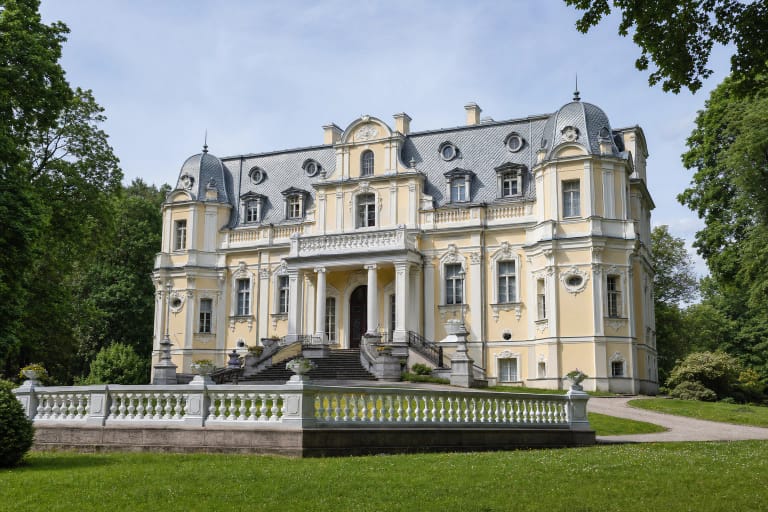
The church does not stand accidentally beyond Sapieha Park. Palace, formal garden, gates, and Trinitarian complex formed a representative Antakalnis residence. Approach through the park to see how the dome and facade terminate its long compositional direction.
Four two-storey monastery ranges enclose a quadrangular courtyard. Their architecture is far more restrained than the sanctuary, making the contrast between everyday monastic buildings and the church's sculptural facade an intentional part of the ensemble.
The Trinitarian mission is written across the facade
The Trinitarian order was founded in the Middle Ages to ransom Christians held captive. The reformed Spanish branch settled in Vilnius. A group over the portal visualises that mission directly: two captive Christian soldiers and an angel offering them reassurance.
An octagonal dome rising over 30 metres crowns the centrally planned church. Two towers added to the facade in the later eighteenth century frame it, while a double relief-decorated frieze links architecture to the order's purpose.
Italian sculptor Pietro Perti supervised and personally contributed to the decoration in 1700-1705. Surviving interior work includes three-sided corner pilasters with Corinthian capitals, a broad entablature with a richly carved frieze, and angels carrying instruments of Christ's Passion below the dome.
The original Jesus of Nazareth statue is now elsewhere
The monastery's first superior, a Spanish priest named Joseph, and Sapieha commissioned a statue of Jesus of Nazareth in Rome after the venerated Ecce Homo image in Madrid. It reached Vilnius in 1700 and entered the church the day after the 1716 consecration, soon becoming its principal devotional object.
Trinitarians promoted its cult especially through solemn services on Fridays in May. The original no longer stands on the Redeemer's high altar: it is kept in the nearby Church of St Peter and St Paul. A copy was installed here in 1940.
Other works were dispersed too. Several altarpieces entered museum stores, while a seventeenth-century Crucifix formerly on a side altar now hangs in the Chapel of Exiles at Vilnius Cathedral. Empty niches therefore record historical destruction; they are not evidence of an unfinished original scheme.
Orthodox church, hospital, warehouse, and renewed community
After the Trinitarian houses were closed in 1864, the church became the Orthodox Church of St Michael the Archangel. Six side altars, a Rococo pulpit, Sapieha's monument, and sculptures were removed; the dome lantern, tower roofs, and entrance were altered. Barracks occupied the monastery.
In 1919 the church was assigned to a Polish military hospital, and the monastery was converted for university clinics in 1924. The sanctuary served as military storage in the Soviet period. Vilnius seminary used the ensemble from 1993, and the Brothers and Sisters of St John settled here in 2000.
The interior deliberately does not resemble a newly manufactured eighteenth-century room. Surviving Baroque work, scars of loss, modern liturgical furnishings, and active monastic life make several historical layers visible together.
Opening hours, services, and respect for an active church
On 27 July 2026, the Vilnius Archdiocese listing stated that the church opened daily from 7 am to 9 pm. Masses were listed at 6.30 pm on Tuesday, Wednesday, and Friday; 11.30 am on Saturday; and 10 am and noon in Lithuanian plus 6.30 pm in Polish on Sunday. Holiday and event schedules change, so verify them on the official page before travelling.
There is no ticket for an ordinary individual visit. Enter quietly, do not photograph worshippers without consent, and avoid walking through the sanctuary or directly before the altar during a ceremony. Concerts, retreats, and tours may require separate registration or payment.
The exact Google listing, Vilniaus (Antakalnio) Išganytojo bažnyčia, held 4.8 from 343 reviews on 27 July 2026. Its coordinates, 54.7004245 and 25.312379, mark the principal church entrance at Antakalnio g. 27.