- Genre
- City-symbol legend
- Source status
- chronicle tradition
- Motifs
- wolf, iron, howling, Vilnius, castle, prophecy
Iron Wolf, Vilnius Iron Wolf, Wolf of Gediminas' Dream
The legend
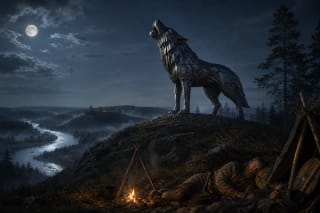
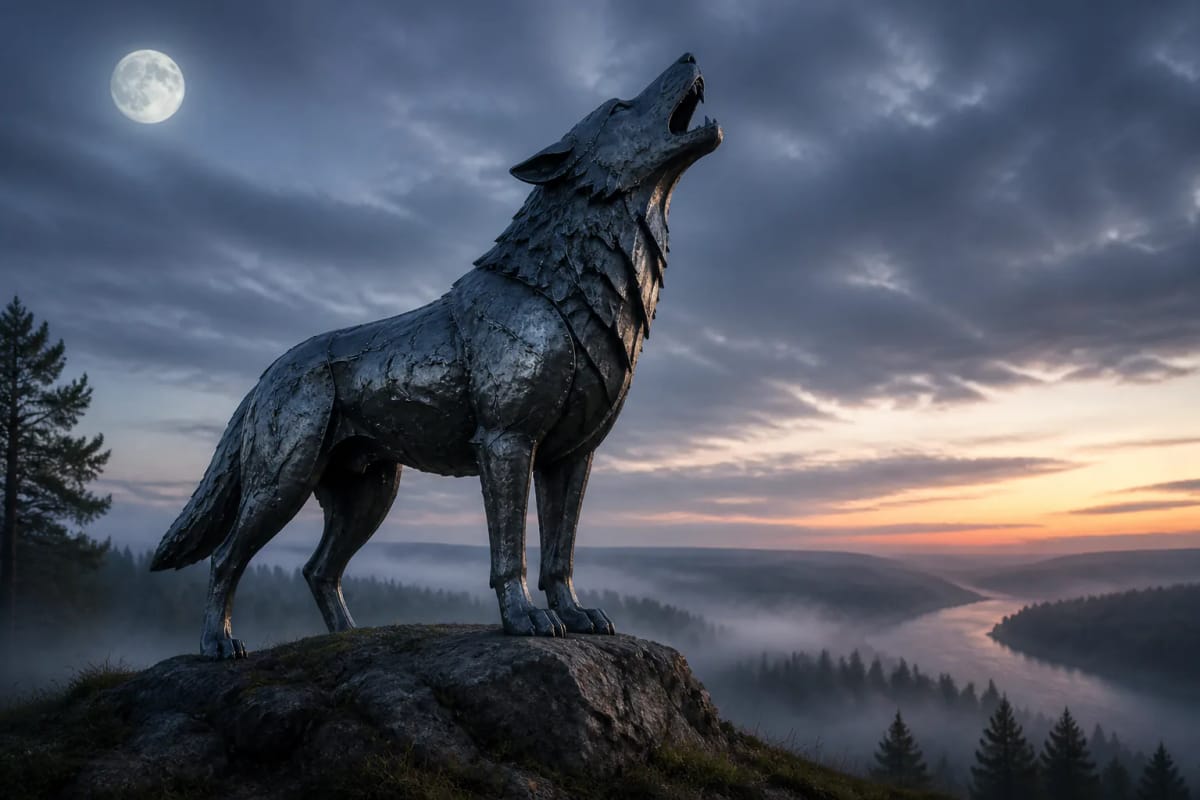
The Iron Wolf appears in Gediminas' dream. After the hunt, the Grand Duke sleeps in the landscape of Vilnius' hills and rivers and sees a wolf standing on a hill. It is not made of flesh and fur but of iron, so the vision immediately looks like a sign.
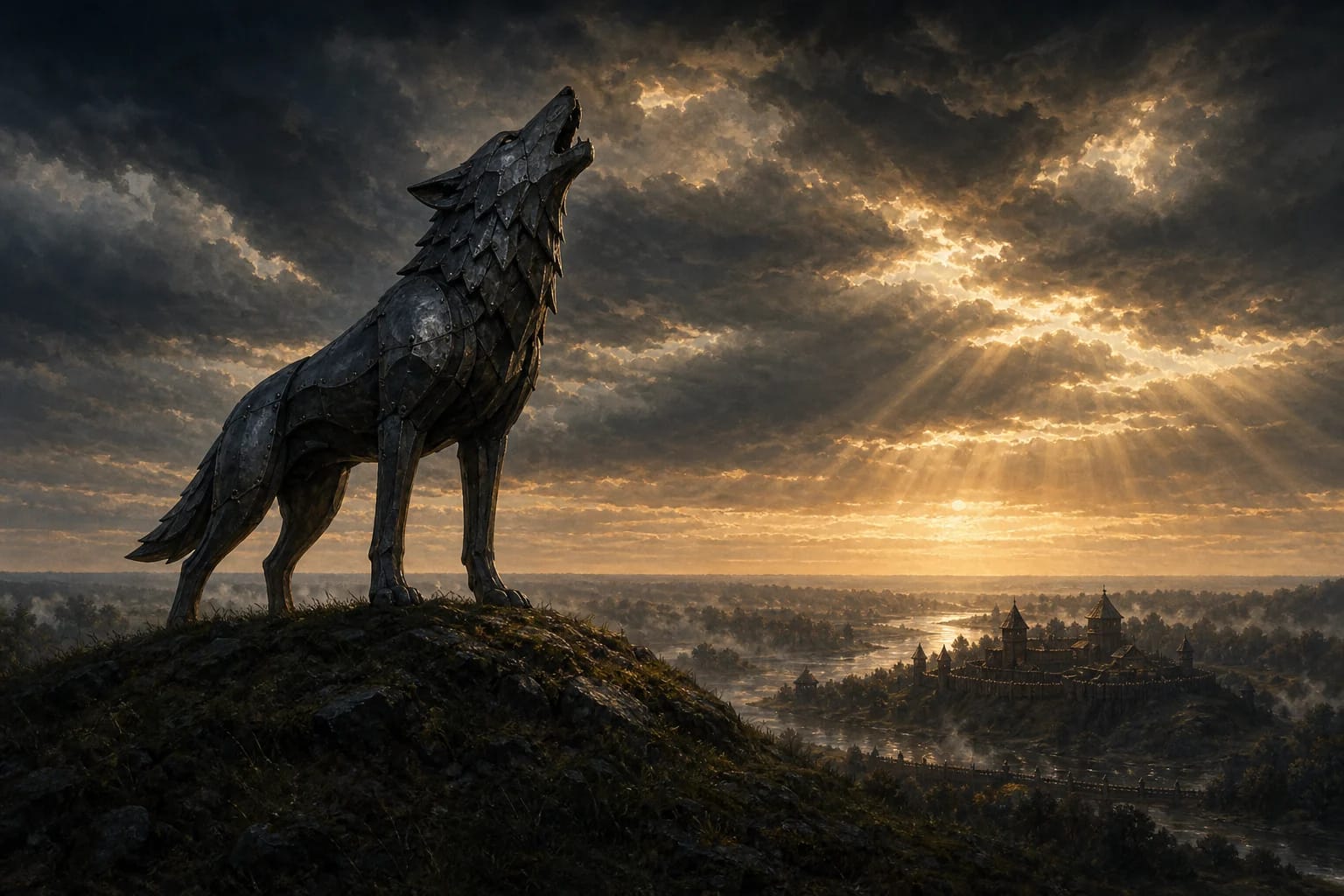
The wolf howls with the force of many wolves. Gediminas asks Lizdeika what such a dream means, and Lizdeika explains that the Iron Wolf signifies a castle and city, while its voice signifies the future capital's fame.
The wolf becomes the core of Vilnius' prophecy. It does not build the city or speak in human words, but its body and voice direct Gediminas toward founding a strong and widely known city.
Interpretation: what does the Iron Wolf mean?
The Iron Wolf joins animal and metal. The animal brings movement, instinct, forest, hunting, and wild energy. Iron brings strength, weapons, fortress, state power, and human-made form.
The howl is not mainly a sound of fear but a metaphor of renown. In Lizdeika's interpretation, it means that Vilnius will be talked about widely. The city is born as a voice before it is built as stone and timber.
The importance of the Iron Wolf also lies in the fact that it is not tamed. It remains wild, yet its iron body allows it to be linked with the castle and with defence. It is not a sign of domestic order but of a capital that rises from a liminal space of frontier, hunting, and war.
Today the Iron Wolf often functions as an emblem of Vilnius. But its strongest layer is not decorative. It reminds us that a city's origin story needs an image that is at once clear, menacing, memorable, and prophetic.
History, variants, and sources
The Iron Wolf belongs to the Lithuanian chronicle tradition and cannot be separated from Gediminas' Dream. It is normally interpreted together with Lizdeika, Šventaragis Valley, and the story of Vilnius' founding.
The Iron Wolf motif is recorded only in sixteenth-century Lithuanian chronicles (the wide redaction, the so-called Bychowiec Chronicle), about two centuries after the historical Gediminas. It is therefore best understood as a late chronicle-legend image, not as an ancient Baltic deity or a sign attested by contemporaries. This is a reminder that both the prophecy of the city's fame and the image of a city 'as famous as the wolf's howl' are a literary construction of the chronicle, not documentary evidence from Gediminas' time.
Retellings may vary in exact wording, place, and detail, but the wolf's iron body and powerful howl remain the central signs.
More authoritative sources matter so that the Iron Wolf is not presented as an independent ancient god or a separate mythical being. From the standpoint of the sources, it is a legendary image that arises in the dream-interpretation scene.
Why did the wolf become a sign of Vilnius?
A wolf is easy to remember, and iron gives it the meaning of endurance and state power. One image can recall the whole sequence: Gediminas, dream, Lizdeika, castle, city, and fame.
For that reason the Iron Wolf has moved naturally into monuments, school narratives, city imagery, and modern cultural references.