- Place
- Birštonas Municipality
- Region
- Birštonas
- Type
- active Gothic Revival Catholic church
- Address
- 14 Birutės Street, Birštonas
- Coordinates
- 54.60156, 24.03395
- Visit duration
- 30-50 minutes outside services
- Best time
- daytime, when light through the stained glass reveals the bright three-aisled interior
Birštonas Church, St Anthony's Church in Birštonas
From wooden churches to the Gothic Revival building of 1909
Catholic worship in Birštonas predates the present masonry church by centuries. The parish history says a church probably stood here by 1529; it was repeatedly rebuilt after decay and war in the seventeenth century, and a new wooden church was erected in 1787 with funding from Prienai elder Kazimierz Sapieha. The parish was restored in 1795.
The design for the present masonry church was approved in 1900. Architect Wacław Michniewicz prepared it, parish priest Jonas Karvelis organised construction with his parishioners, and Edmund Emilian Fryk supervised the work. The church was completed in 1909 and dedicated to St Anthony of Padua.
A compact church beneath a four-stage tower
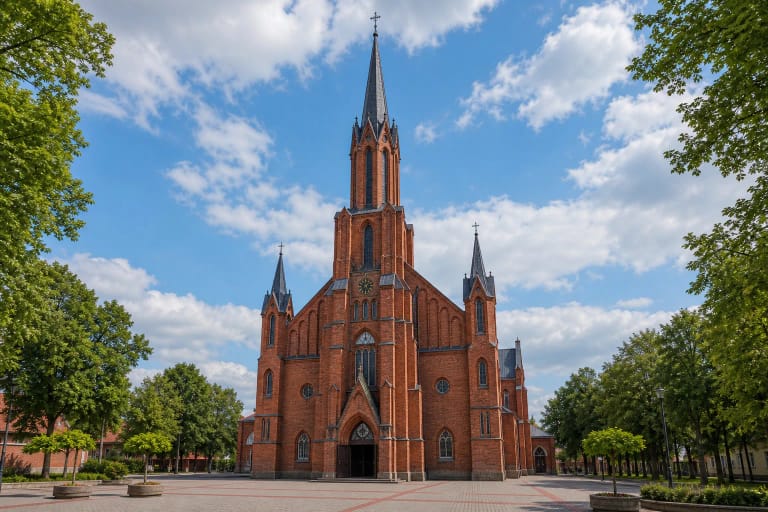
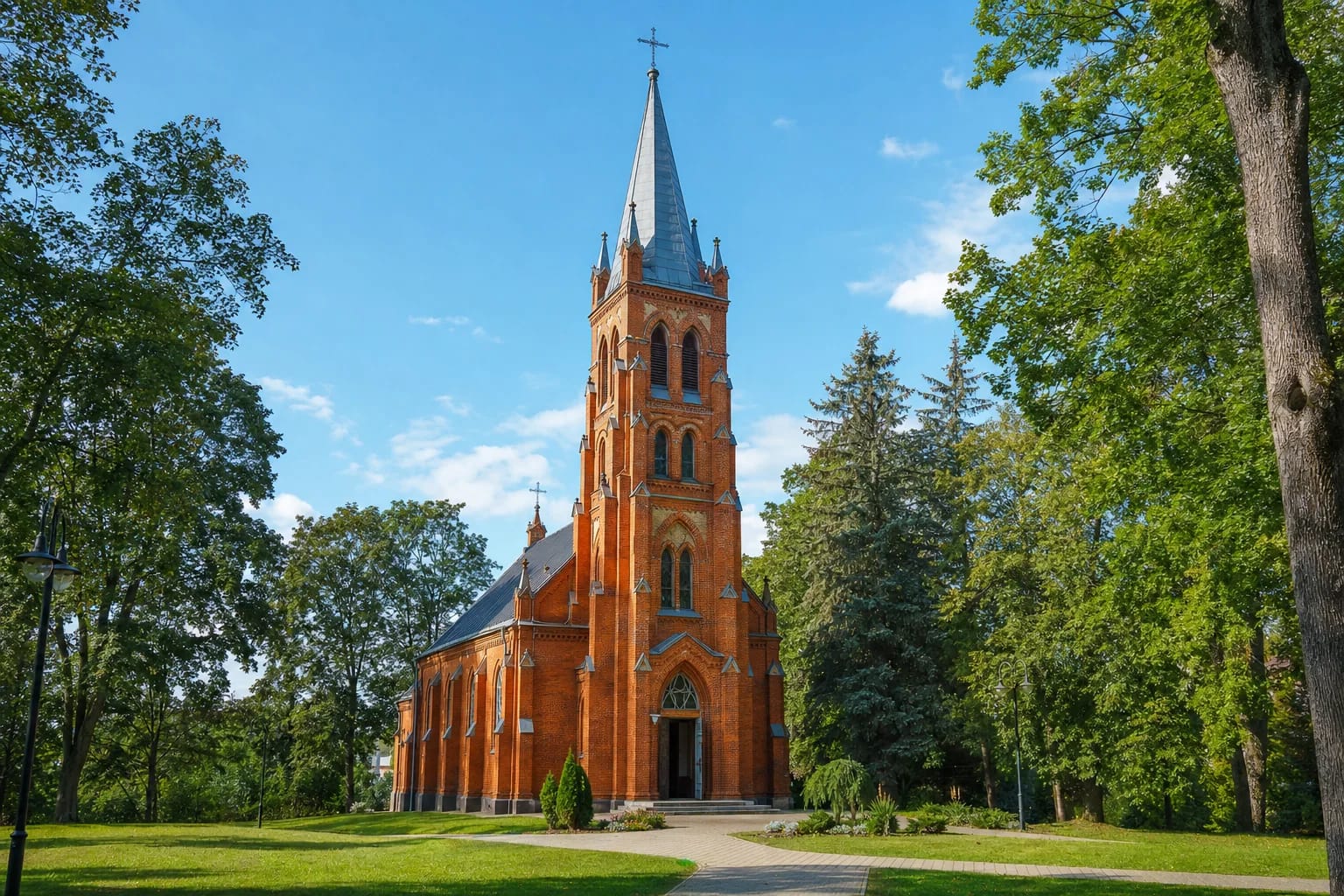
AUTC records the unusually compact dimensions of roughly 6.5 metres by 22 metres. Above the small three-aisled body rises a four-stage tower about 37 metres high, its vertical line strengthened by pointed openings, buttresses, slender pinnacles and a steep spire. It is one of the most recognisable silhouettes in central Birštonas.
Inside, the exterior's Gothic Revival language continues through vaulting, mosaic floors and a coherent suite of wooden furnishings. Adomas Karalius, a craftsman with a strong command of the style, made the altars, furniture and other fittings, allowing exterior and interior to read as a single architectural composition.
Garalevičius's organ, paintings and a quiet message in glass
The eight-stop organ was made in 1908 at Jonas Garalevičius's Kaunas workshop and restored in 1997. The altars contain religious paintings by Stanisław Gobiata and Nikodemas Silvanavičius; the image of St Joseph with the Child is thought to predate the present building and probably came from the earlier wooden church.
Stained glass made by Vytautas Švarlys and Andrius Giedrimas in 1987 marked the 600th anniversary of Lithuania's Christianisation and the 500th anniversary of St Casimir's death. Lithuanian grand dukes Vytautas and Mindaugas appear among the saints, making the cycle both decoration and a subtle statement of historical identity during the Soviet period.
Matulionis's trace and practical visiting
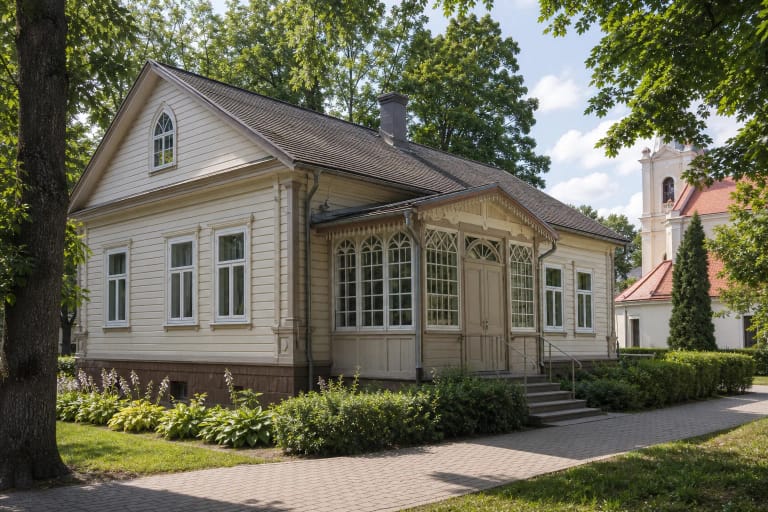
When Bishop Teofilius Matulionis of Kaišiadorys settled in Birštonas after Soviet imprisonment in 1956, the resort briefly became the diocesan seat. Two neighbouring locations should not be confused: Matulionis secretly consecrated Vincentas Sladkevičius in 1957 not in the church nave, but in the rectory next door, now the Birštonas Sacred Art Museum.
This is an active church rather than a ticketed attraction. On 2026-07-22 the parish listed Mass from Tuesday to Saturday at 18:00 and on Sunday at 10:00 and 12:00, with no ordinary Monday Mass shown. Check the official schedule before travelling, visit outside services when possible, and avoid photographing worshippers without permission.