- Place
- Šventoji, Palanga City Municipality
- Region
- Palanga
- Type
- 1982 bronze composition of three women in the coastal dunes
- Address
- Prieplaukos St., Šventoji, Palanga City Municipality
- Coordinates
- 56.02815, 21.07149
- Visit duration
- 15-30 minutes; longer with Šventoji Port and the beach
- Best time
- a quiet morning or evening in daylight, when the bronze forms and dune setting are clear
Žvejo dukros, Fisherman's Daughters, Decorative sculpture Žvejo dukros
Three figures held in the coastal wind
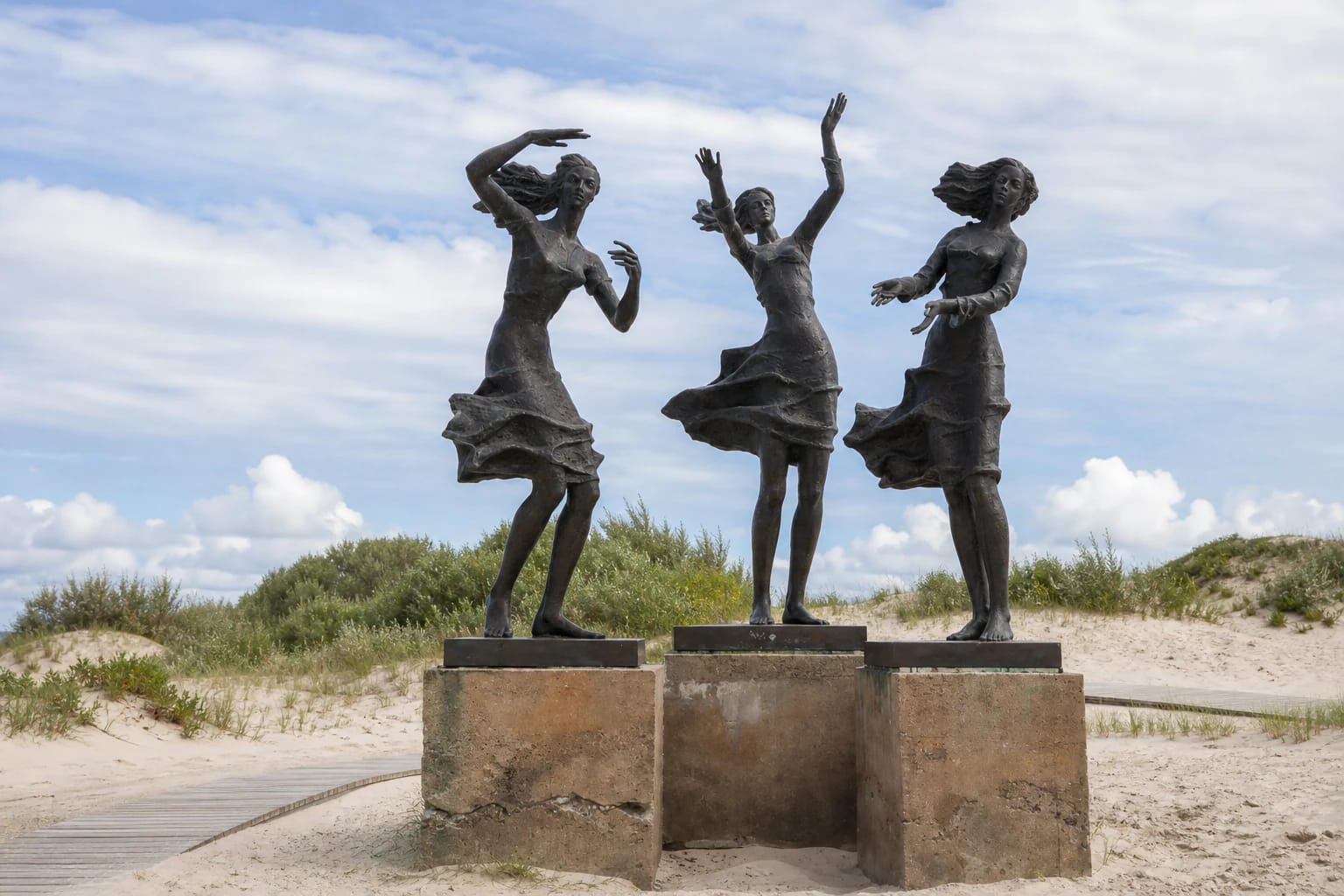
The composition consists of three separately cast bronze women on a rectangular concrete plinth. Seen from the seaward side, the woman on the left shades her eyes with one hand, the central figure raises both arms, and the woman on the right reaches forward. Hair and dress folds are modelled as if driven by a strong coastal wind, making the stationary figures feel like a moment caught in motion.
Official Palanga descriptions give the entire composition a height of about 4 m. Dark bronze, with patches of green-brown patina, and three distinct silhouettes stand sharply against pale sand, dune grasses, and low coastal shrubs. The work needs no imagined boat or added signs: the directions of the bodies and the real Baltic wind create its movement.
From the 1980 models to the 1982 installation
Sculptor Zuzana Pranaitytė created the composition in 1980, and it was installed in the Šventoji dunes in 1982. The Universal Lithuanian Encyclopedia names Živilė Antanina Mačionienė as its architect. The artist's signatures and the date 1980 survive on individual figures, linking the bronze seen today with the year in which the work was prepared.
In a recollection published by Palanga's tourism information service, the artist's niece Lina Wahl said that as a teenager she posed while Pranaitytė modelled the figures' legs and feet, and that the prepared sculptures were taken to what was then Leningrad to be cast. This is family testimony about the creative process, not an inscription displayed at the site.
Fisherman's Daughters was entered in the Register of Cultural Property on 26 April 1993. Its unique code is 15198 and its level of significance is regional. The Register identifies volume, form, and artistic expression among its valuable qualities, so the protected work is not only its bronze but the recognizable solution of three figures on a concrete plinth.
Fisherman's daughters and the three Baltic states
The best-known narrative follows the title directly: three long-haired daughters of a fisherman look out to sea and wait for their father to return from fishing. The subject suits Šventoji's setting as a fishing settlement and port, but it is an artistic story, not a claim about one documented local family.
A second layer of meaning spread publicly after Lina Wahl's account was published in 2016. According to the artist's niece, Pranaitytė used the three women to represent Lithuania, Latvia, and Estonia looking west and waiting for help during Soviet occupation, with Lithuania as the central figure. Because the interpretation comes through a close relative's recollection, it is more accurate to attribute it clearly than to present it as an explanation inscribed on the sculpture.
The Baltic-states reading also became part of public memory. In 2020, Palanga City Municipality held a Baltic Way commemoration at Fisherman's Daughters and described the composition as three Baltic countries looking west with hope. The coastal sculpture thus serves not only as a resort emblem but also as a civic gathering place.
Dunes, harbour gates, and a changing setting
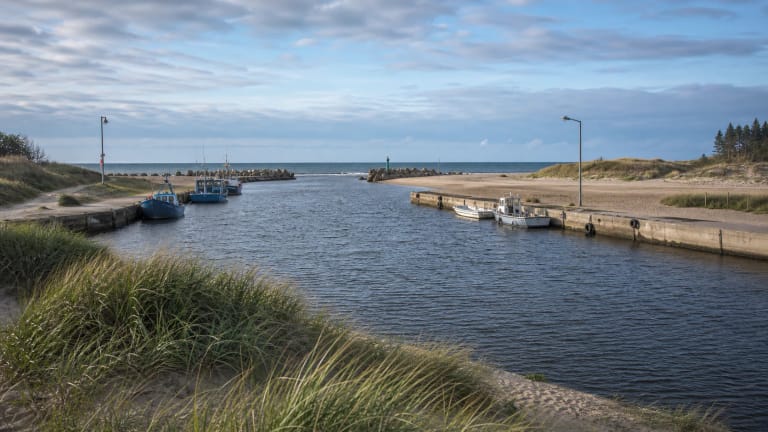
Fisherman's Daughters stands in the dunes at the seaward end of Prieplaukos Street, by the Šventoji harbour gates and near the site of the former timber pier. The figures face the sea, so the real coast completes the work: sand, low vegetation, wind, and the Baltic horizon.
A dune is not a fixed pedestal. A 2017 initiative to improve the setting noted that wind erosion had exposed parts of the foundation while a broad dune on the seaward side reduced the sculpture's visibility from the beach. This explains why photographs from different years show different relationships between the concrete base and the surrounding sand.
Use the existing paths, avoid trampling dune grass, and do not climb the plinth or the figures. The setting is a sensitive coastal habitat and the artwork is a registered cultural property. The best way to see it is to walk calmly around the group and compare its silhouettes from the landward and seaward sides.
Finding and visiting Fisherman's Daughters
The sculpture's site point is 56.028154, 21.071492, at the coastal end of Prieplaukos Street in Šventoji. The navigation link on this page uses the exact Google Maps listing with place ID ChIJPzUN2BMy5UYRQnQaCWB61w0. The pin marks the sculpture itself, not a car park or a service entrance to the harbour.
This is a public outdoor artwork without a ticket desk or a separate staffed display. Official object sources publish neither fixed opening hours nor an admission charge. Daylight is the safest time to visit, and strong wind, storms, or temporary restrictions around harbour approaches should be considered before setting out.
Sand and weather continually alter coastal access. Pedestrian paths and sections of boardwalk lead towards the composition, but sand, uneven ground, and exposed steps may remain beside the plinth, so the entire route should not be assumed to be step-free. Visitors with specific mobility requirements should check current conditions with Palanga Tourism Information Centre before travelling.