- Place
- Vilnius City Municipality
- Region
- Vilnius
- Type
- active historic Conventual Franciscan church
- Address
- 1A Pranciškonų Street, Vilnius
- Coordinates
- 54.67953, 25.28077
- Visit duration
- 40-60 minutes outside services
- Best time
- by day, when both the interior and the Pranciškonų Street ensemble can be seen
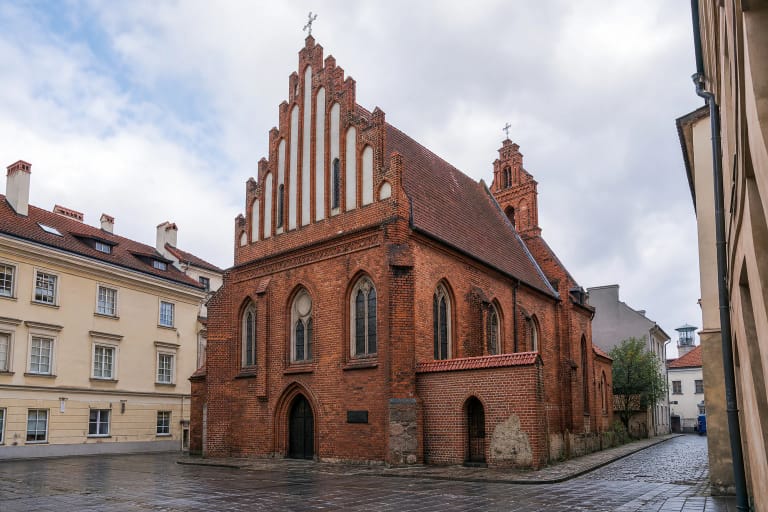
Vilnius Franciscan Church, Church of the Assumption of the Blessed Virgin Mary
Franciscan traces from the fourteenth century
Archaeology has found remains of a mid-fourteenth-century masonry chapel beneath the present church and even earlier Christian burials. The Franciscan foundation is associated with 1388-1392, while written sources mention the church from 1392.
The sanctuary was consecrated under the Assumption of the Blessed Virgin Mary in 1421. It is therefore one of Vilnius Old Town's oldest continuously renewed sacred sites, although its present form emerged through many rebuilding campaigns.
Gothic masonry beneath a late-Baroque mantle
Fire almost destroyed the church and friary in 1533; rebuilding raised the central nave and roof. After further fires in 1737 and 1748, the church was reshaped as a late-Baroque basilica in the second half of the eighteenth century.
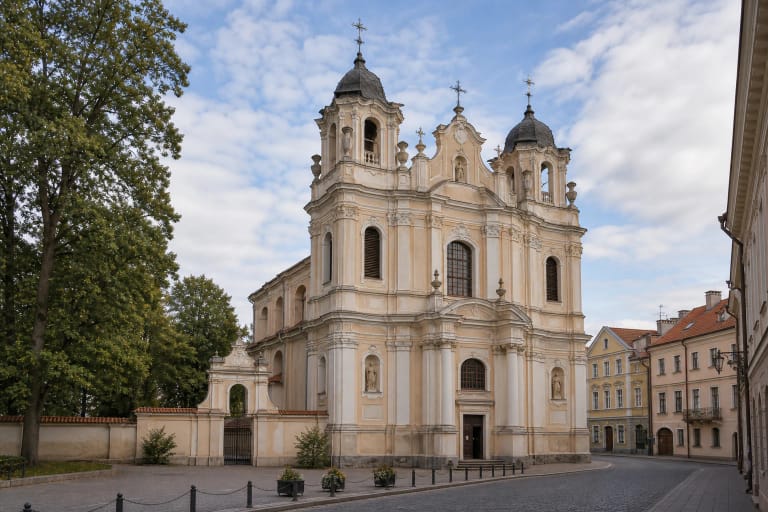
Visitors therefore encounter a monument of several periods. Heavy buttresses and masonry disclose Gothic origins, while the facade, stucco and later remodelling introduce late-Baroque and Classical elements.
Library, printing press, and the White Virgin
The friary maintained a library of several thousand volumes, a printing press from 1670 to 1771 and an elementary school. It was a centre of learning, print and urban culture as well as prayer.
The site is also associated with the White Virgin, an eighteenth-century statue of the Immaculate Conception. Concealed beneath plaster in the nineteenth century and later rediscovered, it moved to St Lawrence Chapel in 1935 as devotion drew larger crowds.
Reading old masonry and a modern altar
Walk around the exterior as far as public access permits. Massive stepped buttresses are among the clearest signs of the Gothic structure, while the eighteenth-century facade speaks an entirely different late-Baroque language. Seeing both prevents the whole ensemble being labelled Baroque simply because its front is the first thing noticed.
The revived interior also has a contemporary layer. VLE records an altar made for the church by Romualdas Sakalauskas in 1999. It is best read not as a reconstruction of lost medieval furnishings but as modern church art responding to a historic building altered many times.
From court archive to revived sanctuary
Because the Franciscans aided participants in the 1863 Uprising, the state confiscated the friary and closed the church in 1864, converting it into a provincial court archive. The friars returned in 1934, but Soviet authorities nationalised the complex and the church again served as archive storage.
The church passed to the Vilnius Archdiocese in 1995 and back to the Conventual Franciscans in 1998. On 2026-07-22 official opening was Monday-Saturday 10:00-19:30 and Sunday 09:00-14:00, with Lithuanian and Polish Masses. Recheck before visiting.