- Place
- Klaipėda City Municipality
- Region
- Klaipėda
- Type
- Regimantas Midvikis's granite-and-bronze public sculpture, returned as an authorised copy in 2006
- Address
- junction of Kalvių and Pasiuntinių streets, Klaipėda
- Coordinates
- 55.70892, 21.13248
- Visit duration
- 10-20 minutes; 45-90 minutes when combined with other Old Town sculptures
- Best time
- in daylight, especially morning or evening, when side light reveals the contrast between granite and bronze
Senamiesčio katinas, Old Town Cat, Klaipėdis
The exact location in Kalvių Square
The Cat stands in a small public space at the junction of Kalvių and Pasiuntinių streets in Klaipėda Old Town. Both the Ieva Simonaitytė Public Library guide and Klaipėda City Municipality's inventory of Old Town artworks use this location. Navigate to 55.7089246, 21.1324834, because some map listings attach a misleading number from a neighbouring building.
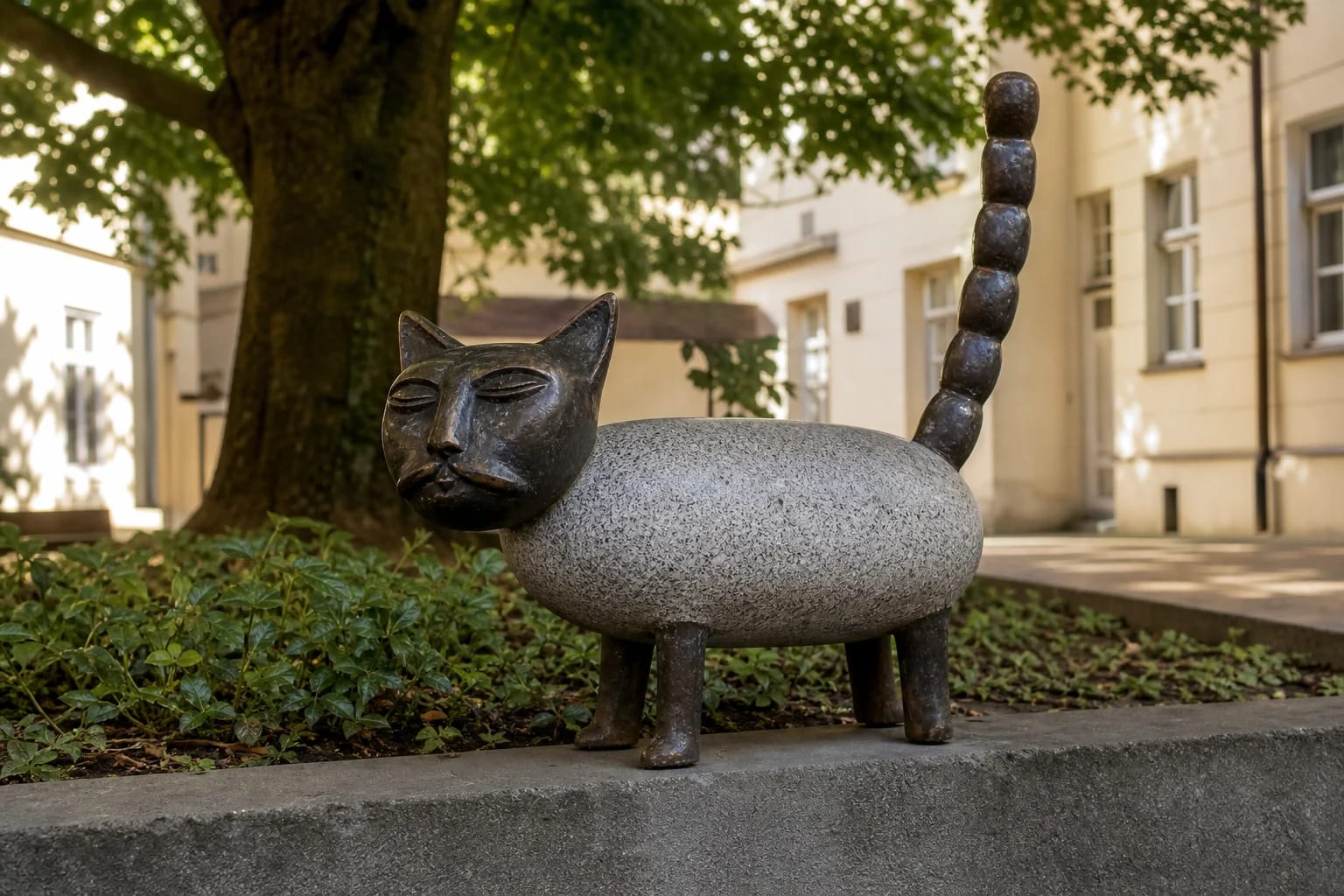
Do not look for a monument in the middle of the square or beside a doorway. The sculpture occupies a low stone border beneath a mature oak, framed by planting and Old Town façades. Its modest scale makes it easy to pass, particularly after dark when the granite merges visually with its support.
On 24 July 2026, the exact Google Maps listing named Sculpture "Cat with a Face of a Gentleman" showed 4.7 out of 5 from 246 reviews. Ratings and review counts change, while the coordinates and street junction remain the reliable way to identify the work.
A granite body and a gentleman cast in bronze
The composition centres on a smooth, horizontally stretched body of speckled granite. Bronze legs, a head and an upright tail assembled from distinct sections are attached to the stone. The material contrast reads clearly even at a distance: the heavy volume feels settled and still, while the darker metal gives movement to the silhouette.
The head is stylised rather than anatomically copied. Pointed ears, a pronounced brow and muzzle, and narrow eyes that seem closed create the restrained character of an elderly gentleman. In 2006, Midvikis said his cat knew everything and even walked with its eyes shut - a line that neatly captures the sculpture's humour.
Walk around both sides. The long granite torso and vertical tail are clearest in profile, while the face and rhythm of the bronze legs emerge from the front. This is small-scale sculpture whose impact comes from a concise silhouette and the unexpected union of stone and metal.
Why the date of the original remains unsettled
The Ieva Simonaitytė Public Library object record and the Immanuel Kant Public Library biography of Midvikis date the Old Town Cat to 1979. Period reports on its 2006 return usually say 1980, while VLE lists the decorative sculpture Cat as a 1982 work.
These dates should not be forced into false agreement. They may refer to different stages of design, installation or cataloguing, but the checked sources do not explain the discrepancy directly. The original dates broadly to 1979-1982, with 1979 established in the library's record of city memory.
Regimantas Midvikis graduated from the Lithuanian Art Institute in 1971, worked at Klaipėda's Dailė art combine in 1975-1979, and created both small sculpture and major monuments. VLE characterises his art by concise generalised forms and expressive silhouettes, qualities distilled with unusual clarity in the Cat.
Disappearances and the documented return in 2006
The library's city guide says the sculpture was restored twice after vandalism and later disappeared again. Newspaper accounts also mention bottles smashed against it and the Cat being thrown into the Danė, but the essential point on which the records agree is the final loss of the original. The sculpture seen today is not the old Cat recovered intact.
In 2006, Midvikis made an authorised copy himself and preserved the earlier appearance. The work returned to its former position on 31 July and remained covered until the ceremony; at 2 pm on 1 August, during Klaipėda's 754th birthday, it was officially unveiled in Kalvių Square. It was ceremonially given the name Klaipėdis.
This chronology makes the present Cat the artist's recreation and continuation of a lost work, not a single original repeatedly repaired. A security camera was later installed nearby, while city events have treated the sculpture as the recognisable storyteller of Kalvių Square.
A short stop on an Old Town sculpture walk
The Cat stands outdoors in a public space with no gate, ticket desk or separate admission. It is visible at any time, although daylight makes both the facial relief and the two materials easier to read. Allow 10-20 minutes to circle the work, photograph it and notice how the square frames it.
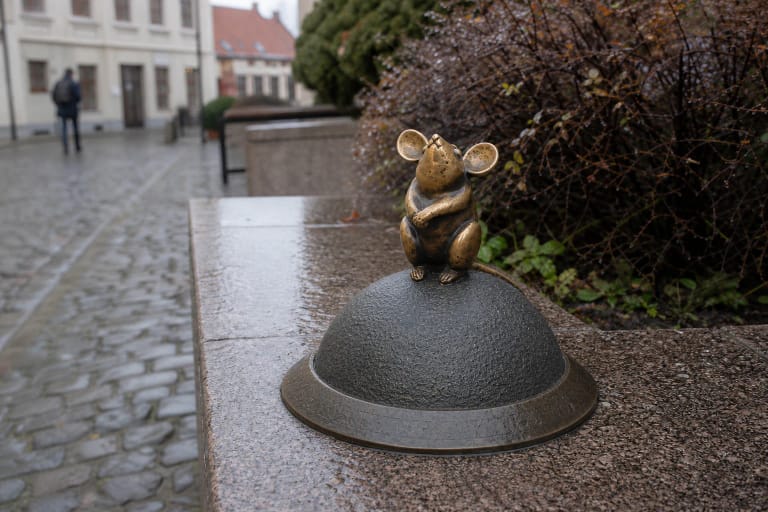
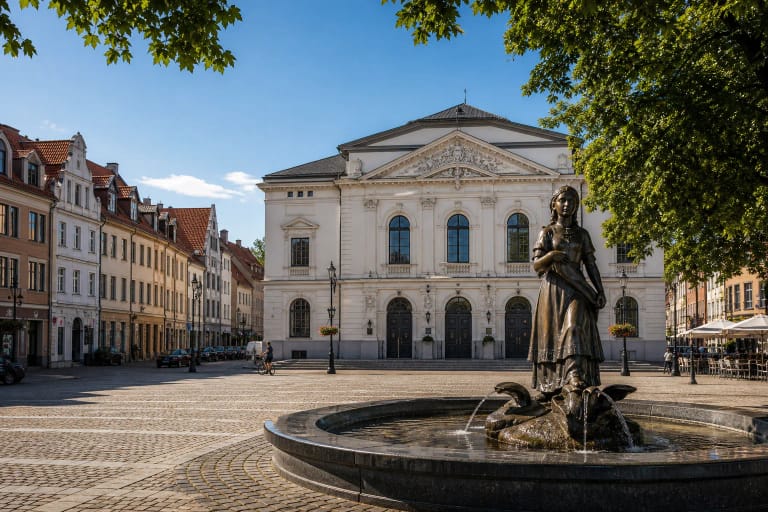
A practical walk begins at Theatre Square, continues to the Cat in Kalvių Square, then reaches the nearby Magical Mouse and the Danė waterfront. The Mouse has its own detailed 2006 story; only one connection matters here - Midvikis's returning Cat provided the playful prompt for a mouse to appear later that same year.
There are no steps immediately beside the sculpture, but Old Town paving, kerbs and narrow passages can affect access. No official accessibility audit is published. The Cat can be viewed from the path; do not climb onto the low border, sit on the work or pull its tail, since the present copy already stands in place of a lost original.