- Place
- Kaišiadorys District Municipality
- Region
- Aukštaitija
- Type
- roughly 10 ha sacred memorial complex with five Rosary chapels, St Joseph Chapel and a retreat house
- Address
- 23 V. Sladkevičiaus Street, Guroniai, Žasliai Eldership, Kaišiadorys District
- Coordinates
- 54.83975, 24.56584
- Visit duration
- 45-75 minutes; roughly 1.5-2.5 hours with a pre-arranged exhibition visit and the separate birthplace cross
- Best time
- a dry, bright half-day after checking the retreat, service and group programme
Guroniai Rosary Mysteries Way, Tėviškės šviesa, Cardinal Vincentas Sladkevičius Homestead in Guroniai
What the homestead park pin actually marks
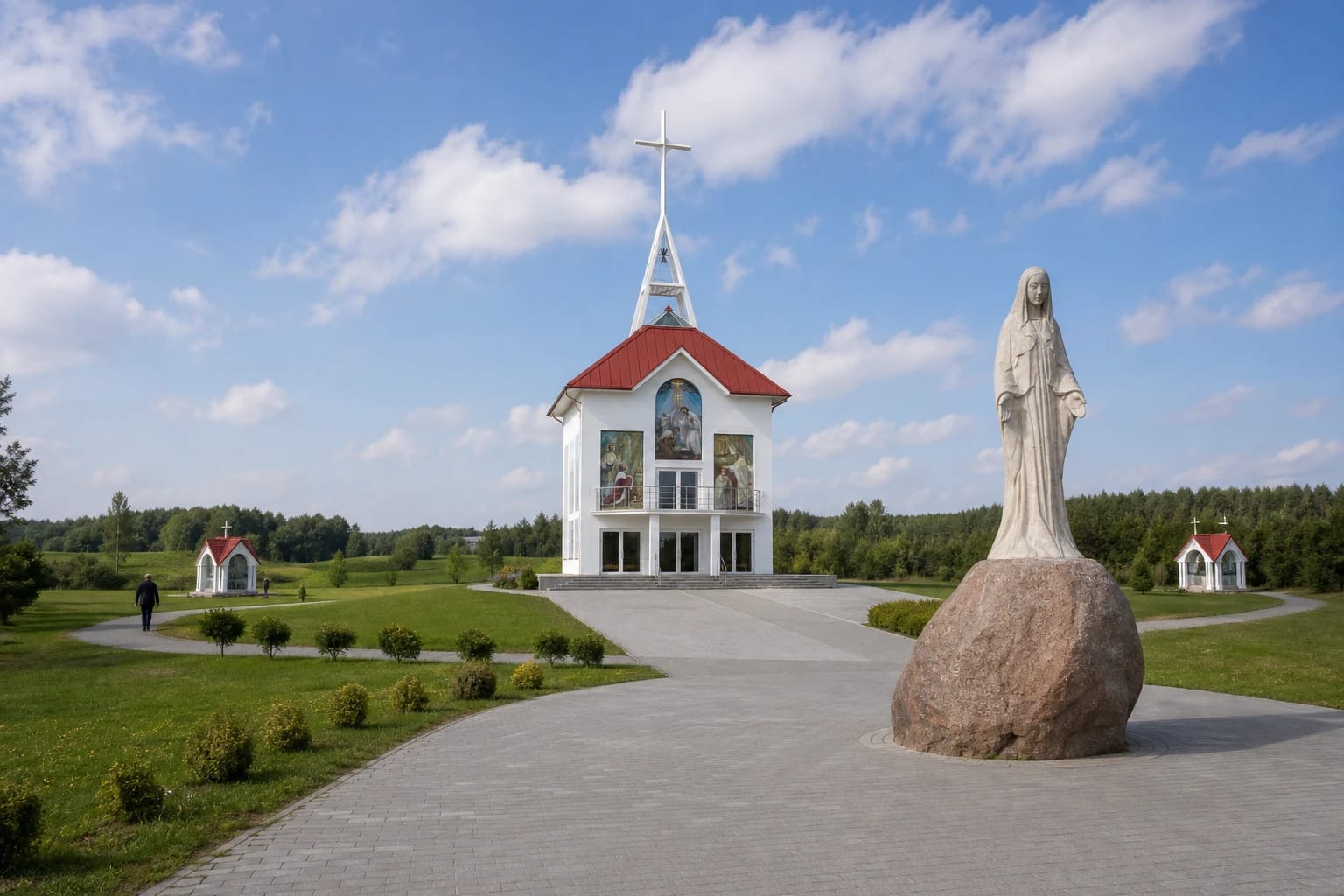
The official coordinates for the Guroniai retreat house, 54.839748, 24.565845, lead to the sacred complex at 23 V. Sladkevičiaus Street. Here the oval Rosary route links five small chapels with the central St Joseph Chapel, a statue of Mary, retreat buildings, planting and ponds. The pin marks the site as a whole, not a specific doorway, parking bay or historic house.
None of the buildings now visited in the park was the cardinal's childhood home. Vincentas Sladkevičius died in 2000; the five Rosary chapels and the statue of Mary were unveiled in 2006, the retreat house opened in 2007, and St Joseph Chapel opened in 2010. This is a deliberately created place of memory and prayer.
Here the word homestead refers to the Sladkevičius family's land and the cardinal's bond with Guroniai, not to one surviving farmstead. A separate cross, roughly one kilometre away, marks the actual site of his birthplace in the old village. Seeing both requires two stops because this page's map pin does not lead to the birthplace cross.
From the 2002 idea to St Joseph Chapel
Work on a new Rosary route in Guroniai began after Pope John Paul II added the Luminous Mysteries to the Rosary in 2002. The family land was chosen to commemorate Cardinal Vincentas Sladkevičius, for whom this prayer was particularly important. Kaišiadorys Diocese developed the project at the initiative of Bishop Juozas Matulaitis.
The five route chapels and the statue of the Virgin Mary were unveiled in 2006 for the diocese's 80th anniversary. Professor Antanas Kmieliauskas created the frescoes and sculpture, while Stasys Petrauskas designed the small chapels. Their white, four-sided forms and red roofs are spaced around the loop, so the scale and rhythm of the ensemble emerge most clearly on foot.
The retreat house opened on the southern side of the complex in 2007 and is administered by the Sisters of the Eucharistic Jesus. St Joseph Chapel, dedicated to the patron of Kaišiadorys Diocese and intended for the Eucharist, opened at the centre of the route in 2010. Inside the retreat house, a rosary collection and a Vincentas Sladkevičius memorial exhibition offer two complementary stories.
How to read five chapels and two prayer routes
Begin the Rosary route near the statue of Mary and follow the oval path at an unhurried pace. Twenty painted compositions cover the outer faces of the five four-sided chapels. Biblical Rosary scenes occupy their upper parts, while episodes from Lithuanian Church and state history appear below, turning the frescoes into both aids to prayer and a paired historical narrative.
Even without praying the Rosary, allow 45-75 minutes for one circuit and a close look at the frescoes. Use a first lap to understand the ensemble, then return to a few selected scenes and their explanations. Because the paintings are outdoors, hard midday light, rain and snow can make details difficult to see.
Guroniai also has a Way of the Seven Sorrows. The official Blessed Teofilius Matulionis pilgrimage page explains that it pairs the seven sorrows of Mary with moments from Matulionis's life. The central chapel and surrounding grounds therefore bring together the memory of two shepherds of Kaišiadorys Diocese, although the Rosary Mysteries Park is primarily a memorial to Sladkevičius.
Two lost farmsteads and one cardinal's life
Vincentas Sladkevičius was born on 20 August 1920 in the old linear village of Guroniai. His father, Mykolas, farmed nearly 10 ha, and the family house stood by the Brastelė stream. From this setting, the boy attended the primary school at Žasliai railway station and travelled with his family to church in Žasliai.
After plans to divide the village into separate farmsteads were prepared in 1938, his brother Jonas inherited the holding and built a new home on another part of the family's land. Their mother, Uršulė, remained there, and Vincentas visited his relatives. This later farmstead disappeared during the Soviet period; an old willow recalls its location within the park. In 2000 a cross made by Algirdas Šalkauskas was consecrated at the old birthplace site.
The memorial matters for more than the cardinal's place of origin. VLE records that Sladkevičius was secretly consecrated a bishop in Birštonas in 1957, prevented from performing his duties and exiled by the Soviet authorities, appointed Apostolic Administrator of Kaišiadorys Diocese in 1982, made a cardinal in 1988 and appointed Archbishop of Kaunas in 1989. The present park interprets this life through his devotion to the Rosary; it is not a preserved museum interior formed during his lifetime.
Kiškio bažnyčia and Zvaninyčia: where evidence ends and legend begins
Two hills recorded as protected heritage places lie beside the park. The Guroniai shrine hill known as Pajauta's Grave or Kiškio bažnyčia has KVR code 5030; the museum's archaeological compendium describes it as a barrow-like rise 28 m in diameter and 3-3.5 m high. About 120 m away is the registered 35 by 25 m Guroniai hill called Zvaninyčia, KVR code 16493.
The stories about these hills are not archaeological conclusions. Folklore describes Kiškio bažnyčia as the grave of a warrior or a Duke Pajauta, heaped up with soldiers' helmets, as the site of a former sacred church, or as a hill connected with Duke Žaslas. Zvaninyčia was said to be the place from which trumpets announced rites at Kiškio bažnyčia. These accounts belong to local oral tradition.
Even the identification of Zvaninyčia's location is uncertain. The Kaišiadorys Museum archaeological compendium notes that some local people considered the registered hill to be the wrong one and said the true Zvaninyčia had been destroyed by land drainage and park works. The compendium does not resolve the dispute. It is therefore incorrect to claim that a bell, church or Pajauta's grave has been found in the hill visible today, and protected ground must not be dug into or otherwise disturbed.
Visiting without invented opening hours or ticket claims
As of 18 July 2026, the official pages did not publish separate opening hours or an admission price for the outdoor park. Kaišiadorys Diocese says St Joseph Chapel is available for pilgrim groups arriving with a priest to celebrate the Eucharist, but that does not promise that every independent visitor will always find the doors unlocked. Walk-in hours for the rosary and memorial exhibitions were also unpublished, so arrange indoor access by calling +370 600 56206 or emailing rekolekcijos@sje.lt.
A retreat is not a park ticket. The official 2026 programme asks participants to register in advance because places are limited, and individuals or groups bringing their own programme must also arrange their stay. On the review date, typical costs for a weekend programme were stated as about EUR 120, with participants invited to contribute according to their means. This amount is not presented as a charge for a short outdoor walk.
Official photographs show paving on the main approach and Rosary loop, with a parking area beside the retreat house. No public accessibility audit was found for gradients, thresholds, an adapted toilet, rest points or parking capacity. Travellers with mobility or sensory requirements should ask about a suitable route through the same contact before setting out, then respect retreat quiet and keep internal access routes clear.