- Place
- Kaunas City Municipality
- Region
- Kaunas
- Type
- interwar Ateitininkai student dormitory and organization palace, now KTU Building III
- Address
- Laisvės al. 13, Kaunas
- Coordinates
- 54.89668, 23.92420
Ateitininku rumai, Ateitininku sendraugiu sajungos rumai, KTU Building III, Kaunas University of Technology Building III
Five storeys on Laisvės aleja
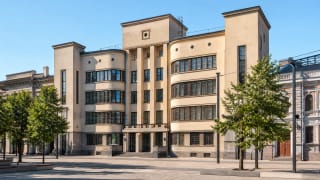
The Ateitininkai Union Palace stands at Laisvės al. 13, in the eastern part of central Kaunas's main pedestrian axis. Today OSM marks it as KTU Building III, an active university building, so for visitors it is primarily an exterior and urban-architecture stop.
The site is more than a handsome facade. It shows how Kaunas architecture moved in the 1920s and 1930s from early independence historicism toward a more restrained, modern language. AUTC classifies the building as modernized historicism and names Feliksas Vizbaras and Algirdas Šalkauskis as the authors.
Ateitininkai and a student dormitory
VLE describes Ateitininkai as a Lithuanian Catholic personal-development organization uniting school pupils, students, and graduates. It operated in Kaunas in 1911-1940, later abroad, and was re-established in Lithuania in 1989.
According to AUTC, on March 16, 1926 the Construction Commission allowed the central board of the Ateitininkai alumni union to build a four-storey masonry residential house for a student dormitory. The palace therefore began not as a representative state office, but as infrastructure for an organization and young people's lives.
The fifth floor and the lift
On August 9, 1927, while construction was already under way, a request was submitted to raise the building to five storeys so more students could live there. AUTC cites the permit condition: the fifth floor had to be provided with a lift.
That detail matters because it reveals not only the building's size, but also interwar Kaunas ambition. A student dormitory on Laisvės aleja was expected to be modern, capacious, and technically convenient. It was social infrastructure on the city's representative street.
Feliksas Vizbaras's starting point
AUTC links the primary project found in the archive with the historicist forms typical of Feliksas Vizbaras's early independence-period work. VLE presents Vizbaras as a twentieth-century Lithuanian engineer and architect who designed important interwar Kaunas buildings, including the Central Post Office, the Ateitininkai Union Palace, and the Pazanga company palace.
The initial project, illustrated by AUTC with a facade drawing, was more ornate than the building visible today. Comparing the drawing with the present facade shows that the object changed not just on the surface, but in its architectural attitude.
The 1931 modernization
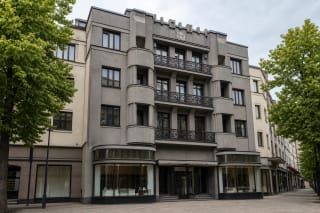
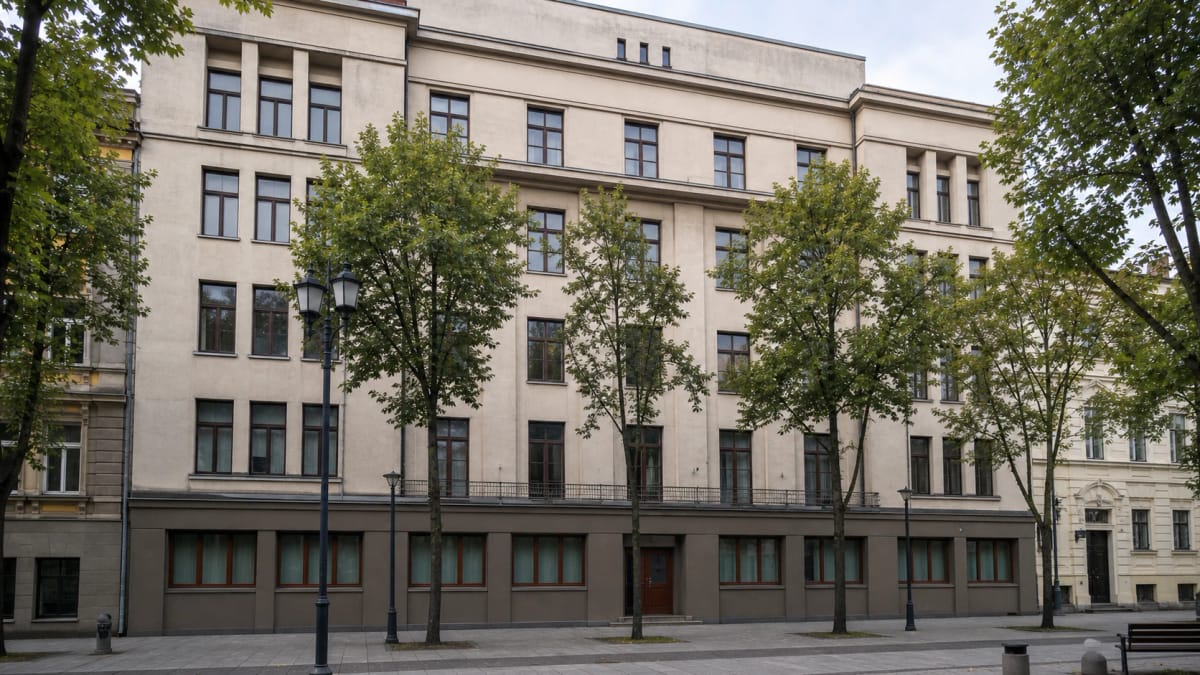
AUTC writes that the building surviving today most likely rose around 1929 and was reconstructed and modernized in summer 1931 according to Algirdas Šalkauskis's design. The current facade is much more restrained: a three-part composition, side projections, rectangular windows, smooth plaster surfaces, and a darker ground-floor band.
This is not a radically functionalist building, but little old decoration remains. It is best read as a transitional object in which the representative palace scale is still recognizable, while ornament has been controlled and the facade begins to work through proportions, window rhythm, and planes.
A public architects' dispute
One of the most valuable contexts for this building is a public architectural debate in 1932. AUTC states that Vizbaras criticized the modernization as a style of rectangular boxes and was especially angry about the removal of columns from the hall, arguing that they were structural as well as decorative.
In his reply, Algirdas Šalkauskis called some earlier decisions an architectural confusion. The dispute shows that interwar Kaunas architecture did not develop quietly: it was discussed in the press, with arguments about construction, style, modernity, and the limits of old decoration.
The present KTU layer
Today the building is used as KTU Building III. OSM marks it as a university building, a five-storey block at Laisvės al. 13. Visitors should therefore not plan an interior visit as if it were a museum: it is an active higher-education space.
The university use is a logical continuation of the history. The building was constructed for a student dormitory and organizational needs, and it remains tied to academic life. The function has changed, but the connection with youth, studies, and Kaunas's educational environment remains.
A heritage-status nuance
The sources used for this page do not confirm a separate individual Cultural Heritage Register code for the Ateitininkai Palace. The AUTC object entry gives no KVR code, so the value of the place is best grounded in AUTC research and the broader heritage context of Kaunas Naujamiestis.
The building is within the historic central Kaunas environment. The Cultural Heritage Register protects the Kaunas city historical part called Naujamiestis under unique code 22149. In the UNESCO Modernist Kaunas context, Laisvės aleja and Naujamiestis buildings help explain the 1919-1939 transformation of the temporary capital, but this specific building should not be called a separately inscribed UNESCO site.
How to view it
The best way to view the building is from the opposite side of Laisvės aleja. Trees often cover part of the facade, but they also show the real scale of the pedestrian avenue. Notice the five-storey rhythm, side projections, tall windows, and darker lower zone.
This stop combines well with Pazanga Palace, Pienocentras Palace, the Central Post Office, and the Garrison Church. In a few minutes, that route shows several stages of interwar Kaunas modernization: from organizations and banks to state institutions and urban infrastructure.