- Place
- Girdiškė, Šilalė District Municipality
- Region
- Samogitia
- Type
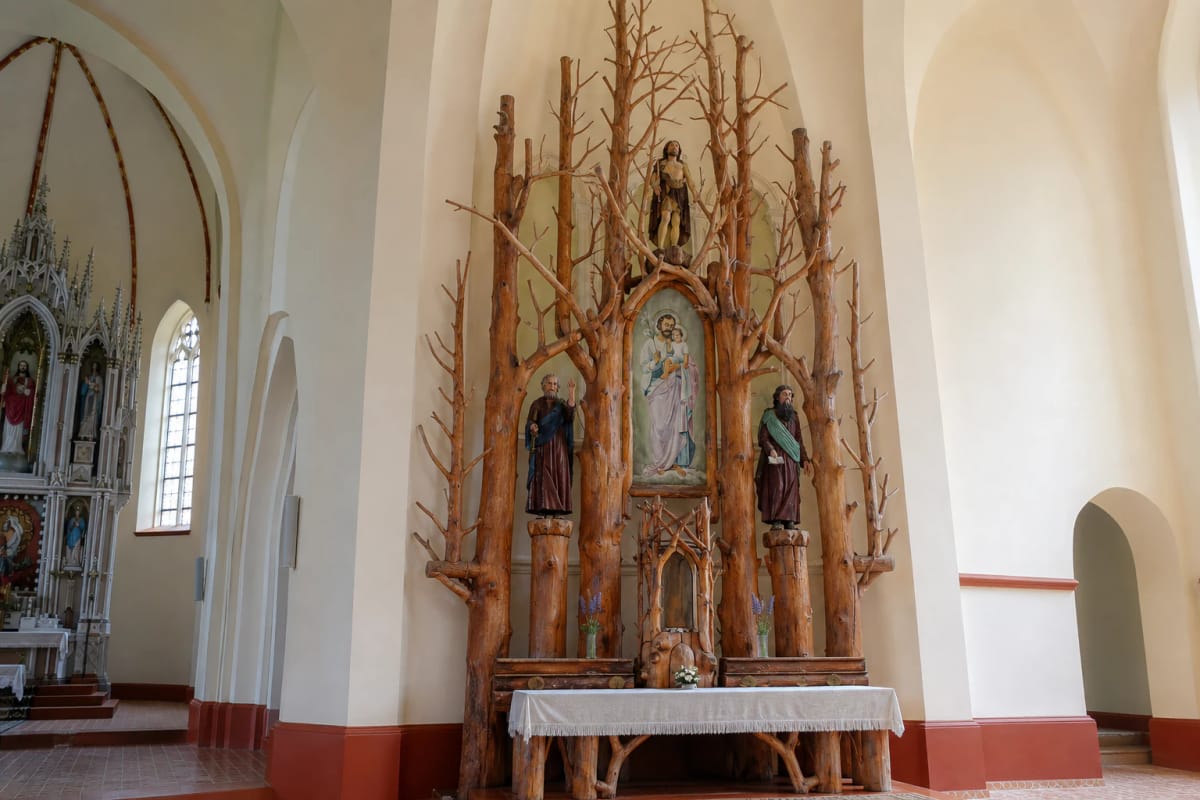
- three-aisled red-brick Neo-Gothic Catholic church built in 1896-1915, with Lithuania's only dedication to Our Lady of the Snows and two original side altars assembled from oak trunks
- Address
- Girdiškė, LT-75221, Šilalė District
- Coordinates
- 55.46608, 22.51667
Girdiškės Švč. Mergelės Marijos Snieginės bažnyčia, Girdiškė Church, Church of the Blessed Virgin Mary of the Snows in Girdiškė, Our Lady of the Snows Church, Girdiškė
The interior is reliably accessible for Sunday Mass or through an arrangement made in advance
The church stands in Girdiškė at coordinates 55.4660782, 22.5166688, roughly four kilometres from Dionizas Poška's Baubliai. The Diocese of Telšiai lists Sunday Mass at 11:00 and services on other days by arrangement. Confessions begin 20 minutes before Mass, so this is not a suitable moment for conspicuous photography or a noisy study of the altars.
There is no museum timetable or admission ticket. The exterior and churchyard can be seen freely, but the doors may be locked outside services. Girdiškė is served by Father Vidmantas Šidlauskas in Upyna. For a visit planned specifically around the interior, the diocese lists mobile +370 657 99 200 and asks visitors to arrange it beforehand. Schedules and contacts change, so recheck the official page before travelling.
Steps lead to the main portal, and the official parish description does not state that a step-free entrance is available. Anyone needing wheelchair access, physical assistance, or a resting place near the entrance should discuss it by telephone first. Ask before taking photographs, disable flash, and do not enter the sanctuary.
Red-brick Neo-Gothic forms enclose an unusually large three-aisled Latin-cross church
The present building is a three-aisled Neo-Gothic church on a Latin-cross plan. Two broad towers with low pyramidal caps, an immense pointed window, and a stepped central gable make up its massive front. Buttresses and pointed windows divide the side elevations, while the end of the transept carries a more ornate stepped gable and circular window.
Inside, tall plastered supports separate the central nave from narrower side spaces. Pointed arches and pale vaults direct attention towards a grey-white Neo-Gothic high altar, while oak altars in a radically different material language rise to either side. The encounter matters more than scale alone: orderly academic Neo-Gothic design meets timber compositions that evoke the structure of a forest.
The long and disputed building process explains the church's ambitious size. Preparations began around 1896, and foundations were recorded by 1902. Father Juozapas Čerkeliauskas, a writer and public figure who had served Girdiškė since 1894, directed the work. The First World War interrupted construction, and the official diocesan chronology gives 1915 as the year of completion.
A timber church endowed by the local landowner in 1781 preceded today's masonry building
The Girdiškė estate appears in written records in 1562. Jonas Adamkavičius, the last member of his family to own it, built the first church here in 1781 and dedicated it to Saint John the Baptist. Initially a chapel and dependency of Batakiai parish, Girdiškė received parish rights from Bishop Józef Arnulf Giedroyć in 1804.
A cemetery was established with the parish and enclosed by a fieldstone wall in 1890. A Lithuanian parish school operated in 1853 with 24 pupils. These details show that the present large church did not emerge in a village without earlier institutions: it was built by a community that had functioned as a parish centre for more than a century.
The old timber church burned on 31 December 1909 under today's calendar. Ordinary services moved to the rectory and holy-day worship to the bell tower while the masonry church remained unfinished. The academic archive study records worship beginning inside the incomplete new building on 11 February 1912. The dates therefore describe different milestones: use in 1912, construction completion in 1915, and consecration later still.
The 1928 consecration is secure, but surviving accounts disagree over the precise date of the oak altars
Bishop Justinas Staugaitis consecrated the church over 1-3 June 1928, joined by seminary rector Vincentas Borisevičius and thirteen priests. It then received the title of Our Lady of the Snows. A priest based in Upyna has served Girdiškė since 1978, which is why today's schedule and arranged visits are managed from another parish.
Published sources diverge over the two side altars. The Diocese of Telšiai dates their installation to 1928, while a detailed local history appoints their designer Kazimieras Andriukaitis to Girdiškė only in 1930. The LKMA study more cautiously credits both the previous priest Kazimieras Gasčiūnas and Andriukaitis with the fittings. It is safest to place the project around the 1928 consecration and the early 1930s rather than manufacture a single certain date.
Šilalė District's official list places the two side altars among cultural-heritage objects protected by the municipality. The distinction matters: the listed assets are the particular church furnishings, while the same document does not identify the whole church as a separate state-protected Cultural Heritage Register building.
Stripped trunks, branch-built niches, and saint figures turn the altars into timber architecture
Several stripped oak trunks rising almost to the vaults establish each side altar's vertical frame. Thinner natural branches cross, lean, and form irregular openings. Religious paintings, polychrome figures of saints, and smaller devotional images occupy those spaces, while the altar tables and platforms have been adapted to the same rough timber composition.
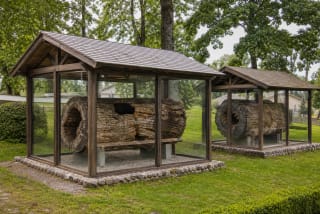
The altars are neither hollowed Baubliai nor a surviving Baltic sacred grove. A local account says that Kazimieras Andriukaitis may have drawn inspiration from Dionizas Poška's ancient oak trunks a few kilometres away, but this remains an interpretation rather than a surviving statement by the designer. The documented points are the use of oak from the Girdiškė area and the involvement of Gasčiūnas and Andriukaitis.
Begin from the central aisle, where both altars frame the sanctuary, and then approach one side. Distance reveals their balancing role; proximity reveals sawn branch ends, differences in trunk diameter, niches fitted by hand, and the relative scale of their figures. The woodland effect does not come from painted imitation: real trunks determine the structures.
The dedication and symbolic summer snow connect Girdiškė with Rome's Basilica of Saint Mary Major
Girdiškė is the only Lithuanian church dedicated to Our Lady of the Snows. The title is connected to the 5 August dedication of Rome's Basilica of Saint Mary Major. The Vatican basilica itself presents the summer snowfall and Mary's choice of a building site as tradition, so the story should not be recast as an archaeologically proven weather report from the fourth century.
White petals falling from above recall the story in Rome. Local people call the Girdiškė feast Snygena, and white pieces of paper imitate summer snow during its procession. They do not claim that snow literally falls on the village in August; the deliberately repeated liturgical image connects a small Samogitian parish with the Roman celebration.
The Diocese of Telšiai schedules the titular feast for the first Sunday in August, with Masses at 10:00 and 12:00. It is the best day to encounter living tradition and the worst for quiet architectural photography. On 13 July 2026, the exact Google Maps church listing averaged 4.9 out of 5 from 82 ratings; that live figure will change over time.